Kong
[Moderator]
7855

A Tribute to a Legend : IWC Ingenieur Chronograph Silberpfeil
With its Ingenieur Chronograph Silberpfeil, IWC breathes fresh life into
the legend of the historic Mercedes-Benz racing car. The designers took
their inspiration from the illustrious W25 while the technicians
equipped the chronograph, as only fitting, with a highly efficient
IWC-manufactured movement.
An old black-and-white photograph taken at a motor race in Bern in 1936 records a very special moment: it shows Albert Pellaton, IWC Schaffhausen’s future Technical Director, walking along the Mercedes-Benz pit and a line of W25 Silver Arrow racing cars. In the background we see the Mercedes team mechanics and even Mercedes’ well-known racing-team manager, Alfred Neubauer. It is a brief encounter between men with a passion for engineering: men who use that passion – in both watchmaking and motorsport – in the pursuit of excellence, and who write technological history. To this day, the two disciplines are united by an obsession for precision technology and the quest for higher efficiency and performance.
Albert Pellaton went on to design a pawl winding mechanism for IWC that was named after him. His 85-calibre movement featured the world’s first bidirectionally wound automatic movement. Unlike conventional winding systems, which functioned only when the rotor was moving in one direction, his mechanism wound in both directions and was significantly more efficient. Pellaton’s invention gave IWC a technological edge over the competition in the 1950s and has been continuously improved ever since. Today, it plays an important role in the Ingenieur watch family. The Mercedes-Benz Silver Arrow dominated international motor- sport in the 1930s and in 1954/55, thanks not least to its mechanics. By the standards of the time, their contribution was simply remarkable. The Mercedes Silver Arrow’s success story has lasted to this day and began with the W25 at the Eifel GP on the Nürburgring in 1934.
It was there that Manfred von Brauchitsch was first past the chequered flag in a cigar-shaped car that developed 354 h.p. and was capable of speeds up to 300 kph. The car had already created a furore in the Mercedes pit before the race even started. During the official technical inspection, it proved to be exactly one kilogram heavier than the permitted maximum weight of 750 kilograms. At this, von Brauchitsch is said to have suggested stripping the white paint to reduce the weight to the permitted limit. And overnight, this is precisely what the mechanics did. This revealed the gleaming aluminium bodywork, which from then on gave the W25 and its successors the name “Silver Arrow” (German: “Silberpfeil”). The legend was born.
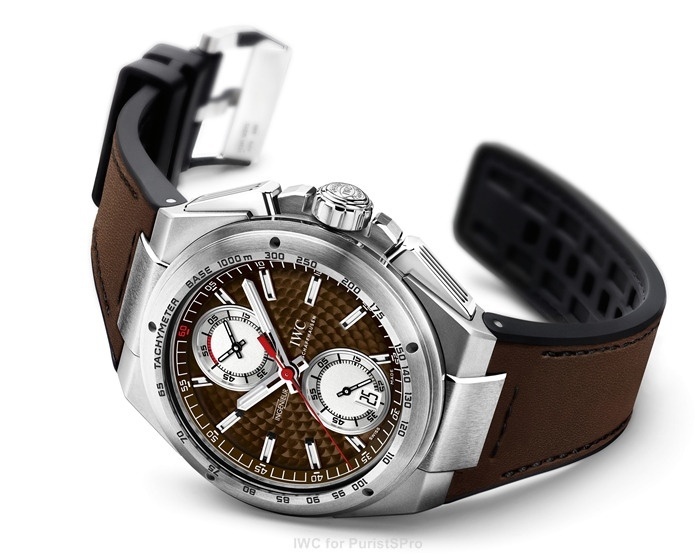
In 2013, IWC Schaffhausen brings together the illustrious names “Ingenieur” and “Silberpfeil” in its new Ingenieur Chronograph Silberpfeil. The thing that strikes you most about the chronograph in its stainless-steel case is the design. One of the most conspicuous features is the circular-grained dial in silver (Ref. IW378505) or brown (Ref. IW378511). Circular graining, or “perlage”, is a cloud-like pattern of small overlapping circles that is usually reserved for plates and bridges. Here, it is a tribute to the legendary Mercedes-Benz W25, whose instruments were mounted on a dashboard with a circular-grained surround. The pattern creates a fascinating play of light and reflections and gives the Ingenieur Chronograph Silberpfeil its high- quality, technically inspired look. The red elements on the silver-plated or brown dial take up the design of the tachometer and revolution counter. The date display is integrated into the lower counter, thus maintaining the perfect symmetry of the dial.
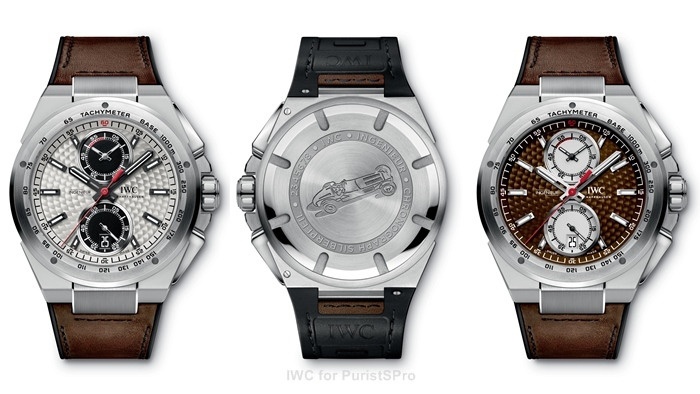
The efficient IWC-manufactured 89361 calibre is one of the best that fine watchmaking currently has to offer. The movement enables stopped hours and minutes to be read off as simply as the time on a subdial, while the central stopwatch hand records short stop times of up to a minute. Used in combination with the tachymeter scale, this provides the speed at which a reference distance of 1,000 metres is completed. Another practical feature for anyone who frequents the world’s racing circuits is the flyback function for measuring pit-stop times: simply pressing the reset button causes the chronograph seconds hand to jump to zero and immediately starts another timing sequence. This eliminates the complicated business of successively pressing the stop, reset and start buttons. The further-improved Pellaton winding system builds up a 68-hour power reserve in next to no time. Its automatic double-pawl winding mechanism is 30 per cent more efficient than the one designed by Albert Pellaton: an enhancement of which the ingenious inventor would wholeheartedly have approved. On top of that, the watch’s accuracy is unaffected when the chronograph is running or when the flyback function is activated.
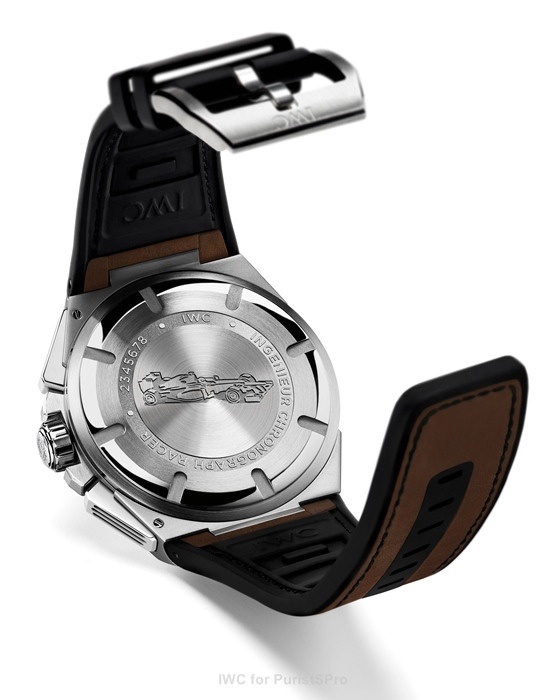
The Ingenieur Chronograph Silberpfeil has a wristband with a brown leather inlay. This likewise takes us back to the world of motor racing in the 1930s, when sturdy leather straps – on the drivers’ overalls as well as in the cockpit and on the car’s bonnet – were virtually omnipresent. Unlike those, however, the chronograph’s high-quality strap is made of finest calfskin, which is bonded with hardwearing rubber on the inner surface. In this way, the traditional leather look is combined with the comfort and long service life of rubber. Another option is the stainless-steel bracelet with a fine-adjustment clasp. An elaborate engraving of a historic Silver Arrow racing car can be found on the case back.
Between 1934 and 1939, Mercedes-Benz won countless Grand Prix victories and championships with the Silver Arrow. In 1935, Rudolf Caracciola was crowned European champion driving the W25: a feat he repeated with its successor, the W125, in 1937, and in 1938 with the W154. Until 1939, he and the other members of the team, such as Manfred von Brauchitsch and Hermann Lang, dominated international motorsport’s premier discipline.
And in 1954, Mercedes-Benz celebrated the return of the Silver Arrows to Formula One™ with a one-two victory at the French Grand Prix. The winner, Juan Manuel Fangio, won three more Grands Prix with his W196 R, and the world championship. The W196 R dominated the 1955 season too. In the seven Grand Prix events that year, the team won five races, four of them one-twos, and Juan Manuel Fangio retained his Formula One™ crown. Teammate Stirling Moss became a living legend when he won the 1955 Mille Miglia in a new record time. After this, Mercedes-Benz retired from motorsport to focus on series production. Since 2010, the MERCEDES AMG PETRONAS Formula One™ Team has been vying for points again, and is now supported by its Official Engineering Partner, IWC Schaffhausen.
Specifications
Mechanical chronograph movement – Date display with crown-activated rapid advance via the crown – Stopwatch function with hours, minutes and seconds – Hour and minute counters combined in a totalizer at 12 o’clock – Flyback function – Small hacking seconds – Screw-in crown – Limited edition of 1,000 watches each, once with silver-plated and once with brown dial
Movement
Calibre 89361
Frequency 28,800 A/h / 4 Hz
Jewels 38
Power reserve 68 h
Winding automatic
Materials
Ref. IW378505: stainless-steel case, silver-plated dial, black rubber strap with brown calfskin inlay, pin buckle in stainless steel, engraving on case back “ONE OUT OF 1,000”
Ref. IW378511: stainless-steel case, brown dial, black rubber strap
with brown calfskin inlay, pin buckle in stainless steel, engraving on case back “ONE OUT OF 1,000”
Glass sapphire, flat, antireflective coating on both sides
Water-resistant 12 bar Diameter 45 mm Case height 14.5 mm
An old black-and-white photograph taken at a motor race in Bern in 1936 records a very special moment: it shows Albert Pellaton, IWC Schaffhausen’s future Technical Director, walking along the Mercedes-Benz pit and a line of W25 Silver Arrow racing cars. In the background we see the Mercedes team mechanics and even Mercedes’ well-known racing-team manager, Alfred Neubauer. It is a brief encounter between men with a passion for engineering: men who use that passion – in both watchmaking and motorsport – in the pursuit of excellence, and who write technological history. To this day, the two disciplines are united by an obsession for precision technology and the quest for higher efficiency and performance.
Albert Pellaton went on to design a pawl winding mechanism for IWC that was named after him. His 85-calibre movement featured the world’s first bidirectionally wound automatic movement. Unlike conventional winding systems, which functioned only when the rotor was moving in one direction, his mechanism wound in both directions and was significantly more efficient. Pellaton’s invention gave IWC a technological edge over the competition in the 1950s and has been continuously improved ever since. Today, it plays an important role in the Ingenieur watch family. The Mercedes-Benz Silver Arrow dominated international motor- sport in the 1930s and in 1954/55, thanks not least to its mechanics. By the standards of the time, their contribution was simply remarkable. The Mercedes Silver Arrow’s success story has lasted to this day and began with the W25 at the Eifel GP on the Nürburgring in 1934.
It was there that Manfred von Brauchitsch was first past the chequered flag in a cigar-shaped car that developed 354 h.p. and was capable of speeds up to 300 kph. The car had already created a furore in the Mercedes pit before the race even started. During the official technical inspection, it proved to be exactly one kilogram heavier than the permitted maximum weight of 750 kilograms. At this, von Brauchitsch is said to have suggested stripping the white paint to reduce the weight to the permitted limit. And overnight, this is precisely what the mechanics did. This revealed the gleaming aluminium bodywork, which from then on gave the W25 and its successors the name “Silver Arrow” (German: “Silberpfeil”). The legend was born.
In 2013, IWC Schaffhausen brings together the illustrious names “Ingenieur” and “Silberpfeil” in its new Ingenieur Chronograph Silberpfeil. The thing that strikes you most about the chronograph in its stainless-steel case is the design. One of the most conspicuous features is the circular-grained dial in silver (Ref. IW378505) or brown (Ref. IW378511). Circular graining, or “perlage”, is a cloud-like pattern of small overlapping circles that is usually reserved for plates and bridges. Here, it is a tribute to the legendary Mercedes-Benz W25, whose instruments were mounted on a dashboard with a circular-grained surround. The pattern creates a fascinating play of light and reflections and gives the Ingenieur Chronograph Silberpfeil its high- quality, technically inspired look. The red elements on the silver-plated or brown dial take up the design of the tachometer and revolution counter. The date display is integrated into the lower counter, thus maintaining the perfect symmetry of the dial.
The efficient IWC-manufactured 89361 calibre is one of the best that fine watchmaking currently has to offer. The movement enables stopped hours and minutes to be read off as simply as the time on a subdial, while the central stopwatch hand records short stop times of up to a minute. Used in combination with the tachymeter scale, this provides the speed at which a reference distance of 1,000 metres is completed. Another practical feature for anyone who frequents the world’s racing circuits is the flyback function for measuring pit-stop times: simply pressing the reset button causes the chronograph seconds hand to jump to zero and immediately starts another timing sequence. This eliminates the complicated business of successively pressing the stop, reset and start buttons. The further-improved Pellaton winding system builds up a 68-hour power reserve in next to no time. Its automatic double-pawl winding mechanism is 30 per cent more efficient than the one designed by Albert Pellaton: an enhancement of which the ingenious inventor would wholeheartedly have approved. On top of that, the watch’s accuracy is unaffected when the chronograph is running or when the flyback function is activated.
The Ingenieur Chronograph Silberpfeil has a wristband with a brown leather inlay. This likewise takes us back to the world of motor racing in the 1930s, when sturdy leather straps – on the drivers’ overalls as well as in the cockpit and on the car’s bonnet – were virtually omnipresent. Unlike those, however, the chronograph’s high-quality strap is made of finest calfskin, which is bonded with hardwearing rubber on the inner surface. In this way, the traditional leather look is combined with the comfort and long service life of rubber. Another option is the stainless-steel bracelet with a fine-adjustment clasp. An elaborate engraving of a historic Silver Arrow racing car can be found on the case back.
Between 1934 and 1939, Mercedes-Benz won countless Grand Prix victories and championships with the Silver Arrow. In 1935, Rudolf Caracciola was crowned European champion driving the W25: a feat he repeated with its successor, the W125, in 1937, and in 1938 with the W154. Until 1939, he and the other members of the team, such as Manfred von Brauchitsch and Hermann Lang, dominated international motorsport’s premier discipline.
And in 1954, Mercedes-Benz celebrated the return of the Silver Arrows to Formula One™ with a one-two victory at the French Grand Prix. The winner, Juan Manuel Fangio, won three more Grands Prix with his W196 R, and the world championship. The W196 R dominated the 1955 season too. In the seven Grand Prix events that year, the team won five races, four of them one-twos, and Juan Manuel Fangio retained his Formula One™ crown. Teammate Stirling Moss became a living legend when he won the 1955 Mille Miglia in a new record time. After this, Mercedes-Benz retired from motorsport to focus on series production. Since 2010, the MERCEDES AMG PETRONAS Formula One™ Team has been vying for points again, and is now supported by its Official Engineering Partner, IWC Schaffhausen.
Specifications
Mechanical chronograph movement – Date display with crown-activated rapid advance via the crown – Stopwatch function with hours, minutes and seconds – Hour and minute counters combined in a totalizer at 12 o’clock – Flyback function – Small hacking seconds – Screw-in crown – Limited edition of 1,000 watches each, once with silver-plated and once with brown dial
Movement
Calibre 89361
Frequency 28,800 A/h / 4 Hz
Jewels 38
Power reserve 68 h
Winding automatic
Materials
Ref. IW378505: stainless-steel case, silver-plated dial, black rubber strap with brown calfskin inlay, pin buckle in stainless steel, engraving on case back “ONE OUT OF 1,000”
Ref. IW378511: stainless-steel case, brown dial, black rubber strap
with brown calfskin inlay, pin buckle in stainless steel, engraving on case back “ONE OUT OF 1,000”
Glass sapphire, flat, antireflective coating on both sides
Water-resistant 12 bar Diameter 45 mm Case height 14.5 mm
Press Release
This message has been edited by Kong on 2013-06-28 03:31:40
Locked
login to reply