
foversta
[PuristSPro Moderator]
20814

Histoire de Tourbillon 2: a light and heavy hypnotizing watch !
First of all, please note that the pictures watch is a prototype.
I have to tell you something: when I first saw the pictures of the press release of the Histoire de Tourbillon 2, I was a bit afraid by the watch size: the watch looked very bulky and I really think that it was quite disappointing for a timepiece which purpose is to highlight the Tourbillon complication. I had the opportunity to see it "in the metal" a few days ago and I changed my mind. Yes, the watch is big but not massive. More important: the feeling of delicacy brought by the revolution of both Tourbillon carriages has been preserved and this leads to an interesting contrast with the powerful case.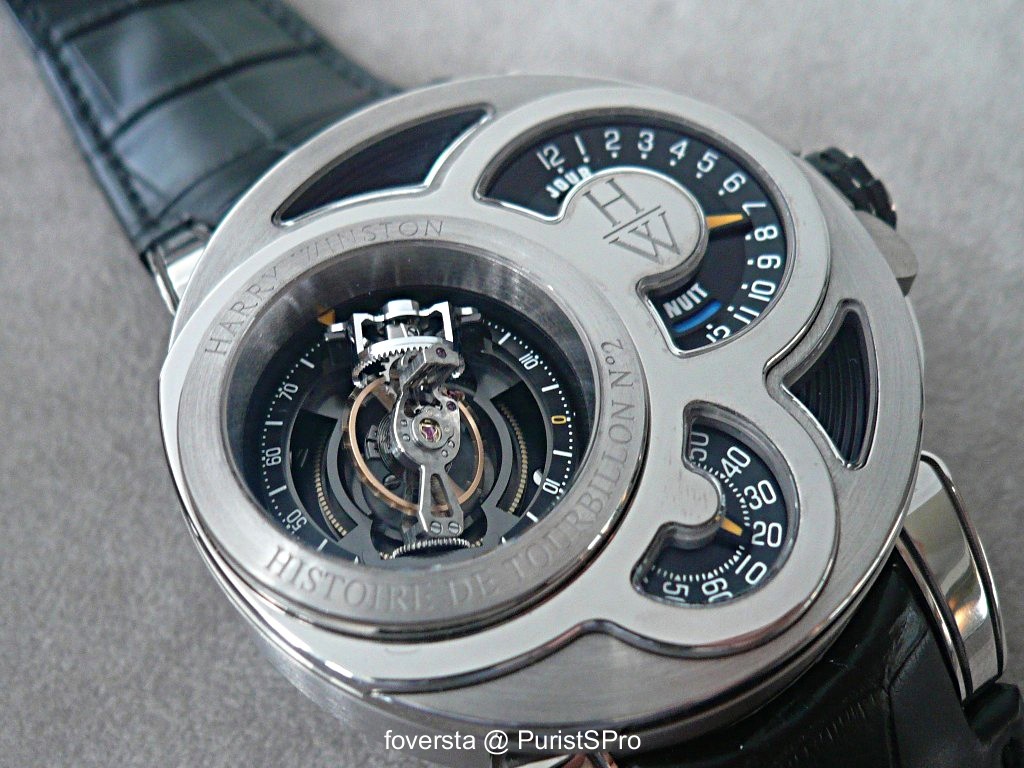
The Histoire de Tourbillon is a collection which has started in 2009. Its objective is to emphasise the large diversity of technical features inherent in the Tourbillon complication: simple Tourbillons, Double-Tourbillons, multi-axis Tourbillons, flying Tourbillons, there is not a single solution but a lot of different ones which always fascinate us. The collection wishes to focuss on the most impressive ones. We know that the efficiency of the Tourbillons in improving the accuracy is quite relative: a simple watch with a fine adjustment can get excellent chronometric results and the use of complex Tourbillon(s) may create more constraints (the energy they require, the regularity of their behaviour etc...) than factors of improvement of the precision. Despite this context, the Tourbillon complication has managed to keep its magic because it has become more and more complex: if it is very difficult to give the proof that this complexity has a positive impact of accuracy, at least, nobody can deny that these multi axis / cages Tourbillons are a true joy for our eyes thanks to their superb show. Actually, some watchmakers are convinced that a Tourbillon becomes efficient in its primary goal if it has at least two carriages or axis. With such Tourbillon, the balance, spiral and escapement have a continuously moving position even if the watch is not worn. A single Tourbillon, when the watch is stationary, changes the position of the regulating part vertically or horizontally but not both at the same time.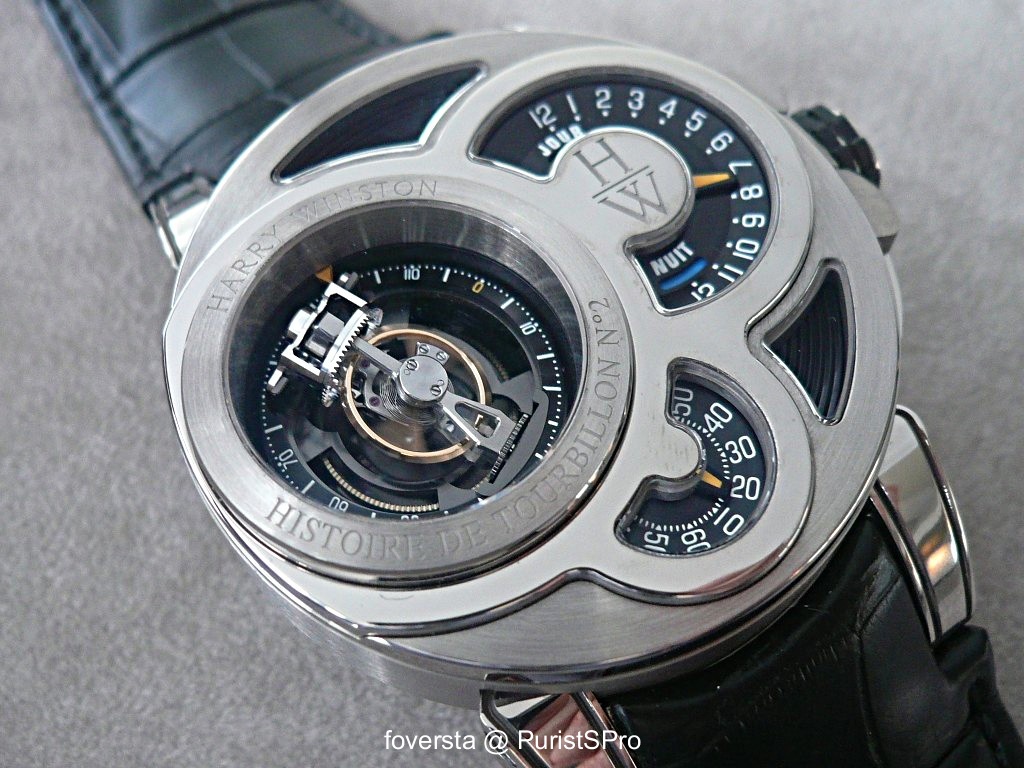
The Histoire de Tourbillon 2, issued in a LE of 20 pieces with WG cases only, belongs to the category of superlative watches: it features at the same time a hypnotizing flying Double-Tourbillon, an original time display ans an unusual dial lay-out. It is totally different from the first watch of the collection which was featuring not a Double-Tourbillon but two inclined Tourbillons. The layout of the dial makes us think a bit about Vianney Halter's style with isolated displays in independent subdials. The watch is far from being flat: as you can see it on the pictures, the dial has three layers. The Double-Tourbillon subdial is taller than the other ones which is a clear indication of what is the main display. Yes, the Histoire de Tourbillon tells the time... but it is mainly dedicated to give a beautiful context for the Double-Tourbillon show.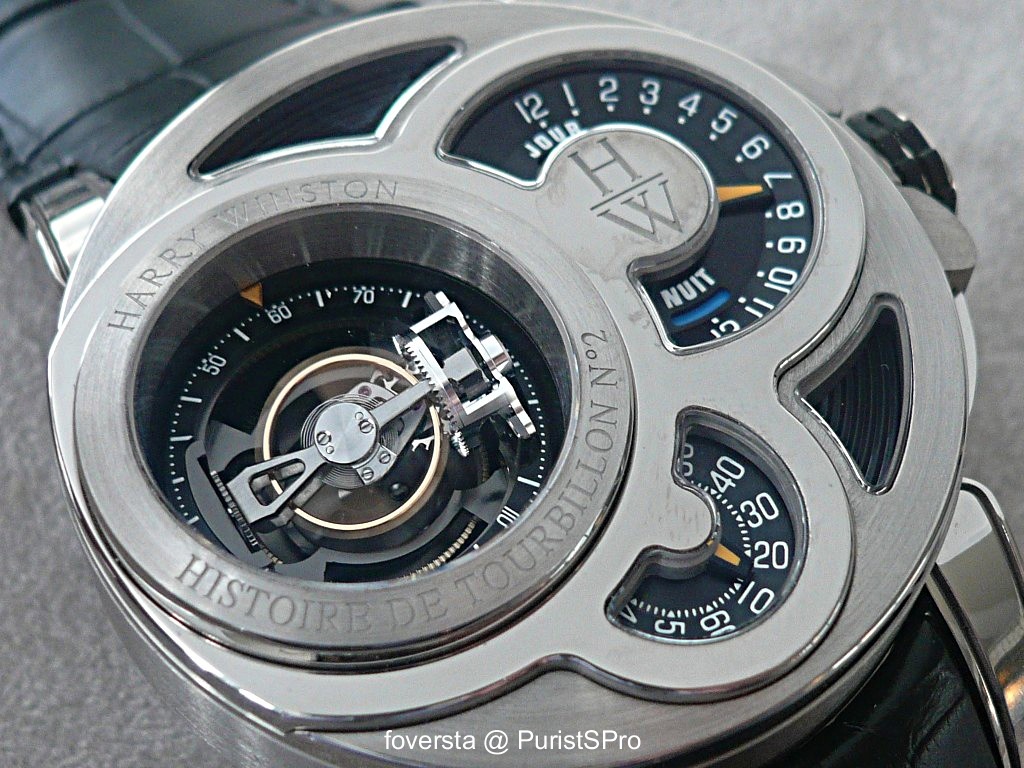
The watch has eight different sapphire crystals:
- 5 dial side. You will notice that 3 are dedicated to displays (Double-Tourbillon, Minutes, Hours&Day-Night) and 2 were added to lighten the design dial side. Without them, the plain surface would have been a bit too large for a 48,5mm diameter case. With them, the design becomes more elegant: somethimes, small details can really improve it and it is the case here.
- 3 back side. 2 are over the caliber main bridges and due to the original architecture of the movement, they don't show something impressive: a few jewels and 2 openings which give us the ability to see a shy part of the wheels. Much more interesting is the third crystal: it unveils the triangular shape of the bridge located below the Tourbillon with its big jewel. But at the end, the back side is somehow disappointing if we compare it to the dial. It is not a trouble here, that's the purpose of the watch!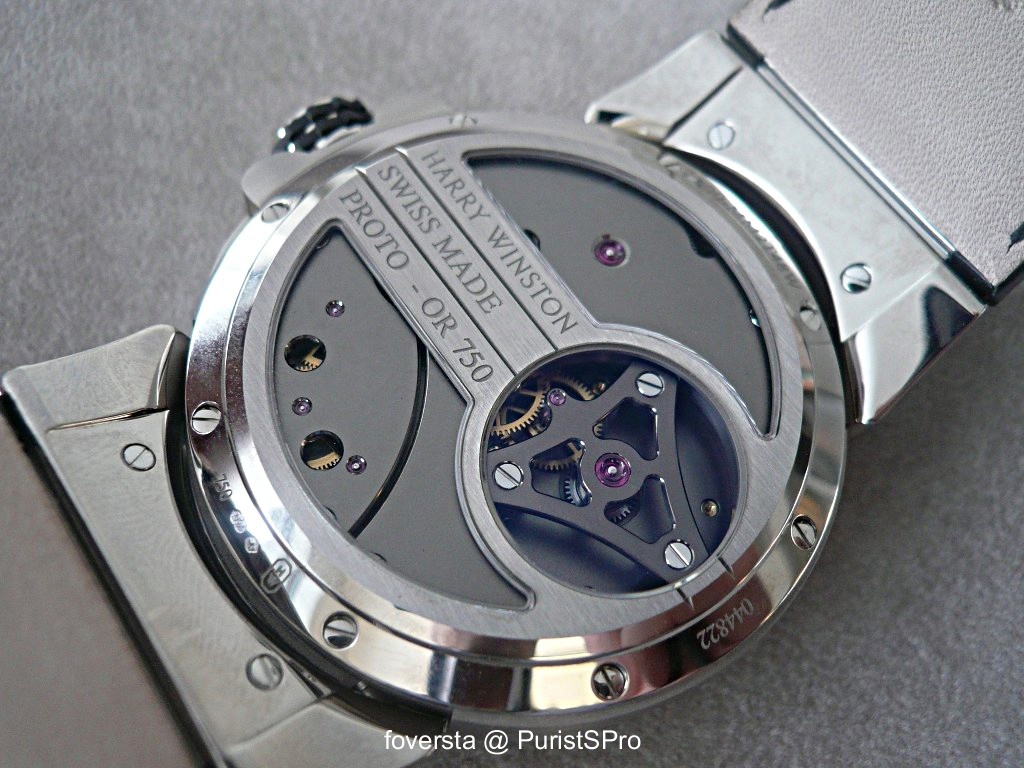
Let's back dial side. Thanks to its tall and deep display, we have the feeling that the Double-Tourbillon is located inside an arena. This big space is required to give enough room for the evolution of the bi-axial flying Tourbillon. Thanks to its two carriages, the Tourbillon gives an impressive 3D visual effect which immediately attracts our eyes. The outer carriage makes a full revolution in 120 seconds (it is the reason why of the seconds scale till 120) while the internal one (which contains the balance, the spiral and the escapement) rotates in 40 seconds. This difference in speed revolution added by the view of the various positions of the balance wheel make us believe that the regulating part is moving randomly. As a flying Tourbillon, its view is not disturbed by the presence of a bridge on top: we have a full view of it and we can't miss a single second of its evolution. The combo between its flying architecture and its two carriages make it aerial and... hypnotizing. This flying Tourbillon is so impressive that we forget the other displays on the dial. Hours and minutes are told through two orange hands while the hours subdial also includes a day&night indicator. I really like the contrast between the small orange details (hands and day indicator) and the opaline black background.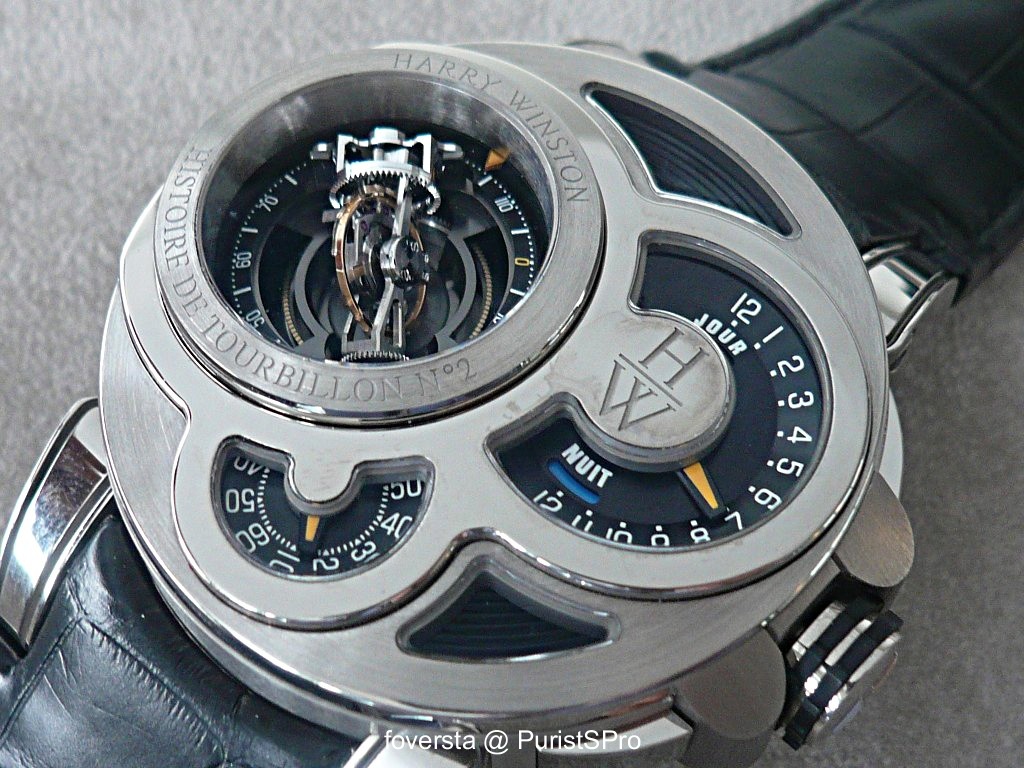
Time comes to put the watch on the wrist: as I expected it, the watch is heavy. But hopefully, the strap is very efficient thanks to its double buckle system (the watch doesn't have a folding clasp). Moreover, the shape of lugs was well-designed: they take on the shape of the wrist and contribute to the good positioning of the watch on the wrist. I shook my hand several times and despite its weight, the watch dosesn't move. As I write it each time I test a big watch: don't hesistate to wear it to check if it is suitable to your wrist. For me, it was OK even if I had the feeling that my wrist size (17,5cm) was the minimum.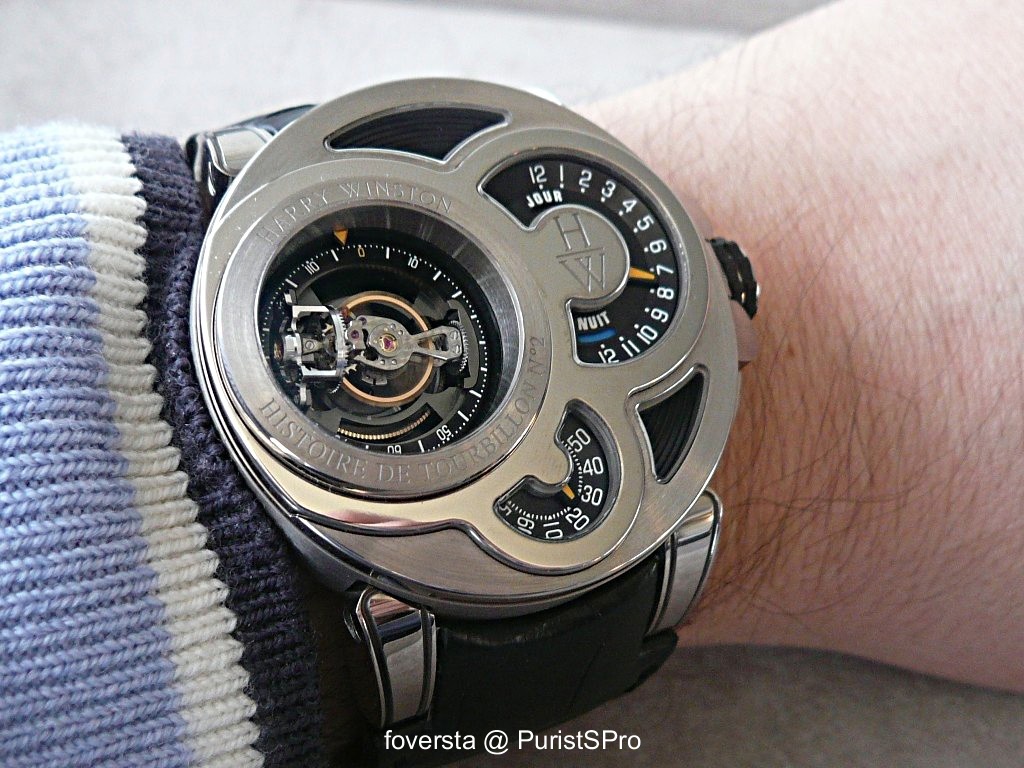
When you have the watch on the wrist, you are immediately seduced by the delicate and subtle movement of the flying Tourbillon: you forget the weight, you forget the case dimension, you forget the time, you only stare at the Tourbillon. The excellent point is that Harry Winston took the decision to create a very modern if not complex design (isolated subdials, three layers) but at the same time, modern and simple: despite its complexity, the dial is not busy and the flying Tourbillon perfectly enhanced. Congrats to the designers for this achievement!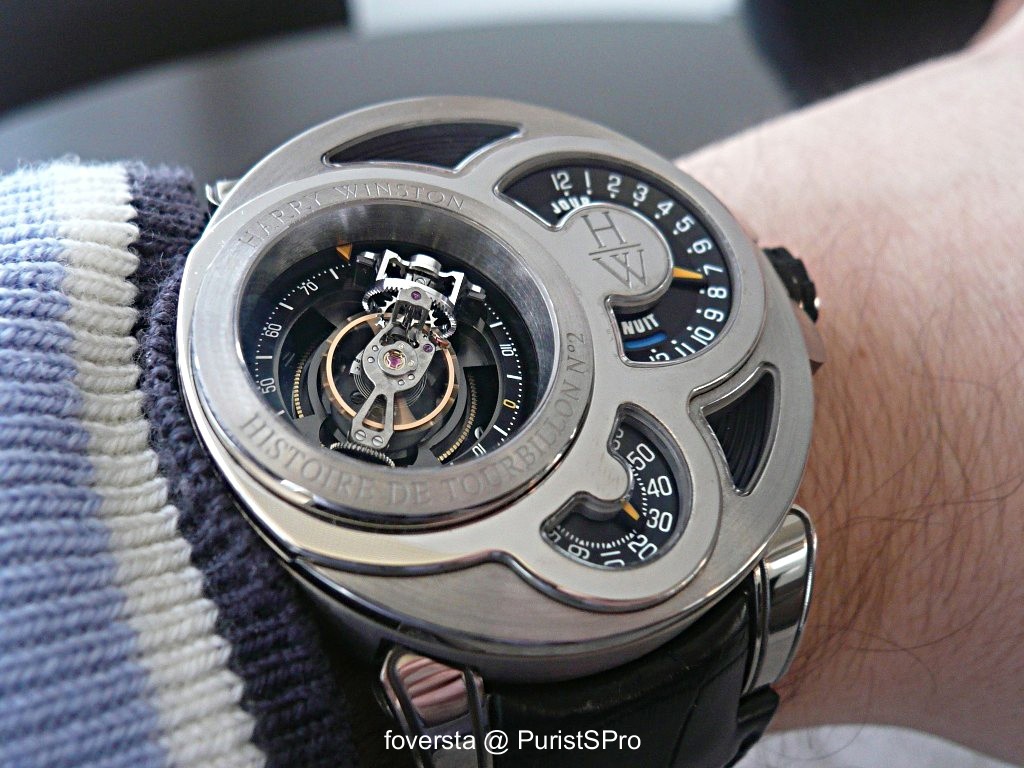
Like for the Histoire de Tourbillon 1, the movement was exclusively developed by CompliTime for Harry Winston. Actually, we easily recognize their capacities in building such two carriages Tourbillon and thanks to the collective work with the Harry Winston team, the complication was perfectly integrated into the Harry Winston context.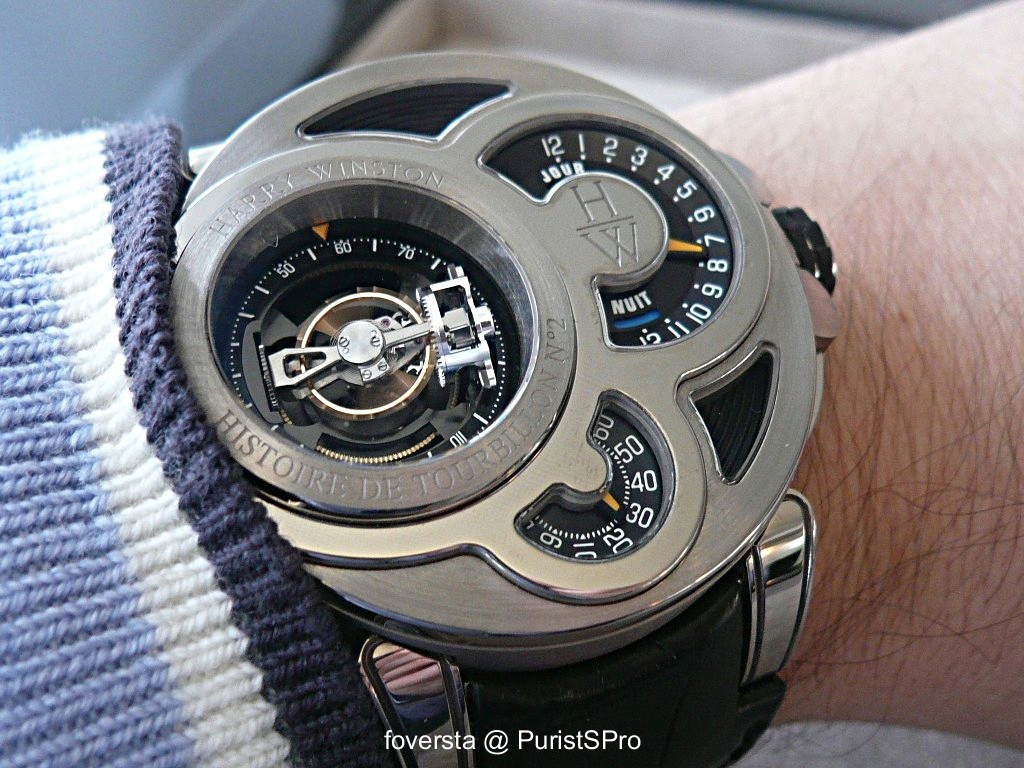
As I told you at the beginning, I was not convinced by the Histoire de Tourbillon 2 when I read the press release. After having seen and handled it, I have now a different point of view. I will not deny the fact that the watch is big because it is actually big... but not massive ! The flying Tourbillon is a sort of counter-weight of the case diameter and lightens the style of the watch. Moreover the big size gave to the designers the ability to create a large "stage" for this Tourbillon which can play its aerial ballet for our biggest pleasure. Without any doubt, the Histoire de Tourbillon 2 is a watch to be seen at work, the static pictures don't give justice to its hypnotizing dial. If you have the opportunity to see it, don't miss it !
A big thank to the Harry Winston team for the warm welcome!
Fr.Xavier
This message has been edited by foversta on 2011-01-30 07:30:31 This message has been edited by foversta on 2011-02-06 11:47:19
Histoire de Tourbillon 2: a light and heavy hypnotizing watch !

Technically superb. Love it.
Thanks a lot Vincente !

For me...
Thanks a lot Daos for your comments.
Woot! *clapping*

Whoa, thank you for your detailed report...
Thanks Ken !

Great review I really enjoyed the video too
Thanks Mike !

What are the lugs like?
Thanks Melvin !

Great review of the watch Fr Xavier - I am still wary of the
Well Andrew...

Very nice review!

Impressive prototype
Thanks Ed !


GREAT pictures which should be shared more!

Hypnotizing indeed.