
PeterCDE
10167

A 1970?s Gyromatic (rather long ramblings with some pictures)
Hi,
first of all, a warm welcome!
Since this is a non-commercial forum and pricing/valuing vintage timepieces is a tricky thing, especially as condition and service history are vital factors. Therefore, we avoid to do so.
Just so far:
GP never made cheap watches and this was a watch of above average quality then. When new in 1972-1974, it sold for roughly 500-580 DM (german marks), which was roughly about $250-300 then. It?s certainly not comparable to ancient pre-1900 GP pieces and not comparable to what GP is doing over the last 1 1/2 decades.
I?d say it may pay you a nice dinner (or two), but not a new car.
I?d recommend to double check the movement number; is it 441-290 rather than 41-290? Based on the picture, the former makes a bit more sense (since GP 41 is a Gyromatic movement of the 2nd generation, which does look different).
The short answer:
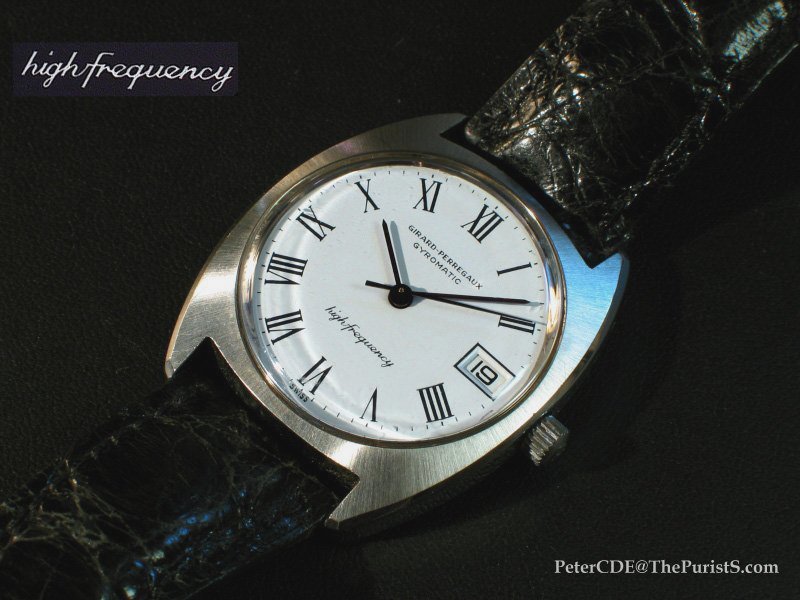
It?s a piece dating about 1974-1976 with a movement based on an ebauche by AS; the 3rd generation fast-beat Gyromatic, which does no longer use GP?s patented "gyrotrone" free drive. It?s not particularly rare and GP made a variety of pieces with round or square shaped cases then, in order to compete with the raisingly popular quartz watches.
Yes, it?s a good watch, reliable and sturdy. But i?m afraid, it was not a luxury timepiece like a piece of current production. That may be indicated by the original price in the 1970?s; it?s been rather expensive, but more affordable than other pieces of higher grades and better makers.
Just to give some outline:
IWC?s reference 1816 Yacht Club automatic, coming with IWC?s own calibre 8541B (one of the best ever made), retailed around 800 DEM, about 50% higher than one of those GP?s.
A Rolex reference 1016 Explorer I sold for $240 in 1972, reference 6263 Daytona Cosmograph for $500. But i?d say it will be very hard to find a 1972 Daytona for the price of an 1972 IWC Yacht Club today, although the retail price was almost the same then.
For all subscribers to the german language watch forum at Watchbizzforum.de, here?s the link to some informations i?ll copy below: click here.
And for your convenience, i?ll copy the specific post here and try to add an english translation:
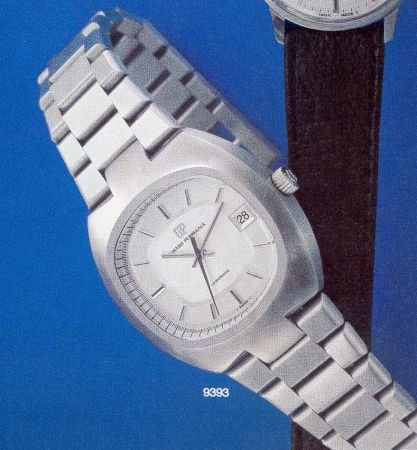
- Die Details zur Referenz 9781MA habe ich nicht zur Hand, aber im Katalog 1974 taucht die Referenz 9393 auf (die nach der damaligen GP-Nomenklatur etwa 1-2 Modelljahre ?lter sein d?rfte):
I don?t have details in terms of reference 9781MA at hand, but the 1974 catalogue lists reference 9393 which should be 1-2 years older:
In 1965 war das GP 32.7 quasi das "allererste" Werk mit 36.000 A/h Schlagzahl, das GP 32A die erste wirkliche Serienfertigung und das Werk, mit dem GP auch bei Observatoriumswettbewerben teilnahm.
In 1965, GP 32.7 was the "very first" movement with 36.000 A/h frequency. GP?s calibre 32A was the first serial production and the movement which GP made use of for observatory chronometer competition trials.
Beide 11 1/2" Werke verf?gen ?ber ein Datum, aber keine Schnellschaltung und auch nicht ?ber einen Sekundenstop.
Both movements, measuring 11 1/2 ligne, feature a date, but no quick-set date and no "hack" second (or stop seconde).
Der kam erst mit dem Nachfolger, dem 1968 lancierten GP42, durch das ein Manko der ersten Schnellschwinger ausgeglichen wurde: Eine relativ knappe Gangreserve. Die schnell zappelnde Clinergic-21 Hemmung ben?tigt halt recht viel "Nachschub", was auf Kosten der Gangreserve realisiert wurde.
The stop second was introduced with the successor, the 1968 calibre GP42, which featured improvements in terms of a weak point of the GP32 series fast-beat watches: A relatively low power reserve. The fast-beat Clinergic-21 escapement needed much energy, which caused a likewise low power reserve.
Das beruhte auf dem von AS gelieferten und f?r GP reservierten Grundwerk, welches f?r eine Schlagzahl von 21.600 A/h konzipiert war und welches auch in den "normalen" Versionen mit 17, 25 oder 39 Steinen zum Einsatz kam.
This (apparently) was caused by the base movement, which was a reserved ebauche for GP by AS and which was done with a regular 21.600 A/h escapement and used for "regular" watches with 17, 25 or 39 jewels.
Das GP 42 ist etwas h?her und basiert auf einem ge?nderten Basiswerk, welches die Verwendung eines gr??eren Federhauses erlaubte. Dadurch wurde die Gangreserve auf ?ber 40 Stunden gesteigert; daneben erhielt das GP 42 einen Sekundenstop.
GP 42 is a little higher and based on a different ebauche than GP 32, which allowed for a larger barrel and spring. Therefore, it was possible to increase the power reserve to 40 hours. Besides, GP42 was equipped with a stop seconde.
Die Schnellschaltung hielt erst mit dem GP 440 Einzug; dieses 1970 vorgestellte Werk basierte auf einem 12 1/2 linigen (reservierten) Grundwerk von AS, welches erstmals (nach Kalenderuhren der 40er Jahre) das Vorschalten des Kalenders durch Dr?cken der Krone erlaubte.
The quick-set date came first with GP 440; this movement, introduced in 1970, is based on a (reserved) 12 1/2 ligne ebauche by AS, which for the first time (after some calendar watches of the 1940?s) featured a quick-setting function for the date by pressing the crown.
Der Nachfolger bzw. das parallel verwendete Kaliber 441 sieht fast so aus:
The successor, respectively the comparable calibre GP 441, looks like this:
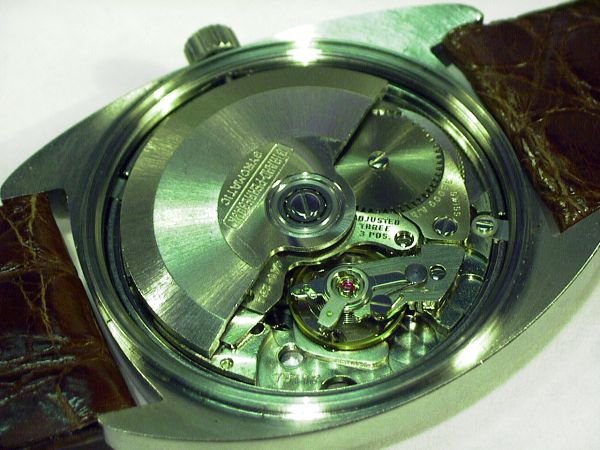
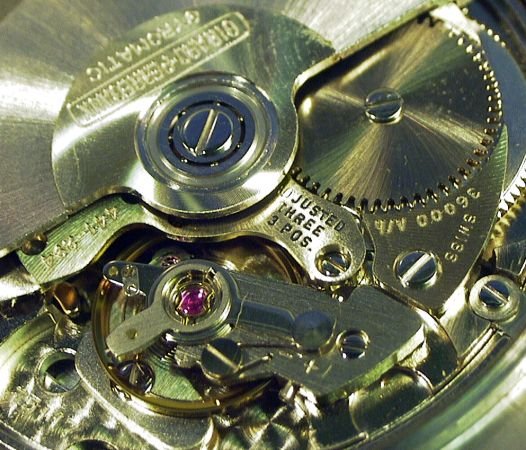
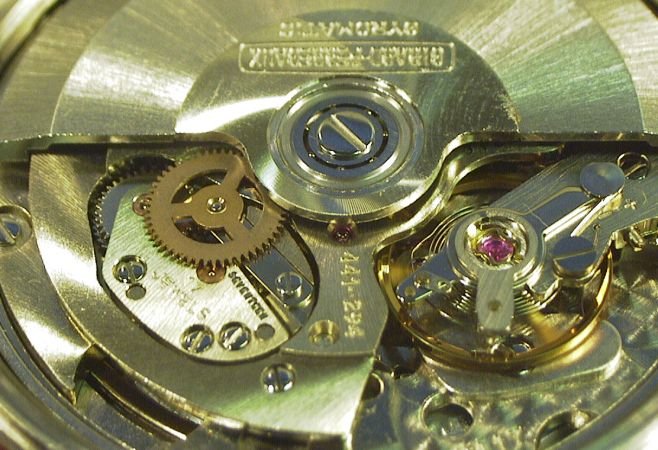
Was das GP 440 nicht mehr verwendete, war der f?r GP patentierte Rollenfreilauf ?ber Stahl- bzw. Rubinrollen und die vorwiegend bei den Chronometer-Versionen eingesetzte patentierte Feinregulierung mittels Micro-Schraube.
What GP 440 did no longer use was GP?s patented free drive with steel or ruby rolls and the patented fine regulation with a micro-screw, which was most often used for chronometer rated movements.
Indessen wurde die erh?hte Schlagzahl noch bis Ende der 70er in einer Reihe von Uhren beibehalten, nebst der relativ eigent?mlichen und heute fast ausgestorbenen Art der Trockenschmierung.
But the high frequency beat rate was kept for a variety of watches until late 1970?s, including the unique and today unusual way of dry lubrication.
Diese Werke gab?s in einer Reihe von Uhren; obwohl jeweils keine Unmengen produziert wurden (im Vergleich zu etwa Omega waren die Uhren von GP zahlenm?ssig immer schon Mauerbl?mchen), scheint es sich um zu der Zeit relativ beliebte Uhren gehandelt zu haben. Hier ist eine andere Version, mit einem (vielleicht) zeitloseren Geh?use:
These movements were encased in a variety of watches; although they didn?t do many pieces then (compared to f.e. Omega, GP always was a very small manufacturer), it seems these pieces were likewise popular then. Here?s another watch, with a different (more timeless?) case:
Und zum Schlu?, Preise:
Die Referenz 9393 hat in 1974 mit Stahlgeh?use und integriertem Stahlband sowie Zifferblatt in wei? oder blau 520.- DM gekostet, die Version mit vergoldetem Geh?use 580.- DM. Ich vermute, die 9781 d?rfte in etwa in der gleichen Preislage gelegen haben.
And finally, some prices:
Reference 9393 sold in 1974 with a steel case and steel bracelet as well as dials in white or blue for 520 DEM (german marks), the version with gold plated case for 580 DEM. I suspect reference 9781 was about the same price range.
Das wahr wohl nicht ganz so wenig: Zum Vergleich, die IWC Ref. 1816 "Yacht Club" Automatik in Stahl mit Stahlband lag im IWC-Katalog von 1972 bei 825.- DM und in Stahl mit Krokoband bei 690.- DM.
That was not a cheap watch then: In comparison, IWC?s reference 1816 "Yacht Club" automatic in steel with steel bracelet sold for 825 DEM (according to IWC?s 1972 price list) and in steel with leather strap for 690 DEM.
Ok, this turned out to be a little longer than expected

Nonetheless, i hope there?s some useful information; those pieces, with a typical 1970?s style, were made when the quartz crisis almost had reached it?s maximum. As with many watches and makers, mechanical movements became out of fashion much quicker than estimated by many makers back then, leading to watches which had to compare with the precise quartz ones in terms of prices and performance.
Therefore, this 9781MA is somewhat of an artefract and made in a time when mechanical watches were about to become a lost species.
Greetings from germany,
Peter