
arolex
516

The three great 1950's automatic movements..
1950’s Automatic Movement:
Great Engineering achievement.
Written by : arolex, Arthur
The 1950’s was an era of remarkable progress, which saw a rapid transformation on our society with significant development in fields of aerospace, communication, automotive development etc. It was an era of technological explosion.
The Horological world was no different. The 1950’s witnessed an ever increasing pace of our society, and with it, an ever increasing demand for efficiency. These societal changes most certainly played a major factor in influencing the watch industry to further develop a more refined, efficient and reliable automatic wrist watch.
.
Although the 1950’s can lay claim for the improvement, and efficiency, and the mass consumer demand for automatic wrist watches, it's 1929 that was truly the birth of the automatic wristwatch.
The Harwood Watch Company was the original pioneer of the automatic wristwatch (1929). Unfortunately, this earlier automatic movement had some short-comings, notwithstanding some seriously cool advertisements by some major Hollywood starlet’s, Joan Crawford being one. The Harwood automatic had limitations and field reliability problems which ultimately resulted in commercial failure. As a footnote, it’s interesting that the Harwood Company has recently been resurrected.
I have focused my discussion on the 1950’s automatic movements for a number of reasons. I believe that the 1950’s really took hold of the automatic wrist watches. Notwithstanding earlier attempts, the perfection of the automatic winding system seemed to have had significant technological advancements, in terms of efficiency and reliability, resulting in consumer acceptance, and increasing demand. Secondly, I chose to focus my attention around three of the great watch houses, who I believe took the concept of the automatic movement a significant step upwards. The three great watch houses that I will be high-lighting are:
i) Rolex 1500 series (1957)
ii) I.W.C. Cal 82-85 Family (1952)
iii) Patek Philippe 12-600 AT (1953)
Rolex Watch Co. - 1500 series caliber
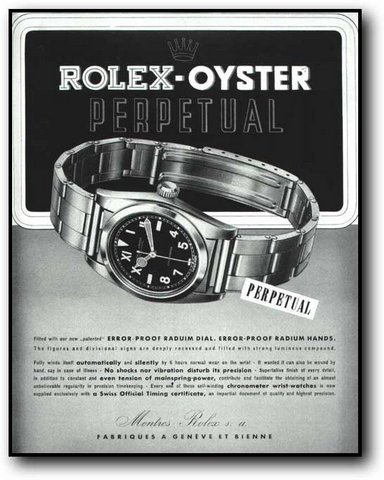
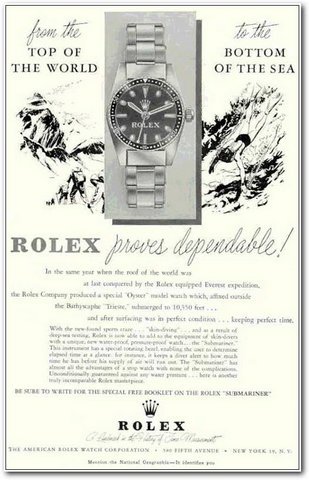
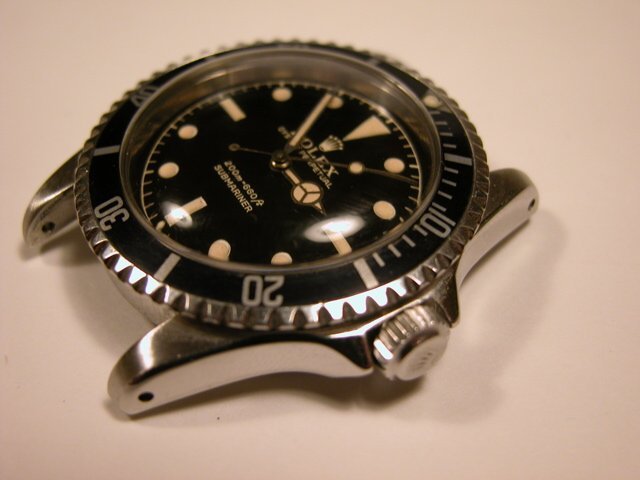
Although Harwood Watch Co. was heralded as the first attempt of the commercial automatic movement wrist watch, it is none other then the great watch house; Rolex Watch Company that took it to the next level, and ultimately commercial success.
The introduction of its famous oyster perpetual movement gained wide acceptance in late 1930’s (original patent 1932). Caliber 620 (sub seconds) & 630 (sweep seconds), were full rotor (not bumper winds, which was more widely available, JLC comes to mind). The Rolex movement was unidirectional, with 17 jewels. The next big revolution was the 1000 series movements. The entire automatic mechanism was now fully jeweled and jewel count increased from 17 to 25. Although the 1000 series movements proved to be more reliable , then it’s predecessor (600 series), it was the 1500 series movement that marked the zenith of the Rolex automatic movement development.
Introduced in 1957, the 1500 series movement is regarded by many Rolex connoisseurs, as Rolex’s finest time only movement built to date. The 1500 series movement underwent a number of modifications, one being the beat count, which was increased from 18000 to 19800 BPM (to improve on accuracy). This movement also came equipped with full rotor, bi-directional, and a relatively high degree of hand finishing, vs. its modern counter-parts.
Specifications:
Rhodium plated 25 jewels, straight line lever escapement, monometallic balance, shock-absorber, self-compensating breguet balance spring. ,
It never seizes to amaze me how incredibly robust these 1500 series movements truly are. I’ve been fortunate to own a few Rolex watches; all equipped with the 1500 series automatic, and have never had a single reliability issue. In fact, I have purchased vintages sport models where the movement had not been serviced for 30-40 years, remarkably still beating and keeping chronometer time.
The finishing can best be described as functional. This does not take away from the craftsmanship of this robust automatic engine. Surely one of the most reliable and robust automatic movements ever produced.
IWC: 82-85 Family (1952)
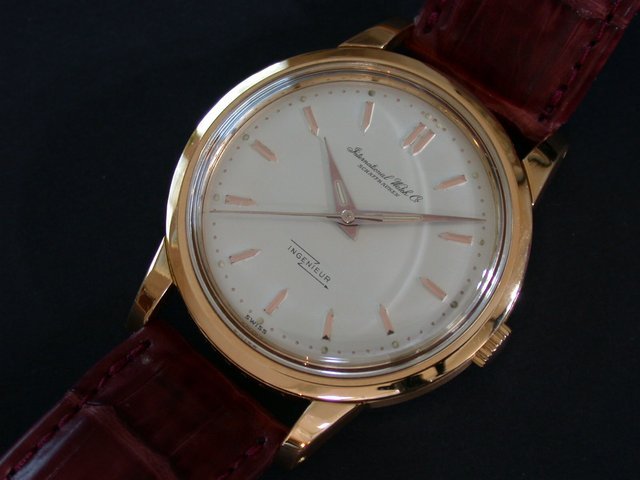
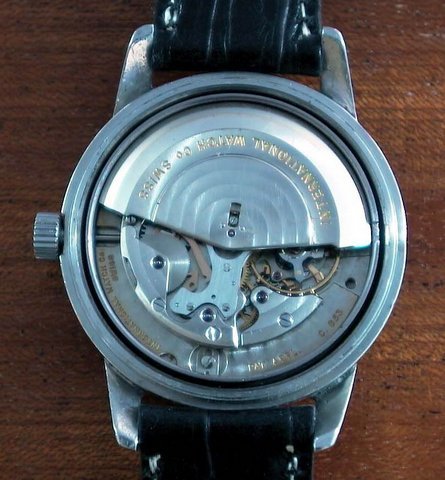
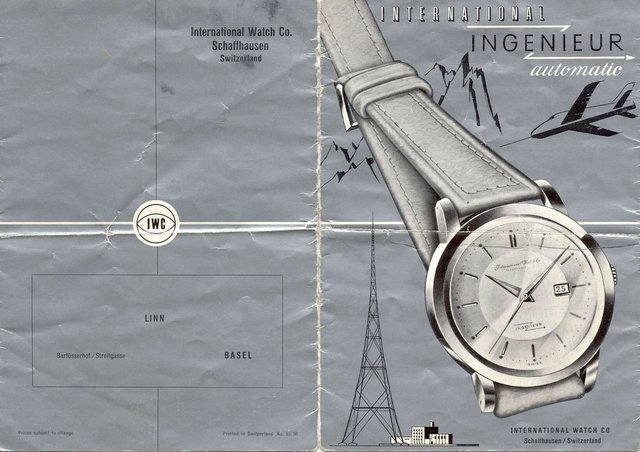
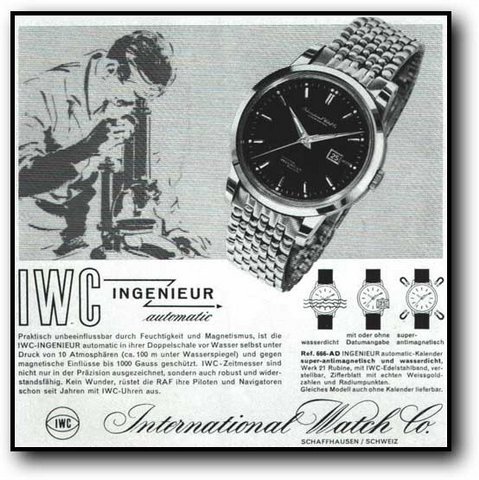
In 1946 Albert Pellaton, technical director for IWC, was credited with the development of the now infamous IWC automatic winding mechanism.
“This movement used Rollers oscillate between eccentric cams, which cause two clicks to ratchet against a saw-toothed winding wheel”. This system proved to be extremely ingenious winding mechanism, easily serviceable, & and beautifully constructed and finished”
In 1952 IWC incorporated the “Pellaton Winding System", in the now famed caliber 82 series. This movement met with world-wide commercial success resulting in over 49,000 movements produced within a 6 year production run. In fact this ingenious automatic winding system proved to be so perfect in its initial execution, that recently IWC incorporated the “Pellaton winding system” in its modern in-house movement: caliber 5000.
Quite remarkable that after 50 years of horological advancement, in the field of metallurgy, and science, that a 50 year old application still proved to be the most efficient design. A true testament and further acceptance of Mr. Pellaton remarkable achievement.
The caliber 82-85 family is truly a beautiful movement, with full rotor, bi-directional, breguet hairspring, and beautifully finished.
Patek Philippe 12-600AT (1953):
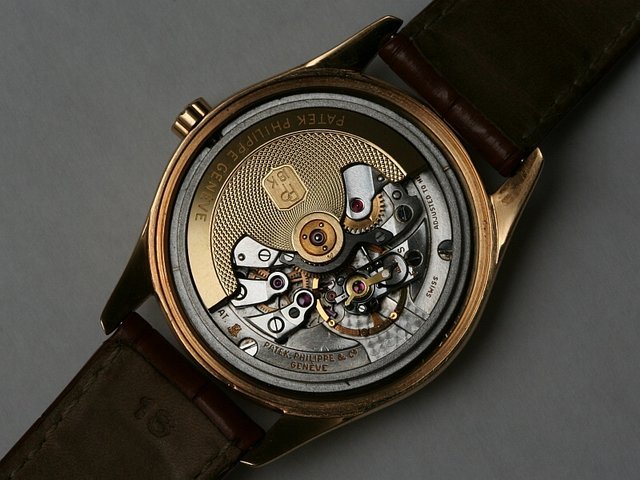
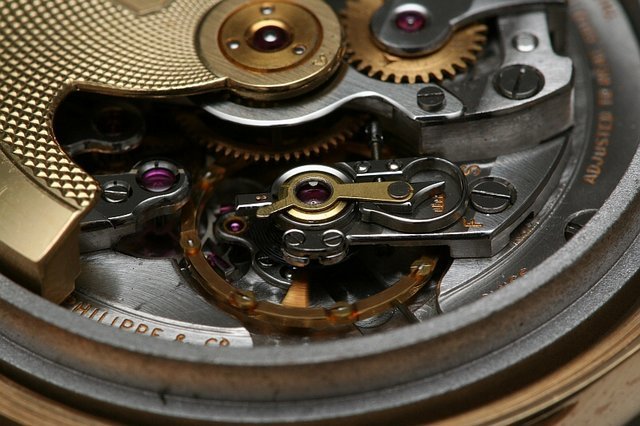
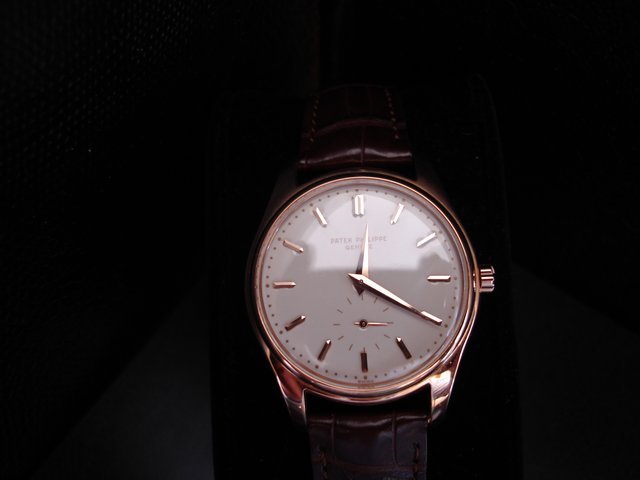
Patek Phillipe was somewhat of a late comer to automatic movement technology. One of the reasons is their hand wind movements were selling very well. Patek, being Patek, did what they do best, they took their time, and developed, arguably, the finest automatic movement ever built,..even by today’s standards.
The famous 12-600AT (12 lignes being the diameter, 6.00 mm, the height , in fact it was more like 5.45mm, and AT representing automatic winding system), or as Patek originally referred as “ Self-Winding” movement.
This movement is completely over-built, with swan neck regulator, full bi-directional rotor. You can clearly see this was an era when the company was directed more my it’s technicians then its accountants.
Specifications:
Stamped with the Geneva Quality Hallmark, rhodium-plated, “fausses-cotes” decoration, 30 jewels, straight line lever escapement, gyromax balance adjusted to heat, cold, isochronisms and 5 positions, shock-absorber, self-compensating Breguet balance spring, micrometer regulator, 18k yellow gold rotor.
The guilloche rotor is a piece of horological art and that unfortunately was lost with its successor the 27-460.
This first automatic movement went through several modifications, and was replaced by the 27-460, which was essentially the same movement design. Thanks to modifications to the automatic winding system overall height was reduced to 4.6mm (5.3 with date).
Although the 27-460 had a few technical modifications, I for one, still prefer the swan neck regulator, and the guilloche rotor of the 12-600AT.
The 12-600AT automatic movement is unmatched, ...even by today’s standard:
In conclusion;
These small technical wonders have proven to stand the test of time, in their technical achievements, reliability and beauty. The Rolex 1500 is still known for its robustness, and tremendous accuracy, the IWC, its leading edge technical innovation, and the Patek for its sheer beauty. These technical wonders are in essence, 1950’s engineering marvels.
arolex
Arthur.
Copyright
all rights reserved
Reference material:
1. IWC Ingenieur “ Incomplete History”: Michael Friedberg
2. IWC Great Automatics: Michael Friedberg
3. Inside the Watch; Rolex Automatics: Tom Graf
4. Patek pics, 1&2: Paul Boutros
5. Rolex adds: Timezone
6. Picture of 5512: Angelo O.
7. Watchtime magazine; Patek Philippe
8. Article: International Ingenieur Automatic: pictures, L.Seiden/ M.Schonenberger/D.Termolen
9. Antiquorum: Movement data
Edited to correct HTML.
This message has been edited by SJX on 2008-05-19 02:45:55


The three great 1950's automatic movements..

Excellent well done. A post worth reading and saving. Many thanks Arthur,
Very nice article.

Fantastic post and job, Arthur

Thanks Arthur and.....
