
Jack Forster
[Elite User]
4381

Greubel Forsey Dinner in New York: Meeting the Masters!
Last night a very select group of Purists were privileged to spend some time with Greubel Forsey, who hosted a dinner for us at Restaurant Danube. Danube is owned by David Bouley, the restaurateur whose eponymous Bouley in 1987 received 4 stars from the New York Times. Danube presents modern, re-imagined versions of classical Viennese cuisine, as well as menu items representing Chef Bouley's own personal style, and it has in addition to magnificently attentive and solicitous service, one of the most romantically attractive dining rooms and cocktail lounges in New York:
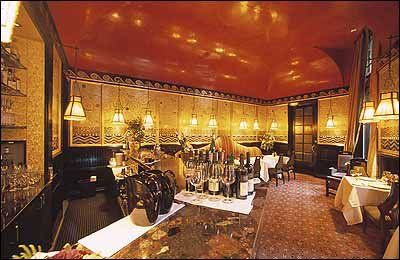
The room is rather reminiscent (deliberately one suspects) of the work of Gustave Klimt:
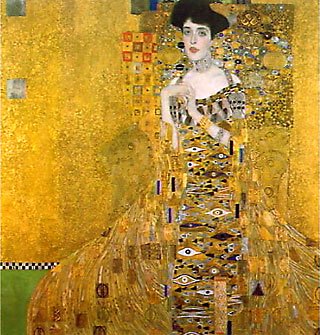
(some Purists may recall this painting recently sold to an anonymous collector for over 150m USD. There was a reproduction on the wall of the cocktail lounge, at least I think it was this one.  )
)
We arrived as the light was fading from an uncharateristically pleasant August twilight in Manhattan- cocktails were served in the lounge while our room was being prepared. One of us enjoyed an iced tea:
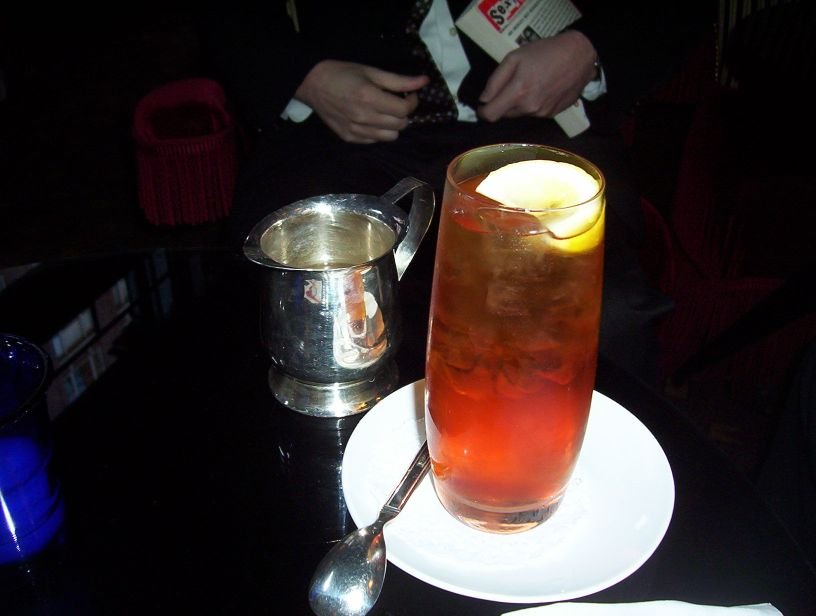
simple syrup served as a sweetener, dissolves more easily in the tea; it's the little details like that which really set a restaurant apart from the competition! 
Gradually the rest of our small group arrived, consisting of our hosts, the team from Greubel Forsey, and in addition to 5 Purists, a select group of journalists and distributors. It was with great pleasure that we were introduced to Stephen Forsey himself, the English half of the duo of Greubel Forsey, who was wearing on his wrist the prototype of the watch that made Greubel Forsey famous, the Double Tourbillon 30 Degrees:
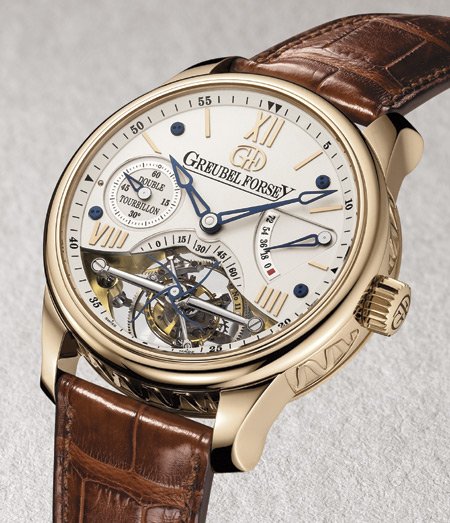
Seeing the Double Tourbillon 30 Degrees is itself a rather rare event; very few are made and they pass into the hands of eager private collectors rapidly. Seeing the prototype from which the final product was developed was a rare and exciting treat:
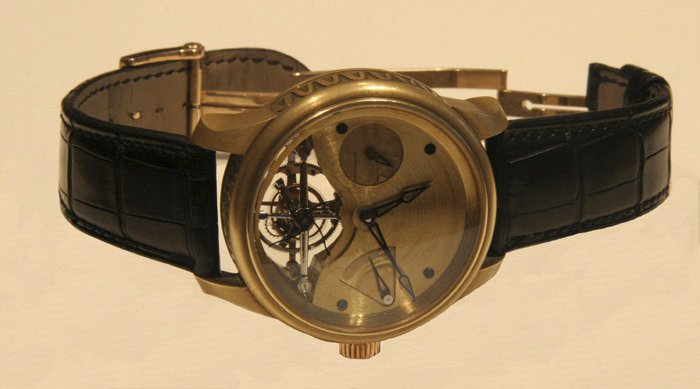
-and we all examined it eagerly
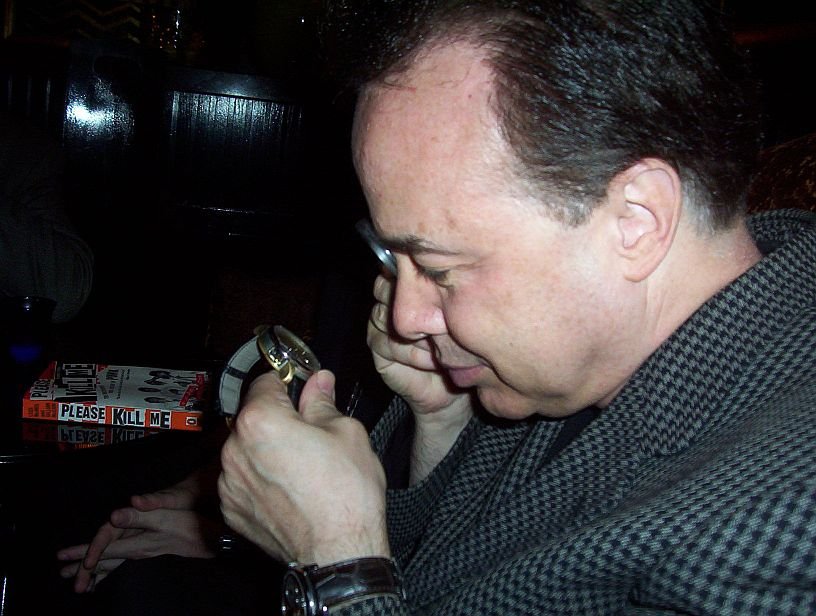
-despite the ambient light in the cocktail lounge being more suited to amorous than horological pursuits .
While our dinner preparations were being finalized Stephen Forsey discussed with us the history of Greubel Forsey and also the remarkable history of the Double Tourbillon 30 Degrees; perhaps a little recap is in order.
The Double Tourbillon 30 Degrees is a remarkable piece of work not only because of its intrinsic complexity and sophistication of execution, but also because of its unique combination of two complications: the double tourbillon, and the inclined axis tourbillon. Multi-axis tourbillons are still relatively rare and extremely difficult to manufacture. The potential for loss of power producing poor running and obviating the potential benefits of a tourbillon regulator are always a concern in any tourbillon, and in a really fine tourbillon the problem is addressed not through the crude expedient of simply making the mainspring more powerful (which would produce accelerated wear in the train as well as a lot of chaotic behavior in the escapement as the cage stops and starts) but through making sure that the highest possible manufacturing precision, best materials, and most careful construction is implemented throughout the power train.
The multi-axis tourbillon itself is a relatively recent innovation, and was first implemented by Richard Good and Anthony Randall; Richard Good produced his first double axis tourbillon clock in 1978 but went on to make a triple axis tourbillon as well in 1987:
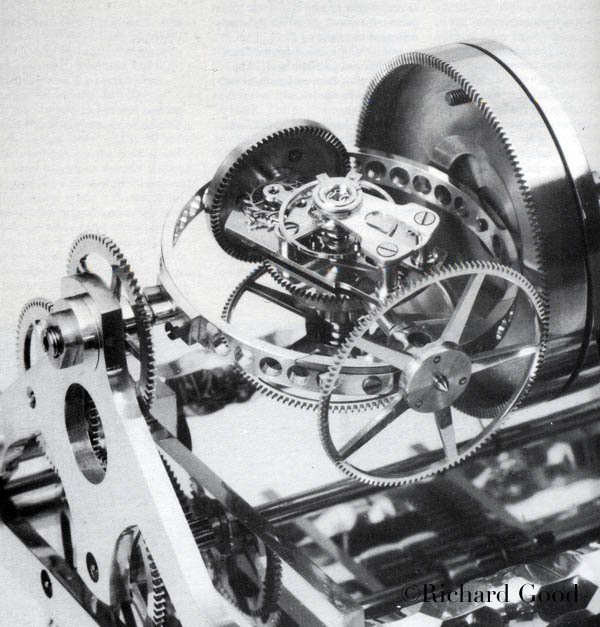
(Richard Good 3 axis tourbillon)
and Anthony Randall produced a double axis tourbillon in 1980:
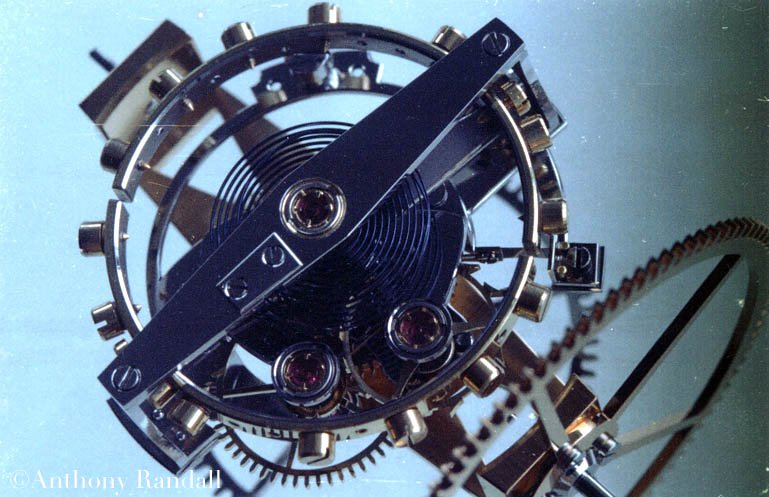
(Anthony Randall 2 axis tourbillon)
While unusual and exciting mechanical complications in and of themselves the multiaxis tourbillon in a wristwatch is a big challenge not only mechanically (the nested cages scaled down to wristwatch size demand meticulous construction) but also an aesthetic headache as the use of multiple cages makes for a very thick watch. Though it can be done it?s very hard to make a multi-axis tourbillon watch that?s really aesthetically successful and seems organically a wristwatch.
The second intriguing aspect of the Greubel Forsey Double Tourbillon 30 Degrees is the use of an inclined axis for the inner tourbillon cage relative to the outer. If multi-axis tourbillons are rare, the inclined axis tourbillon is rarer still. Very, very few have ever been produced and when they have it has generally been as one-off pieces that command, even by the standards of the stratospheric prices of complications and custom pieces, breathtakingly high auction prices. The first inclined axis tourbillon ever made was produced by Walter Prendel, who made an inclined or tilted axis tourbillon finished in 1928. Walter Prendel was a student of the famous German watchmaker Alfred Helwig, and I have read that he was one of only four students to graduate from the Deutches Uhrmacherschule in Glashutte with honors. His tilted axis tourbillon:
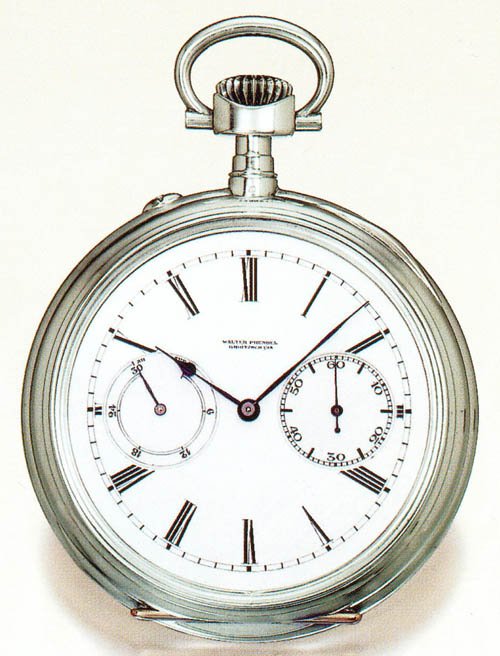
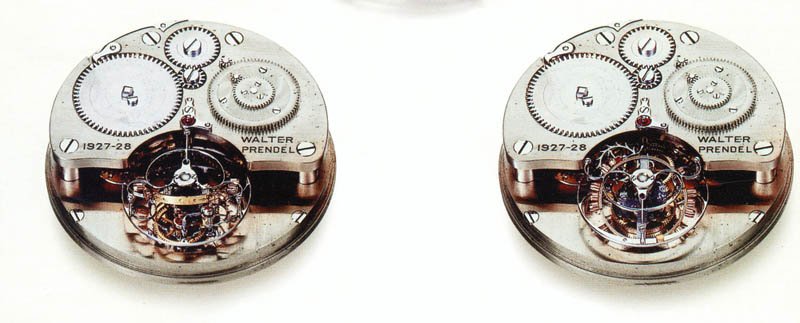
is an extremely exotic design; the pallet fork, escape wheel, and balance gradually inclined more and more away from the horizontal to support the 30 degree inclination of the balance and when it was sold at auction in 2002 it was for the astounding price of 1.2 million SFr.
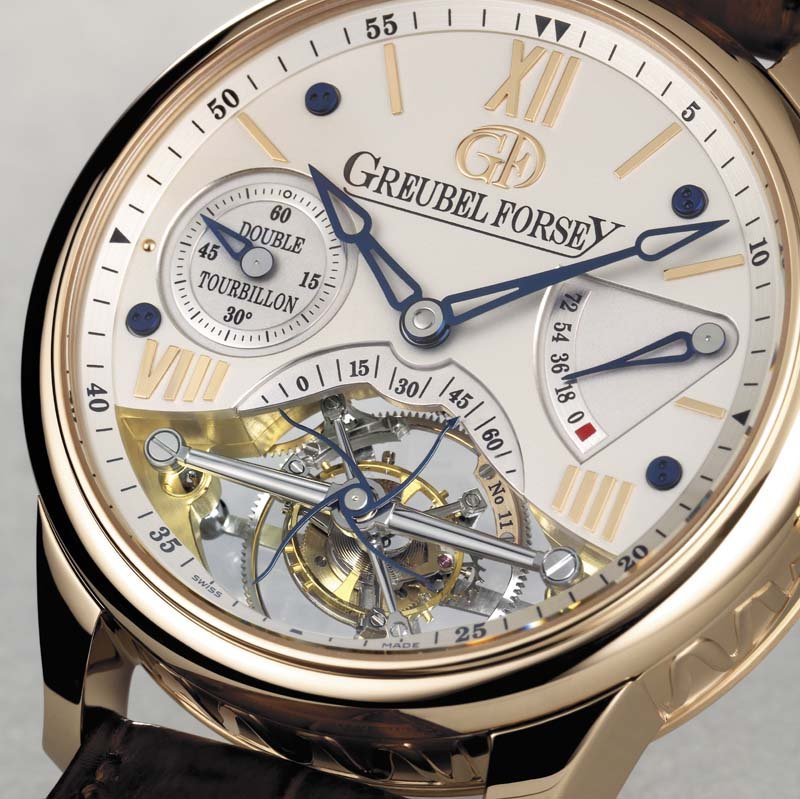
The Greubel Forsey Double Tourbillon 30 Degrees (in addition to combining, in a totally unique design, two already very exotic and difficult complications) is also perhaps the most aesthetically successful multi-axis tourbillon, as the use of two cages (an outer rotating at 4 minutes and an inner rotating at one minute) with the inner inclined with respect to the outer, allows the use of a multi-axis tourbillon design, with all of its seductive visual interest, in a wristwatch design that immediately seems an organic evolution of the art form of the wristwatch, rather than an awkward shoe-horning of a mechanism really more suited to a clock or large pocketwatch into a case that can be strapped on the wrist.
Thus, these two determined gentlemen:
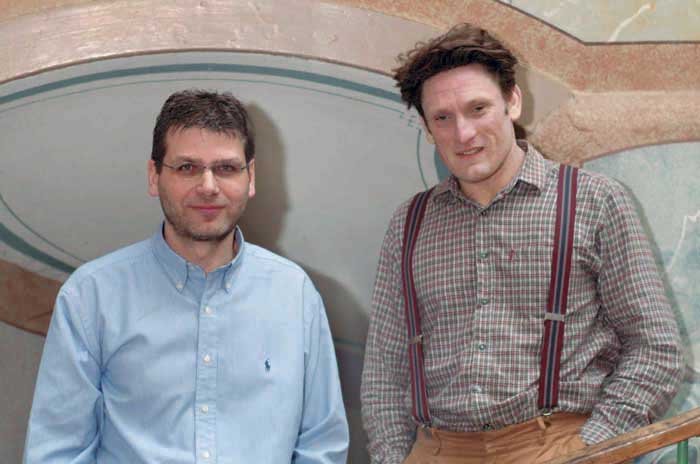
(Robert Greubel, left; Stephen Forsey, right)
have succeeded in producing a multi-axis tourbillon which is not only a success from an engineering standpoint, but which also stands apart aesthetically:
Our horological ruminations were interrupted by a call to dinner and we entered our private dining room.
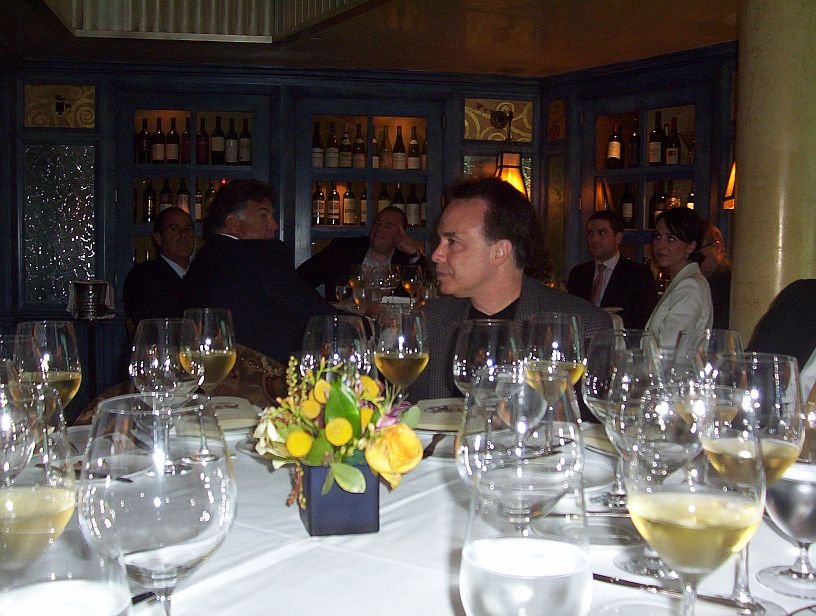
and I was lucky enough to be able to sit with Stephen Forsey, I am afraid I didn?t give him much of a chance to enjoy the splendid dinner that Greubel Forsey and Danube had in store for us as I peppered him mercilessly with questions both personal and horological:
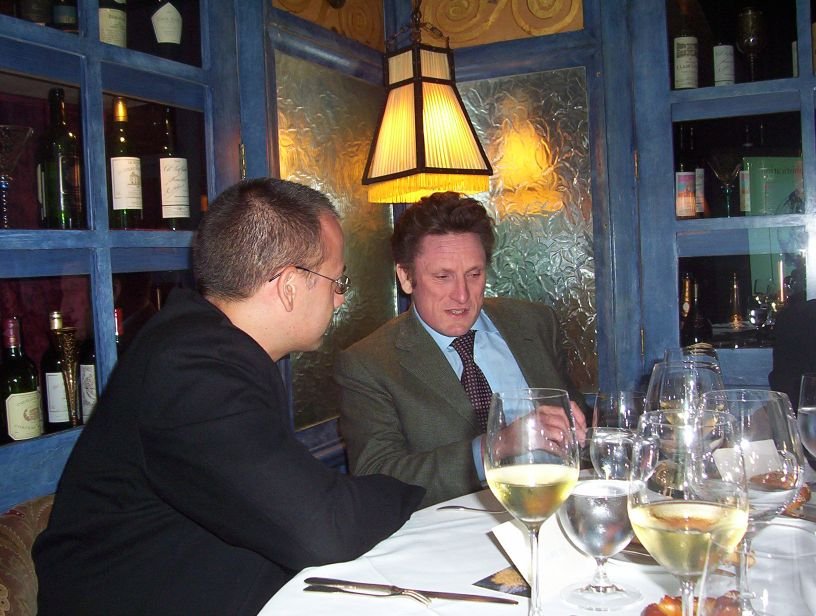
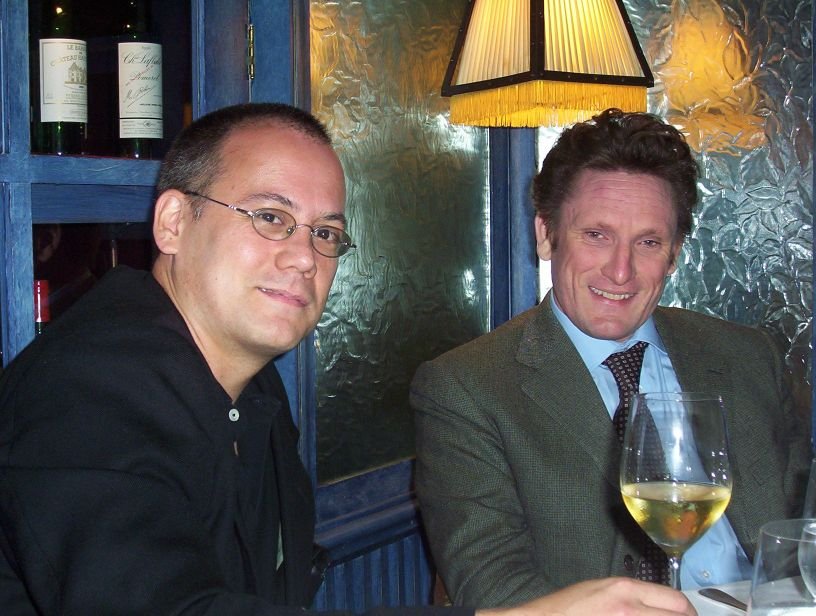
which like a true gentleman and enthusiast he answered not only with enormous courtesy but also with a warmth for the subject which can only be found in an artist who is discussing his passion.
Stephen in a sense is really a repository and representative of not only the finest in modern horological science- he and Robert Greubel worked together for many years at Audemars Piguet/Renaud & Papi, Robert having come to AP from IWC where he had worked on the Grand Complication project- but also of the now nearly lost English watchmaking tradition. I was fascinated to hear that Stephen was actually trained at the very last of the English watchmaking schools, formerly in Clerkenwell, one of the great centers of traditional English watchmaking. His father and grandfather were both deeply involved in mechanics; his father as a vintage auto enthusiast who taught him to use a lathe while Stephen was still a boy (?that was the first nail in the coffin,? Stephen remarked to me, grinning ruefully) and his grandfather as well who worked for the legendary aircraft manufacturer De Havilland.
Stephen spoke very eloquently about his early love of clocks and watches, his discovery of the great masters of early English horology such as Quare, Tompion, and Harrison, and his belief that we still have much to learn from these long-deceased craftsmen. ?When you look at what they accomplished, without any of the sophisticated tools available to us in modern times, with just the simplest hand tools, it really humbles you, it makes you realize that you?ve really got to keep trying harder.?
However, he does not consider himself an English watchmaker per se, but simply a watchmaker. Watchmaking, he commented, is really an international art these days, and the watches of Greubel Forsey express not only the deep personal and national roots of Stephen Forsey and Robert Greubel, but also the international milieu of modern horology, where an Englishman and a Frenchman working in Switzerland produce watches that appeal to the whole world.
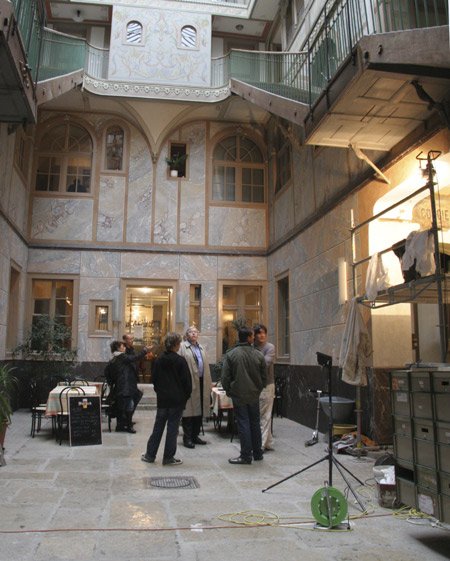
(the ?Ancien Menage,? the home of Greubel Forsey in La Chaux de Fonds)
Stephen also shared with us his feelings about horology as an art. ?Watchmaking is really unique, I think, in that it?s one of those very few activities. . . look, in modern times, so much of our connection to the world around us is broken, it?s made through electronics, things that distance us, and watchmaking is one of those very few activities where there?s really a connection made, still, between the heart and the hands.? Coming from someone who has been devoted to the art of mechanics since boyhood such a remark is not marketing cant but a movingly sincere personal manifesto.
Our discussion was punctuated by an excellent dinner!
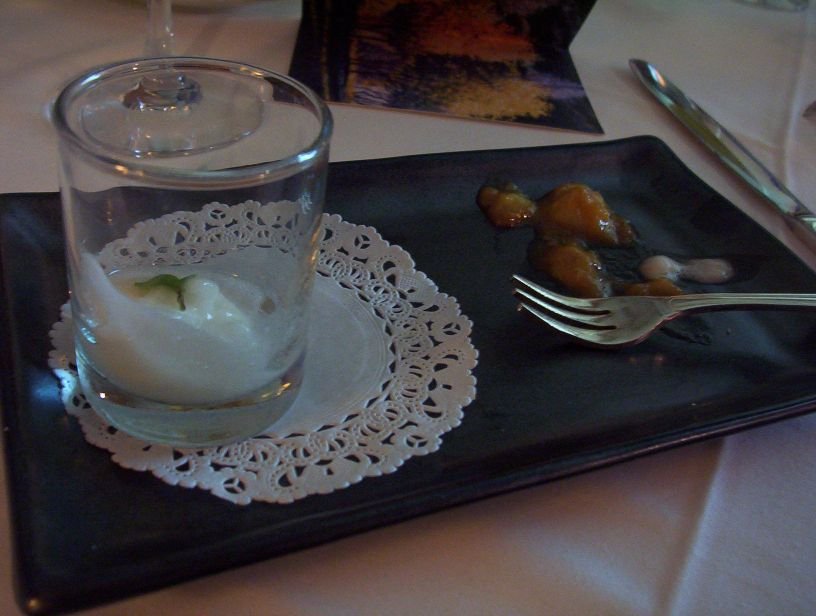
(shellfish amuse-bouche, with citrus foam. Intoxicated not only with the excellent conversation but also by preprandial cocktails and the excellent wines poured during dinner I nearly forgot my journalistic duties!)
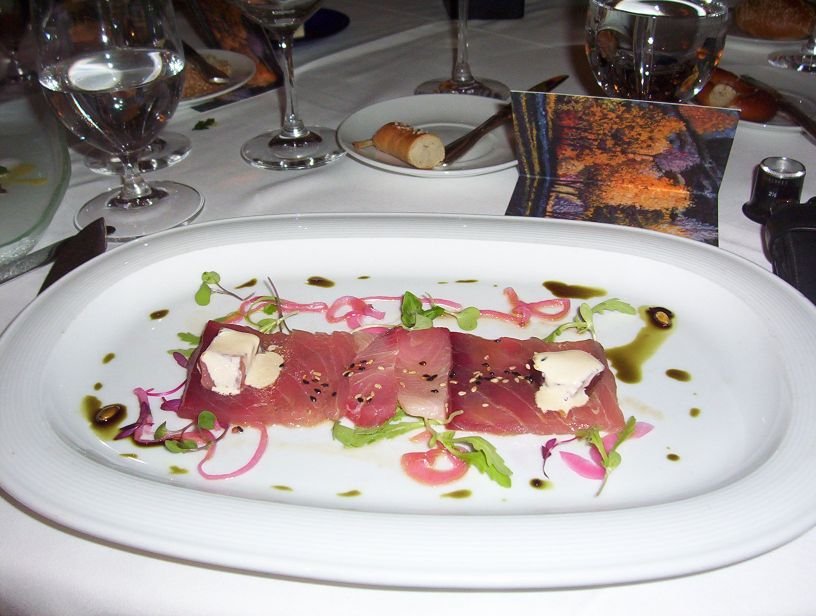
(sashimi grade tuna starter- first grade tuna literally melted on the tongue)
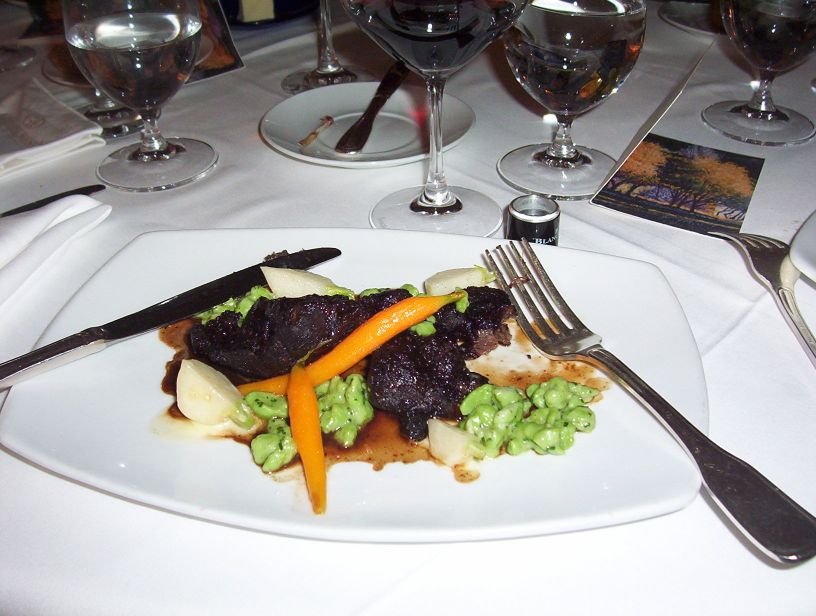
(braised beef cheeks- fork tender, great depth of flavor, great match with the Chateauneuf du Pape that graced our glasses)
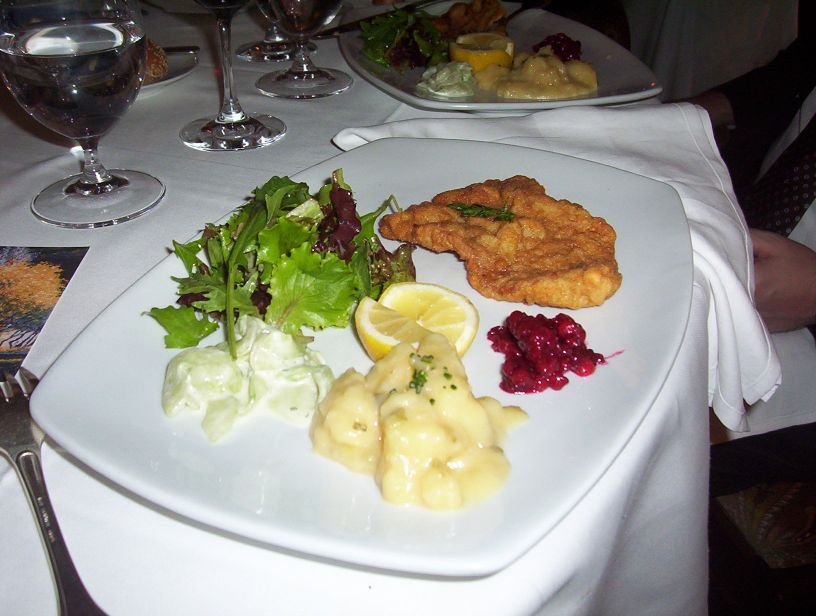
(veal schnitzel- classic Viennese! This was John?s- I can?t turn down beef cheeks if they?re on offer ).
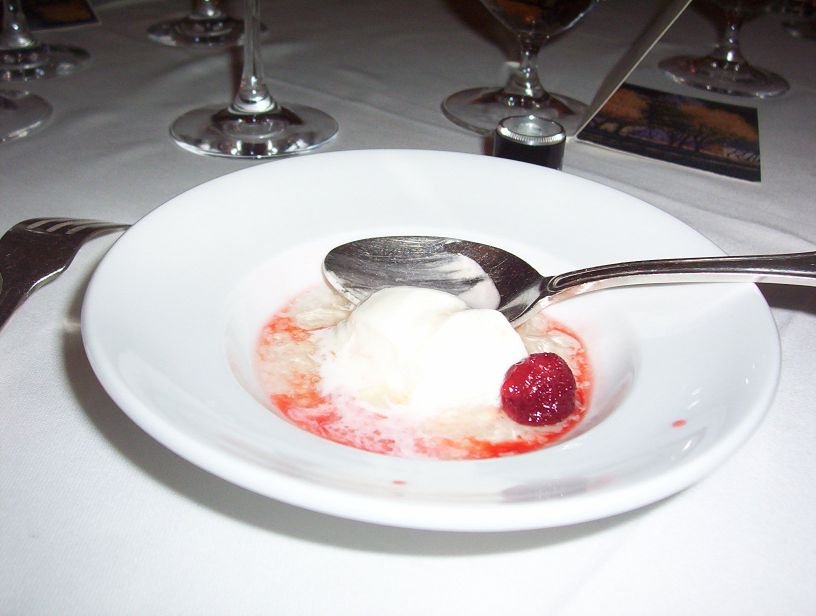
(ice cream and berries, followed by. . .)
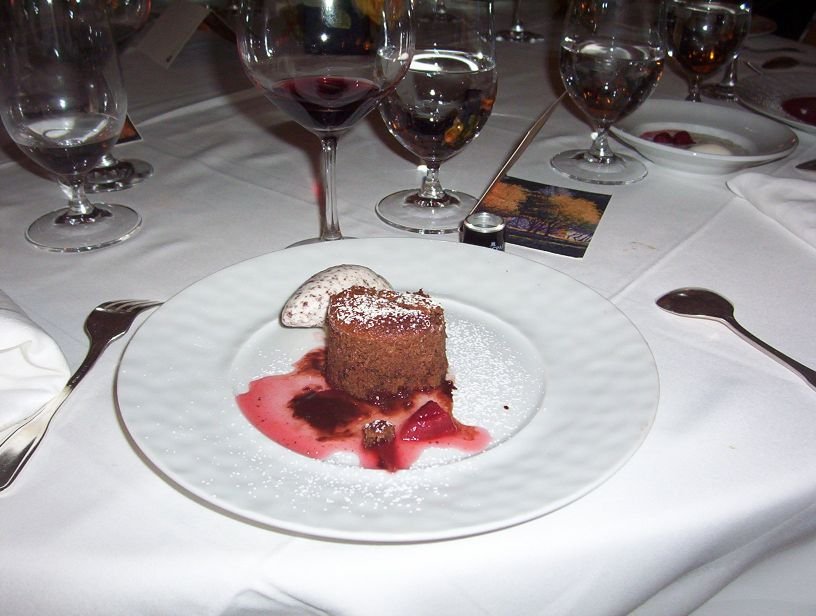
(individual chocolate souffl? )
and as dinner progressed, we were privileged to see the next amazing piece in development at Greubel Forsey!
The Quadruple Differential Tourbillon- another first from Greubel Forsey. Two double axis, inclined tourbillons, linked with a differential which averages the rate of each, the two tourbillons rotating asynchronously so that they are never simultaneously in the same position. Please forgive these very quick pictures of this remarkable timepiece:
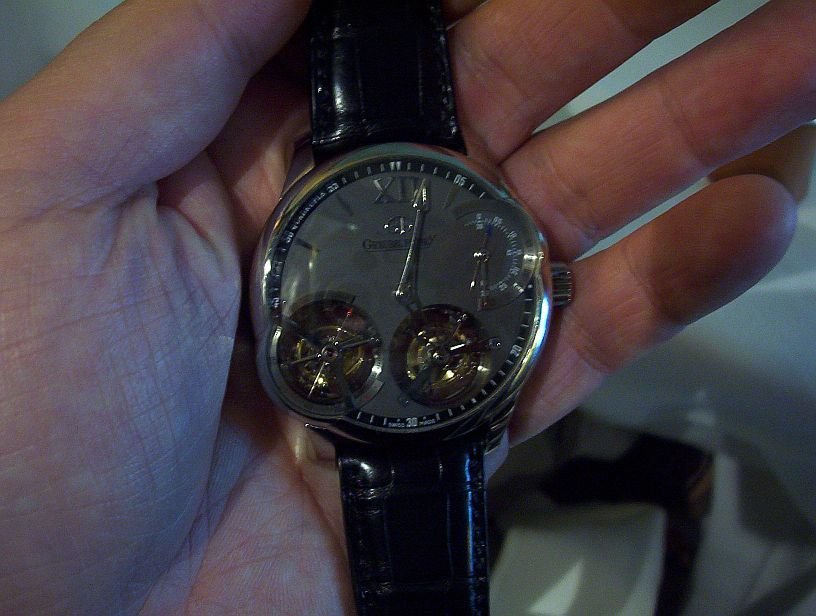
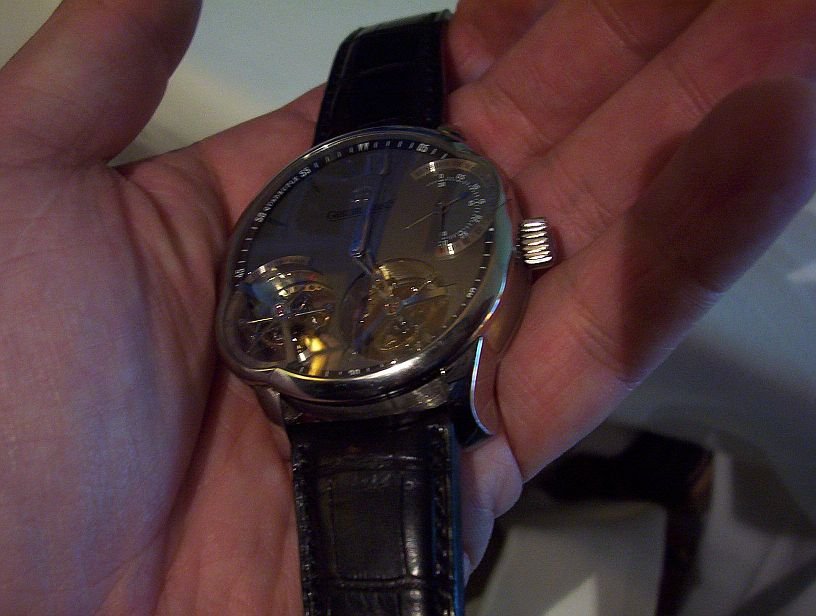
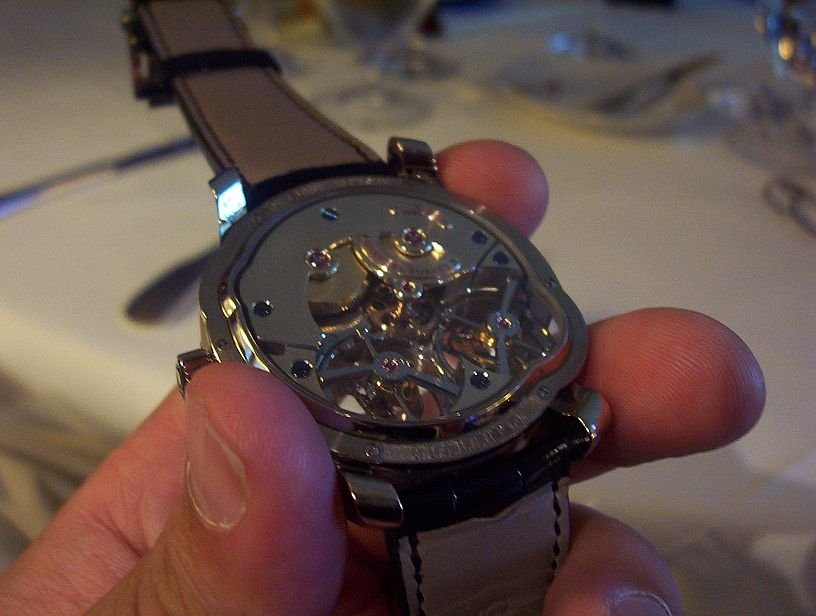
It is difficult to express how beautifully executed this watch is; the visual play of the tourbillon regulators and the mechanical music of the action of the escapements makes for a watch of incredible fascination, and which, as an evolution of the inclined multi-axis tourbillon, is at the leading edge of arguably the most esoterically mesmerizing tradition in horology.
Purists will wonder, what do Stephen Forsey and Robert Greubel, masters of the art of the tourbillon, think of the practical advantages of the tourbillon in a wristwatch- that much debated point?
Stephen Forsey considered the point and then said to us, ?The tourbillon is really all about the quality of execution- in other words, can you maximize the advantages offered by the tourbillon and minimize the disadvantages? One of the big difficulties is that you have to take the time to really test things properly, and you can?t rush it- if you are looking at wear issues, for instance, you can?t just put more power through the train (to accelerate wear) because it?ll affect how the tourbillon runs. . . there is just no substitute for observing how a watch runs over a long enough period of time to get a really clear idea of its performance.? Greubel Forsey is committed not only to the tourbillon as a purely aesthetically compelling art form but also to excellence in performance, and unlike many manufacturers who let the need to introduce novel products trump the need to take time and observe a new movement for long enough to ensure it?s really doing what it?s supposed to, GF makes sure that a new product is what they intend it to be and what connoisseurs expect before releasing it to collectors.
However, this commitment to quality has not impeded innovation! In addition to the groundbreaking Double Tourbillon 30 Degrees, and the wonderful new Quadruple Differential Tourbillon, there is also in development a tourbillon of remarkable properties- an inclined axis tourbillon with a 24 second cage! The cage will be constructed of a unique combination of a special, ultra-rigid aluminum alloy and titanium.
As dinner wound down we all had a chance to circulate, chat, make new friends and say hello to old ones:
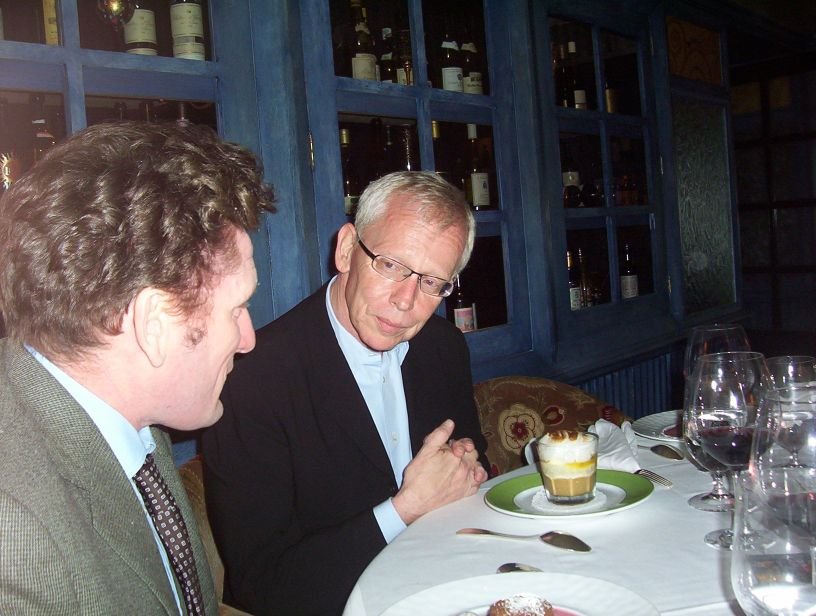
(I finally let Stephen talk to someone else)
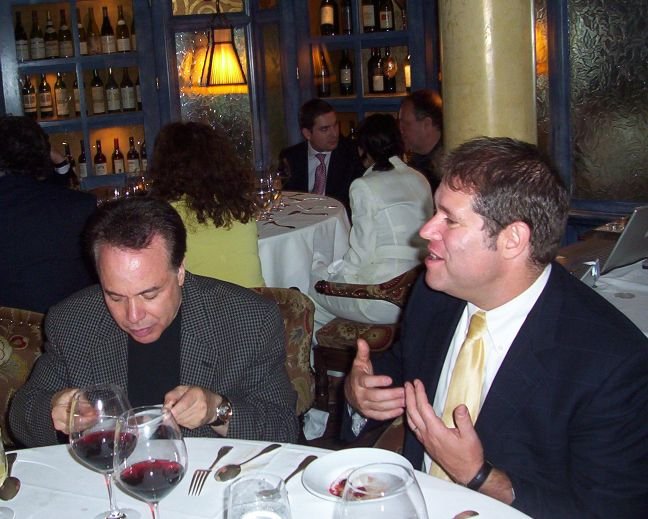
(Purists West and Michael consider gastronomy and horology simultaneously)
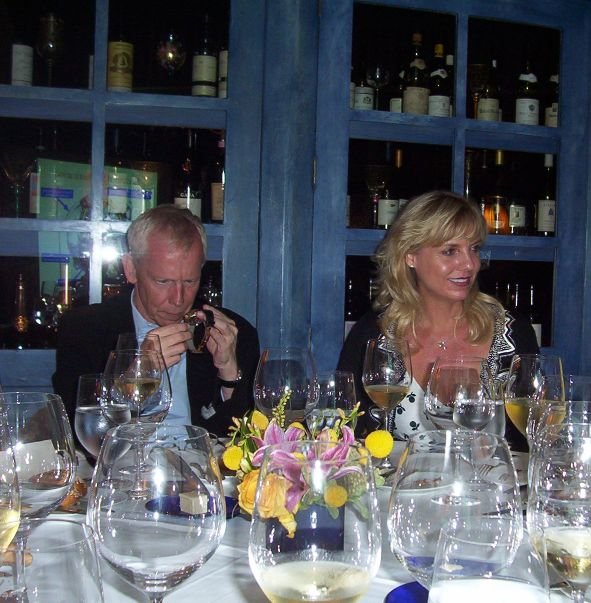
(Guests listen raptly to the GF presentation of the new Quadruple Differential and 24 second tourbillons)
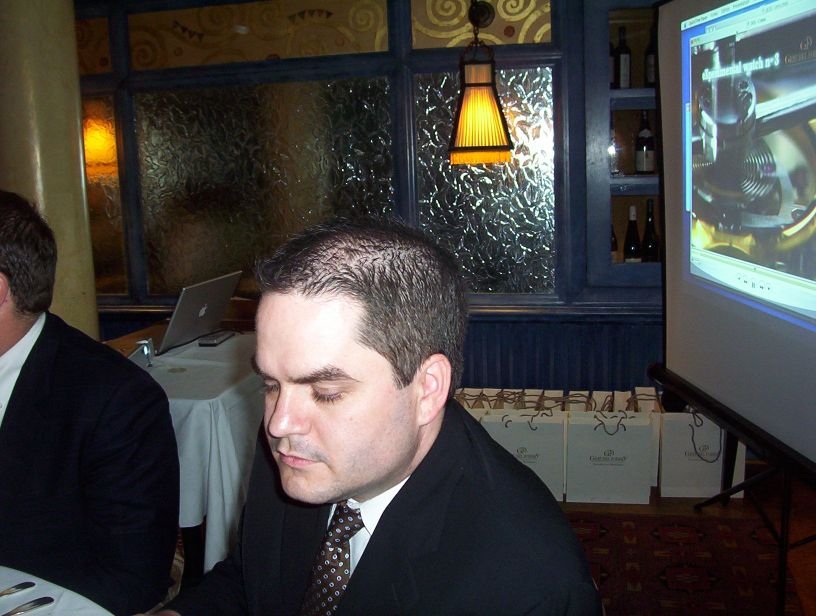
(ei8tohms meditates on the future of horological arts and sciences )
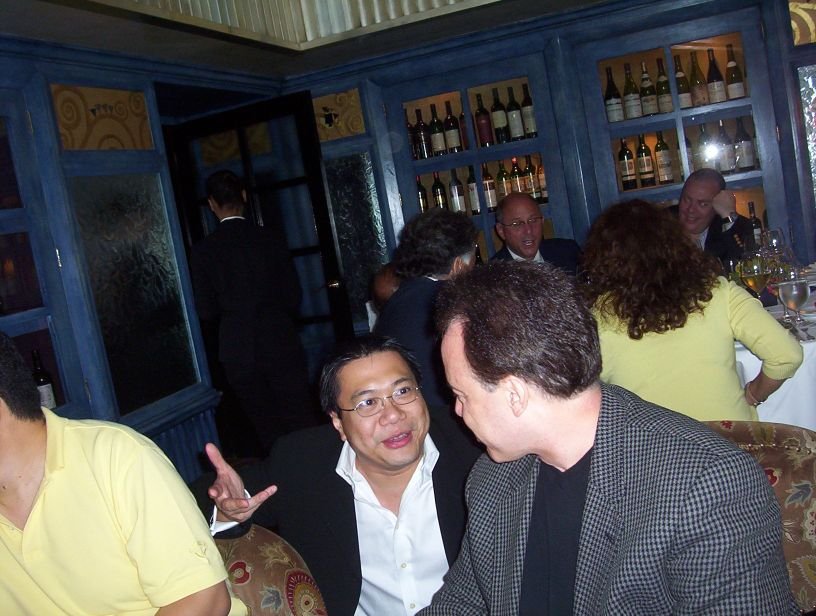
(your reporter runs out of clever captions; let?s just say we all had a great time )
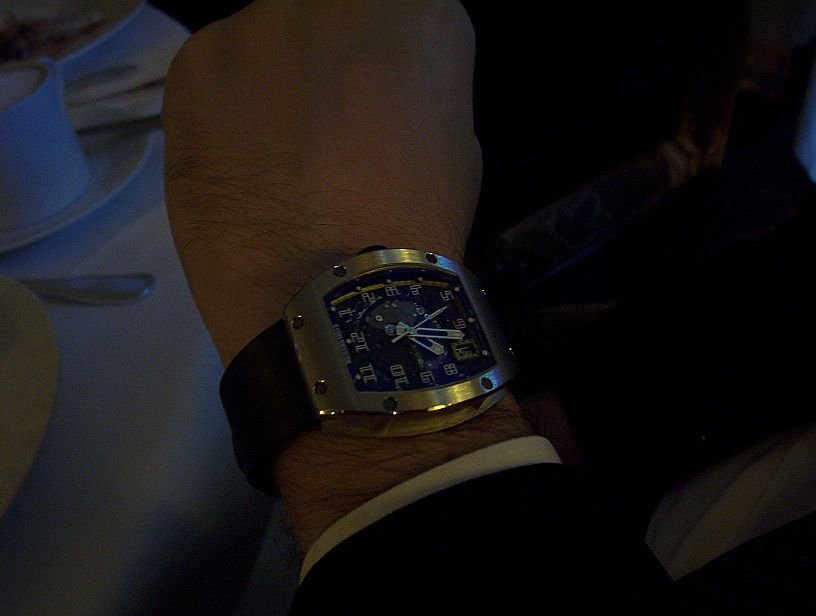
(of course, there were many exotic watches present! This one glowed in the dim room like a golden ember. . . )
It was a most remarkable evening- I would like to thank the entire Greubel Forsey team, Dr. Thomas Mao, and the unflaggingly solicitous staff at Danube for all making it truly an evening to remember. And a big personal thank you to Stephen Forsey, who patiently allowed me to monopolize his attention more or less completely when the poor fellow should have been peacefully enjoying our excellent dinner!
This article may be replete with errors in judgement as well as matters of fact which I happily blame on its being composed whilst I am still enjoying the warm morning after glow of excellent food, wine and company so any corrections will be gladly appreciated!!!!
Jack Forster