
foversta
[PuristSPro Moderator]
20814

Geneva Fair 2013: Urwerk
I have a kind of ritual during the Geneva week: I never miss the Urwerk
presentation at the second floor of the 4 Seasons because for me it is
always a great pleasure to meet the whole team, to discuss with them
about the latest novelties... and about the upcoming
projects.
I will not tell you that what I saw a few
weeks ago was the most surprising offer from Urwerk for ages. I already
had the chance to see the UR-210 ALTIN at the end of the year and the
UR-110PT can't be considered as a spectacular breakthrough in the
collection. But an Urwerk watch has always the little something which
makes it special even if it is not surprising at the first
glance...
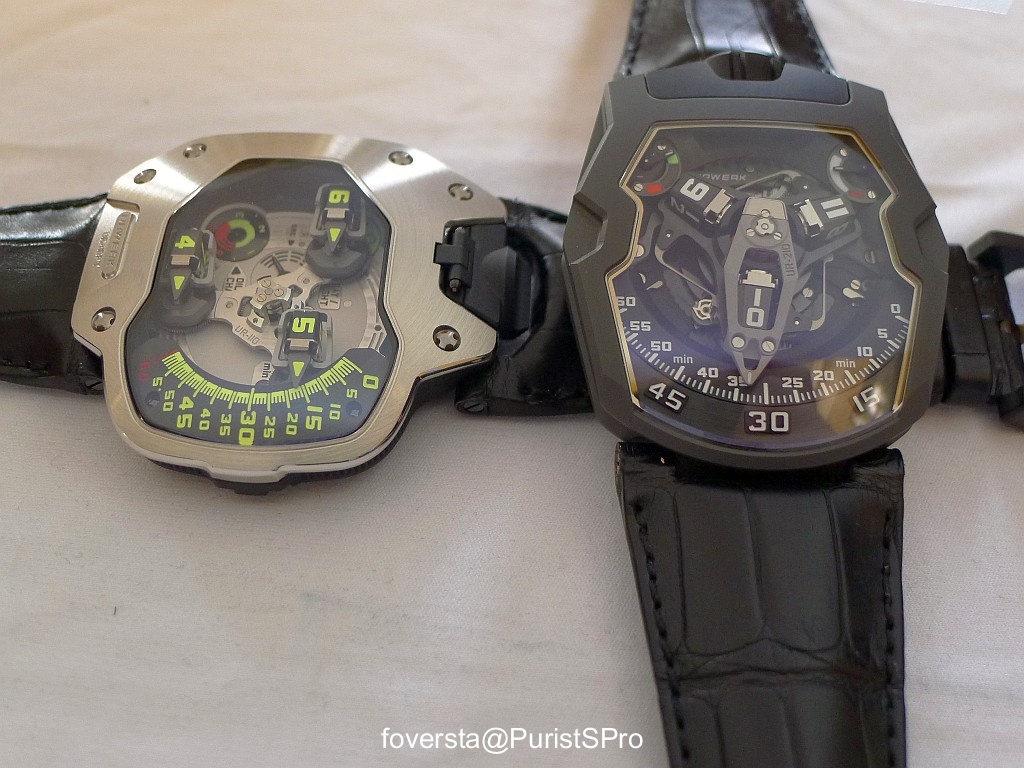
By the way, it was interesting to see these
two watches at the same time because even if they share the same spirit
(a contemporary way to display the wandering hours), they are so
different. Let's compare them very quickly!
UR-110PT:
vertical minutes graduation
UR-210 ALTIN: horizontal minutes
graduation
UR-110PT: no retrograde
hand
UR-210 ALTIN: retrograde hand
UR-110PT:
one small hand per hour satellite
UR-210 ALTIN: one big
hand
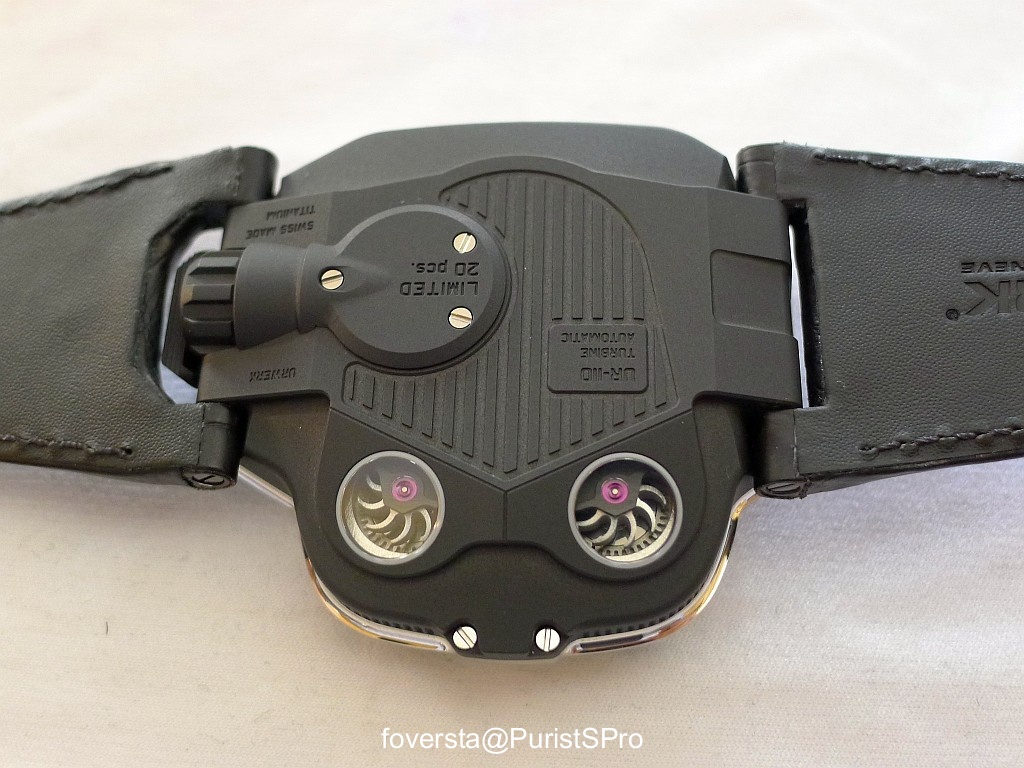
UR-110PT: functional Turbines with no ability to
influence their behaviour
UR-210 ALTIN: functional Turbines
with the ability to measure the winding efficiency and to influence
their behaviour
UR-110PT: presence of a 3-blades
second hand
UR-210 ALTIN: no second
hand
UR-110PT complications: day&night and
oil change indicators
UR-210 ALTIN complications: winding
efficiency and power reserve indicators
So
different... and so Urwerk at the same time!
Look at
the cases and glasses curves, the satellites, the crown, the turbines:
without any doubt, these watches come from the same
company!
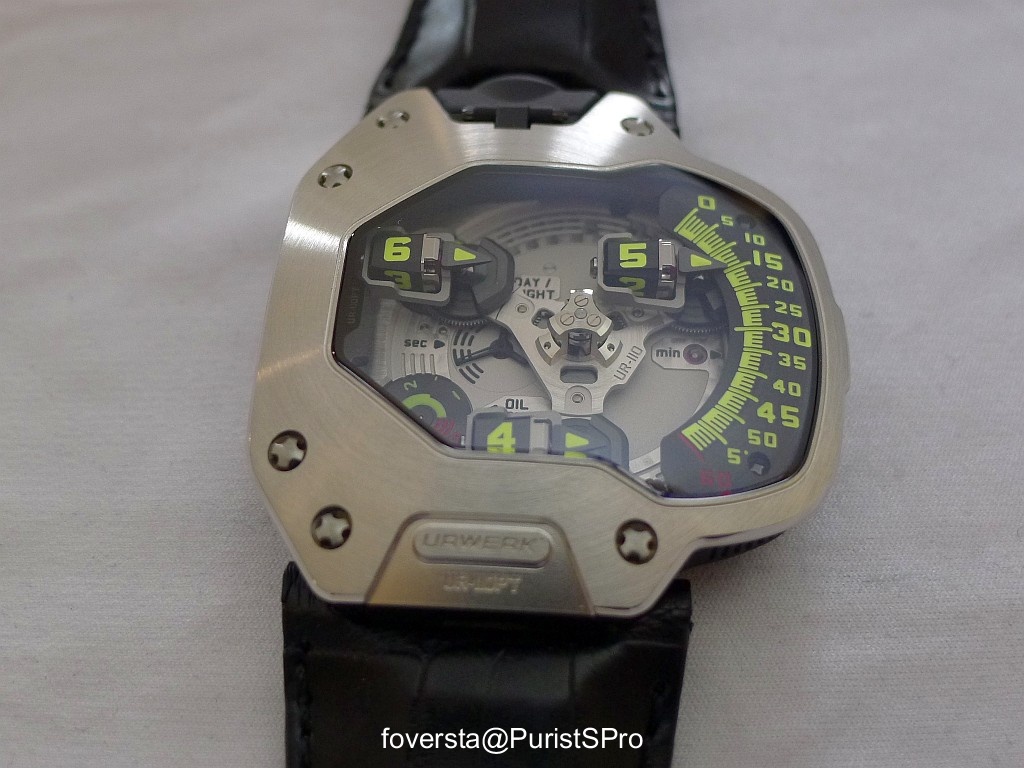
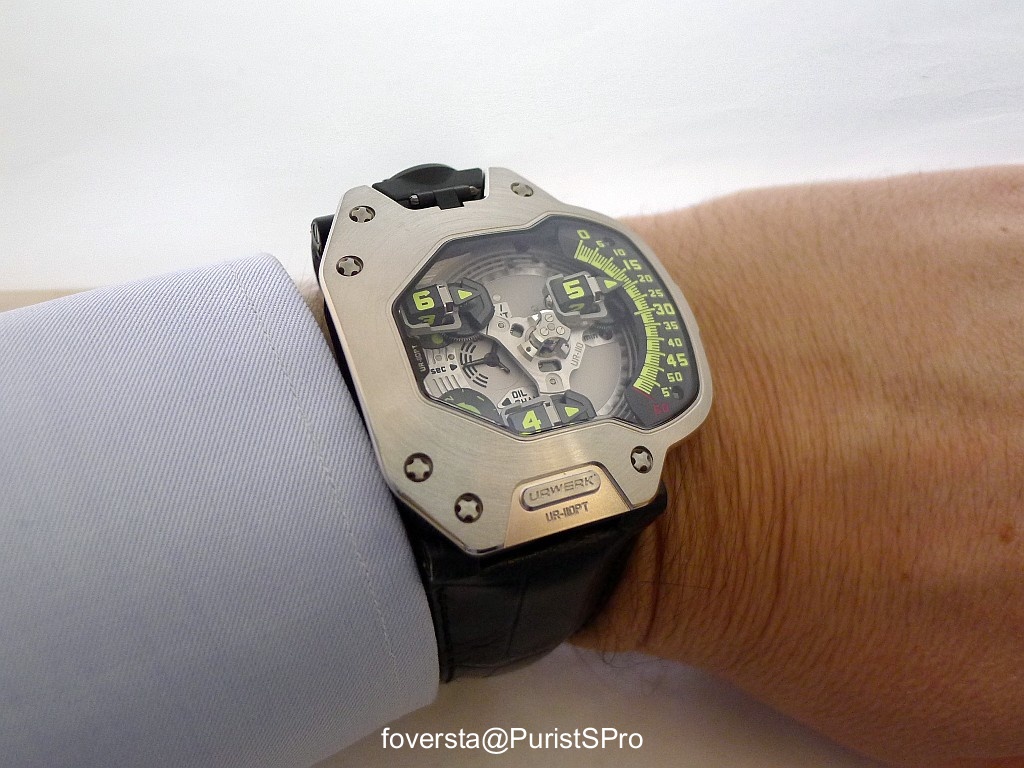
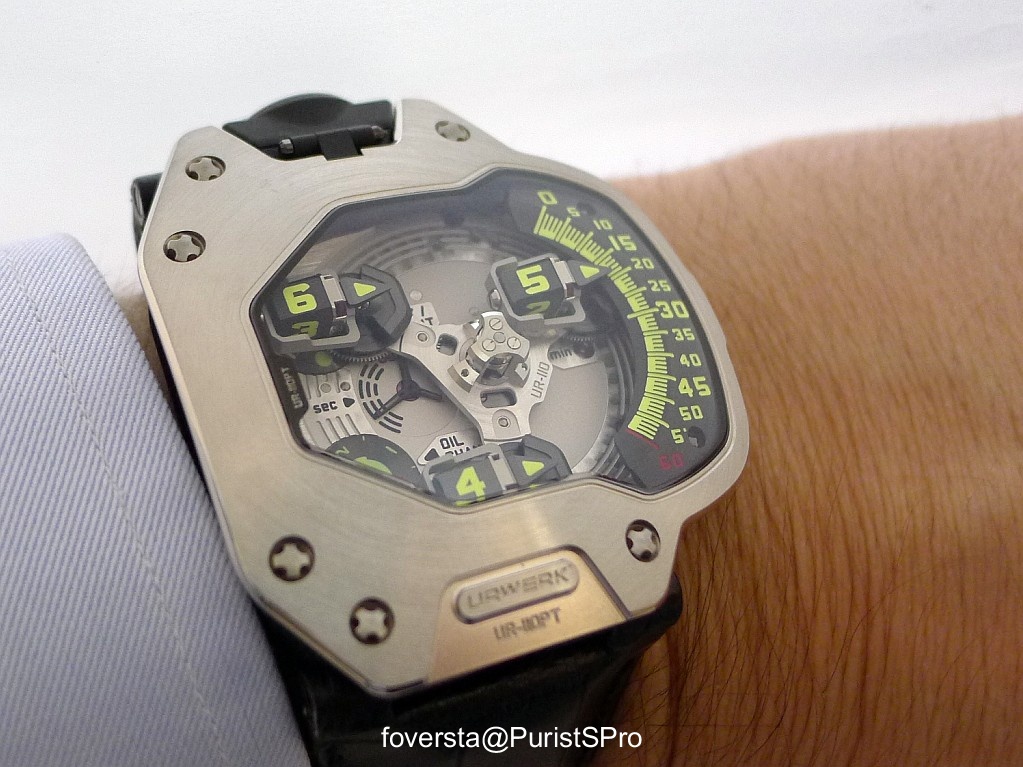
The UR-110PT features a Titanium case and a
platinum bezel which creates a new feeling if we compare it with the
previous versions. First of all it is heavier and secondly it is maybe
the most sober version of this watch. The screws are very discreet which
was not the case of the TTH version.
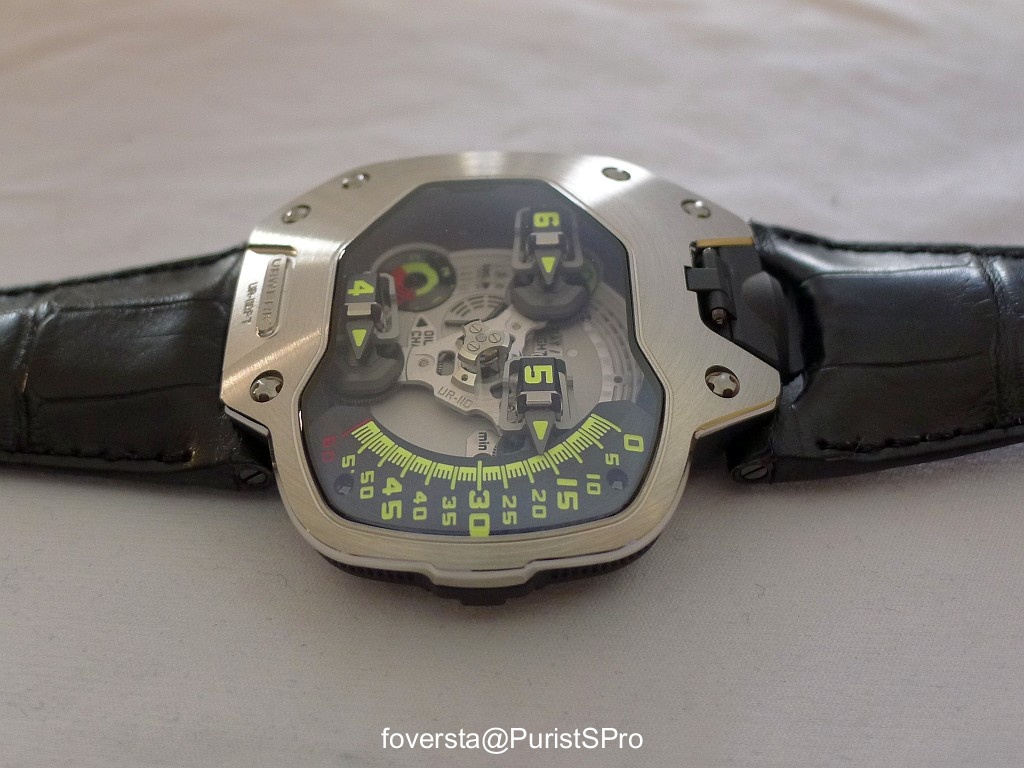
The UR-110PT is
a watch I appreciate due to its aerodynamic design: I always have the
feeling that the air is brushing against it.
The
trick with the UR-110 is that at any moment, the 3 satellites and hands
are strictly parallel. So you can imagine what the planetary gear has to
do in order to keep this parallelism. Turn the crown and you understand
the ballet of the satellites and the difficulties become
obvious.
The caseback of the UR-110PT with the two turbines:
The aerodynamic design of the UR-110PT case and glass. I find that these curves are very sensual... I always want to stroke this watch...
The UR-110PT and the UR-210 ALTIN together. You will notice the sharper lines of the glass and case of the UR210 which seems to be a more aggressive watch.
The UR-110PT on the wrist:
Let's have a closer look at the UR-210 ALTIN
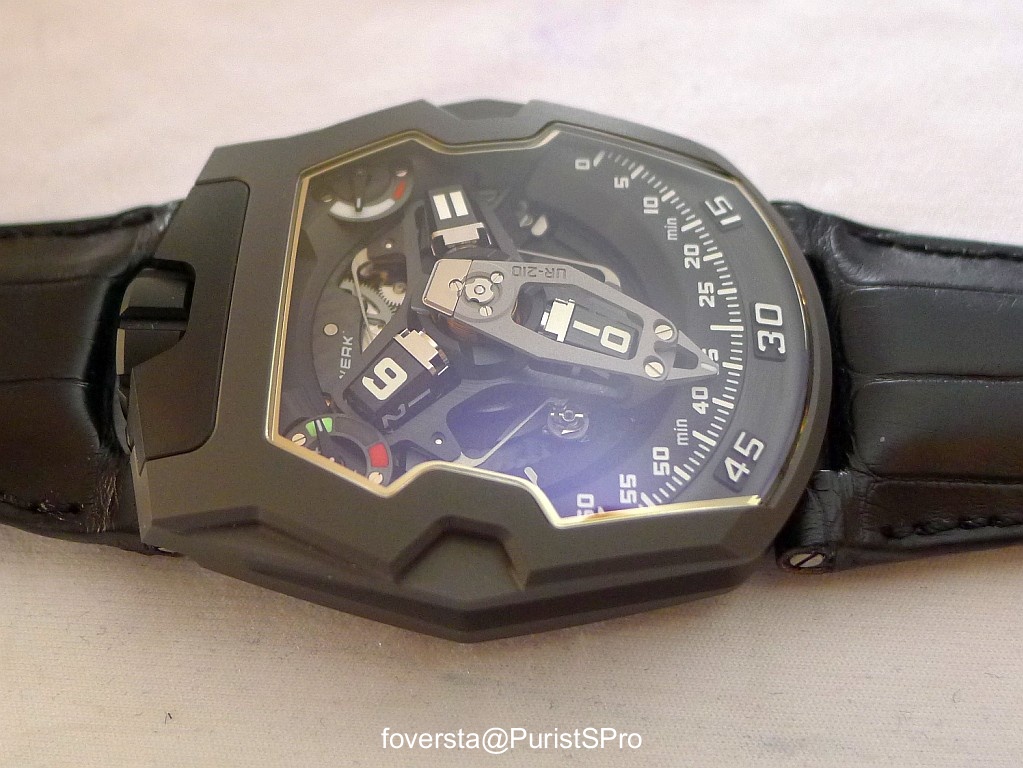
The UR-210 is maybe my fav Urwerk with the UR-202 White Shark. Why? Because I find again the spirit of Opus V inside.
If we consider all Urwerk wristwatches (I don't take into account the UR-1001), there wasn't any retrograde hand... until the unveiling of the UR-210. I consider it as a very matured Opus V. It takes advantage of all the works, the innovative moves created by Urwerk during the last years.
It is really impressive to observe the behaviour of the big second hand: a retrograde system is always very demanding in terms of mechanism but with such size the context becomes very tricky.
This big second hand which wraps each satellite works without any flaw or hesitation. This hand is the key player of the show. Even the reference of the watch is written on it!
This movies shows you the perfect move of the big hand:
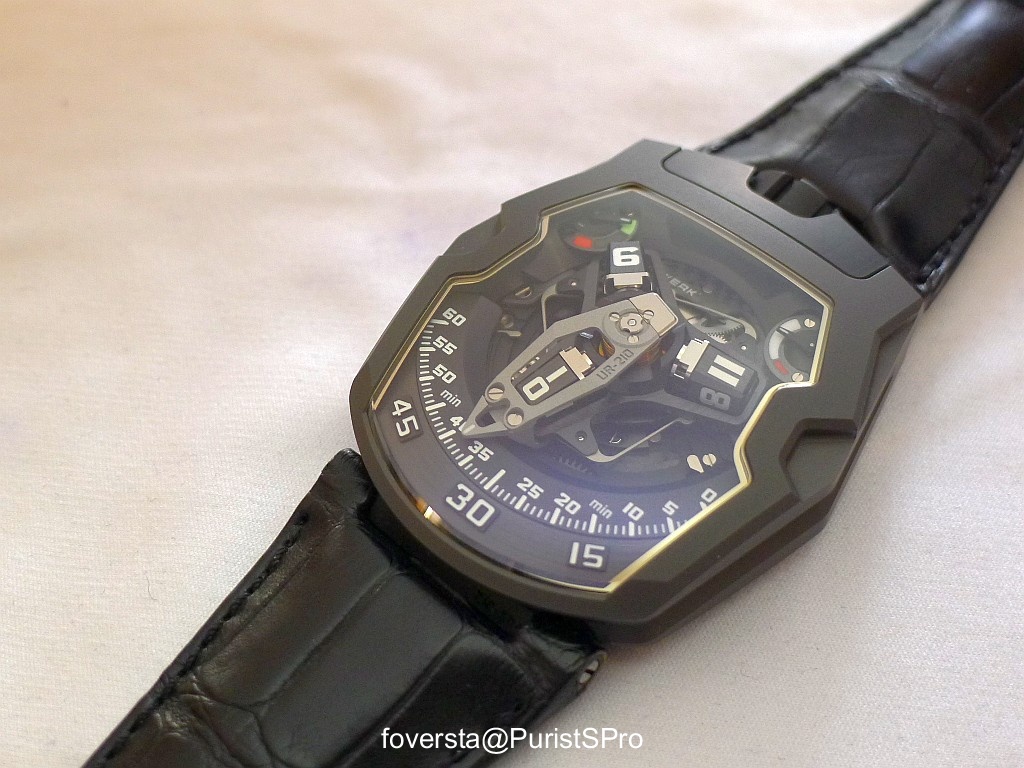
Look at the minutes graduation: each quarter was emphasized in order to improve the legibility: good point.
But have a look now on top of the watch in each corner. On the right side, you see the power reserve indicator. Classic.
But on the left, there is an unusual indicator. It shows the winding efficiency during the last two hours. This is really a nice addition because it is useful in the specific Urwerk context. Why?
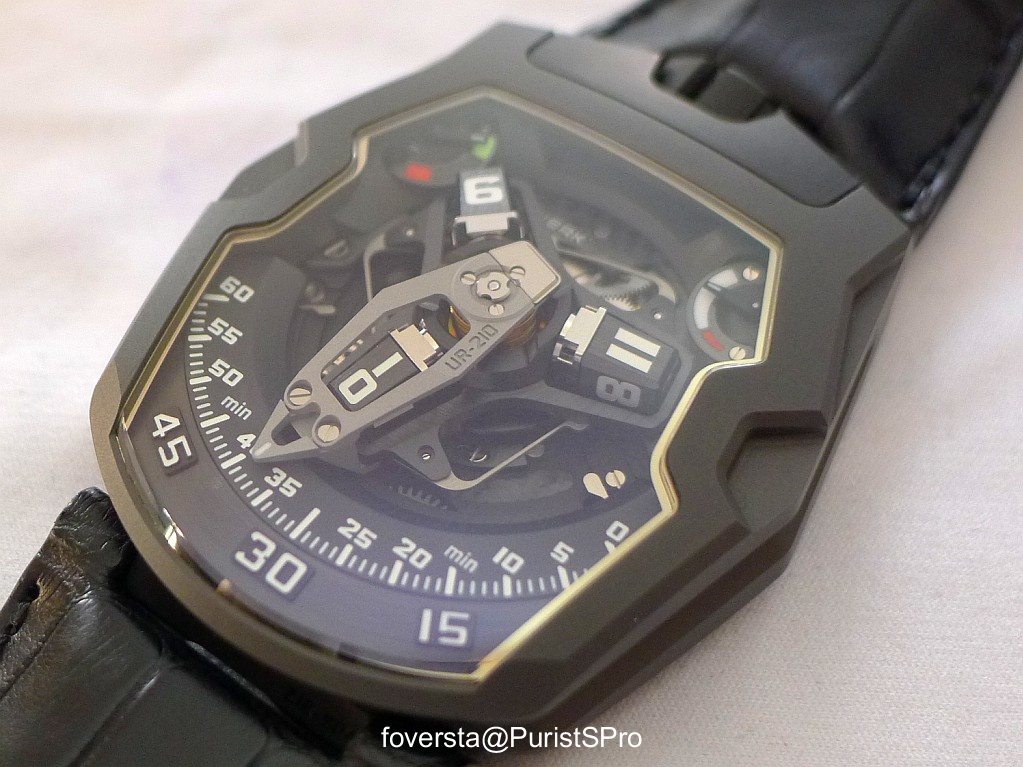
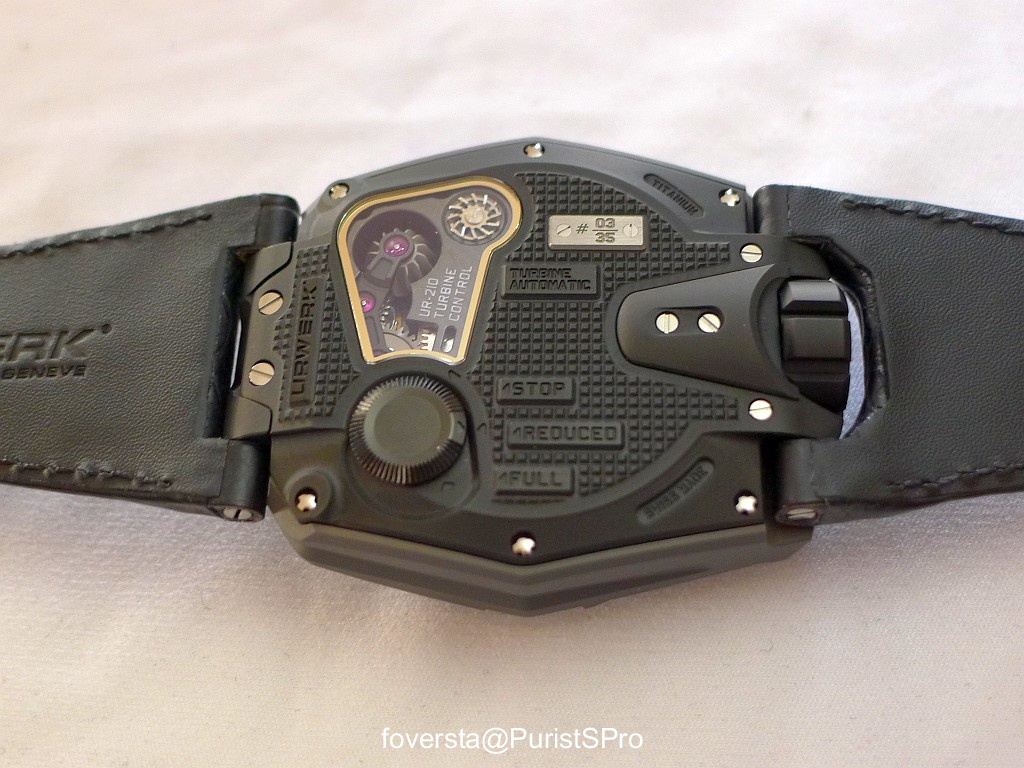
Thanks to the turbines system, you can influence the winding efficiency. But before the indicator, you never knew if it was required to change this efficiency, to improve it or to reduce it. If you are in the red zone, the winding efficiency is too low and your watch is losing power reserve. So you may need to put the lever on the full position. If your watch is too efficient and the power reserve on top, maybe you may wish to reduce this efficiency by putting the lever in front of the reduced position to preserve the movement. I like this interplay between the owner of the UR-210 and the watch.
The UR210 ALTIN on the wrist. We are basically with the same dimension range than with the UR-110 (43,8x53,6 vs 47x51). Both watches are big and rather thick in their highest position (17,8mm vs 16mm). But thanks to the efficiency of the strap and of the buckle, they remain comfortable on the wrist.
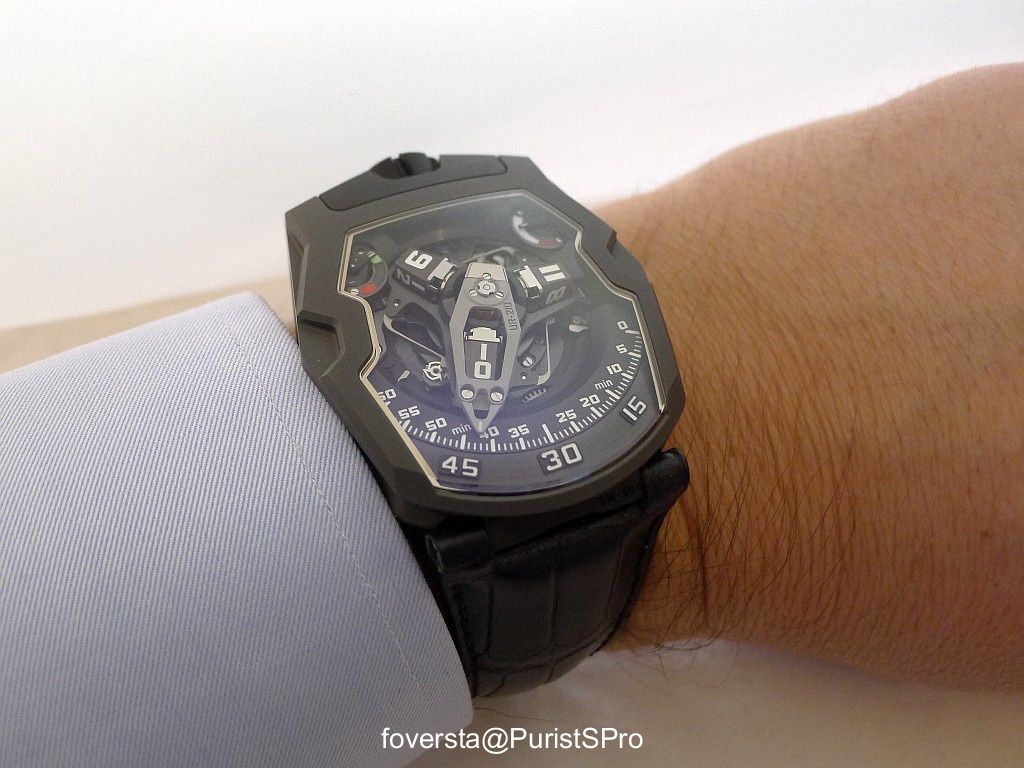
The concern is that you can't wear it under the sleeve of the shirt! Or I have to buy new shirts...
But after all, when you own such watches, such aesthetical achievements, do you really want to hide them under the sleeve?
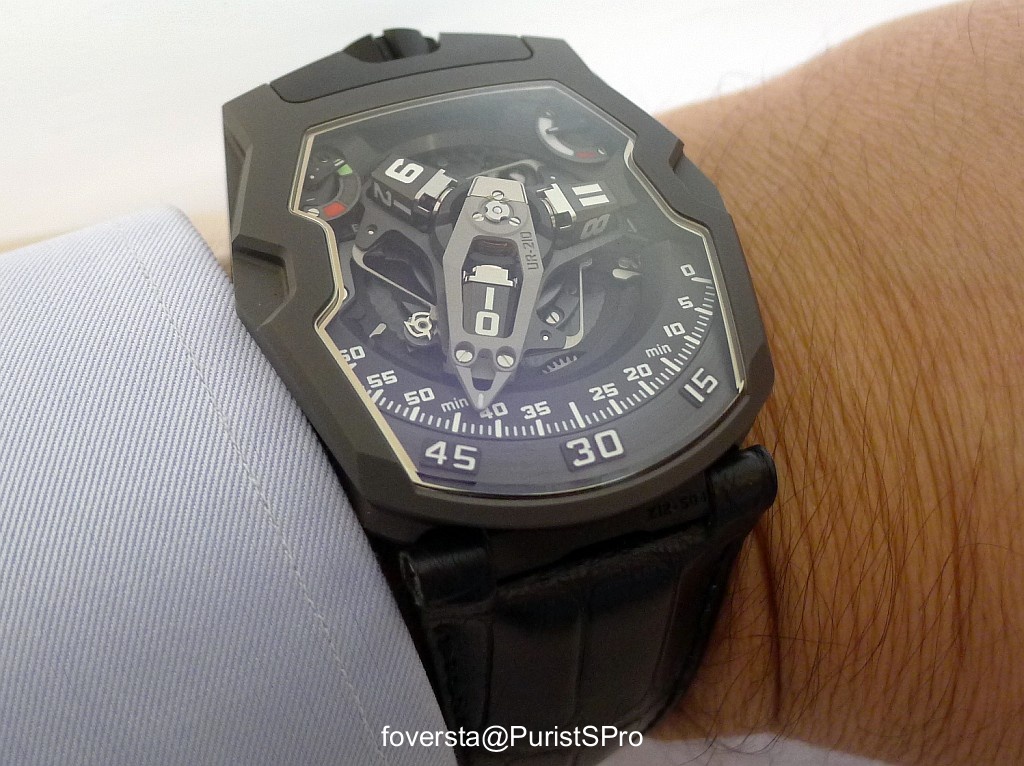
Even if the UR-110PT is a well-made watch, very faithful to Urwerk assets, I much prefer the UR-210, especially in its original version (I'm less seduced by the "black" watches). It is for me a way to rediscover Opus V and just for this, I thank again the Urwerk team for having used for the first time in their wristwatches collection a retrograde hand.
About the future, I can't tell you anything for the moment... except that Urwerk will bring us something very surprising later this year! So we only have to wait!
Thanks a lot to the whole Urwerk team for the warm welcome during the Geneva week.
Fx