
cshimokita
[Photo Forum Moderator]
10714

Extended Red Sensitivity Film
IR film has always floated around on the back burner... it was always there, but never quite pushed me into action... I guess the plate was full with other projects... In November 2007 KODAK announced that it would discontinue HIE Infrared 35 mm film due low market demand. It seems that Efke 820 has also gone by the boards, the options are thin...
I always try to listen when hints are given and so far I have not gone wrong with suggestions from "DonWishnow"... Some years ago he recommended that I visit the Kure Maritime Museum (also called the Yamato Museum) in Kure, Hiroshima, Japan... fantastic location and I should repost some photos from that trip... Recently Don suggested that I give IR a try... I always listen to "Wish"...
Here is what I ended up with...
Ilford SFX 200, a B&W film that has extended red sensitivity (up to 740nm) together with a R72 Infrared Filter. For the test, I was using my Nikon F3P and the AIS 50mm f/1.2...
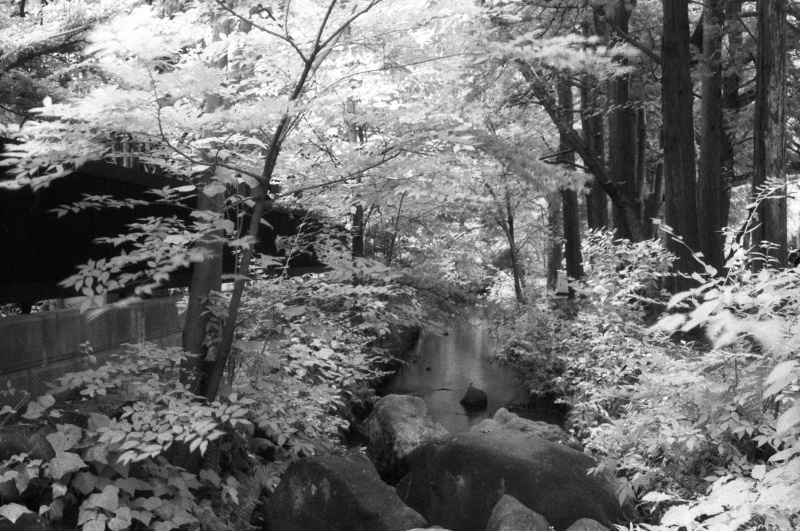
Exposure... The Ilford SFX 200 data sheet recommends shooting in bright sunshine in order to obtain the "best" results. At this point I went searching thru my CD collection to find Michael Bublé's cover of "The Best is Yet to Come"... Call Me Irresponsible ;-)
From different articles on the internet I found that a good baseline for my exposure tests would be to meter at ISO 6. The film is ISO 200 and the R72 filter does not have a fixed filter factor. In fact, according to the filter mfg: "the filter factor for this filter is highly variable and depends largely on the ISO sensitivity in use and lighting conditions". How about that...
Note 01: ISO 200 film metered at ISO 6 is a 5 step difference=Filter Factor of 32
The general consensus was to shoot a test roll from a baseline and bracket plus/minus two steps, which at three shots per composition would give me 12 unique lighting condition tests in a roll of 36 images... I ended up doing plus/minus one step as the ISO 6 suggestion was a common reference.
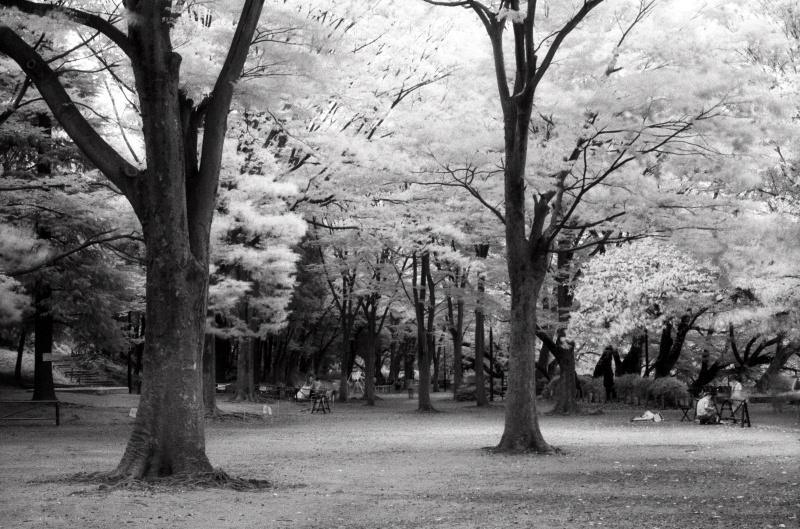
According to the filter maker, "lighting conditions" have an impact on the exposure... depending on what you are looking for as a final image... and true enough my tests, when using SFX 200 and the R72 filter showed the following:
Note 02: in shaded sunny conditions meter at ISO 3 i.e. 6 steps / FFactor of 64
Note 03: in bright direct sunshine meter at ISO 12 i.e. 4 steps / FFactor of 16
... and even at that, there was some variance, so it's only a guideline and bracketing is recommended, at least for the first couple of rolls...
A word about focusing... When working in the IR range you need to focus slightly different than you do with visible light... on older lenses you might see a little dot on the distance scale... the idea is to focus using visible light and then adjust according to the position of the dot... best to stop down a bit and take advantage of a bigger DOF... I was shooting at f/5.6 or f/8 with a 50mm lens. It's impossible to focus a SLR with the R72 attached... so the process was to remove the filter during set-up, composition, and focusing... did I mention that you need to use a tripod ;-)... even with bright sunshine the exposure times were in the range of 1/15 or 1/8 second. With a RF camera, just leave the filter in place ;-)
Some lenses, such as those with apochromatic (APO) design, may not need focus correction when using a very dark red filter.
Development... Ilford SFX 200 is a standard B&W film and requires no special handling during development, as well it is not a chromogenic (C-41) black-and-white film. I mention this as the staff at my local development drop-off point were not familiar with the film and did a check just to make sure... SFX 200 costs about USD 12.00 per roll, so it's not inexpensive... as a comparison my standard ISO 100 B&W film is about USD 4.75 per roll.
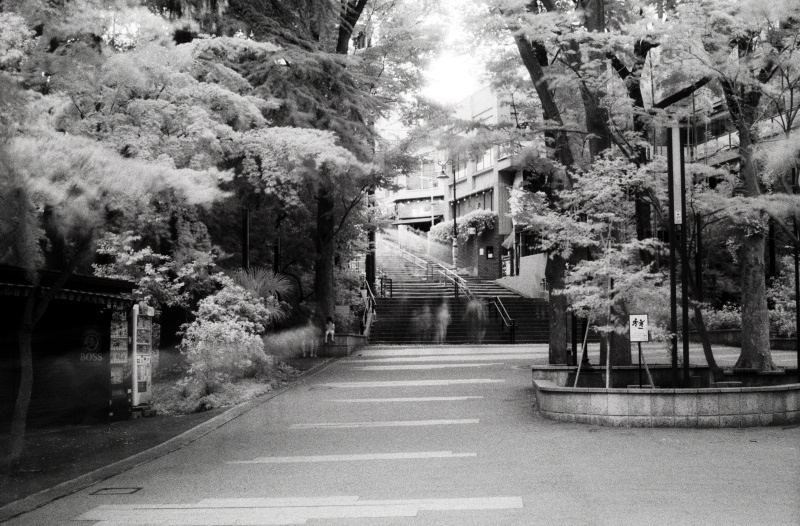
A word for the digital crowd... The R72 Infrared Filter is "a specialized filter used for infrared photography with digital cameras and specialized infrared film". I did try using the filter on my Canon dSLR, but got poor results... It seems to work better with certain digital cameras... it seems that some dSLR users test by pointing and activating a TV remote toward their camera and checking the results (Note 04: at your own risk, this is not a recommendation). For any of you post processors out there, Rock Kenwell has a write up on how to "simulate" the IR effect using software... (Note 05: to be fair the example looked decent enough... but IMO it goes a bit against the grain).
Will I do more testing and/or use IR (extended red sensitivity film) in the future... I have since seen some architecture photos that look very nice... the vegetation pops and the over all effect is very attractive. If I was spending a month or so in the mountains or a remote location I would most likely do a couple of rolls... why not...
Thanks for reading,
Casey
Extended Red Sensitivity Film

Thank you for giving us the technical write up.....
I enjoyed the testing and research ;-)

Fantastic Casey, I looked at the image before reading and said