
SuitbertW
2411

A little bit about the new Patek Philippe "Spiromax?" hairspring....
Hi all,
As already reported Patek Philippe has developed a new hairspring system called "Spiromax".
Apparently this time it's a result of research partners (as already with the silicon escape wheel CSEM) and a cooperation with two other
major companies of the watchindustry (reportedly Rolex and Swatch group or a company which is member of swatch group).
It seems the last years novelty, the first silicon escape wheel for the swiss lever escapement was only the beginning of many more improvements to come. The new hairspring system makes use of the same technology used for prduction of the silicon escape wheel, called DRIE (Deep Reactive Ion Etching). A short description of this method was described here.
For even more information you may also have a look at Ted Diehl's article.
The main advantages of silicon based material and DRIE technique for manufacturing, antimagnetic, very light weight, no corrosion, temperature stability and a highly precise manufacturing method are all the characteristics one would love to have for an ideal hairspring.
However, there is one caveat - although DRIE introduced the "third dimension" for silicon parts (former etching technologies didn't allow for more than a few microns height without loosing precision) which made possible considerable thick parts (> 100 microns IIRC) escape wheel - but an overcoil definetely wouldn't be possible.
Therefore the Patek Philippe research departement looked out for new paths and developed an entirely new hairspring shape - a "one piece" hairspring system with stud, hairspring and collet made up from one part.
When I first saw those patent files last year, it was obvious that there is something going on and we coul await exciting news, but I've to admit that I didn't expect "the ready product" that timely. And as probably in many larger developements, the "large whole" wasn't that obvious as it was split in at least three seperate patent files. I guess it's part of the game, as no company want's to reveal the "real trick" too early  .
.
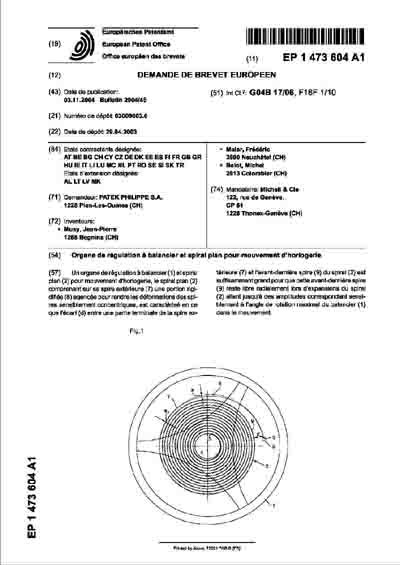
Following the patent files which are already published. The first one is a very elaborat patent file (a real treat for the hairspring maniacs out there ) about a flat hairspring with an outer terminal end allowing for concentric developement throughout the entire amplitude - it may be considered the base for the later patents. Described are different approaches, with or without a sort of "dogleg" but common to all is a specific portion towards the outer end which is slightly thicker - it could be said that this part replaces the traditional upwards bent overcoil:
click for large pic
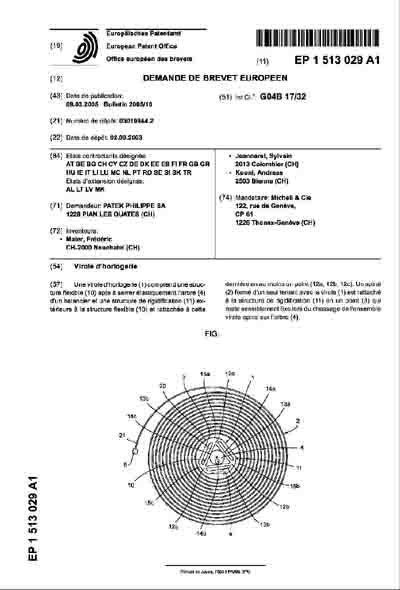
That's the patent drawing describing the silicon collet, interstingly the only patent file explicitely mentioning silicon as material (if I'm not mistaken):
click for large pic
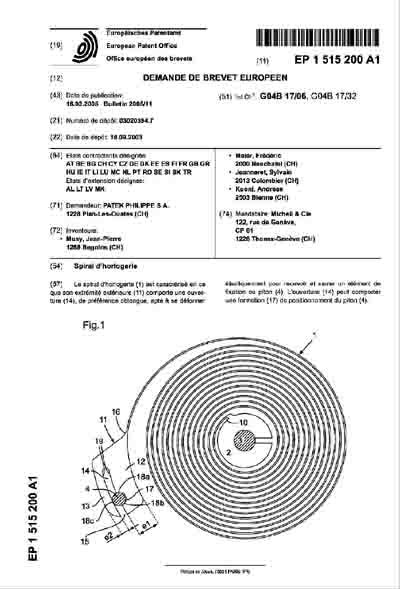
The third part is the outer end fixing device:
click for large pic
One of the main goals for this new flat hairspring was to achieve a concentric developement throughout the entire amplitude (one of the main reasons for a classic overcoil ) to reach the best possible isochronus behaviour.
Appparently the silicon hairspring at the outer end develops towards a stronger, more rigid part, than continuing weaker again towards the end with a sort of "clip" enabling for secure attachemnet to the stud. The inner end, traditionally pinned, crimped or lasered to a collet (with all it's specific drawbacks) is made up of a triangular shaped collet (as said, this is one piece with the entire hairspring as well) with elastic "spokes". This ingenious shape allows an elastic but secure fit without getting in danger of beeing badly centered and thus destroying the poise. Additionally the generally lower weight compared to classical alloys is a great help too - as the contracting and developing hairspring often introduces poise errors as well.
I consider all this new developements as extremely intersting and promising - and again a possibly big step towards real improvements!
I'd like to add a disclaimer here: I don't have any first hand information yet - so please take all this with a large grain of salt and please don't hesitate to correct me if I'm wrong!!!
Best regards
Suitbert
p.s.: And I'd like to add a second disclaimer
-I know UN was the first company using silicon in the escapement part - that's why I chose my words carefully and said "...the frist silicon escape wheel for the swiss lever escapement...".


