Zenith Outsourced Movements Controversy
Discussion

Zenith Outsourced Movements Controversy

By Ornatus-Mundi · Jun 11, 2014 · 30 replies
Ornatus-Mundi
WPS member · Zenith forum
30 replies19464 views0 photos
f 𝕏 in 💬 🔗

Ornatus-Mundi shares a Financial Times article detailing Zenith's controversial decision to outsource movements, specifically the new Calibre 3000 (Sellita SW300). This post sparks a crucial debate among collectors about the implications of a manufacture brand forsaking pure in-house production for growth and broader market appeal. The discussion provides a valuable historical snapshot of a pivotal moment in Zenith's strategy.
30 collectors discussing this on the WatchProSite forumJoin the Conversation →
Dear All:

thanks to my fellow moderator Andrew Daley I can now provide you with an article recently published in the renowned UK newspaper Financial Times. Therein Zenith's global marketing director Juliette North very openly explains the reasoning behind this decision. 

The text sheds some fascinating insights into the circumstances watch brands have to consider in their strategic plans, and also highlights the role collectors - here even called purists - have.

I am reproducing the text here with a view on initiating a lively and mature debate. Please feel free to share your thoughts: Is this an acceptable move for you? Does it hurt the brand'a appreciation? Do you think this could be beneficial since it promises additional revenues without daring excessively on development resources? Do you think other will follow? Etc. - the floor is yours!

Best,
Magnus

"Zenith sacrifices self-reliance to underpin growth
By Robin Swithinbank

In light of the watch industrys continued obsession with in-house production strategies, Zeniths announcement at Baselworld this year that it was forsaking its pure manufacture status by outsourcing movements came as a surprise.

Over the past decade, established watch companies have sunk vast sums into building a self-reliant future, making Zeniths announcement that it is doing the opposite appear incongruous. But the company says the decision is a pivotal part of an ambitious expansion plan that will take it into the mainstream and transform its fortunes, turning it from an insider brand into one of the industry's bigger names.

There are two reasons behind the decision, says Juliette North, Zenith's global marketing director, who spoke to the Financial Times because the companys chief executive, Jean-Frédérique Dufour, is leaving to become chief executive of Rolex. Its important to us to develop the El Primero calibre, which is the backbone of the company. And we want to recruit new customers.

Watches featuring the new three-hand movement called Zenith Calibre 3000 and produced and assembled by Swiss movement manufacturing company Sellita will cost significantly less than those powered by Zeniths in-house equivalent, the Elite calibre. This, the brand believes, will attract new customers and contribute to a spike in sales currently stifled by a lack of capacity.

In the five years since Mr Dufour took the helm at Zenith and following a SFr20m ($22m) investment in the companys manufacturing base, the brands annual output has increased from 8,000 to 50,000 movements a year. About 10,000 of those movements are passed to fellow LVMH Group brands Bulgari, TAG Heuer, Chaumet and Dior. To increase significantly the number of watches it can bring to market, Zenith says it now needs to look elsewhere.

In addition to appealing to a more price-conscious consumer, Zenith believes watches fuelled by Calibre 3000 will draw in consumers less concerned by traditional watchmaking. It means we can talk to customers who may be less aware of the manufacture aspect and care less about it, says Ms North.


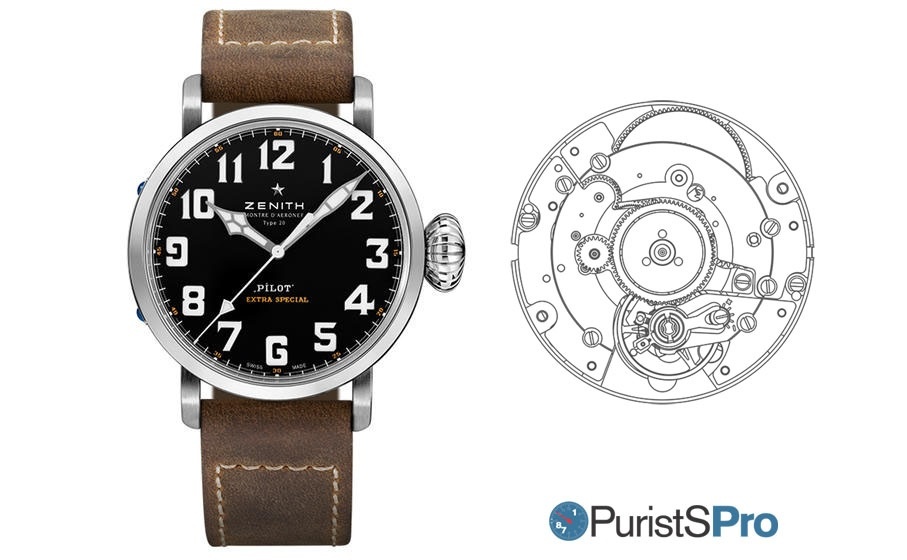
(Zenith Pilot Extra Special with the Cal. 3000 neé Sellita SW300)

Zenith says it is making no attempt to hide the fact the new movement is a rebranded version of Sellitas SW300 calibre, although models carrying Calibre 3000 have solid rather than transparent case backs (another cost-saving measure), and there is no disclaimer on the brands website. Not that Zenith is obliged to declare the genesis of its movements the practice of renaming outsourced calibres is common in the watch industry.

Under the deal, Sellita will supply Zenith with fully assembled movements, which are encased and passed through quality control in Zeniths workshops. Zenith declined to comment on the quantity of movements it has committed to buy, or on how much it is investing in the strategy. Prices for watches with the Calibre 3000 will start from £2,200, some £1,600 less than entry-level Elite models. 

As Zenith looks to pour resources into developing the El Primero, one casualty of the move may be the Elite movement itself. Mr Dufour has been quoted announcing the demise of the calibre introduced in 1994, one of the first in the industry to be designed using CAD technology, but sources have been unable to confirm whether the strategy would be retained by Mr Dufours successor, Aldo Magada, former chief executive of Gucci Group Watches.

Zeniths volte-face may have an impact on its brand positioning and perceptions. Currently, Zenith markets itself as a traditional movement manufacturer that has made more than 600 calibres during its history and been awarded 2,333 prizes for chronometry. At the moment, Zenith is the industrys best-kept secret, says Ms North. Its time for it to grow into a big business.

Her point is not lost on industry observers. Timothy Barber, editor of specialist watch magazine QP, says: Insiders value Zenith as a historic manufacture brand famous for precision and particularly for its El Primero movement. But Zenith has struggled to get that message out more broadly, because it doesnt have the impact of say Omega or TAG Heuer. Its a respectable Swiss brand that is a classy alternative to the big boys, but relatively anonymous. 

So, while watch-educated people may mourn its true manufacture status, they arguably aren't its future core audience. To grow, Zenith needs to reach an audience for whom manufacture status is less of a concern. Much of that growth is expected to come in emerging markets, where accessibly priced, time-only luxury watches are considerably more popular than chronographs. Zeniths Swiss heritage has already won fans in economies where the watch market has experienced rapid recent growth, particularly China, around which the brand has based its pricing strategy.

Mr Dufour saw that Chinas buying power wouldnt last for ever, so he kept prices at a reasonable level, says Ms North. By contrast, some of our competitors are suffering because they put all their eggs in one basket. Going in-house and positioning your brand at double the price point doesn't necessarily succeed. Some have done it and its worked; for other brands, it hasn't, and they're having to bring their prices down.

Zeniths new direction suggests the influence of Jean-Claude Biver, LVMH Groups head of watches and former Hublot chairman, is already kicking in. LVMH hopes Mr Biver can propel Zenith to global recognition as he did Hublot while serving as its chief executive during the 2000s.

Ms North says: Mr Dufour has done a huge job with repositioning the collection, telling people that Zenith exists and taking it back to its true values. Mr Biver is going to add to this, allowing the company to expand. Zeniths status as a traditional or purist brand seems likely to change, but it is confident that in doing so it will become a more successful business. It also believes it wont be the last to adopt the strategy.

Unless brands can produce in-house movements at an affordable price that makes commercial sense to the end consumer, they will have to [follow us], says Ms North." 


About the Antoine Preziuso Concept Ref. 2000

The Patek Philippe World Time reference 2523, launched in 1953, is distinguished by its innovative two-crown system. One crown serves for winding the watch, while the second, positioned at 9 o’clock, controls the city disc. This design marked a significant development in the functionality and user experience of world time complications for the brand.

The reference 2523 was offered in two primary versions. The initial ref. 2523 featured larger lugs that extended above the bezel, with a case diameter of 35.5 mm. A subsequent variant, ref. 2523/1, presented a slightly larger diameter of 36 mm and thinner lugs that were integrated without extending above the bezel. Both versions were powered by the caliber 12-400 HU, which incorporated the world time module developed by Louis Cottier.

This reference appeals to collectors interested in Patek Philippe's historical advancements in complicated watchmaking, particularly the evolution of its World Time series. The distinct design differences between the 2523 and 2523/1, especially regarding lug integration and case dimensions, provide specific points of interest for enthusiasts tracking the model's development and variations.

Specifications

Caliber
12-400 HU
Case
White Gold
Diameter
35.5mm
Dial
Silver
Water Resist.
30m
Crystal
Sapphire

Key Points from the Discussion

Advertisement
The Discussion
BR
brandon1
Jun 11, 2014

Very interesting read; thank you for sharing! I think the last line is particularly interesting; the suggestion that we may begin to see more brands stepping 'down' to sourced movements, in order to evolve to face the new economic realities of the industry. I think this will be a very interesting period in the industry to watch, and has probably been some time in the making. Personally, I find it sad that so many enthusiasts and collectors place such an emphasis on in-house production, almost as

DO
DonCorson
Jun 11, 2014

As I see it, there are at present only two high end industrial watch companies (Swatch Group and Rolex). The rest are more or less boutique marketing houses, especially LMVH. Why Zenith can't sell more than 30'000 watches a year is a mystery. Do they get no support from LMVH? LMVHs specialty is marketing and Zenith has every charactoristic that should allow them to tell a good story to grab those sales. What Mme North is saying is that Zenith can niether make nor sell high end watches in big qua

AA
aaronm
Jun 11, 2014

I entirely understand why, if they want to expand the brand, they need to have a lower entry-price and to achieve that, they must forgo the in-house movements. What I am less clear on is the need to expand the brand. They're not a small company, or even part of a small conglomerate like they once were. LVMH is a massive behemoth. Do they really need every one of their brands to cover every market space on every continent? As Zenith already has enormous value to the company for movements for the

MT
MTF
Jun 11, 2014

Dear forumners, What's the problem? This is the natural cycle of time in the watch industry. By the fact that some people are complaining shows how "young" today's consumer or collector of mechanical watches are. Even our more senior members remember buying quartz watches with first pay check....not counting the children with trust funds who bought their own watches before 1970 At the dawn of time, every watch was "manufactured" by one watchmaker or assembled in small batches in Geneva through S

SP
Spellbound
Jun 11, 2014

Zenith has decided to turn its back on it's loyalists. It would be fine if these moves would be accompanied by moves to make the best possible watch and to innovate. I have no issue with outsourcing so long as this is reflected in the price and they do not make a move to completely outsource. I have more issue that Zenith is becoming Biverised. A marketing circus utilizing cheap (but expensive) tactics to increase sales. Yes, I do expect Zenith to continue to create showpieces that are incredibl

F_
f_klo
Jun 11, 2014

I can't say that Zenith's decision to start using outsourced movements is the wrong direction for the brand as it is still too early to tell. But I must say that the "Pilot Type 20 Extra Special" a bad start. Here's a few classic examples why. 1. Customer walks through the door and likes the Pilot Type 20 EXTRA Special and asks the dealer "Whats so 'special' about this Pilot Type 20?" The dealer then replies "Its the first watch we outsourced the movement". 2. You wear a Pilot Type 20 "Extra Spe

Advertisement

Continue the conversation

This thread is active on the Zenith forum with 30 replies. Share your knowledge with fellow collectors.

Join the Discussion →