Ornatus-Mundi provides an in-depth look at the Zenith Heritage 146, a watch that signals a new direction for the brand under Jean-Claude Biver's influence. This review meticulously details the watch's design elements, from its vintage-inspired aesthetics to the technical prowess of its El Primero movement. The author's detailed observations offer valuable insights into Zenith's strategy of blending heritage with contemporary appeal.
Probably the first stressable glimpse into Zenith 4.0 *), aka the Biver-era, is the new
Zenith Heritage 146 series of watches, which look fresh and at the same time so well-known (for several reasons, see below ;-)):

The Heritage 146 is an
étude in simplicity, largely characterised by a sunburst-finished dial, a permanent seconds hand with a crossed scale, a 30 min counter and a tachmeter scale around the dial. Hands are elegant leaves, which affords the pieces their difficult to resist vintage 1960s charme. The watch comes in a very much vintage (but highly welcome by collectors)
38mm stainless steel case.
Zenith offers two versions of this watch: blue and brown:

If a watch is meant to attract with elegance, thus implying restraint and simplicity, the details need to be perfect for the watch to convince. In my view, Zenith did a great job here:

First of all, the sunburst finish is an excellent starting point as it brightens the inherent restraint of he design with its countless variations painted by light.

It is not only that different structures are revealed, also the colour
meanders between a cold clayish (above) and warmer chocolate-coloured
shades (below):

The outer tachymeter scale acts as a nicely designed and actually quite useful element that in my view references the good old days of gentlemen drivers, a nod which is also reflected by the new calfskin strap with its motor-racing inspired punched holes:

The Heritage's dial is flat, complemented with indices of a simple rectangular shape. These rather basic profiles are a prerequisite for the sensual baton-shaped hands to unfold their full potential, and to act as effective counter-points. They are not only highly polished, but in addition rounded on the top surfaces. Thus, they stand out not only because of the way they are sculpted, but also in they way they model light. They simply have a different quality compared to the indices, for example.


The watches are powered by the El Primero Cal. 4069, the chronometer-grade version with two counters (lacking the hours counter) and without date. Note that the watch in the picture is a prototype with a completely wrong inscription...

Blued screws (some of them) and a blued column wheel:

The Heritage 146 watch sits superbly on the wrist, with a wonderful presence, extremely nice proportions (also thanks to the rather modest 38mm case), and tiny bit of quirkiness imbued from the very differing subdial design:


The second version is then the same watch in blue, down to the strap.

Like its brown sibling, the blue may assume various shades of its colour:


It certainly has a cooler presence on the wrist


Well then, the new Heritage 146 cannot be appreciated without a discussion of the distant and the closer history of this watch. Certainly, the inspiration of this piece comes from a series of rather popular (at their time) two-register chronographs from the 1950s/1960s, all of which were driven by the sought-after Zenith Cal. 146D. Below is a speciment (image taken from the web):
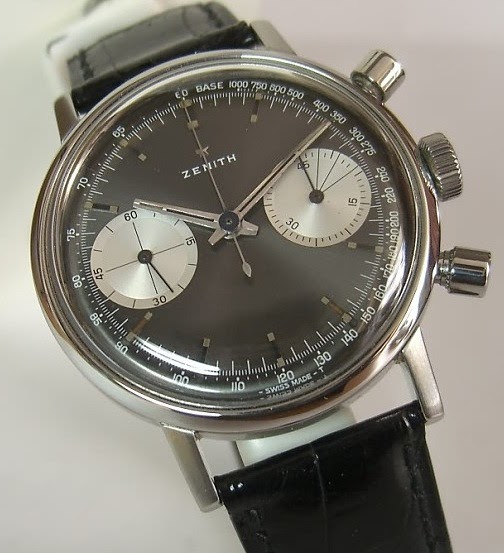
These watches came in a broad variety, particularly when it comes to the shape of the hands. They are beautiful but under-appreciated within the collector's scene, making them a bit of a sleeper.
Watch blog
Hodinkee was aware of the potential, and inspired Zenith to create a very limited series of 25 pieces for them with a grey dial. It differs from the now presented Heritage 146 in the design of the subdials, a chronometer inscription, as well as a slightly thinner crown.
Here is a group shot comparing the watches (note that the Hodinkee watch to the right is a prototype which had the brushed finish on top the lugs polished away):

Now, certainly there was - even on this forum - a vivid discussion on how and how much Zenith was riding on the seemingly "flying-out-the-door" sales of the Hodinkee watch. Jean-Claude Biver is not shy of clear statements, and put it quite frankly and open:
"When the Hodinkee watch was developed and from 1st second on, it was not really clear that we would do another variation. But from the 2nd second (once we saw our first drawings and prototypes) we knew that we would have to come up with a similar design where "less is more" would be best expressed and visible.
So one can say that the merit of the Hodinkee watch was the fact that it gave us the courage and the input to go ahead with a "less is more" concept."
That should put the discussion to rest: yes, without the Hodinkee watch there would be no Heritage 146 collection. Yes, Zenith very early on realised the potential and decided accordingly; and I for one would be very surprised if they did not share within the discussions.
Reference: 03.2150.4069/51.C805
Best,
Magnus
_________
*
Zenith 1.0 - foundation until late 1990s;
Zenith 2.0 - the Thierry Nataf era;
Zenith 3.0 - the Jean-Frédéric Dufour era;
Zenith 3.1 -
the Aldo Magada era;
Zenith 4.0 - the interim JCB era


