Ornatus-Mundi provides a hands-on review of the Zenith Defy Classic with a blue dial, positioning it as a 'hidden gem' from BaselWorld 2018. This article delves into how Zenith is expanding its Defy line, offering a more refined and elegant option that bridges the gap between the avant-garde Defy 21 and the brand's classical offerings.
With the Defy Classic Zenith not only added an interesting entry level watch to the Defy line, the brand also voiced a clear message that it intends to expand 'Defy' into a veritable collection: the modern, avantgarde face of Zenith. During Baselworld, Zenith showed us two versions, a modernist skeletonised version with tremendous visual attraction, and a more refined, elegant blue watch with a solid dial. Whereas the former is a logical talking piece, combining solid watchmaking with the modern, expressive face in line with the Defy 21 (or the Defy Laboratory), it is the latter which acts as bridge to the more classical remainder of the Zenith collection.
Reason enough for me to take a closer look at the blue model:
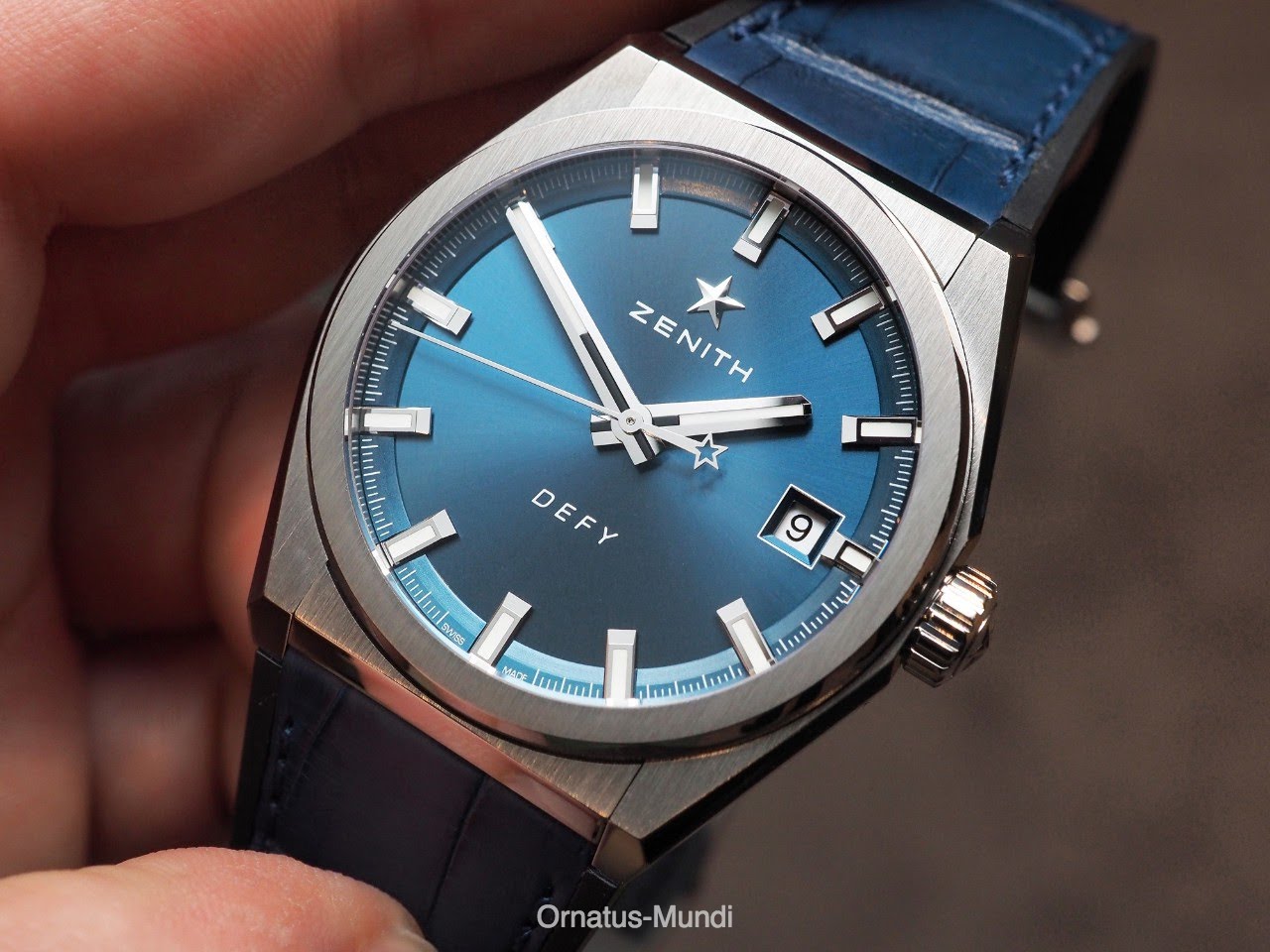
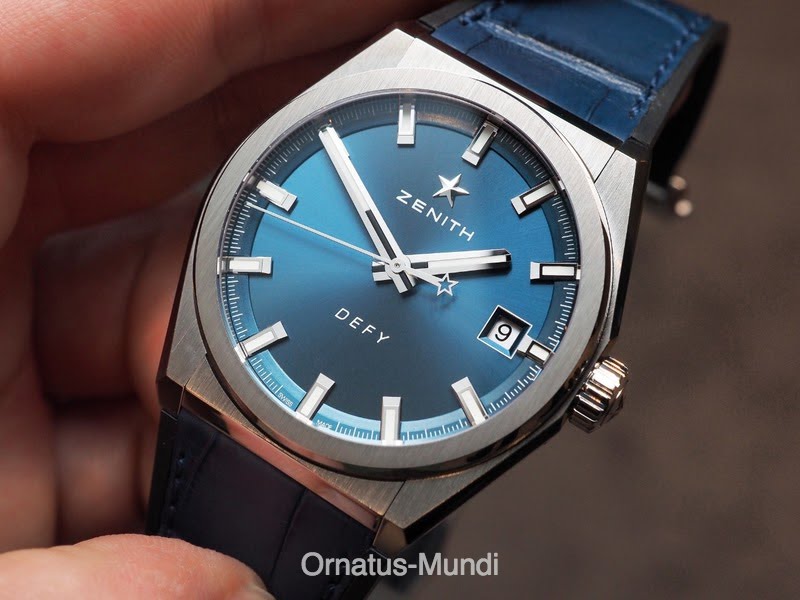
In this watch Zenith has complemented that bold case of the Defy line with an equally punchy, but carefully considered face: You find only few design elements, essentially those you need in a basic time-only watch (indices, hands, date window):

Mounted on top a sunburst-brushed blue dial plate, the Defy Classic sports the typical Zenith-style applied indices, which are nicely 3D sculptured. Compared to their Chronomaster line they lack the additional lume spot in their inwards side, thereby emphasising the massiveness of the indices without requiring any unnatural heft.
Time is read by a pair of corresponding solid hands with aptly chosen lengths. Again, these are typical Zenith hands easily identified by the top finish: from the centre we find a long black followed by an even longer luminous insert, topped off (pun intended) again by a black dot. This layout has historical roots with the brand.
For a watch intended to please a broad market range it seems that a date window is necessary. I personally would have preferred a more subtle implementation, at a different location (perhaps between 4 and 5 o'clock?), but Zenith certainly has done a good job here: the window is located fairly to the outside of the dial, with a shorter 3 o'clock index to set this of. As we shall see further down, a date window is also historically correct for this model.
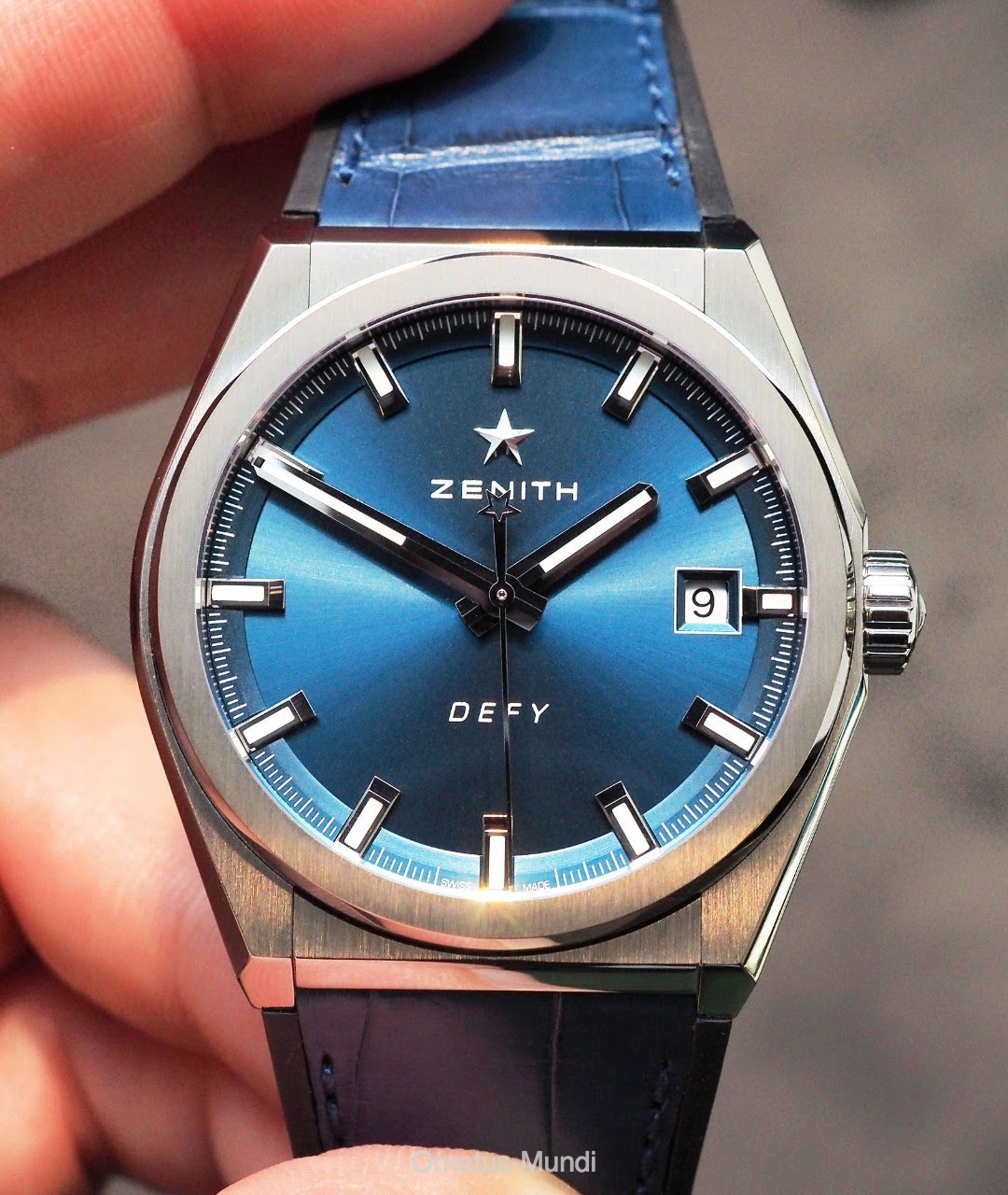
Getting a bit closer I'd like to highlight the dial construction and quality. The indices are diamond cut and tack-sharp, and offer a pleasant contrast to the shiny and brushed dial plate.

There are two Zenith stars on the watch's face: one applied to the dial itself, the other integrated into the seconds hand. Both display different and complementary reflections of light: one highlighting the topology, the other the shape of the star:
Please note that the serial production model won't show the 'Defy' printing!
Now let's take a look at the 41mm case, modelled as a vertically stretched octagonal case with a round bezel, crafted in brushed titanium (grade 5, of course)...
... and with an appealing juxtaposition of brushed (vertical and horizontal surfaces) and polished (angled surfaces) finishings:

The profilie of the case is nicely thin (unfortunately I do not have the exact values, but a side view gives a clear impression):
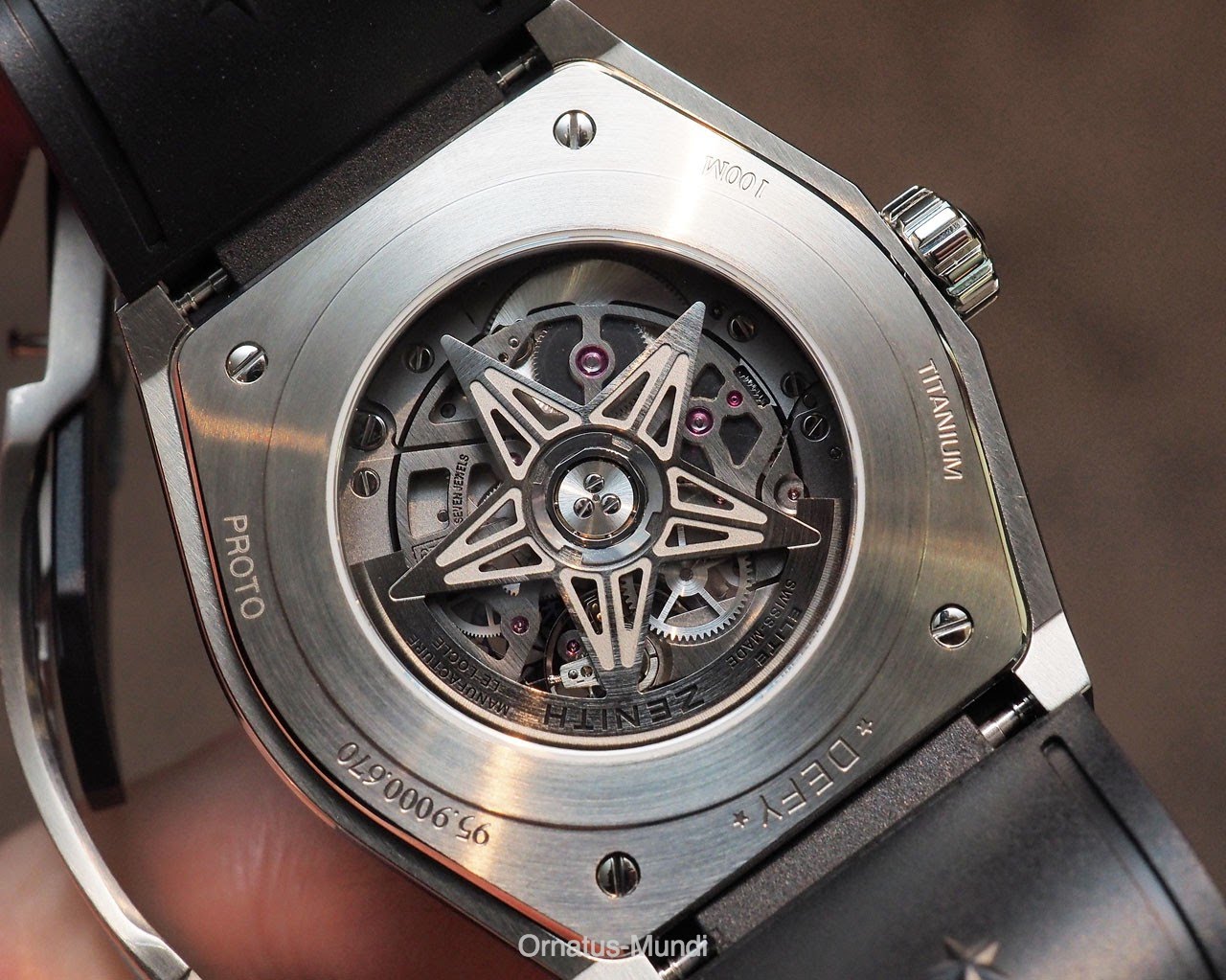
Of course, for a manufacture like Zenith an in-house manufactory movement is (almost

) mandatory. Zenith does not disappoint and equipped the Defy Classic with a modernised version of its famous 'Elite' movement, now with a silicon escapement system (pallet and escapement wheel) and a new movement number:
Elite 670 SK. The bridges are partially openworked and redesigned to match the contemporary case design. Its almost monochrome appearance nicely spotlights the (large) rubies:
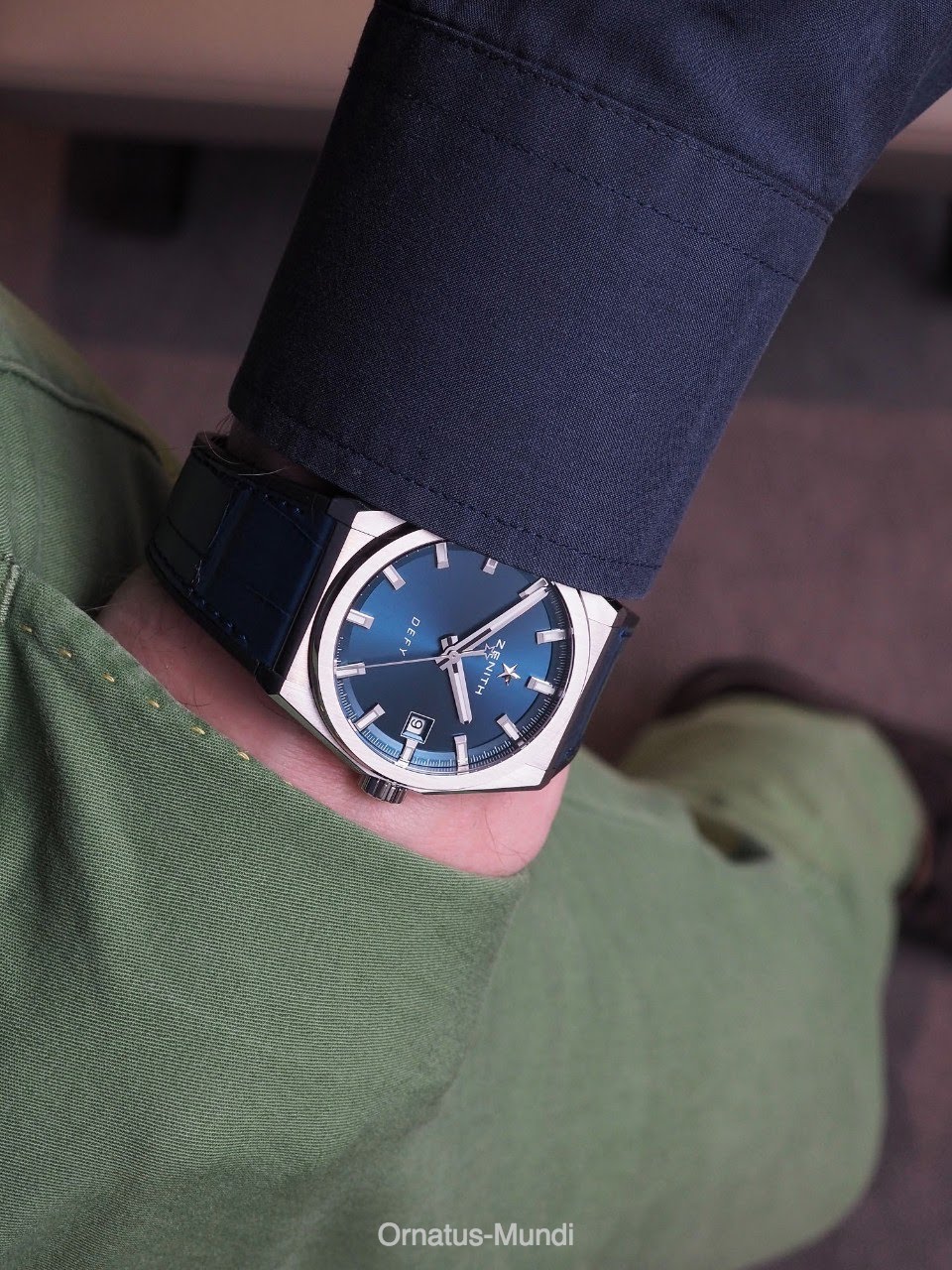
Now, on the wrist. Recall that the Defy Classic comes in a 41mm case, but its tense and bold layout belies the size: it wears smaller, like quite a number of contemporary Zenith watches (our own PuristSPro-15 watch included).
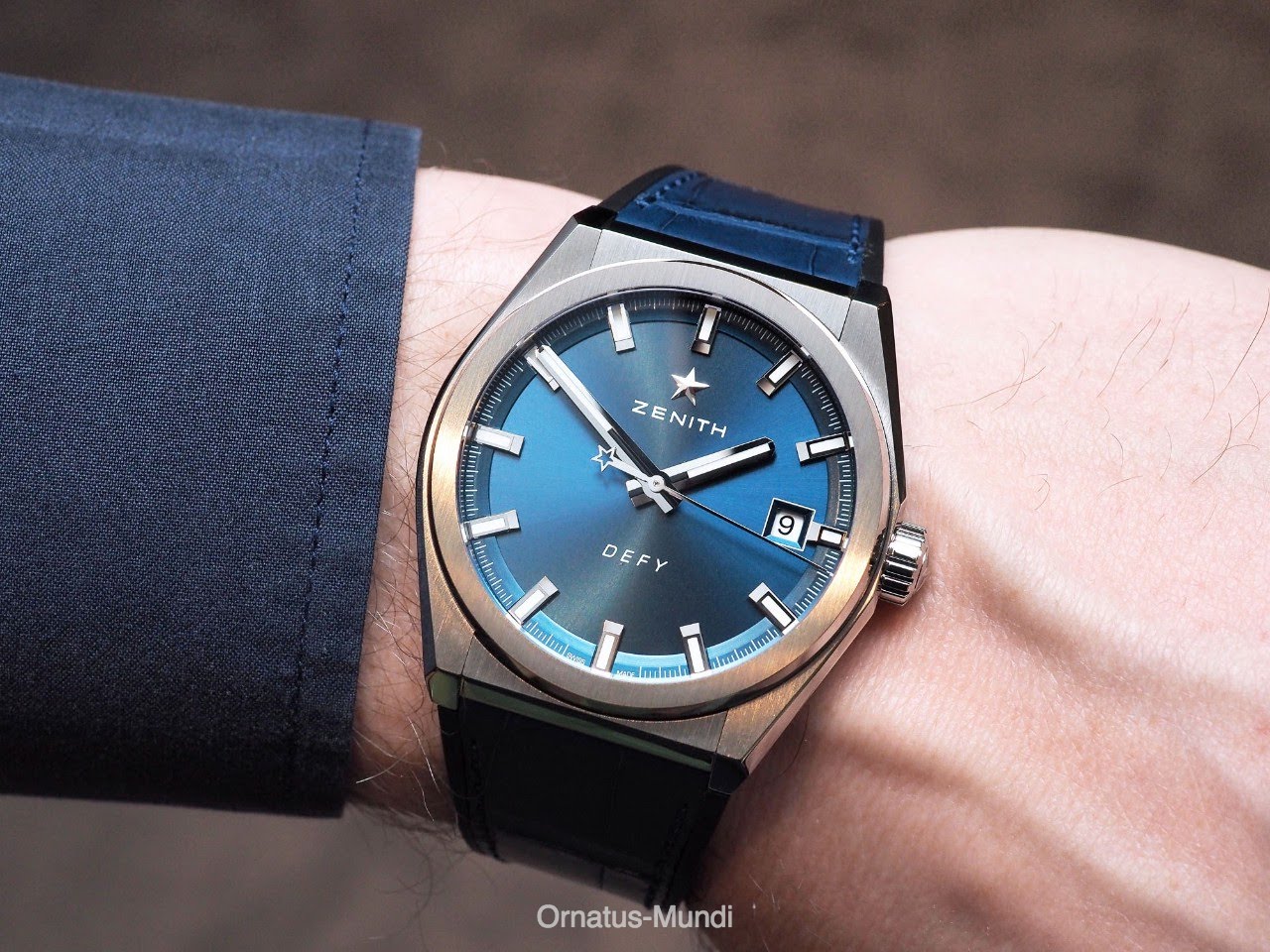
Its slimness makes for a very sexy wristwear:

Zenith's Defy collection has been met with enthusiasm (particularly by the market), but also with criticism: too close to Hublot, the 'Hublotisation of Zenith' seems looming. And then there is this name... 'Defy'... Well, here is my take:
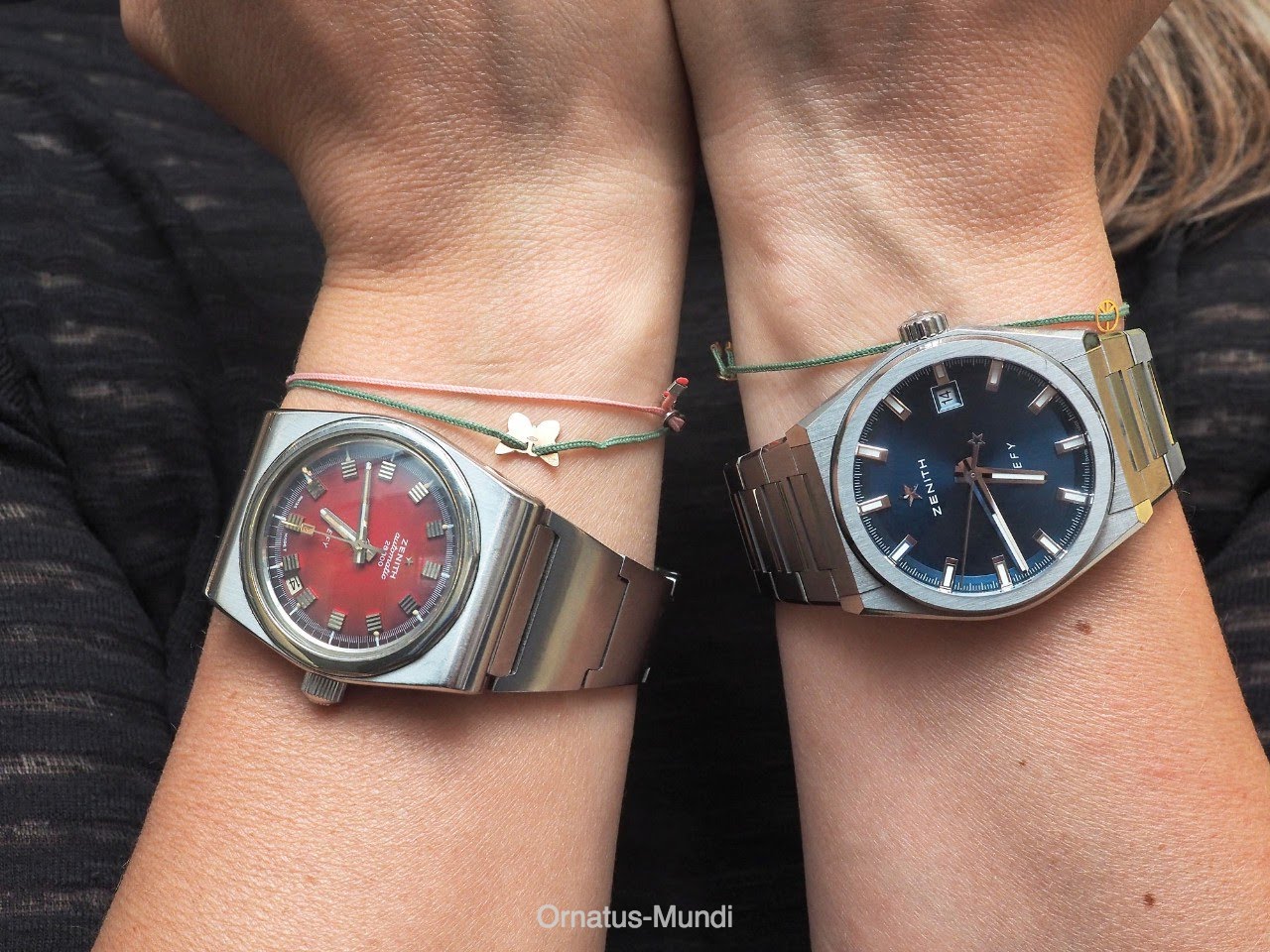
The Defy collection has its firm place in the more recent history of the Zenith brand. It came in the 1970s, when the typical design language of this era was flying high. Zenith for sure did contribute. The historical 'Defy', here two examples framing this year's version (left, an 'AFP' (“Alta Frequenza Precisione”, this watch came with a 36.000 vph movement Cal. 405!) with an automatic day-date movement, right, a vintage Defy with its original bracelet), came in a bold case, with an equally characterful dial design: note how conceptuallly similar the vintage and the modern versions are, down to the dial sections (note: outer rim!), the indices, hands, the date frame - and even the (large and rounded) crown!

In this context, the modern Defy is clearly following an established and
increasingly recognised (by collectors) family tree. One could debate
the choice of 'Defy' as the continuing family name, as particularly the
English speaking amongst us might smile. Zenith indeed may have had
second thoughts after launch and subsequently removed the name from the
dial (regrettably, as far as I am concerned).
In essence, in my view, the Zenith Defy is an avantgarde daily wearer, right up there with the likes of a Glashütte Original Seventies. It may never earn the allure of a Patek Philippe Nautilus or the like, but it has immense intrinsic qualities, flawless workmanship, combined with a longstanding pedigree which still needs better exploitation.
The Defy has all qualities which would make it an apt choice as the only watch to take on an extended trip: style, reliability, chronometric performance, technical qualifications. And this is exactly the scenario where the blue version with its solid dial outshines its skeletonised sibling!
Thanks for reading,
Magnus