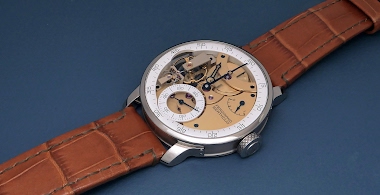
Emmanuel, known as quattro on WatchProSite, delves into the often-overlooked artistry of click springs, a small yet vital component in a watch movement. His detailed exploration highlights how these functional elements are transformed into miniature sculptures by master watchmakers. This article showcases Emmanuel's passion for the intricate details that define high horology, making a compelling case for appreciating the hidden beauty within a watch's caliber.
In some of my previous threads, I've highlighted this
small, but
crucial and sometimes wonderfully beautiful
component of a watch's movement.
The click is a pawl often shaped like a beak or as a cam with two tips. It's held in tension by a spring that forces it against the ratchet wheel of the mainspring barrel or intermediary gear, preventing the mainspring from unwinding.
The click and its dedicated spring are often two distinct elements and they aren't always visible. But it also happens that the click is somehow integrated to the end of the spring.
So, let's have a look at some wonderful
clicks and
click springs (during my research for this post, I found this article by
Ryan Schmidt on Quill & Pad, which has helped me a lot).
Best, Emmanuel
1/ GRAND SEIKO, ref. SLGW004 (dedicated thread
here)
The click of calibre 9SA4 is shaped like a wagtail bird, a tribute to the bird native to the area where the GS Studio Shizukuishi manufacture is located.
In a video at the end, you can see the click in action.


credit: monochrome & wikipedia (Japanese wagtail -
Motacilla grandis)
2/ YOSUKE SEKIGUCHI's PRIMEVÈRE (dedicated thread
here)
Like in the Jules Jürgensen pocket watch calibers which served as a source of inspiration, the blade click spring has an omega shape and the click is an invisible pawl finger placed at the end of the blade.


credit: hodinkee (1 & 4), Sjx (2-3) & personal photo
3/ XHEVDET REXHEPI'S Minute Inerte (dedicated thread
here)
The shape of the click spring is directly inspired by the segmental pediments found in the Tribuna room of the Palazzo Grimani di Santa Maria Formosa in Venice.


credit: hodinkee (1, 2 & 5) @Xhevdet Rexhepi (3) & artsupp (4)
4/ PHILIPPE DUFOUR Simplicity
The click spring is designed like a ”cutthroat razor”.


credit: quill & pad (1-3 & 6) & the naked watchmaker (4-5)
5/ LAURENT FERRIER Tourbillon Double Spiral, ref. LCF001.G1.D2AG
Another example of crossbar or long blade click spring in this calibre LF (or FBN) 619.01:


credit: hodinkee
6/ AKRIVIA AK-04 Tourbillon Regulator
Here, the spring is anchored on the right, reaching the click on the left across the top of the movement.


credit:esperluxe
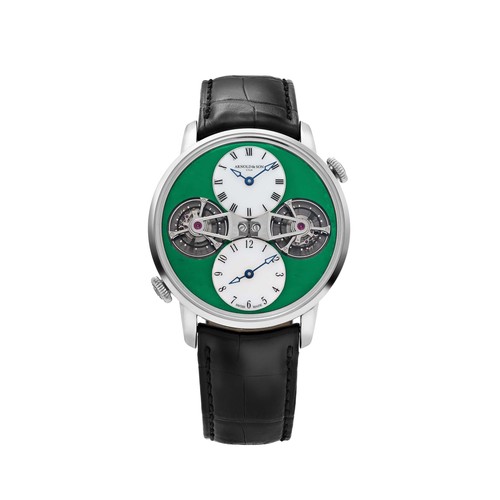
7/ ARNOLD & SON Double Tourbillon Escapement, ref. 1DTAW.S01A.C121W
The click spring of the caliber A&S8513 is designed like an ouroboros (ancient symbol depicting a snake or dragon eating its own tail).


credit: watch collecting lifestyle (1 & 4), deployant (2) & Wikimedia (3)
8/ GREUBEL FORSAY Signature 1
Here, the click is ingeniously concealed in the tripod bridge of the barrel.
In a video at the end, you can see the click spring in action.


credit: hodinkee
9/ JAEGER-LECOULTRE Duomètre à Chronographe, ref. 6012521 (aka: Q6012521)
With caliber 380A, things gets complicated because the movement has two independent mainsprings (each located in its dedicated barrel) coupled by the same manual winding transmission (through one single crown) to power two independent complications (hours/minutes & chronograph). To charge one mainspring you turn the crown clockwise, to charge the other you turn it counterclockwise.
So, in order to achieve such a transmission that can wind in both directions, while not unwinding in either, each winding wheel has not one but two complementary or twin “passenger” clicks, each held in tension by the spring of the other.


credit: a blog to watch
10/ KONSTANTIN CHAYKIN Cinema, ref. K200PT0A05LS
Like the caliber of the JLC Duomètre, the caliber K.06-0 has two winding barrels, one for the zoopraxiscope module (which, at the bottom, provides animated images of a galloping horse) and the other one for the movement of the minute and hour hands at the top.
In a video at the end, you can see the zoopraxiscope in action.


credit: watch pro (1 & 4) & a blog to watch (2-3)
11/ PHILIPPE DUFOUR Grande Sonnerie Pocket Watch n° 1 (an in-depth analysis by JX Su can
be found here)
Last, but certainly not least, here's another example of twin-train masterpiece with twin "passenger" click springs reminiscent of a "double-ouroboros".
In a video below, you can listen to the watch chiming.


credit: Sjx (except for the two dragons eating each other's tails: line engraving from Abraham Eleazar's 'Uraltes Chymisches Werk,' Leipzig, Germany, 1760)
VIDEOS