Cazalea delves into the often-overlooked details of watch case construction, expanding on his 'I've Got Your Back' series. This installment explores the diverse materials used for watch cases and backs, and the various methods employed to achieve different aesthetic and protective qualities, from solid metals to intricate plating techniques. His insights highlight the engineering and material science behind watch durability and appearance.
Thinking last night about what I have missed in this series, I came up with nothing. But Christmas shopping for watches on the web reminded me of some details that were not discussed.
Many different materials have been used for a watch case - aluminum, bronze, carbon, ceramic, gold (pink, red, white, yellow, "Magic"), palladium, plastic, platinum, stainless steel, tantalum, titanium, tungsten, Wolfram...
Some of these materials can be "colored" by adding a plating of a different material. Or they may be hardened by treatments that make them more resistant to scratching. The backs are usually NOT treated in the same way for reasons having to do with cost, efficiency of threading and unthreading the back, expansion-contraction, etc. Here's a black Sinn with silver back.
Sometimes watches could be considered as a "sandwich" of differing metals. Here's a new Chopard that has a steel bezel, titanium case, and steel back.
Proving this is not a new concept, here's an old Gerald Genta of mine, with Bronze bezel and case, black rubber and composition gaskets, and steel back.
Nowadays we tend to forget the once-popular "pot metal" or "base metal" aka inexpensive metal alloy that was used to make cast watch cases. Stainless steel snap-on backs were most commonly used with this material - the base metal case could corrode away from skin oils and sweat, but the watch caseback would not. I can think of a half-dozen watches that my Physical Education teacher/wife has destroyed this way during her tenure on the athletic fields.
A step up in the pecking order is the solid stainless steel case, but another option for a nicer look is to provide a gold look without the cost of real gold. We have had many different technical approaches to this:
- Gold plating is a method of depositing a thin layer of gold onto the surface of another metal, most often copper or silver (to make silver-gilt), by chemical or electrochemical plating.
- Gold-filling is a solid layer of gold, which must make up at least 5% of the item's total weight. It is mechanically bonded to sterling silver or a base metal.
- Rolled gold plate/gold overlay are equivalent terms which may be used if the layer of gold constitutes less than 5% of the item's weight.
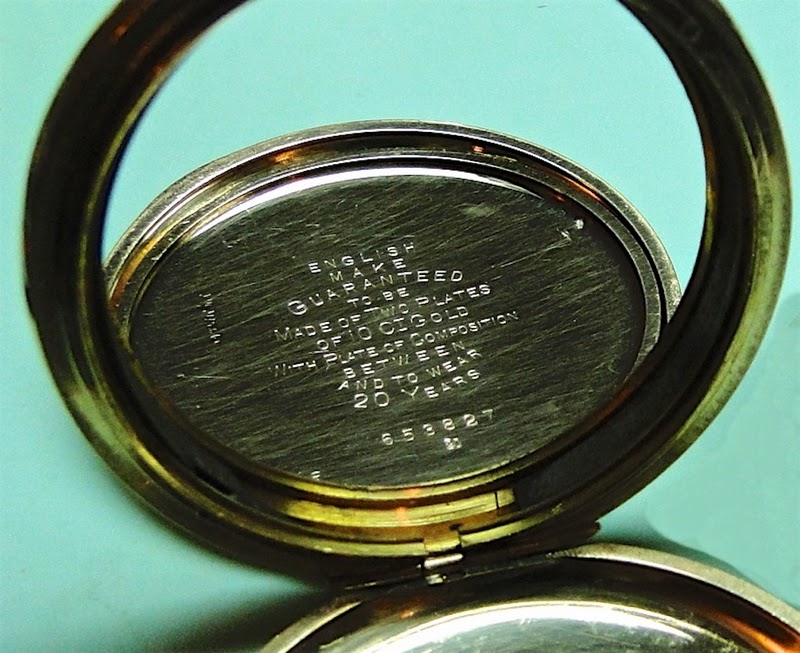
Notice the writing inside this pocket watch case (photo used earlier in this series). It says 2 plates of 10K gold with a plate of base metal in between and thick enough to be guaranteed for 20 years of wear in a pocket.

Here are three watches from an auction website. The first is a Grand Seiko. As you look at the edges, you can clearly see the gold cap which has been overlaid on the steel case. Notice the corrosion below the cap, on the edge of the steel.

The next photo is a Rolex with gold cap. If you look below the strap, inside the lugs, you can clearly see the seam of the cap against the stainless steel case. This cap is more securely fastened along the edges.

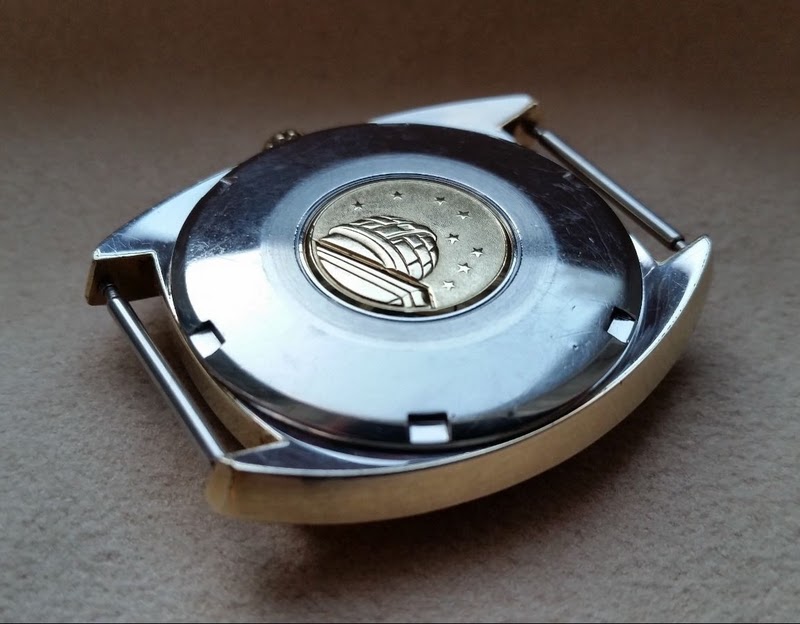
Finally, here is a gold-capped Omega Constellation. You can see the join along the edges. To make things even more complicated, the caseback (on this gold-capped watch) is "gold-capped".

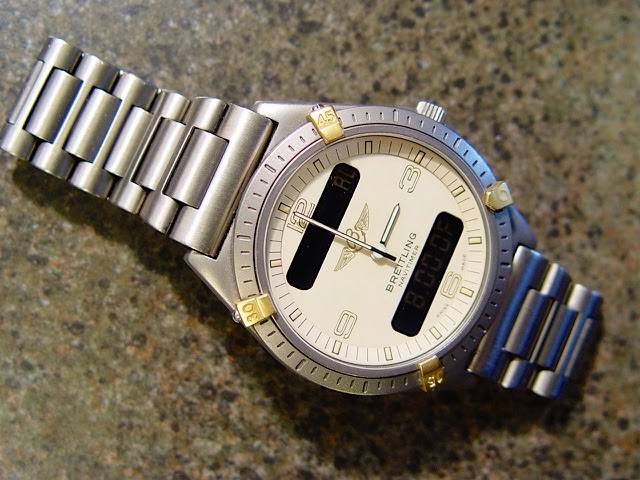
Of course there are other gold items that appear on a watch case, such as the crown, or gold bezels on Rolexes, or gold rider tabs on Breitlings, and other sorts of trim pieces. But we are only concerned with what we see on the backs of our watches...

This Girard Perregaux has a plastic crystal back which seems invisible.

and my Record has a virtually invisible back as well.
Thanks for reading along on "I've Got Your Back".
Cazalea