
Review
Dr No's 'on-the-wrist' appreciation of the Omega Aqua Terra Teck Annual Calendar offers a refreshingly personal take on watch evaluation. Eschewing traditional objectivity, Art Dakessian shares his genuine fascination with Omega, providing insights into the brand's commitment to technical excellence and value. This article highlights the importance of real-world wearability and personal connection in understanding a timepiece.


An "On-The-Wrist" Review of the Omega Aqua Terra Teck Annual Calendar
By Art Dakessian
This report of the Omega Aqua Terra Teck annual calendar begins with a digression: I feel more comfortable labeling my comments as an 'appreciation' rather than a 'review' because a review should be exhaustive, detailed, and most importantly, objective. These elements are missing here, partially because of the limited resources and capabilities at my disposal; I'm neither a watchmaker nor a photographer, so an in-depth examination into the mechanics of the movement isn't in the cards. Nor can I claim to be objective, as I've remarked on at least a few occasions about my interest in and fascination for Omega . . . their history and tradition, commitment to consistently providing both technical excellence and value (both intrinsic and relative) to the watch-buying public, and the enormous breadth and depth of their product line marks them as a manufacture par excellence, imho. I've owned a few vintage Omegas, this Speedmaster Mk II,
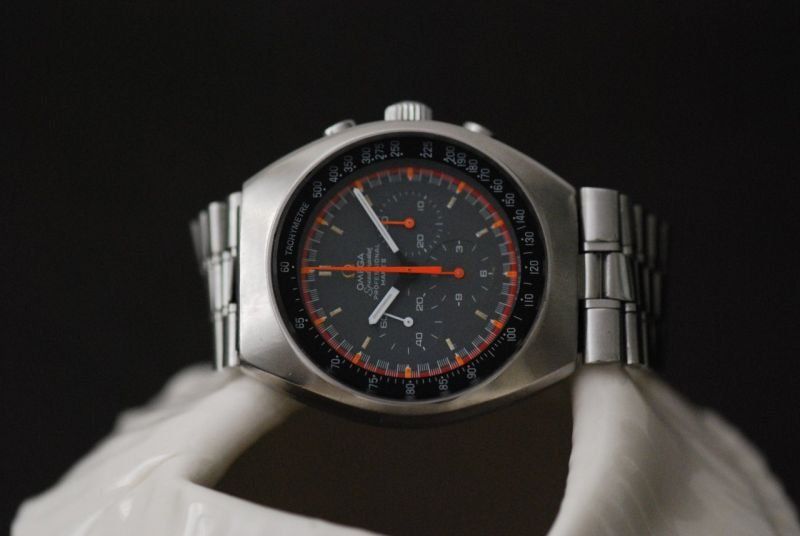
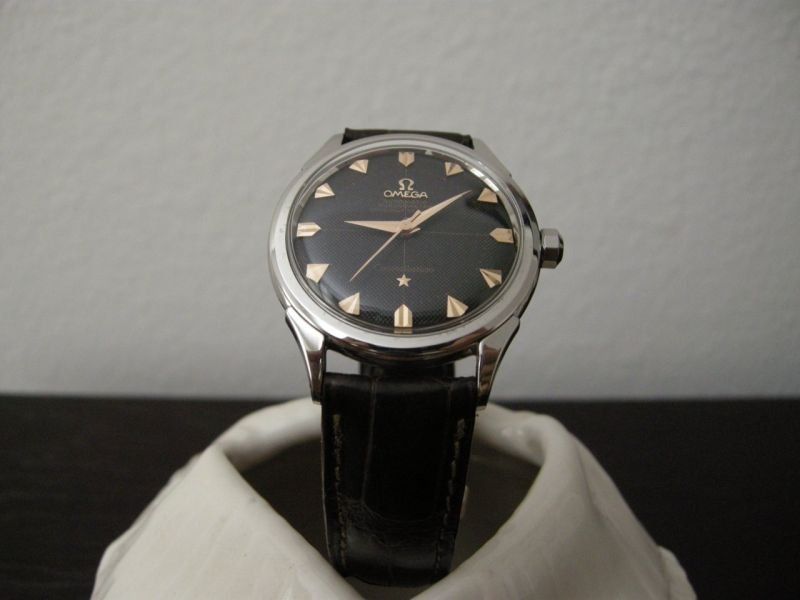
which now graces the wrist of a fellow Purist, and currently a '57 Constellation:
As for current production, however, I haven't taken the plunge yet, even though there have been several models over the past few years that have caught my imagination, like the Constellation Double Eagle Mission Hills chronograph, a few limited edition Speedmasters, the 1948 Centenary, and above all, the automatic version of the Railmaster. The fascination these watches hold are partly due to tradition and aesthetics, but my underlying interest over the past several years has been primed by the exclusive co-axial escapement that graces many Omega automatic movements (and a few manual-winding models as well).
Simply put, there has been much favorable anecdotal evidence from both public and private sources regarding the performance of Omega's movements so equipped. Of course, I could've just bought one to find out for myself, but the model that most captures my imagination, the Railmaster, hasn't been fitted with the latest incarnation of Omega's movement technology yet. Rather than wait, I decided to ask Greg Swift, President of Omega US, for a review sample of another model that has also captured my interest, the new Aqua Terra Teck. Greg affirmed his willingness to offer one, and several weeks later, I received an e-mail from his assistant to the effect that the AT Teck in steel was unavailable, but would I mind borrowing the Annual Calendar model instead? "Alacrity" is the first word that came to mind!
Anthony handed it off to me seven weeks ago, and I've been wearing it (almost) daily ever since, so I've got a few observations and comments to make. Unlike previous reviews, this one will be subjective, and I'll preface my remarks by acknowledging in advance that I'm partial to the design
So, what is an Aqua Terra, and why an Aqua Terra? The first question is fairly simple as a translation of the name provides a description of intent: Sea Land conjures an image that has roots in nautical watches melded with the simpler technical requirements of a watch that will likely never be used in a harsh marine environment. In short, a practical dive watch for normal everyday use, meant for the vast majority of guys who might venture into a swimming pool or the beach but rarely, if ever, go snorkeling or diving. It's a mystery that so many of us are willing to spend vast sums on watches designed for a specific purpose that will never be used in their intended capacity. Cool, yes . . . useful in any practical sense, probably not. My sense is that the Aqua Terra line is geared towards that segment of the public that appreciates the essence of nautical inspiration but without actual need of the technical requirements inherent in such designs. In other words, a guy like Purist Joe Za, seen here with #1 on his shoulders:

Joe has a vintage Seamaster 300 on his wrist and a vista of land and sea behind him . . . the perfect backdrop for an Aqua Terra!
Anthony had told me the AT arrived in a Fed-ex package, but I was still astounded at the negligible protection the shipping department provided - the watch was ticking away in a plastic container not unlike the blueberry containers you'll find in a grocery store, and the package was a standard express envelope with only one layer of bubble wrap. If Omega was trying to send a subliminal message about how tough the Teck is, they succeeded big time!
The very next day I went to get the watch sized; a friend in the jewelry trade spent half an hour sizing and adjusting the bracelet:
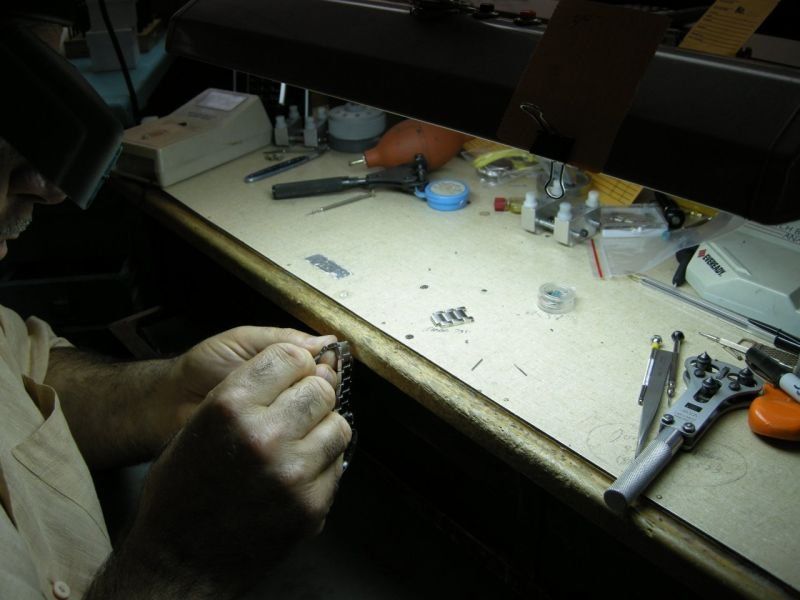
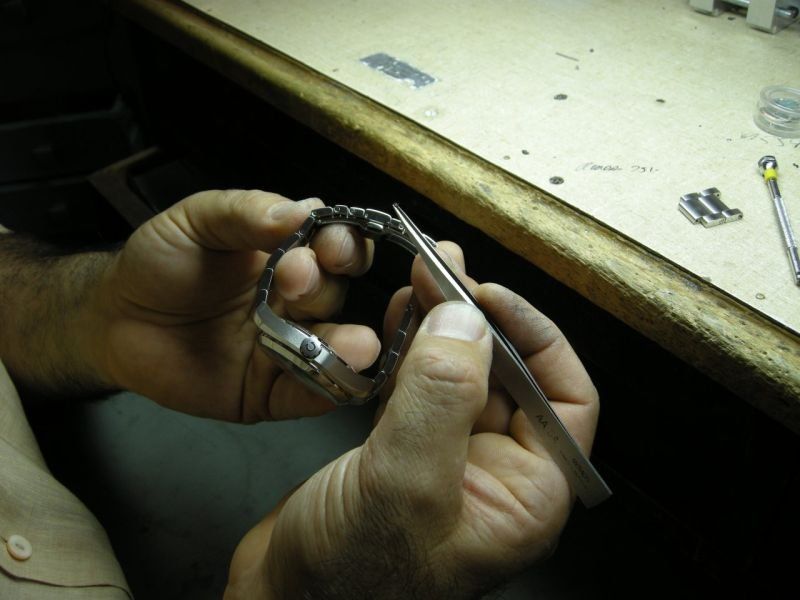
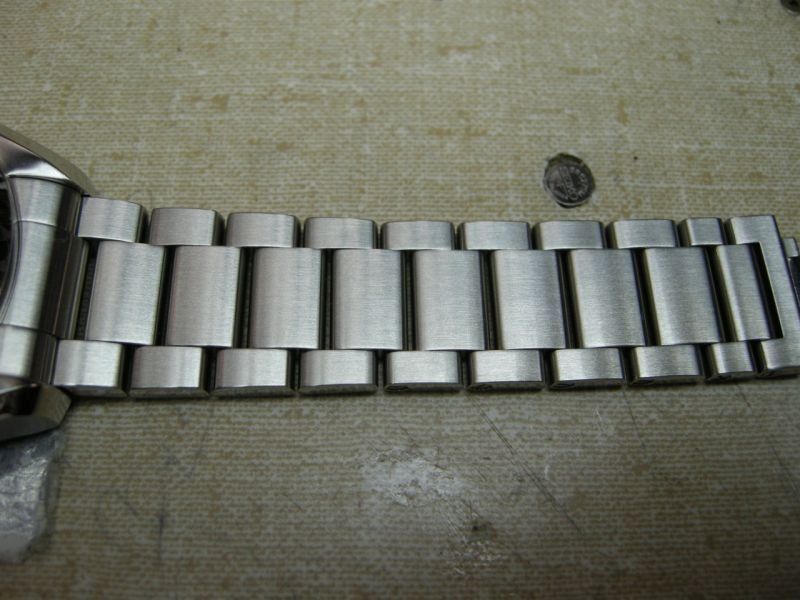
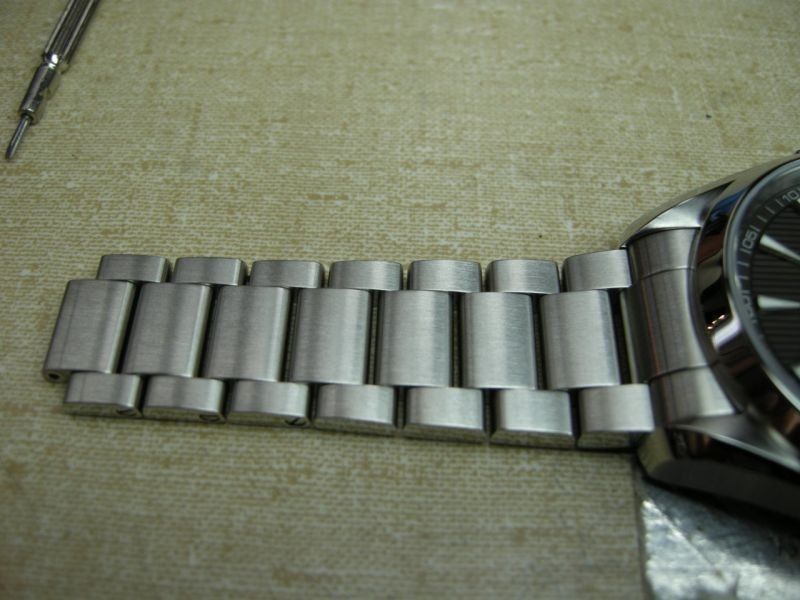
Three and a half links in all had to be removed, and although I'm uncertain as to how many from each side, one thing's for sure - it's . . .

At this point in an objective review, the watch under examination is described, often in excruciating detail. Not so this time . . . I trust that the photos will convey the appearance adequately. Nor will there be any historical context offered - again, the story of the Seamaster has been told before, and as fascinating as it may be, it's really unnecessary to gain an appreciation for this particular watch. Rather, I'm going to try to convey the gestalt of the AT Teck annual calendar.
With these caveats in mind, let's start with the first quality that makes an immediate impression, namely, the weight and density of the watch. The 41 mm AT/ac [Aqua Terra annual calendar] is, in my experience, a subjectively heavy watch. I've tried on many steel watches of similar size, yet the AT/ac is noticeably heftier than most of them. Not only is it relatively heavy, it's also top-heavy; I don't think there's a version offered with a strap, but if there were, I'd be sure to try both on as the weight balance would shift even further towards top-heaviness. These impressions are not meant as criticism - I personally find the heft pleasing as it conveys a perception of solidity and strength. My impressions were confirmed when I finally switched back to one of my Glashütte Originals after wearing the AT/ac continually for six weeks . . . not only is the heft noticeable on it's own, it's highlighted in comparison to the watches I own.
The comfort level set by the AT/ac is high. The clasp isn't adjustable, so the only adjustments possible are those made by removing links. The fit achieved by removing three and a half links was just right, and I never felt the watch tightening on me as the day wore on. I wouldn't say it was the most comfortable bracelet-equipped watch I've ever worn, but the tautness of the bracelet and the overall fit were fine for my wrist, even though the clasp lacks the facility for fine adjustments.
The sapphire back is flat and not curved to conform to the contours of the wrist, as can be seen in these profile shots:
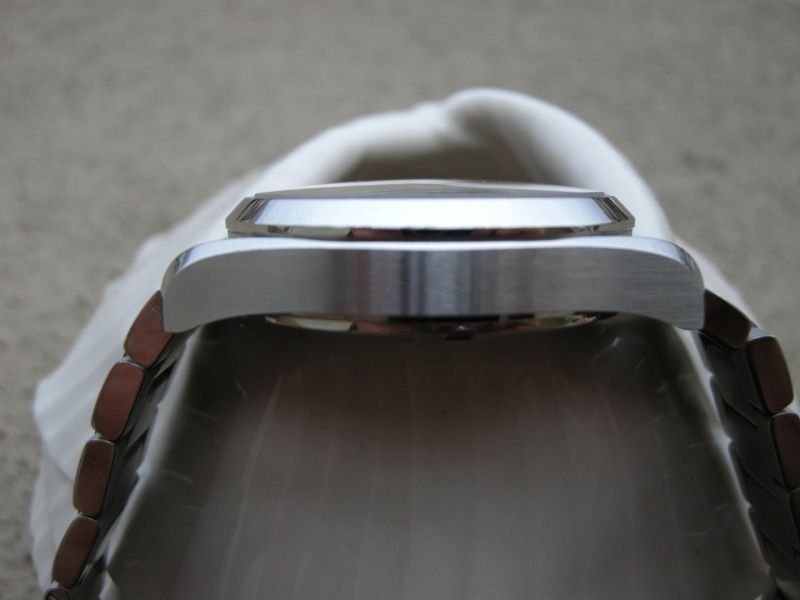
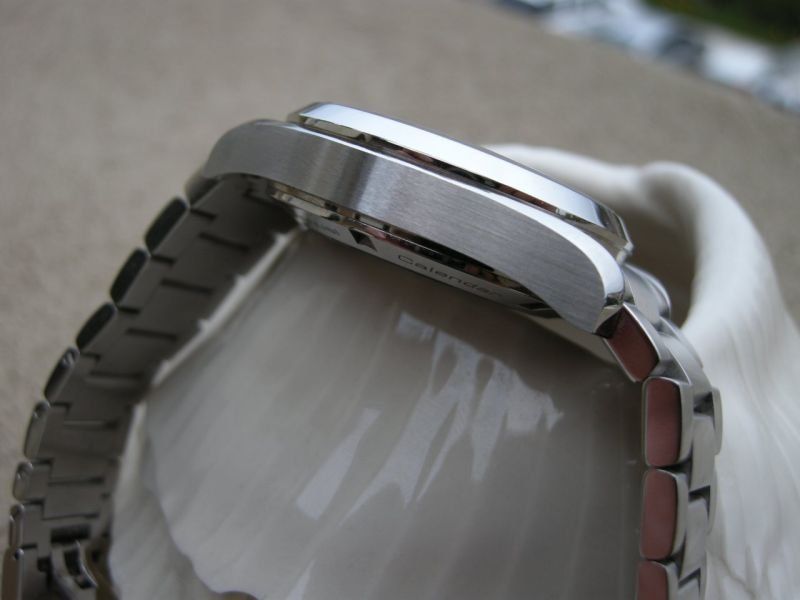
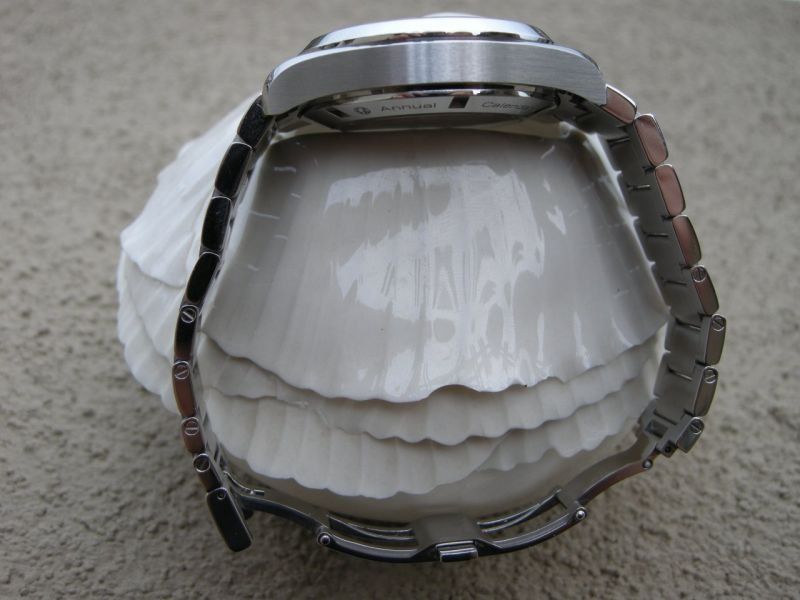
There are a few exceptionally comfortable steel bracelet equipped watches in my experience other than the AT/ac, but none of them are so much more comfortable as to take the margin into consideration. One note: the bracelet did kink up twice (no photo, unfortunately) but in both instances the kink was worked out manually without recourse to tools.
The new Aqua Terras build on the aesthetic foundation laid by previous models with a layer of touches that I find appealing. First off, and most noticeable, are the vertical slats in the dial that resemble deck planking:
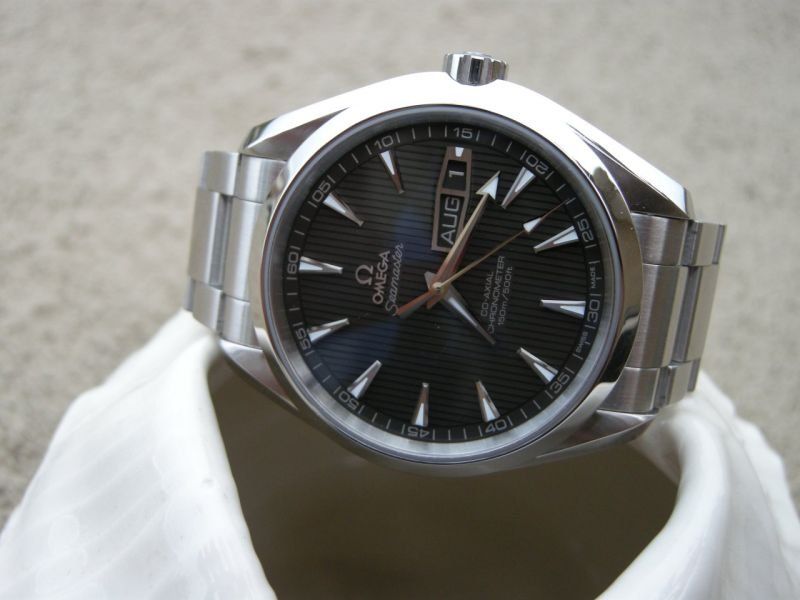
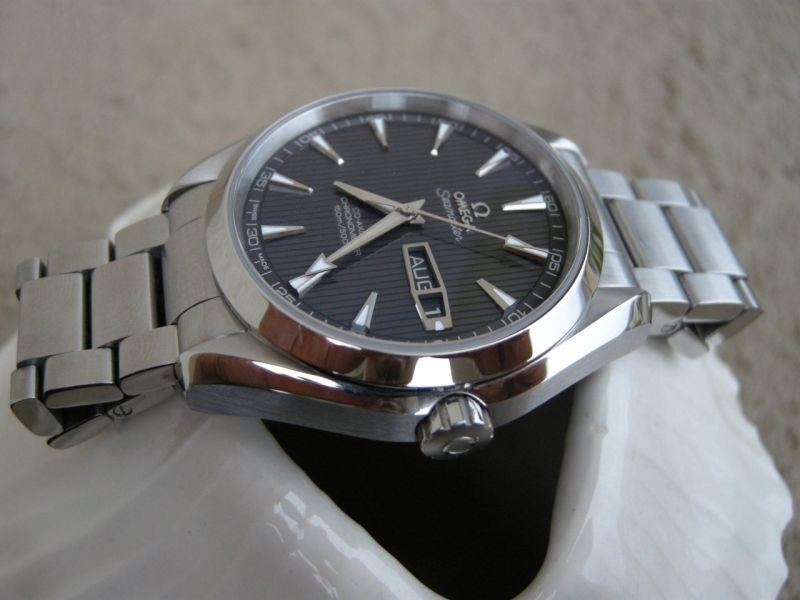
The effect is immediately obvious in comparison with earlier models, but to Omega's credit, it's tastefully subtle. The delta tipped seconds hand and arrowhead minute hand are staples of Omega design, and they sweep across the dial in aesthetic harmony with the applied wedge hour markers. The seconds divisions are different from previous models, though; the printed seconds strokes are contained in a peripheral ring, augmented by Arabics every five seconds (or minutes, depending). This treatment has freshened the dial design without going over the top, and very nicely done in my opinion. The most artful design element of the dial is the lozenge-shaped aperture display for the month and date; compare it to the more ornate aperture on the De Ville annual calendar:
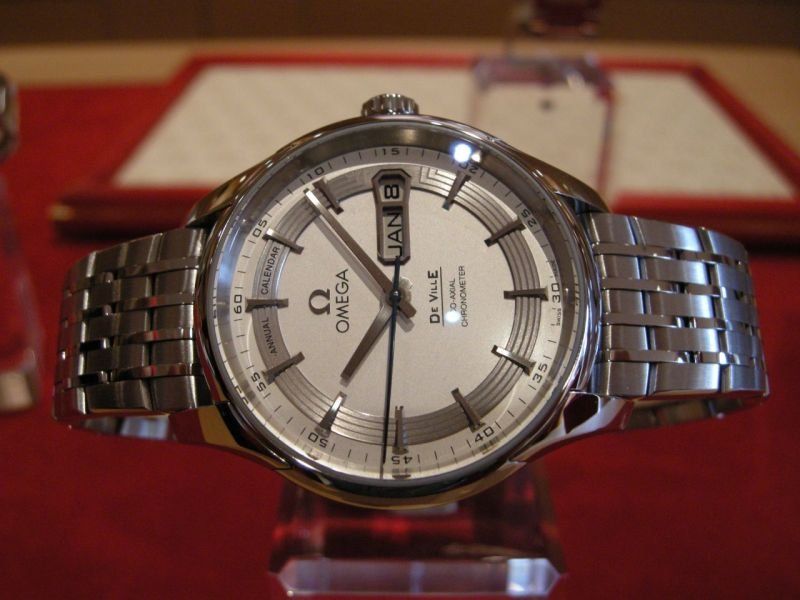
A few people who've seen the watch have commented favorably on this aspect of the design. You'll notice the small segment of lume on the aperture window at 3:00 - extra points to the design team at Omega for that detail! My appreciation extends to the overall minimalist approach - no splashes of color, oversized script, or garish markings here.
Moving away from the details of the dial, the macro perspective of the AT/ac is best appreciated on the wrist:
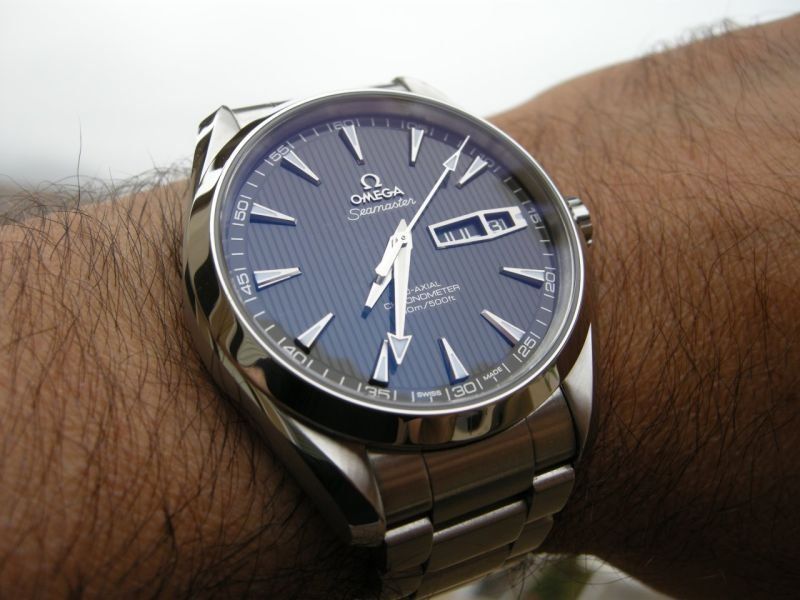
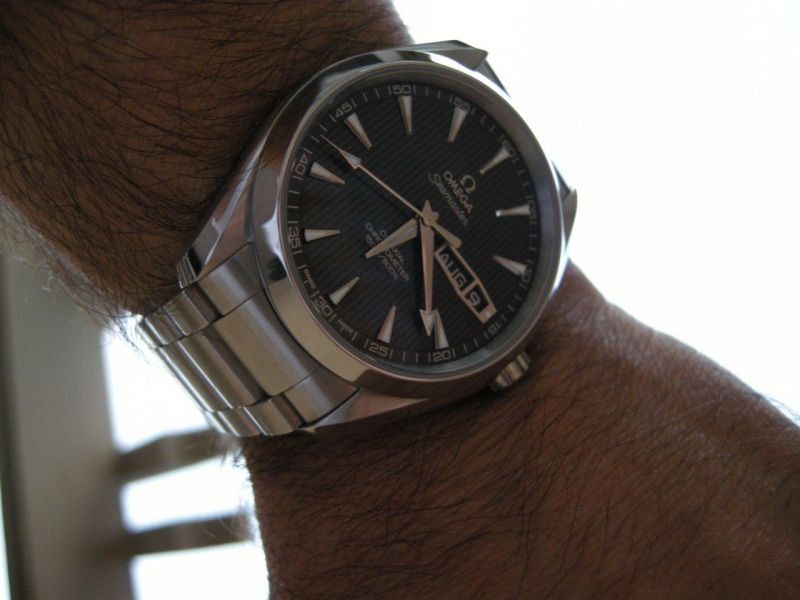
A couple of notes on the design: first, although Omega isn't unique in this regard, my sense is that they've come as close to perfecting the illusion of a seamless transition between case and bracelet without the necessity for an integrated design as anyone; this particular model is a standout in that regard. The lugs in particular blend into the case and bracelet with exquisite poise. Signature Omega design, and well executed here. Similarly, the screwed-in crown isn't new to the AT/ac, but again is thoughtfully executed, without the encumbrance of crown guards; it's also tastefully proportioned to the watch.
We all have an image in our minds of what works on our wrists, or more precisely, what doesn't. While there are a few trendy large watches that I feel comfortable wearing, for the most part my preference is for more circumspect designs. A recurring theme on watch forums involves the notion of a threshold above or below which one's comfort level resides; I find myself uncomfortable with almost all round watches over a certain nominal limit, and the AT/ac is right on that border.
I was pleasantly surprised to find myself acclimating immediately to the watch on my wrist; however, several days into the trial (and entirely unintentionally) I saw a reflection of it in a mirror, and my instantaneous reaction was, "Hmmm . . . it is a big watch!" To put it another way, my sense of it's proportions changed with respect to the aspect of perception - the more distant the perspective, the larger it seemed. Most of the people who know me commented on the size, not so much unfavorably, but more along the lines of how extraordinary it was; I didn't fully appreciate what they were saying until the moment I saw the reflection. Thankfully, at least one of my friends with a predilection for larger watches was supportive ;-).
After seven weeks I can say that I've settled in with it, but my comfort level is more easily accommodated by a design with a lower profile. It's not an issue for a person with a larger wrist or a taste for watches this size, but I'm fairly sensitive to matters of size and proportion. Chalk me up as favorable on this count, but potentially more so if given the option of a smaller version.
The markers are applied daggers with a dollop of lume . . .

. . . on each, which allows for easy reading. The lume wasn't the brightest I've ever encountered, but more than sufficient to meet it's purpose.
The decorated movement is visible from under a sapphire crystal:
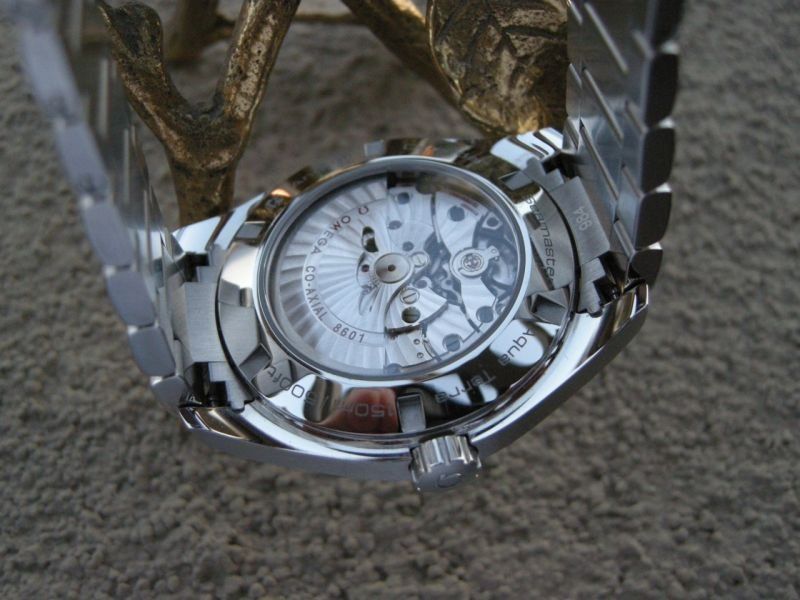
The view is engaging, but I suspect there's more interest in the technical details - the proprietary co-axial escapement, free-sprung balance with just two adjustment screws, non-magnetic silicon hairspring - than in the finishing. Most interesting of all is the inclusion of an instantaneous annual calendar mechanism that works flawlessly as far as I can tell, with changeovers at 23:59 even on the last day of the month:
The crucial question is, how did the AT/ac perform? The reason I wanted to try out one of the new Omegas was to gauge their reputation for high levels of timing accuracy; as I don't have access to any support other than an atomic clock, the results are purely observational. As I mentioned previously, the watch was powered up when I took delivery, so when I began the initial timing test, the watch had been on my wrist for a just a day. In the course of seven days, from 11:00 AM Saturday June 20th to 11:00 AM Saturday June 27th I observed a net loss of 5 seconds; it was either on my wrist or set on my dresser dial up for the duration. No comment necessary.
The following holiday weekend, I took the AT off my wrist around 8:00 PM Friday July 3rd, and when I checked it on Sunday after going without on Saturday, it had stopped running at approximately 8:00 AM that morning. This was unexpected as the specified power reserve is 55 hours. I then re-set the watch with a few turns of the crown to power it up and put it back on my wrist to give it additional break-in time, then took it off the evening of July 17th to see if the power reserve had changed. Unexpectedly, the observed power reserve was again just 36 hours. I powered the movement back up again with several turns of the crown, and ran a longer-term test between July 19th and 31st; again, the timing was remarkable with an observed loss of 3 seconds over the twelve days. I can't account for the deviation as I wasn't keeping track on a daily basis, but the gross result is still remarkable.
What I wasn't expecting was a repetition of the initial power reserve result, but that's just what happened. On the afternoon of August 2nd as I was checking the timing against the atomic clock on the Government's internet service, I saw the movement come to a halt as I placed it back on my desk, approximately 33 hours after it had last been on my wrist. As luck would have it, I brought the matter up with Bill Sohne, and after relaying the pattern of events, he suggested that it was possible the movement had never been fully powered up. It was running when it arrived, so there was no way of knowing how low the reserve was when it first stopped; the second time around it had been running continuously for two weeks, but from a starting point that was well short of being fully powered up, and the same was true of the third shutdown. After a few days of complete inactivity, I powered it back up on Wednesday August 5th and wore it on the 6th, taking it off in the evening; it ran until 8:38 AM Sunday the 9th, a duration of 58 hours. Oh, and at 56 hour mark just after 6:00 AM, the observed timing was +2 seconds from when it had been set four days prior. Simply outstanding, in anyone's book.
The most intriguing aspect of the AT/ac is it's instantaneous calendar complication. I'm not aware of any annual calendars that offer an instantaneous jump at anywhere near the asking price of the AT other than it's DeVille counterpart, which is a decidedly dressier design. Iconic sports watch design, median size and proportions, outstanding mechanical performance, a cool complication, and all at reasonable cost makes the new Aqua Terra Teck annual calendar . . .
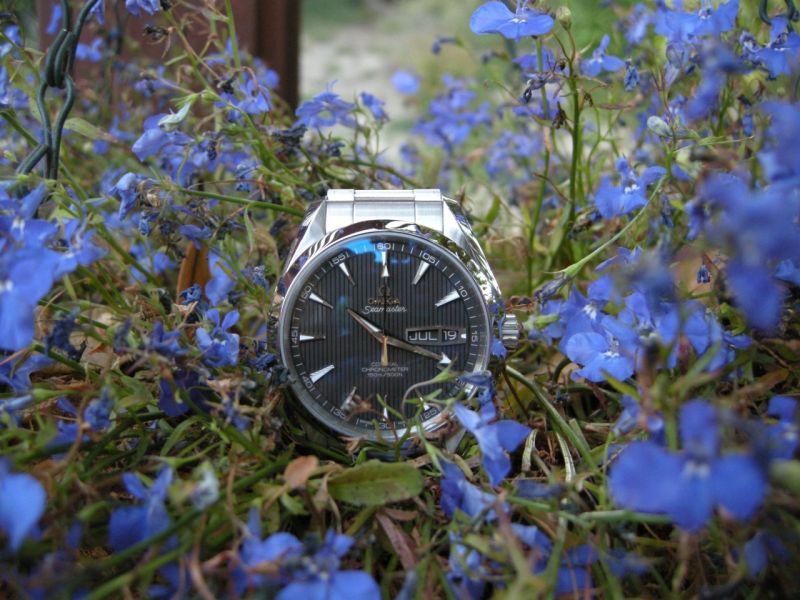
. . . a decidedly thoughtful choice. Cordially, Art
The Seamaster 300 reference is a re-edition that draws inspiration from Omega's historical dive watches. It is characterized by its robust construction and design elements that pay homage to early professional timepieces, while incorporating modern watchmaking advancements. This reference is positioned as a contemporary interpretation for enthusiasts who appreciate vintage aesthetics combined with current performance standards.
This particular Seamaster 300 features a stainless steel case, typically measuring 41 mm in diameter. It is equipped with an automatic movement, often a Master Co-Axial caliber, providing a substantial power reserve. The watch is fitted with a domed sapphire crystal, contributing to its vintage appearance while offering enhanced scratch resistance. Its construction ensures a high degree of water resistance suitable for aquatic activities.
For collectors, this reference appeals to those seeking a blend of historical design and modern technical specifications. It represents Omega's commitment to its heritage while offering a reliable and well-engineered timepiece. The Seamaster 300 is a significant part of the brand's contemporary collection, offering a distinct alternative to other models within the Seamaster family.
I like your prospective. You mention things about the watch I would not have noticed. Looks to me like Omega is well on their way in building a little gem of workhorse motor both in realiability and accuracy. Thank you for your time and effort. I enjoy these "On -The-Wrist" reviews here on the PuristSPro. I think that is a nice and refreshingly new feature of this little "nook on the net". Hope to see more reviews. I suspect the AT line and it's variants will do very well for Omega
Thanks for your thoughts and impressions on the Omega AT/ac, Art! (you notice how I try to avoid saying "review" ) Although you claim to be no photographer, I think you did a great job presenting this watch and did so in a very contagious manner - at least I would like to see this watch in real! But it seems the watch is not available yet, is it? My interest in Omega is quite new, but I second all the points you made about the attraction of this brand. For example, it never happened to me before
. . . when I last visited seven weeks ago, but I'll be stopping by this weekend and will check for you. I don't think we'll see a mid-size, either . . . personally, I feel the AT/ac is intended to compete in the same market with watches like the IWC Ingenieur and VC Overseas, and those designs are comparable in size or even larger . . . cordially, Art
... or I should have a serious problem with my sensory apparatus. So, the watch you presented is not a very special LE for a merited Purist´s moderator ? Probably, time will solve the mystery! Thanks again for your essay, anaesdoc
. . . in my humble opinion, this 'little gem of a workhorse' is going to be acclaimed as one of the great movements, as it's hard to conceive of any meaningful improvements. I would have loved to perform a long-term review to assess it's reliability and endurance, but I don't think Omega would let me hold onto it indefinitely . . . cordially, Art
Art, Thank you for this piece, which might just be the encouragement I need to get to know the Omega brand a little better. Your [overly self-effaced] photography skills seem to be improving dramatically, but your videography has the stability of "Aqua", not "Terra" ;-). Cheers!
This thread is active on the Omega forum with 61 replies. Share your knowledge with fellow collectors.
Join the Discussion →


