
Comparison
WHL presents a compelling side-by-side comparison of the Vacheron Constantin Historiques Toledo 1951 and 1952, offering a detailed visual and analytical review. This article delves into the subtle yet significant differences between these two iconic references, providing valuable insights for collectors contemplating either model. His personal preference for the 1951, contrasting with community feedback favoring the 1952, sparks an engaging discussion on design philosophy.


I have recently taken a shine to the Historiques Toledo 1951, dedicating a full review to it and stating that it has leap-frogged the Historiques American 1921 as my favorite watch in the Historiques collection. In private conversations with some forum members I have been getting feedback that they actually have a preference for (and more often than not, actually own) the Toledo 1952, which has the classic triple calendar display. I finally got the chance to have the rose gold Toledo 1951 sit side-by-side with the Toledo 1952 and wanted to share the photos with the forum.
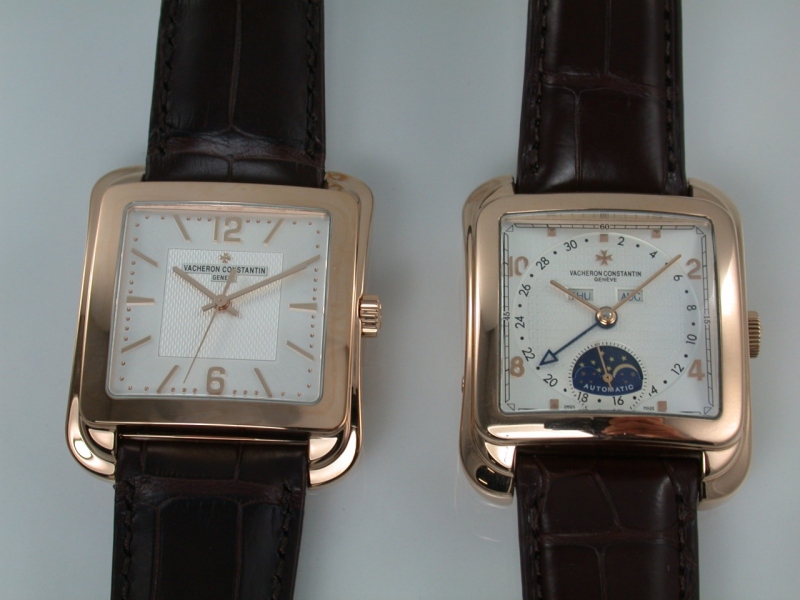
The Toledo 1951 has a width of 36.4 mm and the Toledo 1952 a width of 35.7. While essentially the same, the 1951 has a larger presence due to the fact that the dial has so much open space.
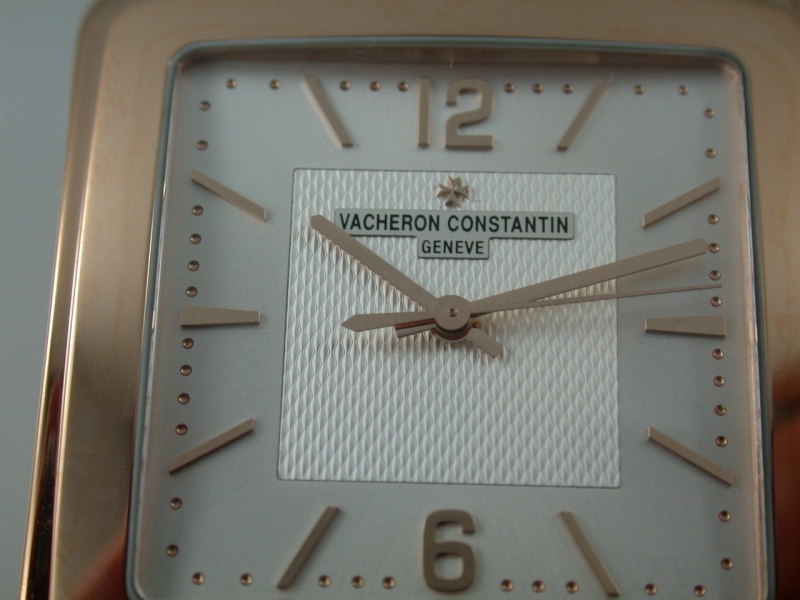
On the other hand, the 1952 has a dial that really pops due to all the information that is on display.
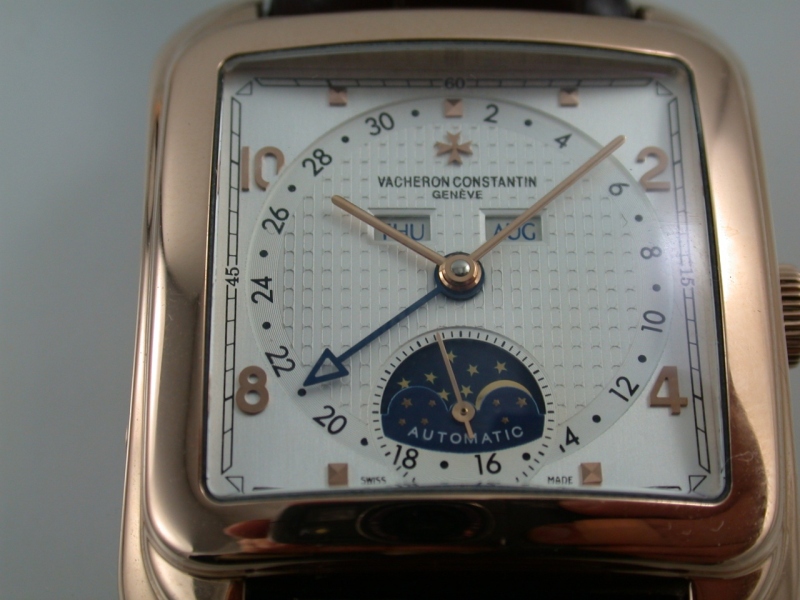
I especially like the moon phase with blue background, gold stars, and that the night sky expends beyond the blue disk to the dial.
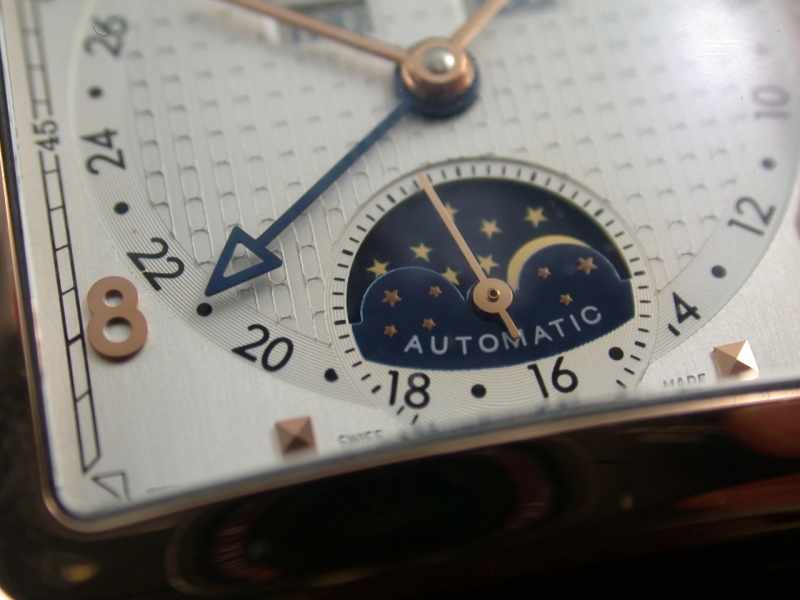
The designers at Vacheron Constantin did a great job in keep the dial of the triple calendar clean, with frames for the day and month, an inner textured pattern that stops at the date ring, which then steps up to the outer applied hour and railroad minute track.
The Purist in me appreciates the fact that the guilloche dial of the 1951 is hand-made on a rose engine on a gold plate which is then silvered.
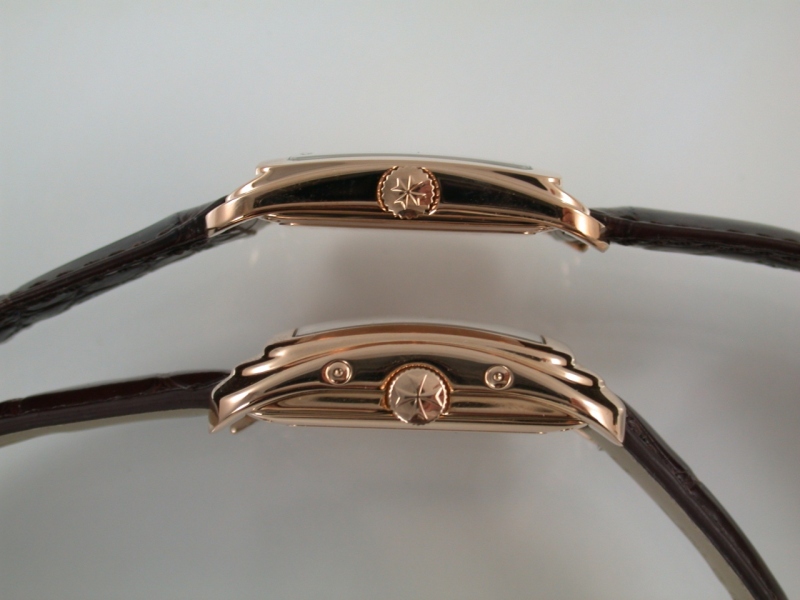
Note the extra thickness of the 1952 over the 1951, due to the movement being thicker to accommodate the calendar complication.
When the Toledo 1952 came out in 2003 Vacheron Constantin did not yet have an in-house self-winding movement to power the watch. As was the brand’s tradition, it sourced the movement from Jaeger-LeCoultre.
Both the 1951 and the 1952 have solid case backs.
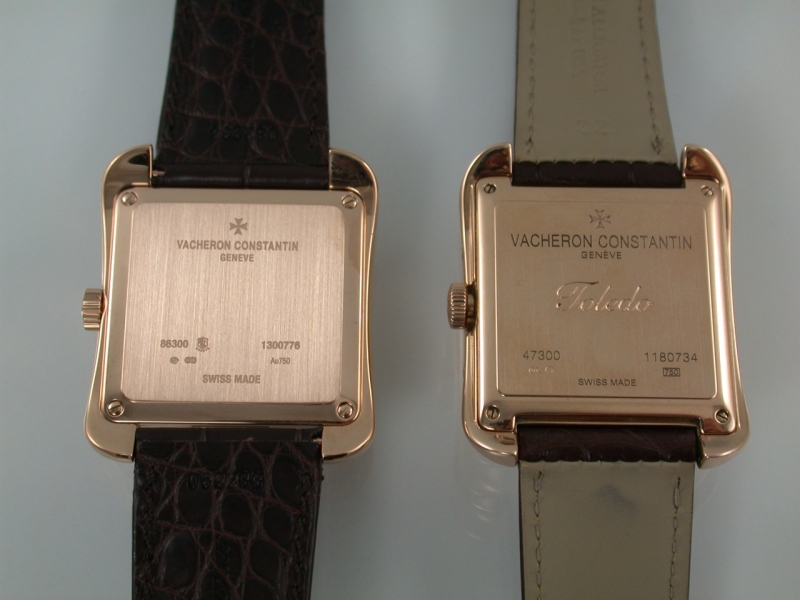
Again, the Purist in me has a preference for the manufacture movement (calibre 2460 SC) in the 1951. Vacheron Constantin also now has the entire watch certified for the Geneva Hallmark, and the hallmark is engraved on the movement as well as on the case back (next to the reference number).
One subtle change that Vacheron Constantin has been bringing to its watches over the past couple of years is having a small scale alligator backing for the straps that go on some of its watches. This wasn’t and option when the Toledo 1952 came out, but it is small detail that I appreciated, if only for hiding moisture and sweat staines on the inside of the strap.
Both of these watches are outstanding, and would have a place of pride in any collection, but I still have a preference for the Toledo 1951 over the Toledo 1952. Please let me know which you prefer, and why.
Bill
VC Forum Moderator
The Vacheron Constantin Toledo 1952, often referred to as 'Cioccolatone' by Italian collectors, features a distinctive curved square case, known as 'carré galbé'. This particular reference is a reinterpretation from the late 20th and early 21st centuries, drawing inspiration from the original Toledo cases introduced in the 1950s. It represents a significant revival of a historically important case shape for the brand, distinguishing itself from more conventional round or rectangular designs. The Toledo 1952 was part of a series of seven different references that revisited the Toledo case during this period.
The Toledo 1952 is typically presented in precious metals, with its characteristic curved square case designed to sit comfortably on the wrist. The watch houses an automatic mechanical movement, reflecting contemporary watchmaking standards while maintaining a classic aesthetic. The crystal is generally sapphire, offering durability and clarity. The design emphasizes the unique geometry of the case, which is a central element of its appeal.
This reference appeals to collectors interested in Vacheron Constantin's design heritage and those who appreciate watches with a strong, recognizable architectural form. It stands as a modern homage to a mid-century design, bridging different eras of the brand's production. The 'Cioccolatone' nickname underscores its unique visual character and its place in collector discourse, highlighting its distinctive and memorable profile within the broader Vacheron Constantin catalog.
and If I could I would keep both of them , but If I had to choose I would go with 1951.In this case (a square watch), its thinness is in my oppinion an asset ! as well as the simplicity of a dial. looks more noble. Not to take away from the compilations of 1952 but in my oppinion watch loving is not always only about how many features it has. What is important as well is overall feel to the watch , as to the strap, you change it anyway every six month and luxury straps are not hard to find. good
because to me it offers more charming details. Just for the pleasure of looking ... ... a lovely vintage piece that I had the pleasure to see at a VC collectors dinner some time ago.
for those who like cacao ;-)) Both are nice. Maybe 1952 for men and 1951 for women a perfect duo. Thanks for this side-by-side presentation. Cheers, Patrickh
I love the case design of the Toledos and in PG, they are just warm and awesome to me. They wear a little big for my small wrist but I can appreciate the feeling of them on my wrist. Both are beautifully crafted - case, dial. Between the two, purely on looks of the dial, I think the Toledo 1952 has more VC charms to it. The Toledo 1951 feels more modern and cleaner and those who prefer a non-cluttered, simplier elegant look may prefer the 1951. I won't mind owning either of these to be honest bu
on the inside the 1952 strap? :-) Stewart
This thread is active on the Vacheron Constantin forum with 6 replies. Share your knowledge with fellow collectors.
Join the Discussion →


