Reference Guide
quattro's deep dive into the Vacheron Constantin 1972 Prestige de la France is an essential resource for collectors navigating the model's complex history. His meticulous research clarifies often-confusing online data, providing a much-needed guide to the various iterations of this iconic asymmetrical timepiece. This article not only celebrates the watch's unique design but also traces its evolution, making it invaluable for both seasoned enthusiasts and new admirers of Vacheron Constantin's heritage.


On June 23, 1972 Vacheron Constantin received the « Prestige de la France » award, being the first watch manufacturer to receive this recognition.
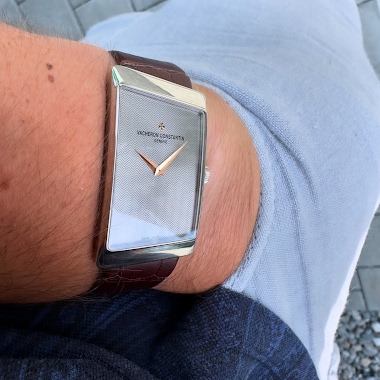
This award celebrated the new design of an asymmetrical and ultra-thin watch (ultra-thin thanks to its 1050 caliber with variable inertia balance regulator) which would become an icon of the Maison.


Years earlier, in 1958, the airplane “La Caravelle” received this award, and in 1963 it was awarded to the famous transatlantic liner “Le France”.


Pieces were engraved on the back with the emblem of the association: a laurel-leaf crown surrounding the words “Prestige de la France”.
The award ceremony took place at the Ritz Hotel in Paris: a unique moment for the brand and it's CEO at the time, Mr. Jacques Ketterer, in presence of the Minister of Industrial and Scientific Development, Mr. Ortoli.
The artist Jean Carzou created a lithograph for Vacheron Constantin entitled "Temps qui passe" (Passing time), printed in limited copies to accompany the first series of watches produced.
The lithographic stone was destroyed in public after the award ceremony at the Ritz Hotel, definitively limiting the printing of the work.


The 1997 model reference 37010 pays homage to its predecessors, incorporating the thin Calibre 1055, measuring just 2.1mm thick and offering a 40-hour power reserve.
The watch's back is engraved with "MCMLXXII" – the Roman numeral for 1972.


The Chronoswiss Historiques 1972Prestige is a distinctive model within the Historiques collection, characterized by its non-traditional case shape. It represents Chronoswiss's exploration of design beyond conventional round forms, offering a unique aesthetic that appeals to collectors seeking individuality and historical design influences from the early 1970s. This reference stands out for its commitment to a specific period's design language while maintaining Chronoswiss's signature attention to detail.
The watch features an 18k white gold case, measuring 38mm x 38mm, which houses the automatic caliber C. 125. This movement provides a power reserve of 40 hours. The silver dial is protected by a sapphire crystal, ensuring clarity and durability. Water resistance is rated at 30 meters, suitable for everyday wear but not for immersion. The fixed bezel complements the overall case design.
This reference appeals to collectors who appreciate independent watchmaking and specific vintage design cues, particularly those drawn to the 1970s aesthetic. It offers a blend of traditional craftsmanship with a less common case silhouette, making it a noteworthy piece for those interested in Chronoswiss's more experimental designs. The inclusion of a date complication adds practical functionality to its distinctive appearance.
It’s a watch I will someday own
Best, Emmanuel
Probably Black dial stick indicators. Someone on this forum has a black / grey dial with what looks like a guilloche. Those are nice too.
I wish you the best for the hunt.
That's kind of cool! And now I know why they have 1972 in the back! I actually didn't know this rather important and somewhat obvious detail. Much appreciated! Learned something today! Never really considered these since they're so long - and my wrist isn't big enough. But always nice to see these cool watches!
Works with my chicken wrist, too 😊
This thread is active on the Vacheron Constantin forum with 70 replies. Share your knowledge with fellow collectors.
Join the Discussion →