Vacheron Constantin Mid-Century Stamped Guilloché Dials
Vintage

Vacheron Constantin Mid-Century Stamped Guilloché Dials

By Volney. · Jan 13, 2023 · 11 replies
Volney.
WPS member · Vacheron Constantin forum
11 replies2341 views5 photos
f 𝕏 in 💬 🔗

Volney's meticulous research into Franco Cologni's authoritative book, "Les secrets de Vacheron Constantin," uncovers a fascinating horological mystery: the precise technique behind Vacheron & Constantin's distinctive mid-century wave-patterned dials. His detailed analysis, supported by historical references and personal observations, challenges a specific description in the text, inviting the community to weigh in on whether these intricate patterns were achieved through stamping or the more revered guillochage.

11 collectors discussing this on the WatchProSite forumJoin the Conversation →
My previous post has been deleted; on our moderator Tick Talk's invitation, I give it a renewed try. 

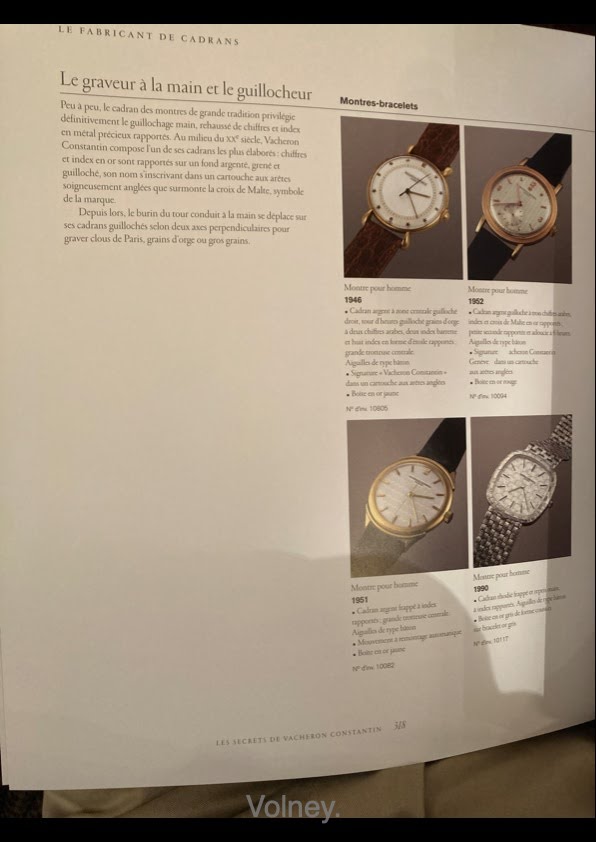
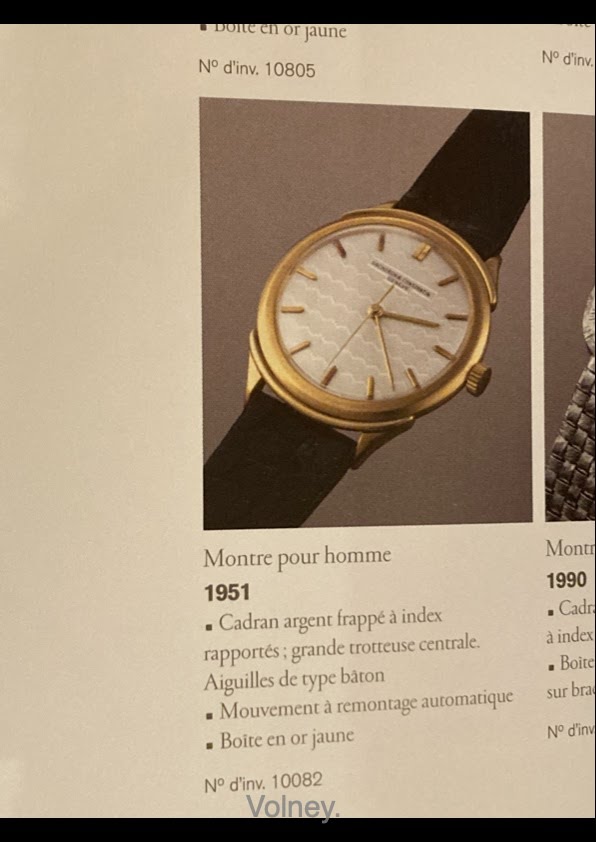
Reading through the French edition of Franco Cologni's "Les secrets de Vacheron Constantin" (Flammarion, Paris, 2005), I noticed something rather strange at page 318 (in "L'horloger", the book's last section, Chapter 3 "Le fabricant de cadrans" - "Le graveur à la main et le guillocheur"): a watch from year 1951 is described as having been fitted with a "Cadran argent frappé à index rapportés", which could be translated as "Stamped silver dial with applied indexes" (see pictures 1-2). 


Picture 1: Page 318 from Franco Cologni's "Les secrets de Vacheron Constantin" (Flammarion, Paris, 2005). 


Picture 2: Detail from above featuring the discussed 1951 watch and its "stamped silver dial" as it is being described ("Cadran argent frappé"). 


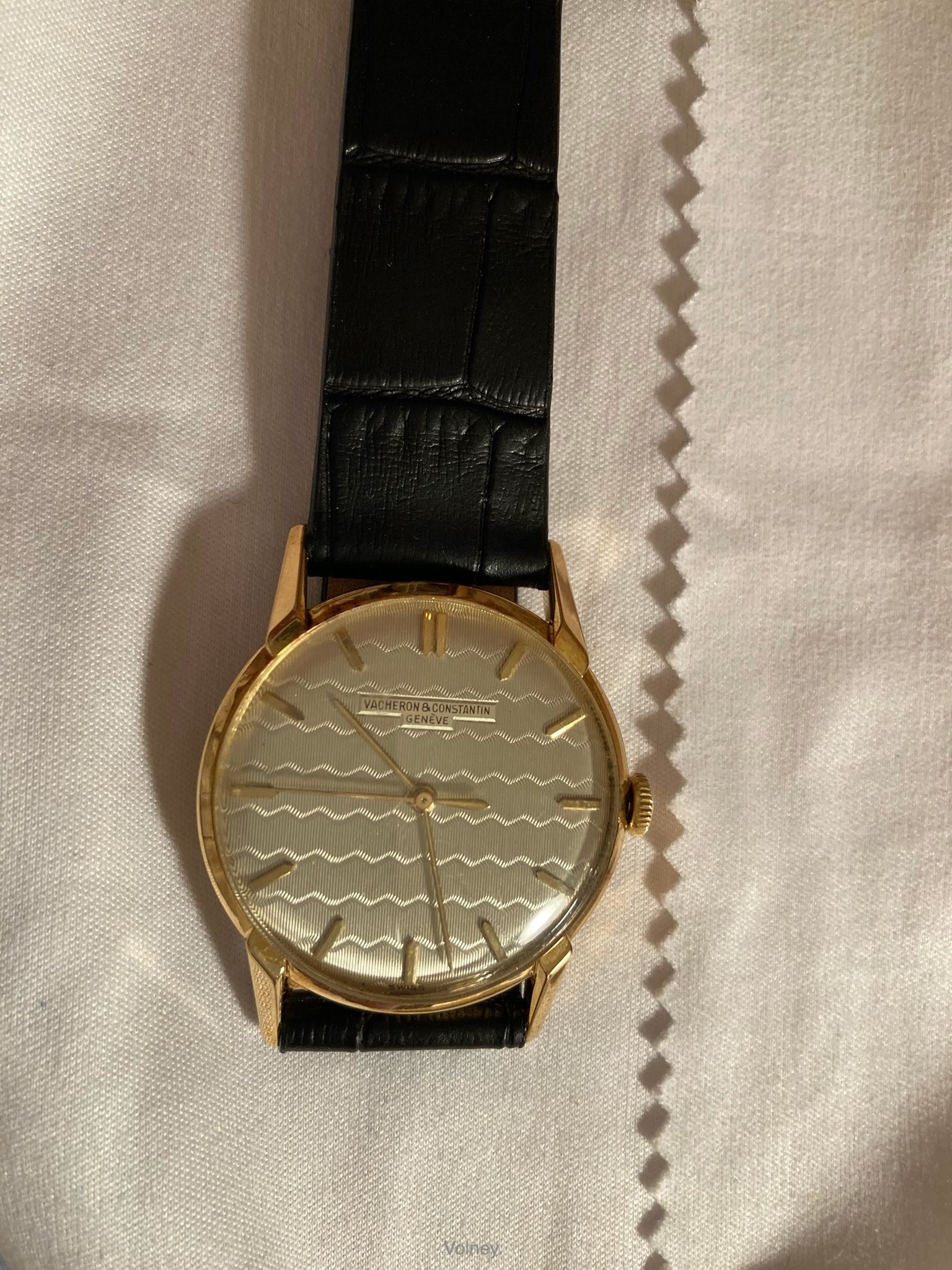
I find this description as a "stamped silver dial" rather intriguing, as variations on this specific wave pattern can be found on several Vacheron & Constantin watches from the 1940s-1950s (see pictures 3-4-5), notably on the Ref. 4872 presumably presented by Zsa Zsa Gabor to Marlon Brando in 1954 (see picture 3) and is regularly referred to as a product of the guillochage technique. I personally have had the opportunity to handle the specimen seen on picture 5 and to observe the light reflecting itself on its dial: the depth and precision of the pattern, as well as the finish of incised surfaces rather evoked guilloché to me. 


Picture 3: Vacheron & Constantin Ref. 4872 (Cal. 1001), presumably presented to Marlon Brando by Zsa Zsa Gabor on June 24, 1954, auctioned at Antiquorum's in New York on September 17, 2009 (Credits: Antiquorum). 


Picture 4: Detail of a variation on the same pattern on a larger dial fitted on a 37 mm. Vacheron & Constantin watch reviewed on WatchProSite by Aaronm on May 27, 2011 (" www.watchprosite.com "; Credits: Aaronm). 


Picture 5: Vacheron & Constantin Ref. 4892 (Cal. 1002, with U.S. import mark ; private European collection). 


I were curious to read about your opinions on this particular matter. Does it seem plausible to you that such a result might have been achieved in the 1940s-1950s through stamping techniques? Do you think dial-makers could have used both stamping and guillochage techniques alongside in order to obtain a similar pattern? Is the mention of stamping a translation error specific to the French edition of Franco Cologni's book? 

Though this cannot - technically - be considered my first thread, I take this opportunity to thank the two members who wished me welcome here and who had received no answer yet because of the initial conversation's disappearance. 

Volney. 


Key Points from the Discussion

Advertisement
The Discussion
NO
northcentralsouth
Jan 15, 2023

I'm 100% certain that guilloche dials were not ever stamped. I love these watches more than any other and this was really what distinguished them from their competitors, at least up until 1955. The odd thing was for how short a span of time these watches were produced. The earliest appeared about 1945 and they ended in 1954. As an aside, I owned what I called "The Marlon Watch", and I was the seller in 2009. I later heard that the buyer was the V&C museum.

VO
Volney.
Jan 16, 2023

Those dials are indeed a particular favorite of mine!

VO
Volney.
Jan 16, 2023

This is an interesting technique.

VO
Volney.
Jan 16, 2023

Back in 2009, I was but a kid: but I would have enjoyed handling the Marlon watch. The rupture introduced by the small second in the dial's pattern is especially enticing to me. In my appreciation of a watch's dial, texture is key, and mid-century Vacheron & Constantin guilloché here almost reigns supreme.

MZ
MZHammer
Jan 17, 2023

The English version of the book also clearly states "silver dial stamped using the frappé technique with applied markers" while other entries on the page clearly reference guilloché . Very strange.

VO
Volney.
Jan 19, 2023

We should inquire this further; as mentioned above, I am skeptical regarding the possibility of obtaining such results with stamping, especially in those years.

Advertisement

Continue the conversation

This thread is active on the Vacheron Constantin forum with 11 replies. Share your knowledge with fellow collectors.

Join the Discussion →