Vintage
Baron - Mr Red initiates a fascinating discussion on Rolex's design evolution, prompted by his wife's observation that many Rolex models appear similar. This post delves into the subtle yet significant details that differentiate vintage and modern references, particularly focusing on the Rolex Explorer I. His comparative analysis challenges collectors to consider which Rolex reference has best preserved its original DNA over decades.
As I cradle my Sea-Dweller, admiring its wonderful rail dial and appreciating its weight and presence on the wrist, my wife turns to me and says…”It looks just like all the others!” “Absurd!” (I think).
And this got me thinking more. As time passes and our respective knowledge grows, we become very specific to detail. I think it is true in most areas of life. The exclam dot; or the rail dial; or the nature of the font. These seemingly small issues take on a big meaning. Yet to someone who looks at the watches in a purely aesthetic manner (like my wife), I can easily see how many specific Rolex do appear quite similar.
So, out of interest I lined up my 5508 Sub against a modern-day contemporary. To be honest, although the DNA is still there, the comparison shows a lot of differences. Time has definitely changed the watch!
So instead, I tried something else - to find the Rolex reference that, through time, has kept closest to its original….even when that original is 60 or more years old.
The outcome was actually very obvious. I have lined up 3 watches…the 114270, 6610 and 14270.
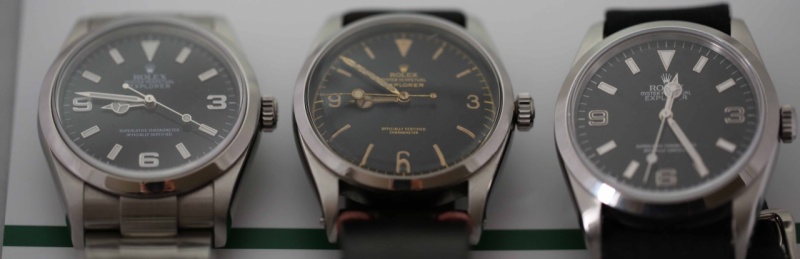
It is like a game of spot-the-difference. All have stainless steel cases. All self-winding movement. No dates. Simplicity. Black 3-6-9 dial. Mercedes hands. No crown guards. On and on the list can go.
OK…the one in the middle has a little bit of red writing and the respective depth ratings may have altered a touch. But wouldn’t you agree that the Explorer 1 has remained remarkably close to its original, despite 60 years of time and “modernisation”. OK, I hear some of you might say that these two modern Explorers are now discontinued and the 36mm variation is no longer available. That is fair enough. In this world, bigger is the current mode. But the question is, would you agree that the Explorer 1 is the Rolex that has stayed closest to its original DNA?
Actually, there are a few questions I have. Second, if you don’t agree that it’s the Explorer 1, what would your suggestion be? And finally, I’d love to see posts of the ancient vrs modern that have moved most apart over time. I am thinking the original Milgauss is some way away from its Rasta descendant! Though it still has some of that DNA.
The Rolex Submariner reference 5508 represents the No Date series within the Submariner model range. Produced from 1958 to 1962, this reference is distinguished by its black dial that has developed spider patina over time.
The 5508 features a 37mm stainless steel case fitted with an acrylic crystal and rotating bezel. Water resistance is rated to 200 meters. The automatic Cal. 1530 movement provides 42-48 hours of power reserve. The watch is paired with a steel bracelet.
This reference appeals to collectors focused on vintage Submariner variants from the late 1950s and early 1960s production period. The spider patina dial condition represents a specific aging characteristic that develops over decades. Within the No Date Submariner lineup, the 5508 occupies the position of a four-year production run reference with the Cal. 1530 movement.
You posted 3 same watch to make your case. Put something from the 50s/60s and some modern ones from the 90s would better show what you wanna say. ;) LOL I agree Joe. PS Pls stop torturing me with your red depth. I'm dying here. Regard Tyler
Lucky I got my pills beside me. Great photos btw. This old lady age well. :) Regard Tyler
only goes to confirm the opposite theory. While the three watches share many of the same elements, the vintage one, to my eye, stands apart from the other two by a long way. It's subtle differences combining together to make something more appealing, in some way it's lack of high precision in comparison to the other two make it more emotional.
.....I think we may be comparing different things. If it is charm, then I am with you 100%. However, I am thinking more along the lines of original DNA. Take a 5508 Sub and compare that with a modern Sub.... the comparison is a bit like an old 1950s 911 vrs today's 997.... so diffewrent they could be different cars...only the vaguest of DNA still connects them. Whereas with the Explorer 1, so much of the DNA is still there. I grant you, 60 years of ageing on the lume and dial has imparted someth
watches that have kept their core look over the years. The one that springs to mind outside of Roles is the Omega Speedmaster. When you go back and look at vintage longevity that is also interesting. Take a movement like the Valjoux 72, first basic production around 1938 the same basic calibre still being used in the early 70's. Which also means that the basic chronograph triple date dial has also been relatively fixed over that period of time.
This thread is active on the Rolex forum with 9 replies. Share your knowledge with fellow collectors.
Join the Discussion →