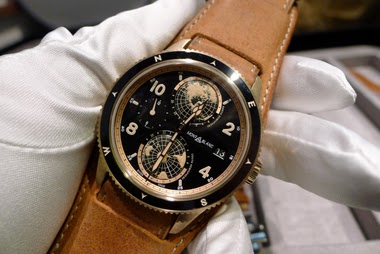
Complications
Mkt33 initiates a deep dive into esoteric watch engineering, focusing on a subtle but significant design change in the Montblanc Villeret movement. This post challenges the community to identify a specific modification to the chronograph teeth profile and debate its mechanical advantage and significance for horological purists.

It is the smallest of details but Montblanc Villeret made a change to its design. Here it is.
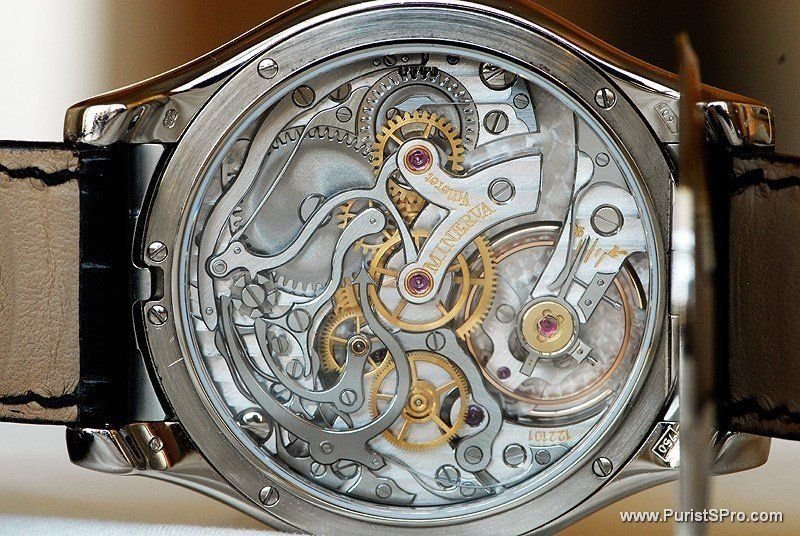
The basic engineering theory can be found in horological text books dating back to the late 1800's (thanks to Google's Library Project) but nothing current. Can anyone see it?
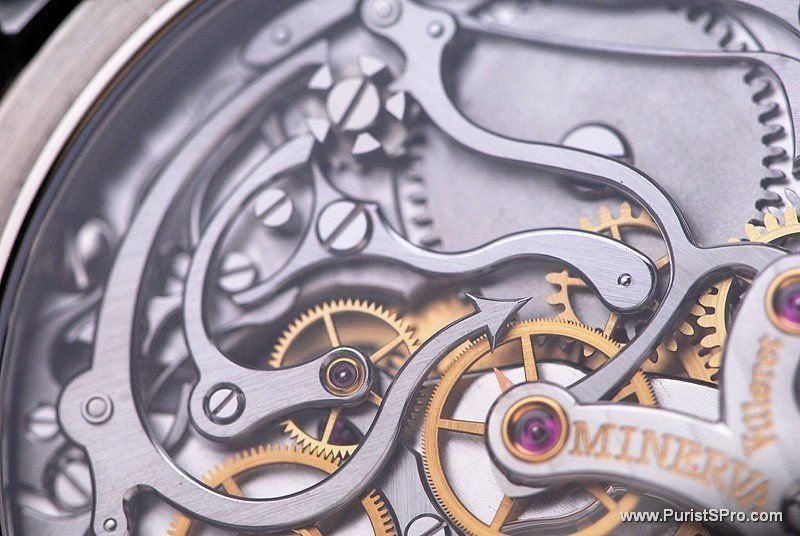
Does it really provide for a mechanical advantage and an interesting detail for PuristS or is it insignificant?
Mike
with its arrow-shaped top: I consider this an aspect that shows the attention to details in a very subtle way. Such tiny Minerva arrows were first introduced in the Cal. 16-29 and 62-00, but now Montblanc/Minerva also included them in the Cal. 13-21 and 16-15. And this is precisely one reason why I admire the company. But this is not all. There are other (functional) aspects where the company demonstrated their technical ability without making much fuss about it... Best, Magnus
A topic that is also a bit esoteric is the proper geometry and travel of the different levers in a chronograph movement which I hope can be another discussion. But you've hinted at what I was hoping to discuss ( I think ) with your last sentence! Best, Mike
I am talking about the shape and the geometry of the chronograph teeth. Minerva sought to improve the measurement of time by optimising the interaction of the transfer wheel (which is mounted in the axis of the seconds wheel and engages, once the Chronograph is switched on, with the intermediate wheel to transfer the energy to the Chronograph seconds counter) with the intermediate wheel. This is achieved by altering the shape of the teeth on the transfer wheel to a more rounded, nearly epicycloi
To focus everyone on the specific area of interest, here is the Minerva Cal 16-29 Photocredit: Anthony Tsai Here is the similar area on a Lange Datograph. Photocredit: SteveG A modern VC chronograph using a Lamania based design. Photocredit: Armanico So trying to understand teething profile for wheels is almost a dead science since the literature I've been reading are from the late 1800s to early 1900s. It would seem that once standard profiles were generated nothing new has occurred. But every
Hi Mike, all, the funny thing is, it has been done before. Even one of your pictures above exactly shows an example, that this was a common approach 60 or 70 years ago (at least) - the Lemania caliber. I'm pretty sure there are others as well, but I'd have to browse a bit more through my archives. I'm sure they weren't using the exact profile as Minerva/Montblanc - but the underlying principle has been realized for a long, long time . BTW, I'd be surprised to learn that this exact improvement wo
around for a while. From reading around it would seem that the ideal for most gearing is to have conjugate action so that when a gear rotates at a constant angular velocity, the mating gear also rotates at a constant velocity. It also would seem that given nearly any reasonable curve for a tooth, a mating tooth can be designed that will give conjugate action. The reason for having different gear tooth design rules is to satisfy other conditions such as lower friction, ease of manufacture, or tol
This thread is active on the Montblanc forum with 15 replies. Share your knowledge with fellow collectors.
Join the Discussion →