Complications
MTF provides a retrospective look at the Montblanc TimeWalker 1000th of a Second Chronograph, a standout release from SIHH 2017. This article revisits the technical marvel of its dual-oscillator movement and its unprecedented 1/1000th of a second accuracy, offering a deeper dive beyond the initial trade show buzz.


Now that the chaos of the watch trade shows are over and we've had time to digest the new watches offered, here are some second thoughts.
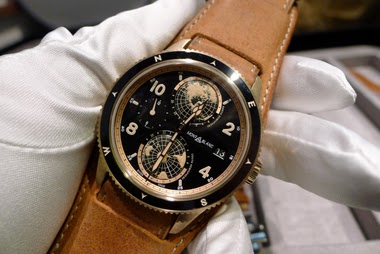
One spectacular offer from Montblanc is the TimeWalker 1000th of a Second Chronograph, a monopusher chronograph equipped with two oscillators.


Based on a specialised movement launched in 2012 in a super high-end, concept watch, handmade at Montblanc’s Villeret workshops, the two oscillators were an elegant solution to address normal timekeeping and measure short epochs of time. The first oscillator for running time, beats at the measured rate of 18,000vph used traditionally in marine chronometers, while the second balance wheel beats at 360,000vph that allows accurate chronograph timing events to 1/100th of a second.


By taking the technical ideas from the original uber expensive Villeret watch and industrialising them into a Montblanc wristwatch, it is more "affordable" although CHF 175,000 sounds a lot to me. Still, only 18 people need to be convinced.....
Regards,
MTF
But before we get into that, lets simplify with a different example, to make it easier to understand. You can skip this whole section if you want to get straight to the point: ==================================================================================================== Imagine a normal chronograph with a balance wheel at 2.5Hz, or 5 beats per second. This means that the chronograph has a precision of 0.2 seconds as the smallest timescale it can measure. A normal chronograph is "stopped" w
The TAG Mikrograph and the Mikrotimer both have separate power supplies. The Mikrograph has a routine 46 ish power reserve for the time function and about 90 minutes for the 1/100 chronograph. Whereas it is interesting that it seems that Montblanc seems to divide the 100th of seconds into tenths the Mikrotimer is purer in that it's chronograph vibrates at 3.6 million vps and is truly counting the thousandths. Of course the chronograph in the Mikrotimer has a power reserve of about 3 1/2 minutes
Calibre MB is hand wound 488-component movement with separate going trains for the time and chronograph functions. Time keeping power reserve is about 100 hours and chronograph power reserve is rated on the dial indicator as 45 mins. But you can extend the chronograph power reserve repeatedly by hand winding its mainspring while the chronograph is running. Regards, MTF.
and not functionality. Cheers
I was hoping it would be you explaining You have a talent for demonstrating how complex mechanical arrangements work in a way that non-technical people grasp it, too Thanks!
And a truly fascinating concept watch - taking things a step further from the TimeWalker Chronograph 100 of some years ago, which had a similar basic layout but was limited to 1/100 of a seconds precision.
This thread is active on the Montblanc forum with 16 replies. Share your knowledge with fellow collectors.
Join the Discussion →