New Release
Mike (mkt33) introduces the Montblanc Heritage Chronometrie Collection from SIHH 2015, presenting the official press release that details the collection's inspiration and design philosophy. This initial overview sets the stage for a deeper exploration of Montblanc's commitment to fine watchmaking virtues and innovative mechanisms.
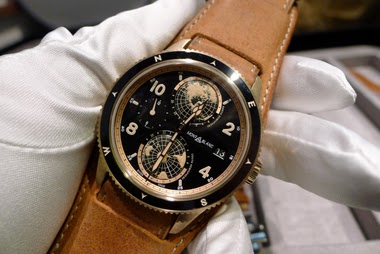
Introducing the newest family of watches: The Montblanc Heritage Chronometrie Collection.
Here is the official Montblanc Press release detailing the inspiration behind the collection.
I will post the PR for each of the individual watches in separate threads...Our PPro reporter at SIHH 2015 will revisit these watches soon with photos and commentary. But please feel free to chime in with your thoughts!
Enjoy, Mike

Heritage Chronométrie Collection unites fundamental virtues of fine watchmaking, the best Swiss craftsmanship, and Montblanc’s own tradition. These are reflected in refined, elegantly puristic cases and innovative mechanisms.
The Discoverer – Inspiration and Homage
Vasco da Gama set sail from Lisbon’s Restelo harbour on 8 July 1497 with a small feet of four ships. His flagship was the nau (carrack) Sao Gabriel with its crew of 60 men: it weighed 120 tonnes, was 27 metres long and 8.5 metres wide, had a draught of 2.3 metres, and could raise a total sail area of 372 square metres. Vasco da Gama’s goal was the coast of India. If his expedition succeeded, he would become the first seafarer to find a Southern seaway to India. Nowadays we know that he did indeed succeed. This enabled him to bypass Arabian, Persian, Turkish and Venetian middlemen, who had made it extremely expensive for Europeans to import valuable spices such as pepper, as well as precious stones. With this voyage and subsequent expeditions, the Portuguese fortified their predominance as a seafaring and trading nation. Portugal’s best helmsmen and finest navigators sailed aboard Vasco da Gama’s little fleet, but they had at their disposal only the most rudimentary instruments for navigating the vast expanses of the still largely unknown South Atlantic. The sextant, an important instrument for naval navigation, wouldn’t be invented until the early 17th century, and accurate charts of unknown parts of the ocean were likewise nonexistent. Vasco da Gama could only rely on relatively primitive navigational instruments such as the nocturlabium or "star clock", which was a predecessor of the sextant, and the Jacob’s staff. The stars above his masts served as the only reliable map for navigation on the high seas. With the aid of the nocturlabium and the stars, Vasco da Gama was able to navigate his little fleet. Historical documents confirm that one constellation above all others was particularly helpful in enabling him to find his destination: the Southern Cross is a small but very distinctive and easily recognizable constellation. Its four bright stars Alpha, Beta, Gamma and Delta form a sort of celestial crucifix traversed by the pale band of the Milky Way. If one begins with the longer axis of the Southern Cross and continues in the direction its longer leg for a distance equal to 4½ times the length of this longer axis, one arrives at the South Celestial Pole. If one then imagines a vertical line descending from that point to the horizon, the two lines will intersect at the Earth’s geographic South Pole. The success of Vasco da Gama’s expedition can ultimately be credited to its commander’s courage, thirst for action, willingness to take risks and, above all, his obsession with precision.
The fleet reached Saint Helena Bay on the southwest coast of Africa on 4 November 1497. Several days later, the three Portuguese ships sailed in a large arc around the Cape of Good Hope and landed in Mosselbaai on 25 November. Vasco da Gama finally reached India at a point near Calicut on the Malabar Coast on 20 May 1498. For the first time ever, European sailing ships had voyaged to India via a sea route around the Southern tip of Africa. Fully laden with a bountiful cargo of precious spices, Vasco da Gama’s fleet began its homeward voyage to Portugal on 8 October 1498. The first ship in his fleet reached its homeland on 10 July 1499. Vasco da Gama himself landed in Lisbon on 9 September, where a triumphal reception was prepared for him.
The Legacy – Precision Always Was and Still Is Essential
Vasco da Gama’s pioneering spirit and skilful navigation inspired Montblanc to create a new watch collection which connects the Portuguese explorer’s obsession with precision and the roots of fine watchmaking. Precision, which has always been the paramount goal of watchmaking, has become synonymous with the French word "chronométrie", i.e. highly accurate time measurement. This heritage of fine watchmaking provided the name for the new Montblanc Heritage Chronométrie Collection. A special edition of the timepieces in this series bears Vasco da Gama’s name and pays homage to this outstanding discoverer. The distinctive cruciform constellation in the sky above the Southern Hemisphere also plays an essential role.
The Values – Minerva’s heritage
The tradition of fine watchmaking as practiced by the venerable Minerva Manufacture since 1858 has been continued and responsibly cultivated by Montblanc under its own roof.
In the course of its 157-year history, Minerva in Villeret distinguished itself as a specialist in one of the Swiss watchmaking industry’s most important traditions: namely, chronometric functions, especially chronographs and stopwatches. Important developments that originated in Villeret include Calibre 13/20, which debuted in the early 1920s as one of the first chronograph calibres developed especially for use in wristwatches, and the hundredth-of-a-second stopwatch, which was unveiled in 1936. This dedication to precise time measurement and the necessarily associated mastery of various frequencies enabled Minerva to set itself apart at an early date as a leading expert in the fabrication of its own balances and hairsprings. The Montblanc Manufacture in Villeret upholds and continues this tradition today.
This same heritage also inspired Montblanc to develop the movements for the Heritage Chronométrie Collection.
But Minerva’s history also provides another great role model: the "Pythagore", which Minerva debuted in the 1950s. This model encased either 10½-ligne hand-wound Calibre 48, which was developed in 1948 and displayed the seconds on a subdial, or 10½-ligne hand-wound Calibre 49 with a sweep second-hand. Its design codes, which epitomized classical Swiss fine watchmaking, serves today as the inspiration and basis for the design of the Heritage Chronométrie Collection. Leaving nothing to chance, the cases too have been refined in every detail: they have satin-finished and polished surfaces, a low overall height and slim appeal, a stepped bezel with a flat surface, and rounded horns with characteristic facets. The crown bears a relief engraving of Montblanc’s distinctive emblem. A sunburst or "grainé" pattern embellishes the dials, which celebrates their chronometric heritage with a precisely legible minute scale double facetted applied indexes and timelessly styled Arabic numerals. Facetted word-shaped hands complete the harmonious picture and assure clear readability of the various functions in the spirit of Swiss "chronométrie".
"Sharing the passion for fine watchmaking" is the horological principle of Montblanc. The aesthetic approach pursued in the Heritage Chronométrie Collection fully expresses this motto. The selfsame meticulousness and love for details are lavished on the grandes complications and on the elegant, superbly functional, three-handed watch. With this new collection, Montblanc again offers watch aficionados all the passion and beauty of the traditional watchmaker’s art.
The Mechanisms – Useful and Innovative
In the same spirit, Montblanc’s approach to developing the new movements is equally challenging. The Heritage Chronométrie Collection features three innovative and practical complications that have been designed for daily use, along with the further evolution of a patented horological complication that was first presented in 2010.
The collection accordingly includes a timepiece that displays a second zone time (Dual Time) with an in-house developed complication that expresses Montblanc’s own developmental competence, also offers a full calendar mechanism with classical window indicators (Quantième Complet) and an annual calendar mechanism (Quantième Annuel). An innovative further development is embodied by the reinterpretation of the patented "ExoTourbillon", which was originally introduced in the Collection Villeret in 2010.
Heritage Chronométrie – Traditional Craftsmanship at Every Level
Some of the legendary timepieces that belong to the heritage of the Minerva Manufacture were an important source of inspiration. Montblanc’s own craftsmanly skills were a second contributor. Many of the fundamental virtues of fine watchmaking, coupled with the best Swiss craftsmanship, could accordingly culminate in the development of these wristwatches. The Heritage Chronométrie Collection is also equipped with high-quality alligator-leather wristbands crafted by the Montblanc Pelletteria, the Maison’s own leather manufacture in Florence, Italy. Montblanc numbers among the very few Swiss watch manufactures that can equip their models with leather straps of their own fabrication.
Tested Quality – 500 Torturous Hours
Before it is allowed to leave the Montblanc Manufacture at Le Locle in Switzerland’s Jura region, every watch in the Heritage Chronométrie Collection must first pass the strict Montblanc Laboratory test 500. This examination, which detects any inaccuracies that may have crept in during the processes of assembly and fine adjustment, guarantees that Montblanc’s customers invariably receive timepieces of the utmost quality, which is certified by comprehensive and practically oriented tests. Each watch that passes this rigorous ordeal is issued its own individual certificate
The Rolex Bubble Back, reference 1858, represents an early example of Rolex's self-winding waterproof wristwatches. This reference is part of the broader Bubble Back family, characterized by its distinctive domed case back designed to accommodate the thicker automatic movement of the era. It showcases Rolex's foundational efforts in developing robust and reliable automatic timepieces for everyday wear, laying groundwork for future Oyster Perpetual models.
This particular reference features an 18k white gold case, measuring 38mm in diameter. It is fitted with a sapphire crystal, protecting a silver dial. The watch is powered by an automatic movement, specifically the Boucheron 1858 caliber, offering a power reserve of 42 hours. The fixed bezel and leather strap complete the watch's classic presentation.
For collectors, the reference 1858 holds interest as an early and relatively rare iteration within the Bubble Back series, especially in white gold. Its larger case size for the period also makes it appealing to modern tastes. The presence of a date complication adds to its functionality, distinguishing it from simpler time-only Bubble Back models and highlighting Rolex's early integration of practical features.
This thread is active on the Montblanc forum with 0 replies. Share your knowledge with fellow collectors.
Join the Discussion →