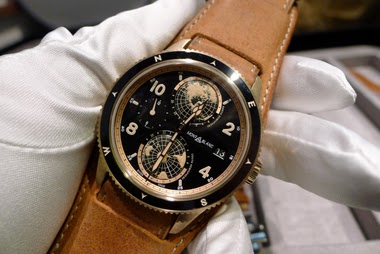
Amanico provides a compelling side-by-side comparison of the Montblanc 1858 Tachymeter in steel and the Patek Philippe 5172G, offering a detailed look at their dial aesthetics, movement architecture, and case dimensions. This post invites collectors to critically evaluate two distinct approaches to the chronograph complication from both a technical and finishing perspective, sparking a lively debate within the community.
Dial side: With some common elements of style. The Patek has its two sub dials located under the 3 and 9 o clock line, while the Montblanc is well centered. Some will like, others won't.

Movements: Cal CH 29-525 for the Patek, Cal 16.29 for the Montblanc Villeret Minerva, which is almost 10 mm bigger than the Patek. But with a smaller power reserve ( Circa 55 hours for the Montblanc, 65 hours for the Patek ).

As for the finishings, the Montblanc wins, clearly.
While for the case, the Patek wins. Smaller, 41 mm instead of 44 mm, thinner, 11, 45 mm / 13, 5 mm, better finished...
It is interesting to compare them, I think.
Best,
Nicolas
About the Montblanc 1858 Collection Ref. 1858
The Rolex Bubble Back, reference 1858, represents an early example of Rolex's self-winding waterproof wristwatches. This reference is part of the broader Bubble Back family, characterized by its distinctive domed case back designed to accommodate the thicker automatic movement of the era. It showcases Rolex's foundational efforts in developing robust and reliable automatic timepieces for everyday wear, laying groundwork for future Oyster Perpetual models.
This particular reference features an 18k white gold case, measuring 38mm in diameter. It is fitted with a sapphire crystal, protecting a silver dial. The watch is powered by an automatic movement, specifically the Boucheron 1858 caliber, offering a power reserve of 42 hours. The fixed bezel and leather strap complete the watch's classic presentation.
For collectors, the reference 1858 holds interest as an early and relatively rare iteration within the Bubble Back series, especially in white gold. Its larger case size for the period also makes it appealing to modern tastes. The presence of a date complication adds to its functionality, distinguishing it from simpler time-only Bubble Back models and highlighting Rolex's early integration of practical features.
Specifications
- Caliber
- Boucheron 1858
- Case
- 18k white gold
- Diameter
- 38mm
- Dial
- Silver
- Crystal
- Sapphire
About the Patek Philippe Chronograph Ref. 5172
The Patek Philippe Chronograph reference 5172 represents a contemporary interpretation of the classic manually wound chronograph within the brand's collection. It succeeded the reference 5170, introducing updated case proportions and dial aesthetics while retaining the traditional two-register chronograph layout. This reference is distinguished by its round pushers and a slightly larger case diameter, offering a modern presence on the wrist while honoring Patek Philippe's heritage in complicated watchmaking. It is a key offering for collectors seeking a pure chronograph function without additional complications.
The 5172 is typically presented in a precious metal case, housing the in-house caliber CH 29-535 PS. This manual-wind movement is visible through a sapphire crystal case back, showcasing its traditional architecture and finishing. The movement provides a substantial power reserve, ensuring reliable timekeeping and chronograph operation. The front crystal is also sapphire, protecting a dial designed for legibility with applied numerals and a pulsometer scale.
This reference appeals to collectors who appreciate Patek Philippe's commitment to traditional haute horlogerie and the art of the manually wound chronograph. Its design cues, such as the syringe hands and applied Breguet numerals, evoke vintage chronographs while being executed with contemporary precision. The 5172 stands as a testament to Patek Philippe's enduring capability in producing high-quality, in-house chronograph movements, positioning it as a significant piece for enthusiasts of complicated timepieces.
Specifications
- Caliber
- CH 29-535 PS
- Case
- 18k white gold
- Diameter
- 41mm
- Dial
- Blue
- Water Resist.
- 30m
- Crystal
- Sapphire
About the Montblanc Ref. 1858Collection
The Montblanc 1858 Split Second Chronograph is a limited edition offering within the 1858 collection, distinguished by its complex split-second chronograph complication. This particular reference, limited to 100 pieces, features a unique burgundy dial, setting it apart from other models in the series and appealing to collectors seeking a more exclusive and visually distinct timepiece with advanced horological functions.
The watch is housed in a stainless steel case measuring 44mm in diameter and 15.2mm in thickness. It is fitted with a fixed 18k white gold fluted bezel. The dark burgundy dial, finished with a sunray pattern, complements the case materials. Protecting the dial is a sapphire crystal. The timepiece is powered by the hand-wound MB 16.31 calibre, which measures 38.4 x 8.13 mm, and offers a power reserve suitable for its intricate mechanical functions.
This reference appeals to collectors interested in high-complication chronographs and Montblanc's Minerva heritage. Its limited production run and specific dial color make it a notable variant within the 1858 collection, offering a blend of historical design cues and modern watchmaking. The large dimensions reflect its pocket watch-inspired movement architecture, a characteristic often appreciated by enthusiasts of traditional horology.
Specifications
- Caliber
- MB 16.31
- Case
- Stainless steel
- Diameter
- 44mm
- Dial
- Burgundy
- Water Resist.
- 100m
- Crystal
- Sapphire
About the Montblanc Ref. 1858Tachymeter
The 1858 Tachymeter Chronograph is a limited edition monopusher chronograph that draws inspiration from Minerva chronographs of the 1930s. This reference is distinguished by its historical design cues, including a tachymeter scale on the dial and cathedral-style hands, which are characteristic of vintage military and pilot's watches. It represents a significant offering within the 1858 collection, emphasizing traditional watchmaking and a vintage aesthetic.
This particular model features an 18k rose gold case measuring 44mm in diameter and 13.15mm in thickness. It houses the manual-wind caliber MB M16.29, a movement known for its large balance wheel and V-shaped chronograph bridge, visible through the sapphire crystal case back. The movement provides a power reserve of 50 hours. A domed sapphire crystal protects the black dial, and the watch is water-resistant to 30 meters.
As a limited edition, this reference appeals to collectors interested in historically inspired chronographs and the artisanal craftsmanship associated with the Minerva manufacture. Its monopusher complication and the visible finishing of the movement are key attractions. The watch is fitted with an alligator leather strap, completing its classic presentation and reinforcing its position as a collector-grade timepiece within the brand's heritage-focused offerings.
Specifications
- Caliber
- MB M16.29
- Case
- 18k rose gold
- Diameter
- 44mm
- Dial
- Black
- Water Resist.
- 30m
- Crystal
- Sapphire