Review
KMII provides an in-depth review of the Minerva Pythagore A481, a timepiece that embodies the Golden Ratio in its movement design. This article delves into the historical context of the Caliber 48, its aesthetic appeal, and its significance during a pivotal period for Minerva prior to its acquisition. KMII's analysis offers a detailed look at a watch cherished by early digital-era collectors for its in-house movement and storied heritage.


Le Corbusier
1.61803398875 - the Golden Ratio. The number has been a source of fascination for philosophers, mathematicians, artists, architects and watchmakers for millennia. And the last group – at least from an 19th century British pocket watch making perspective (1) – was deeply convinced that there is a strong correlation between an aesthetically pleasing arrangement of movement components and the timing accuracy of a movement. Whether Andre Frey, who designed the Cal. 48 in 1943 was of the same persuasion, is open to debate. That it is likewise pleasing to the eye and the Witschi timer, less so.
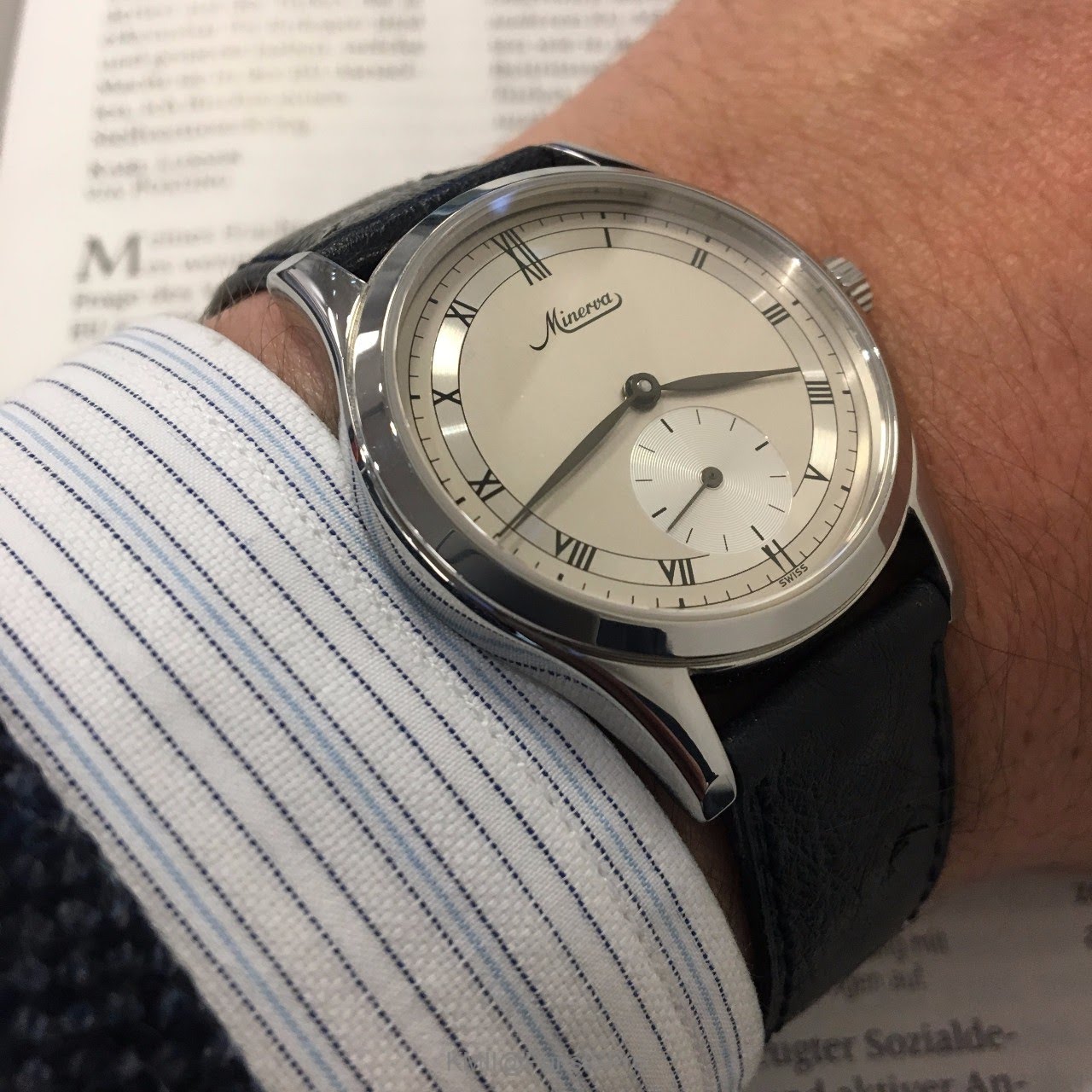
My specimen is from 1996, which can be described as the swan song period of the Frey era at Minerva, prior to its acquisition by Emilio Gnutti and the re-launch under the guidance of Beppe Menaldo and Demetrio Cabbidu (2). The era it is from also coincides with the rise of the horological side of the Internet and the brand was an early favorite of the digital generation – in-house movements, a rich and storied history and a still relatively affordable price point of entry.
The shock that came with the Gnutti take-over, re-engineering and consequent price increases was hard for many to bear, leading to heated discussions on the one hand but also to some honest assessments on the other (a good review is to be found here: http://www.thepurists.com/watch/features/8ohms/minervacal48/index.html (3)). What is undoubtedly true is that the brand achieved new heights under the technical leadership of Mr. Cabbidu and that the era brought watches, which would have been unthinkable amongst the 6 full time employee Minerva of old. This also increased the brand’s interest to big time players like Chopard (which decided on an in-house development instead (4)) and Richemont, which took the brand over in 2006 and subsequently integrated it under the Montblanc umbrella (5).
So what we have is a watch with lots of old school charm, an in-house movement, a Golden Ratio. At the same time it is a watch that came at a price point, where countless hours of painstaking manual finishing of each and every component was simply not feasible. Still, the watch is unapologetic, not pretending to be more than it is.
The first point to consider is the size. While Uhren Magazin (6) called it solid midsize in 1996, its 33,65mm x 8,7mm will be considered positively tiny by the current standards. Yet, when I claimed that life begins at 34 (here: www.watchprosite.com  , I meant it and if you do not have the wrists of a wrestler, the watch will sit perfectly. And at only 38g, including the leather strap and pin buckle, it is no wonder that Montblanc decided to use a version of the movement for the TimeWalker Pythagore Ultra-Light Concept. A true watch that you do not feel on your wrist. Not only will it slip under every cuff, it will also always be a pleasant, understated companion.
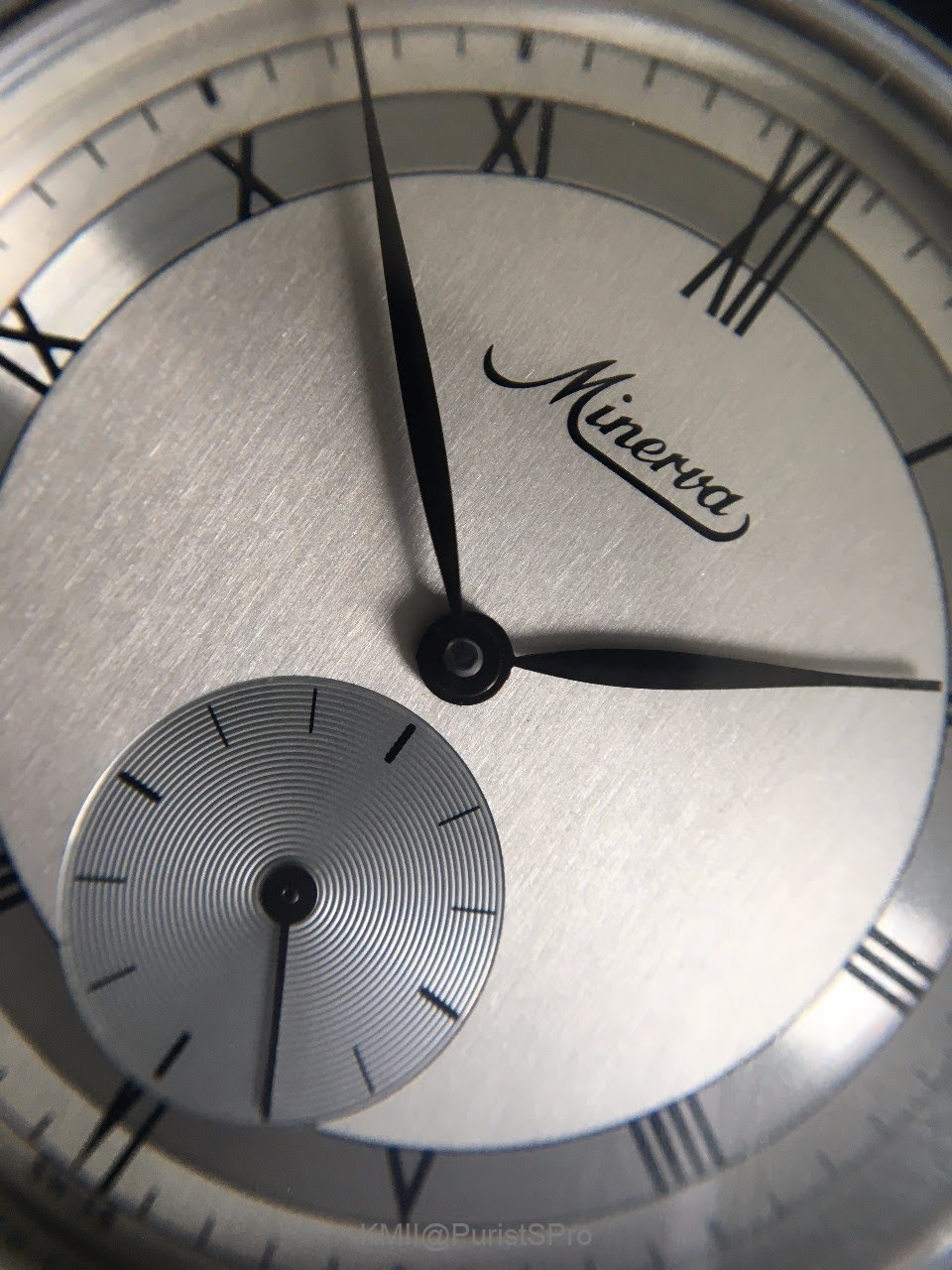
Looking at it more closely, the dial is clearly one of the more mesmerizing aspects of the piece. The watch comes with a sector dial – not interrupted by any date windows here – with a vertically brushed finish in the center, a circular brushing for the hour ring and a differentiated finish on the small seconds subdial. The roman hour numerals are painted, with XII and VI being larger, while the others fit into the hour ring nicely. If you are bothered by a numeral being cut by a subdial, well, the 'VI' is. Still, it is so harmonious that it would be churlish to complain. This is the aspect of the watch I first fell in love with through deBalzac’s great photography of his example.
The hour and minute hands are leaf shaped and the watch is supremely legible, even in low ambient lighting conditions (as there is no lume, total darkness will of course not help).

Cal. 48 is a hand-wound movement, making crown size and operation even more important. At 4,7mm the crown is far from dainty and it manages to look perfectly proportioned to the rest of the case, while allowing for a trouble free winding routine. Winding does require a certain amount of force – this is definitely not a digital era zero feedback product – but is smooth and you can imagine the spring behind it while operating the crown. Various contemporary tests and articles mentioned that pulling out the crown for time setting required a disproportionate amount of force, something I cannot confirm in my specimen.
The crown is marked with a Minerva arrow, which together with another one on the movement, on the pin buckle, the movement marking and the logo on the dial forms all the branding there is.

This brings me to the movement, and the Golden Ratio. All the bridges are positioned at either 45, 90 or 0 degrees towards each other and the movement uses the Golden Ratio in its proportions. As the straight bridges were seen as too severe by some, Cabbidu later re-engineered the movement into Cal. 62 with much more rounded bridges instead. Still, if LeCorbussier is your thing, so is likely the Cal. 48 layout, stark as it may be.
The movement finishing is appropriate but does not display any flights of fancy, or countless hours of hand attention. You have Geneva stripes on the bridges, some sunburst pattern on the gears but that’s about it. While the Anniversary versions and the later Gnutti era Cals. 48 had a swan neck adjustment, it is missing in this model.
In the 1996 Test, the movement is where the watch lost most of its points, simply as it did not contain any complicated elements – no Breguet overcoil, no anglage, no fine adjustment mechanism, no perlage…
Another area that has been criticized in the past (3) is that there is absolutely no finishing on the dial side of the movement. As I do not ever intend to play hobby horologist with the piece, it is something that does not bother me particularly. And there were no skeletonized versions of it back then, so this is an aspect that the average user will hardly, if ever, see.
In addition, the movement is not adjusted – neither in various positions, nor is there a temperature component or isochronism tested. Still, the tested watches seemed to exhibit a better than COSC worthy accuracy, with the long term test results yielding the watch being around 1,8s a day fast – nothing to be scoffed at at this level. I have not timed mine yet but it seems very accurate at first glance. Wearing it for a handful of days at a time, I never felt the need to readjust it. Maybe there is something behind the Golden Ratio movement design and accuracy after all.

The watch still sports its original strap – a navy blue ostrich leather model – and pin buckle. The leather has remained supple over the last 20 years and the strap is a real joy. I have generally tended to dislike ostrich but it looks spot on in this application. No pterodactyl upgrades for this one, although I may feel the urge to start experimenting with it at some point.
The buckle is marked with a Minerva arrow and at the same time light, solid and easy to operate.

So last but not least, what’s my overall impression? I can say that the watch has made a firm believer of me that 34mm can be perfectly adequate even on normally sized wrists – if the proportions are spot on. Generations of men seemed to agree and our wrists have not grown that disproportionately in the last 20 years, repetitive strain injury or not. The watch also existed in a larger 38mm case for those finding the smaller one too hard to swallow but of course the movement remained the same – meaning that the ratio between a 38mm case and a 23,6mm movement wasn’t as optimal. Not something that is disturbing dial side but when flipping it over, it becomes noticeable.
The case design is relatively simple but at the same time there is nothing superfluous about it and it would be hard to pinpoint any area that needed improvement. Grammar of Design – Swiss style, if you wish – without zaratsu polishing.
The classical dimensions, the dial and the relatively neutral strap all conspire to make this a supremely versatile piece. Sure, neither the (late) ostrich strap nor the 30m water resistance will benefit from super sporty activities but apart from that it is a watch that works equally well with a suit, or a casual outfit. At a stretch it could even do formal – it is small, thin and understated enough.
In fact, it is a watch I can recommend to any Purist – at least as a ‘Gedankenexperiment’. And while there are no six sided glaciers on the watch, I would also claim it fits seamlessly into the overall Montblanc heritage, even if the joint story only started about 10 years later.
The Heritage Chronometrie Ultra Slim may have gained a more modern size (both in terms of diameter and its slimness) and lost the iconic movement but it offers a similar value based, honest and versatile understanding / approach to horology.

Sources:
(1) Hans Mikl (1997): Minerva, Zeit-Schreiber 1/97
(2) Dr. Magnus Bosse (2005): Like Phoenix from the ashes - the astonishing rebirth of Minerva SA, Villeret (http://www.ornatus-mundi.ch/artikel_11/artikel_11_1.htm)
(3) ei8htohms (2003): The Minerva Pythagore "Anniversary Dial" ( www.thepurists.com
(4) Wei Koh (2016): Karl-Friedrich Scheufele — No Holds Barred / Chopard L.U.C. (https://www.revolution.watch/karl-friedrich-scheufele-no-holds-barred/)
(5) Franco Cologni, Gisbert Brunner (2010): Montblanc: Writing Time, Flammarion Press
(6) Ed (1996): Göttliche Minerva, Uhrenmagazin 12/96
I would love to see more watches in the 34 / 37 mm range. WITH manual winding movements! Thanks for this superb article, K. All the best, Nicolas
The size range is very appealing to me, although I have to say it does require some thought, as not all the watches from that size range look right on the average wrist. But that is not a question of size per se but of proportions and how well the watch sits on the wrist. I am also fully on board with the manual movements and there are some options out there (of course many more, the higher up the price range you go). It is actually a very nice routine to wind a watch in the morning... And final
I have sometimes wondered about the relative lengths of watch hands and hour markers. If the minute and hour hands are in the ratio 10:7, then the minute hand sweeps a circle which has twice the area of the circle swept by the hour hand. If a watch has hands in those proportions, and if the hour markers are just long enough so that they just touch the tip of the hour hand, the watch face looks balanced. Lange seems to use that ratio in its watches, which I think is one reason why they look "righ
I have not heard or read about it so far but it seems spot on - at least the watches you mention seem to work well that way.
Quite frankly, I never would have guessed the size based on the wrist shots. It definitely looks larger. Very nice timepiece.
Glad you liked it As you say the size looks perfectly adequate. I guess that we aren\'t only made for 40mm plus watches - both above and below can work well, if properly proportioned.
This thread is active on the Montblanc forum with 56 replies. Share your knowledge with fellow collectors.
Join the Discussion →