Marcus Hanke's Basel 2009 report on Linde Werdelin introduces a brand focused on creating a sports watch system that merges electronic information with mechanical movements. This article highlights the innovative SpidoLite, a watch designed for extreme lightness through extensive case skeletonization. Hanke's detailed analysis makes this a crucial read for understanding Linde Werdelin's unique position in the watch industry and its collaboration with AHCI member Svend Andersen.
Basel 2009:
by Marcus Hanke
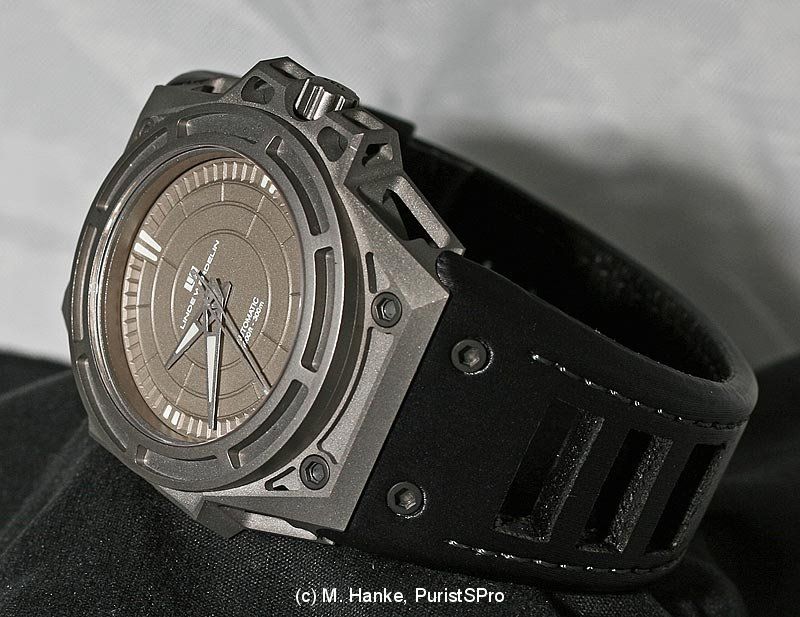
SpidoLite
Anyway, it is of course necessary to keep an eye on the small, lesser known, or even completely unknown brands and newcomers. These could be the Purist brands of tomorrow, and more than once we found highly interesting designs and ideas realised by such small companies.
For this year, I want to present you a very small and new manufacturer of sports watches. - Yawn, you might say - or rather express your boredom with. However, falling asleep now will make you miss an interesting novelty, I assure you.
The ideas behind Linde Werdelin were conceived by Morten Linde and Jorn Werdelin in 2002, followed by the official foundation of the brand in 2006. It can be truly called a European brand: While both, Linde, the designer, and Werdelin, the businessman, are Danish, the company is located in the United Kingdom, and uses Swiss watch technology. The goal behind the cooperation of the two gentlemen was the creation of a sports watch system, rather than of just another sports watch. This system should combine the advantages of the variety of information that can be collected and presented by electronic systems, with the solidness and classic feel of an analogue watch with mechanical movement.
Unfortunately, the first years of the brand activities went unnoticed of "purist" horology enthusiasts, despite its innovative approaches. However, the most certain way to catch purists' attention is to cooperate with an independent watchmaker, or better even, a member of the prestigious AHCI. This is what Linde and Werdelin did, approaching another Danish, the famous watchmaker and AHCI founding member Svend Andersen, and asking him to make a watch movement for them. The announcement alone worked well, since it stirred some interest in the watch lovers' communities. It was also the reason why I undertook the search for the small booth.
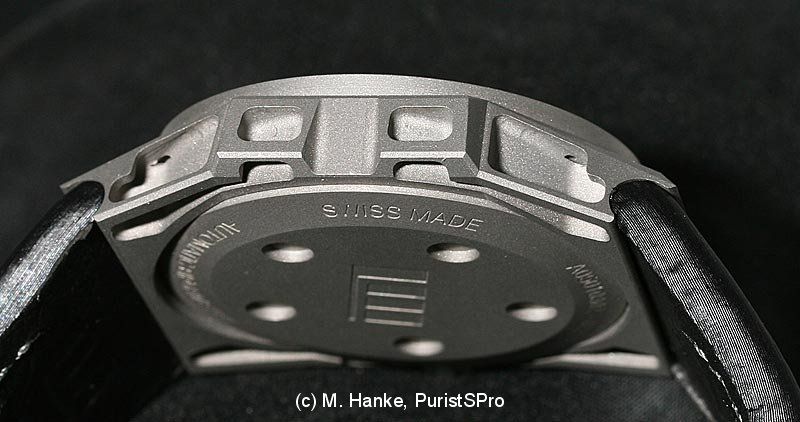
Here is the new watch in question, called SpidoLite. The constructive goal was to create a mechanical watch that is as light as possible. While using titanium as case material is a good starting point, Linde Werdelin achieved a hitherto unknown degree of lightness by fully skeletonising the case itself, leaving only what is necessary to keep the watch structurally stable and water tight to 300 meters. The result is a case weight of only 29 grams! For a limited edition of 44 pieces, Linde Werdelin even skeletonised the dial.
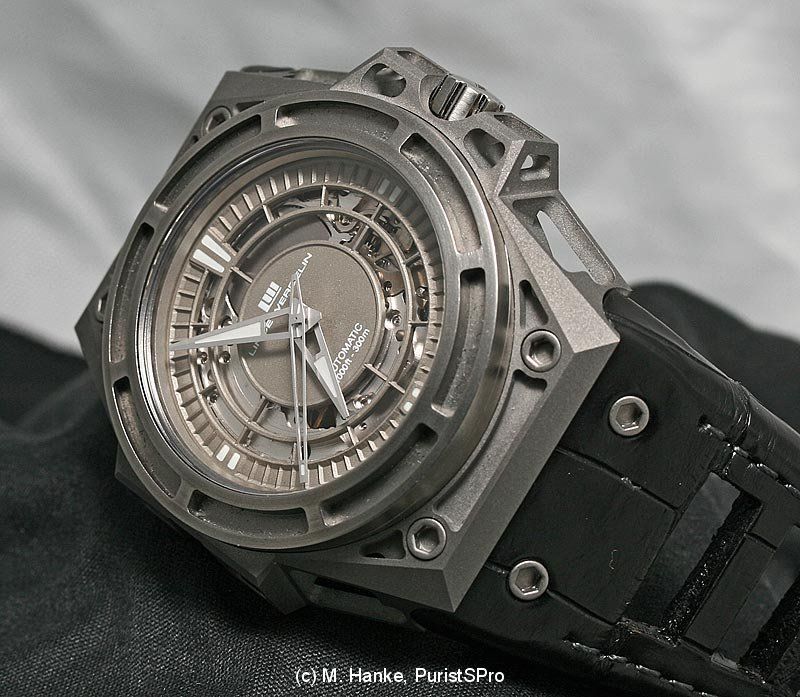
SpidoLite with skeletonised dial
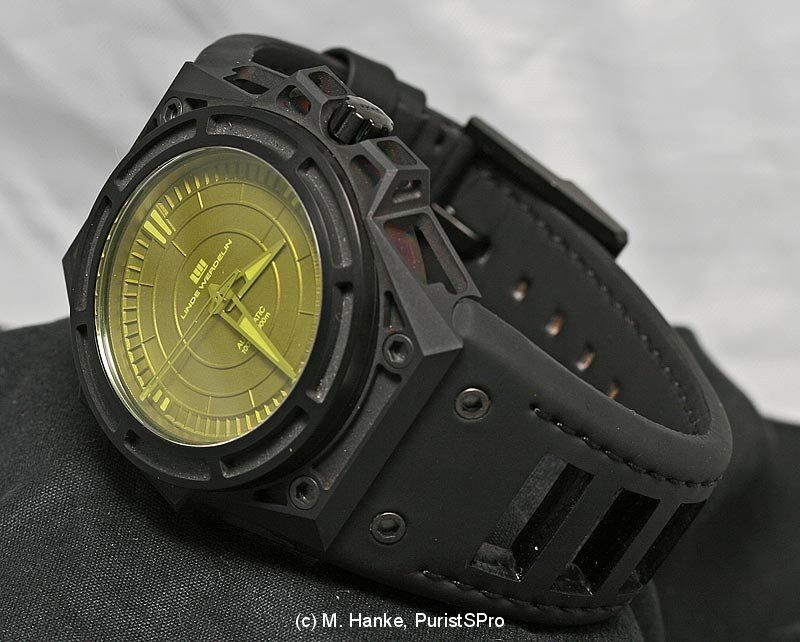
SpidoLite with experimental UV filter foil on the rear side of the crystal
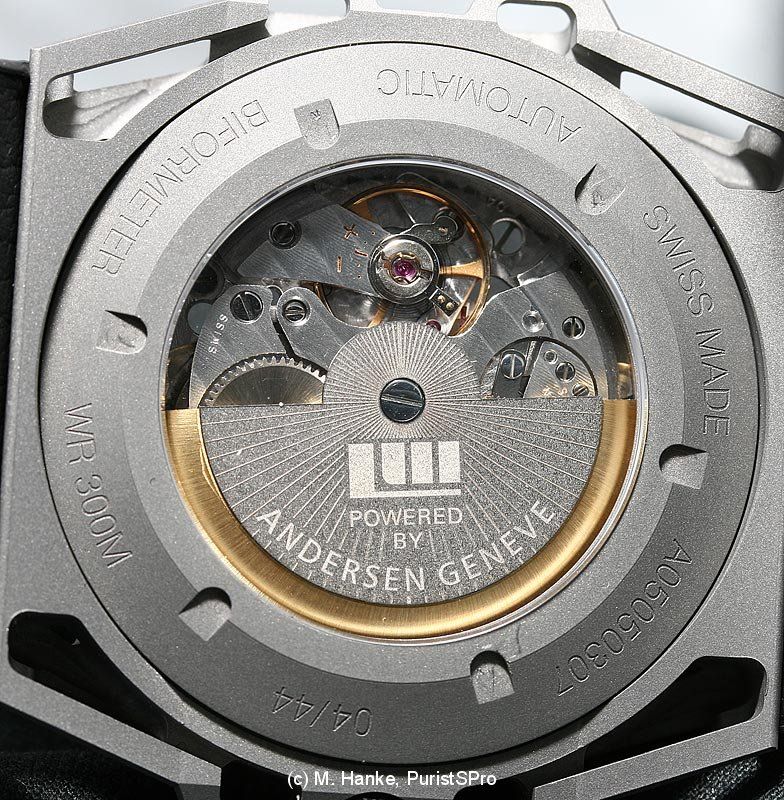
This is also the edition using the Svend Andersen movement you already have heard about. In fact, Linde Werdelin of course could not undertake the task of having a completely new movement designed and tested from scratch. Instead, Andersen took a batch of 1970s selfwinding movements, the A. Schild AS 1876, and completely reworked it. A new balance and fine regulator was added, as well as a new rotor with its bearing. Additionally, all parts were decorated and coated. Thus the old movement became able to reach a high degree of accuracy. All other watches in the LW collection are using the tried ETA 2892/3 A2 selfwinding movements.
In my opinion though, the truly interesting with this brand is not the old, rejuvenated movement. Rather the system as a whole is what makes Linde Werdelin really unique on the sports watch market. Every LW watch shares some common design features on the case; this being the general dimensions (except the height, which differs according to the water tightness rating), outlines, and the four depressions in the case flanks. These serve for attachment and locking of digital modules, which can be set on the top of the watch. Why should anybody want to do this?
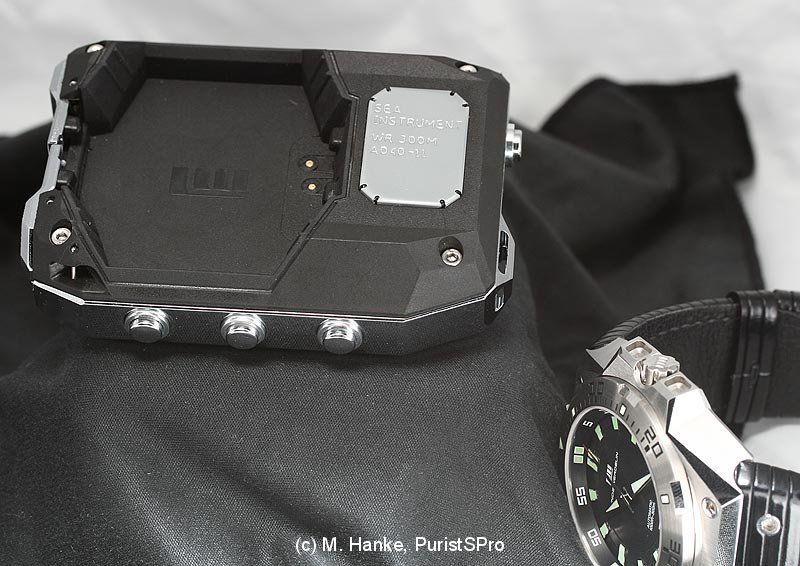
As I already have mentioned, the principle idea behind the LW sports watch system is to have a reliable and attractive mechanical watch, but to also have a digital sensor pack full of functions added, whenever necessary. An electronic module can measure so many data, and present the readings in a highly legible way.
This ability is especially needed for diving. Therefore, the most important digital module for LW watches is called "The Reef", and is nothing less than a veritable diving computer; complete with depth gauge, decompression chronograph, with alarm function when the decompression intervals are not followed, dive algorithms, water temperature, compass, and a logbook function, showing all the recorded data of the previous dives. While the module's battery is charged on an adapter, the user can also connect it with a PC by USB, and transfer the data to a logbook software.
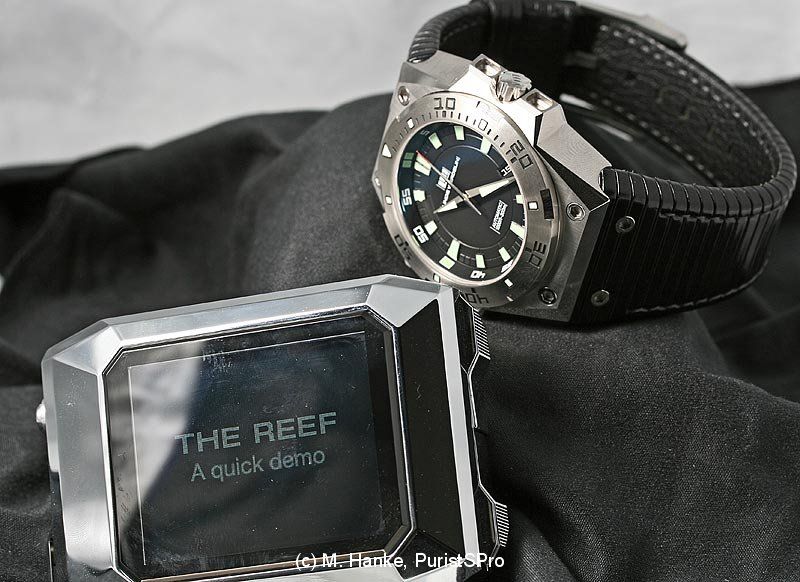
The One with marine module "The Reef"
Most divers use diving computers now, and take a mechanical diving watch with them, as a backup. Any instrument depending on electrical energy can fail in sudden temperature changes, when the stored energy is not enough. Therefore, a mechanical backup watch can save lives. With the Linde Werdelin system, the diver simply unplugs the digital module from the watch, and has the backup underneath.
Not only divers are taken care for, but also climbers and skiers, mountain bikers and other outdoor activists. A smaller module, called "The Rock", adds a compass, barometric altimeter, chronograph, inclination reading, and an external temperature sensor. Unlike other thermometers integrated into watches, this sensor does not measure the wrist temperature, but is external, and can be clipped anywhere with a karabiner hook. It communicates with the digital module by a 2.4 GHz wireless sensor network.
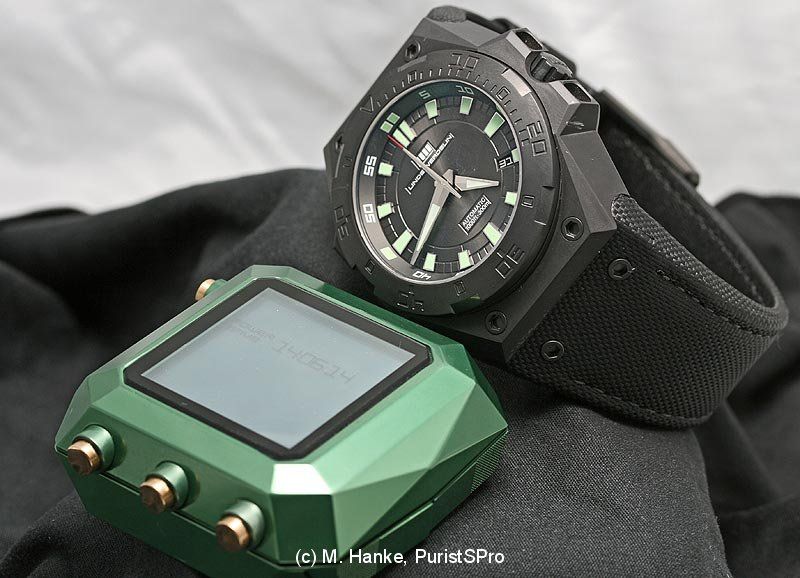
The One with land module "The Rock"
Additionally, "The Rock" warns from frostbites, avalanches and weather trends, and even includes a ski guide database (currently several resorts in France, Italy and Switzerland). Its log book can also be transferred to a computer. Both modules are prepared to accept a GPS receiver, which will be implemented shortly. The nice thing is that the digital part can be upgraded, and is not that expensive to be replaced, even if it is damaged beyond repair. They are offered in various finishes and colours.
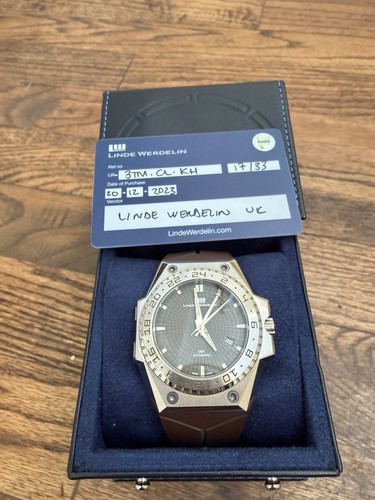
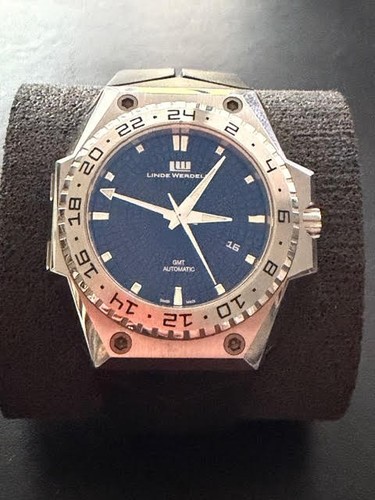
Under either "The Reef" or "The Rock", one can wear the SpidoLite already mentioned, or the other three models offered in the Linde Werdelin collection. the most elegant of them is the 3-Timer, which adds a 24 hours hand and a separately bi-directionally turning bezel with 24 hours markings. This permits to read three different time zones.
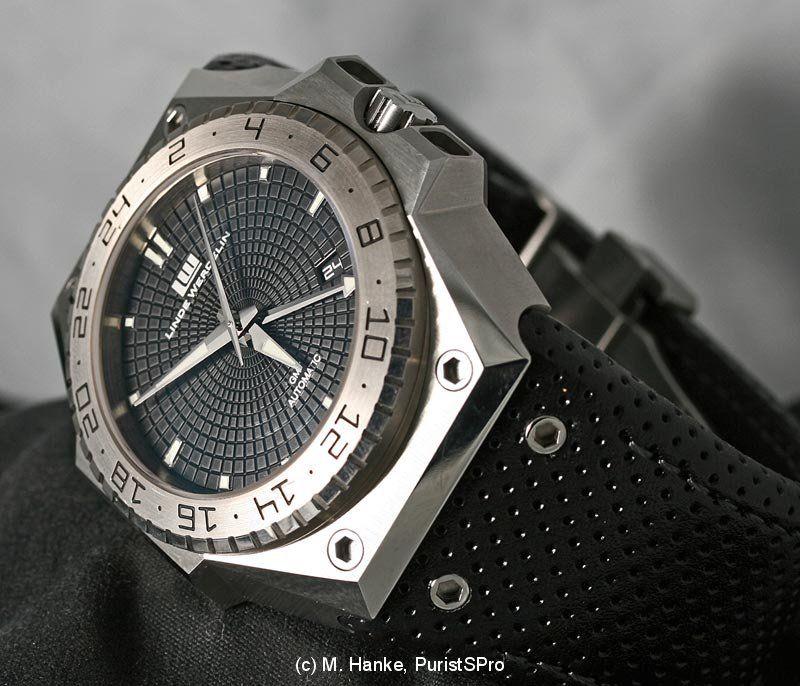
3-Timer
A bit more bold is the design of the standard dive and sports watch, simply dubbed "The One", and my personal favourite. It is rated to 300 meters depth, has larger luminous hands and markers than the 3-Timer, and a diver bezel.
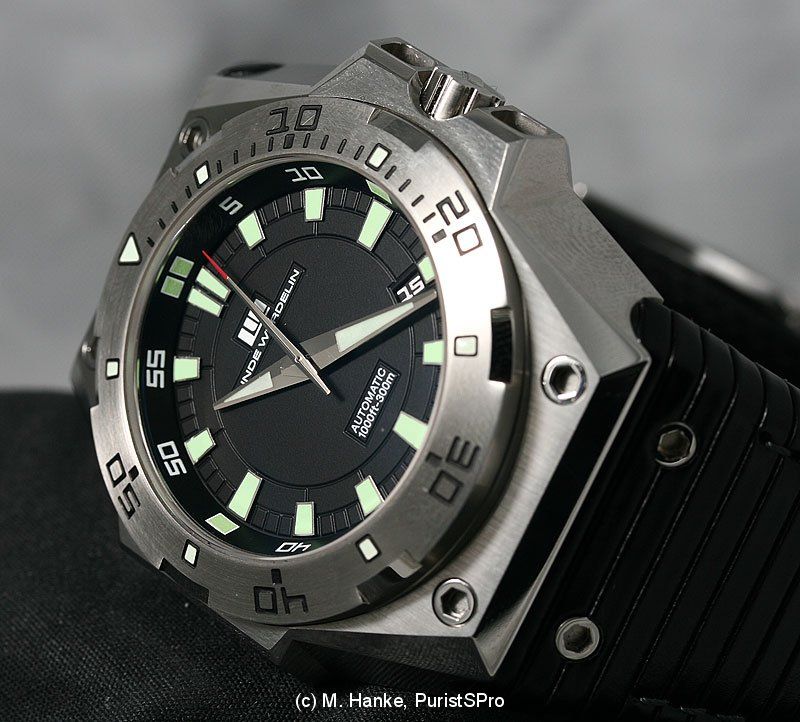
The One
Finally, the "Oktopus" is the specialised diving watch, with a substantially thicker case and a 4mm sapphire crystal, resulting in a rating down to 1,111 meters, or 3,333 feet. For the larger markers, the date window had to be sacrificed.
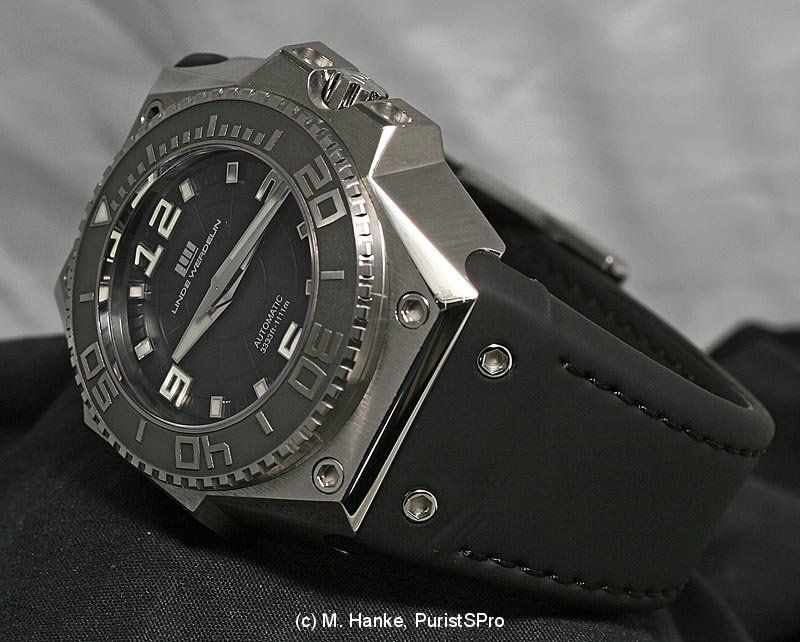
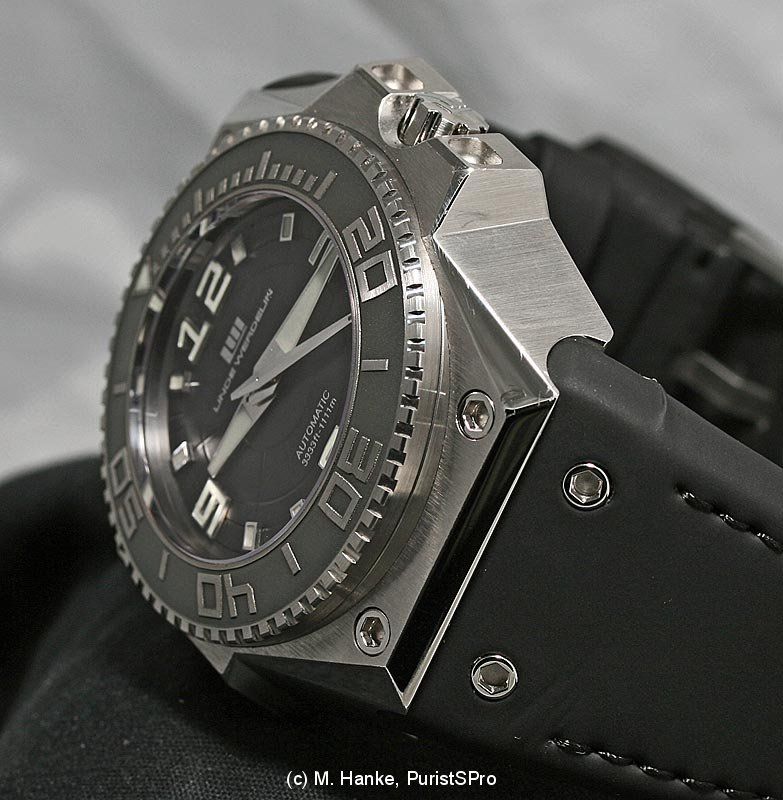
Oktopus
I think Linde Werdelin is a highly interesting niche brand. Unlike many other products I saw in Basel, designated sports watches, the LW concepts bear the traces of real experience. I hope to see that development to be pursued further. So, did I make false promises? You have to admit: Falling asleep because of "'ye another sports watch brand" would have been a mistake here, wouldn't it?
Regards,
Marcus
This message has been edited by Marcus Hanke on 2009-04-10 13:04:20
This message has been edited by MTF on 2009-04-14 07:48:34 This message has been edited by Marcus Hanke on 2009-04-15 00:19:23