WPS member · Horological Meandering forum
34 replies25696 views0 photos
Marcus Hanke provides an exclusive tour of Donzé Cadrans, the renowned enamel dial manufacturer recently acquired by Ulysse Nardin. His report highlights the intricate, dust-laden process of creating 'grand feu' enamel dials and the company's crucial role as a supplier to numerous luxury watch brands, preserving a unique handcraft tradition.
Donzé Cadrans: Visiting the famous enamel dial maker
Report by Marcus Hanke
Just a year ago, Ulysse Nardin announced that it had acquired the enamel dial manufacturer Donzé Cadrans:
ulyssenardin.watchprosite.com
Not only was this small company, run by Francine Donzé and her
spouse Michel Vermot, responsible for the landmark Ulysse Nardin watches
with breathtakingly executed cloisonné enamel dials, but also supplied
plain enamel dials “a grand feu” to the majority of luxury watch
manufacturers.
When the couple neared their retirement, they tried
to assure the continued operation by searching a buyer who would be
aware of this handcraft’s unique tradition. What would be more natural
than to choose its long-standing partner and customer Ulysse Nardin?
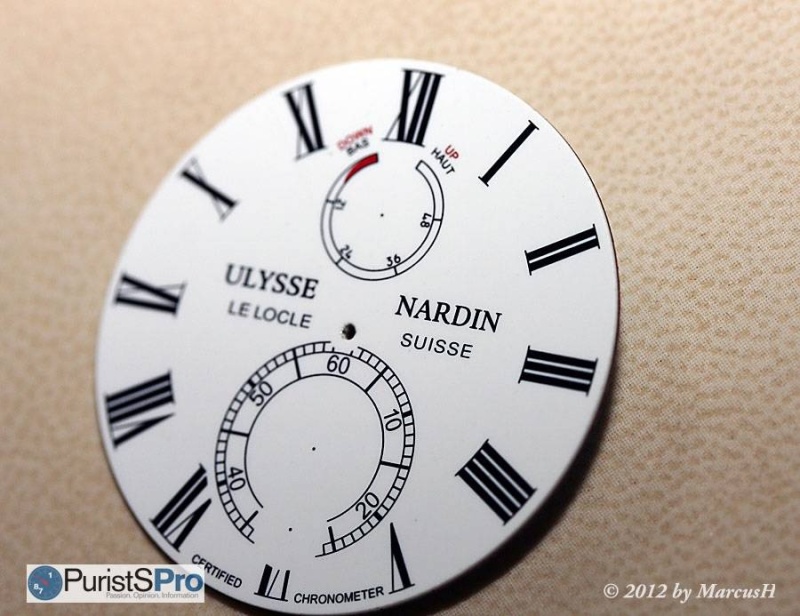
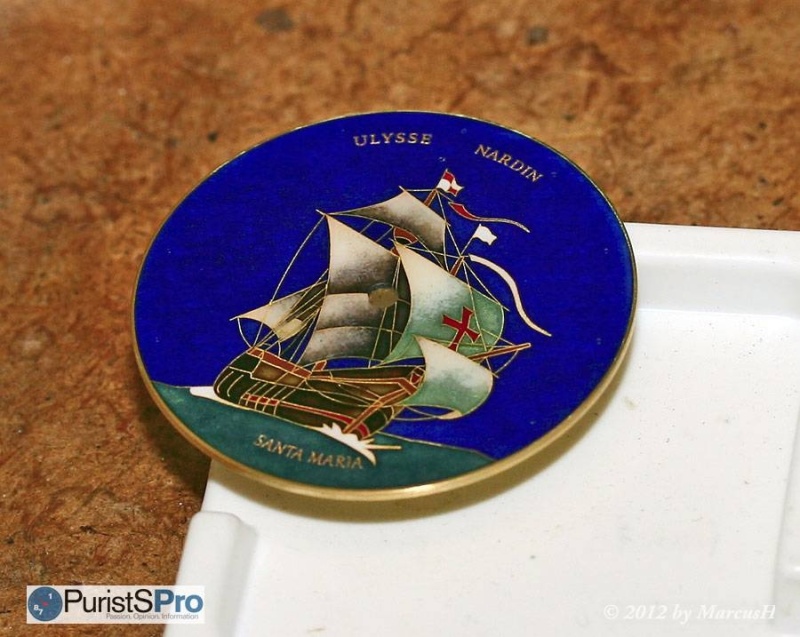
Consequently, I was eager to pay Donzé Cadrans a visit when I came to Le Locle this July.
A
navigation system is not a must, but clearly helps finding the
company’s building in the Rue de l’Avenir, the “Street of Future”.
Hidden behind other buildings, up on one of Locle’s numerous hillsides,
and after some very sharp turns and twists of narrow roads, is an
inconspicuous building in the style of the 60s. Currently, it is under
renovation, since the company did not see a lot of investments during
the last years of operation. The first thing apparent is the ubiquitous
layer of powder fine dust covering practically every surface, be it
horizontal or vertical. At first I credited it to the renovation works.
“No”,
our charming guide Claude-Eric Jan says. He is responsible for the
operations at Donzé Cadrans. “This is enamel dust, resulting from the
application of the enamel powder to the dials, from polishing and
cutting procedures. It is everywhere, you cannot avoid it.”
“When
Ulysse Nardin had acquired the company, they also got the old building;
it was part of the deal. To avoid a costly renovation, it was planned
to integrate the dial manufactory into Ulysse Nardin’s main production
facilities. However, there all effort is undertaken to keep dust away
from the watch production, so it would have been a bad idea to bring
such a source of fine dust as our enterprise into close proximity.”
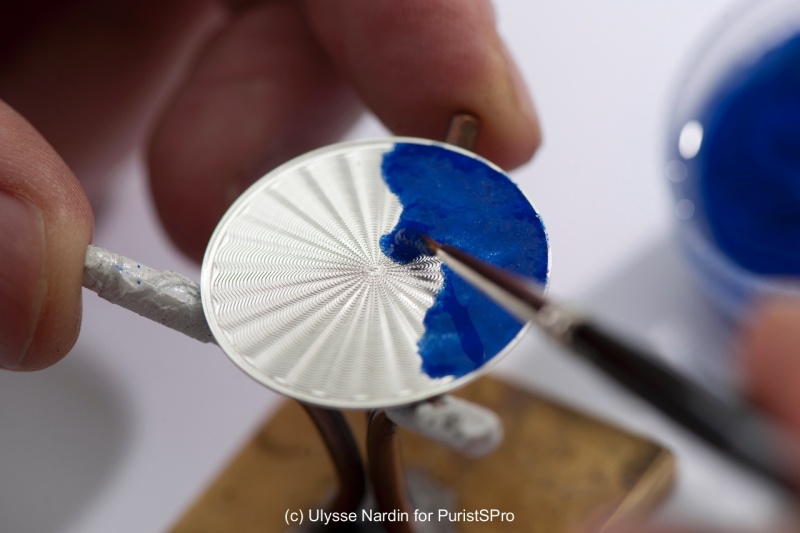
The
decision to keep the enamel dial production separated from the Ulysse
Nardin watch factory had another, previously unexpected advantage, which
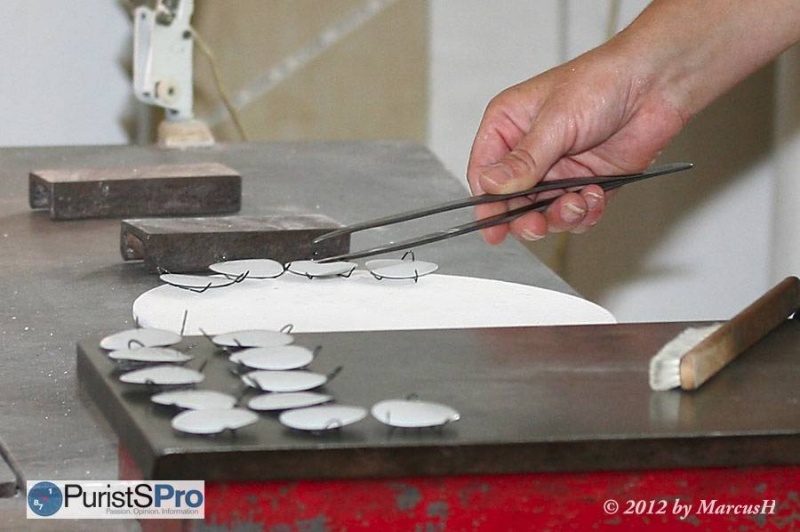
is now demonstrated by Claude-Eric: Before us, he aligns a series of
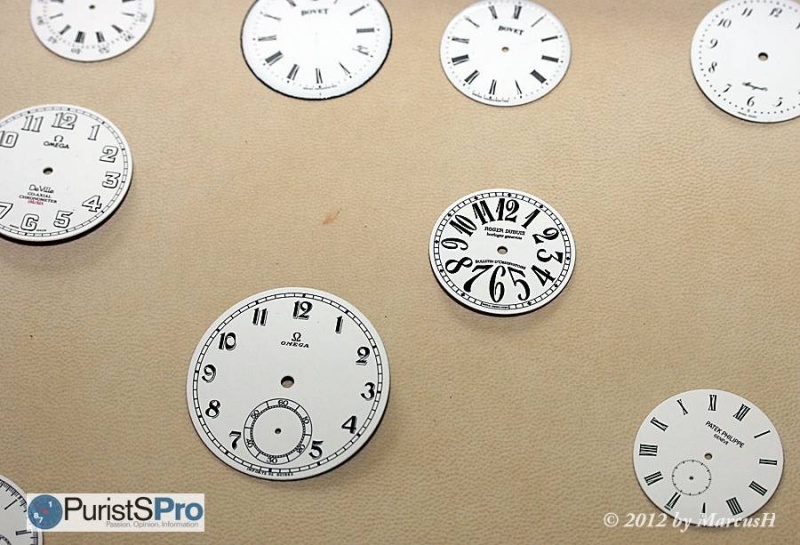
fine white enamel dials, all wearing names of famous watch companies:
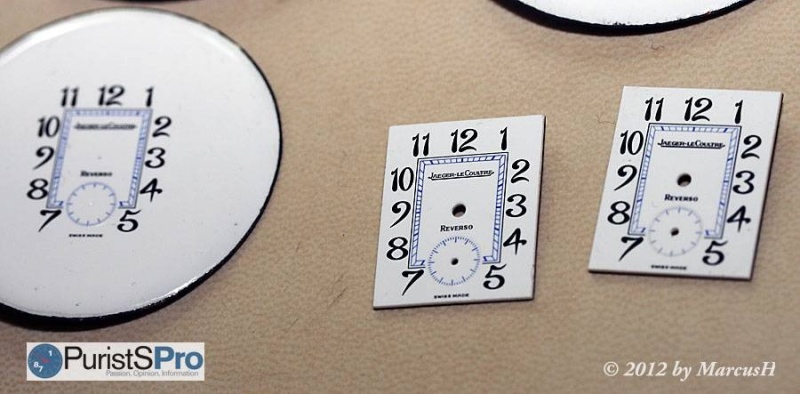
Patek Philippe, Jaeger leCoultre, Girard Perregaux, Omega, Lang and
Heyne (from Dresden), Roger Dubuis, and many others. Enamel dials are a
common sight on very sophisticated watches and limited editions. Yet
there is only a handful of dial manufacturers in Europe still able to
produce them. Additionally, Donzé Cadrans has a reputation of producing
first rate dials on time, which is another very decisive factor. It
makes things easier if watch manufacturers order their enamel dials from
Donzé, instead from Ulysse Nardin.
Showing
us various beautiful dials, Claude-Eric points out that, unlike other
producers, Donzé does not print the various text and register elements
onto the enamel surface. The standard printing process of numerals,
markers and inscriptions results in the printing paint to show a raised
structure on the dial surface. Instead, Donzé adds all these graphic
elements with enamel paint and fires them into the enamel base, thus
achieving a perfectly smooth and even surface.
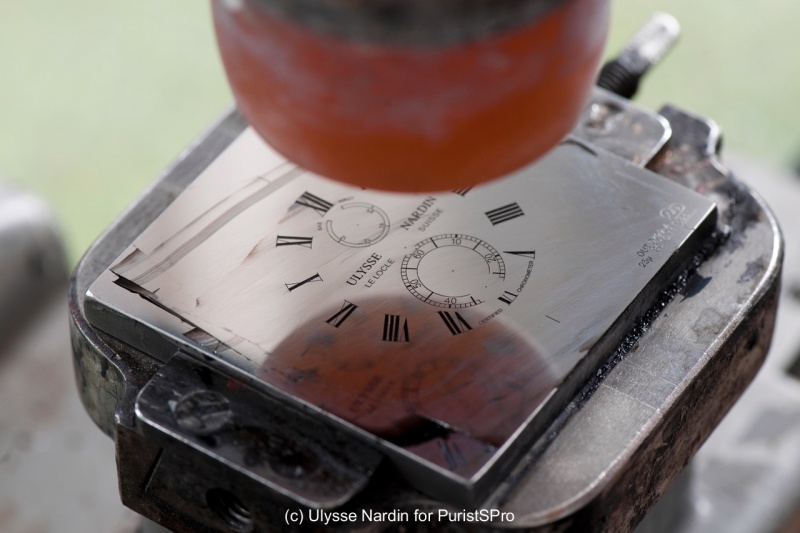
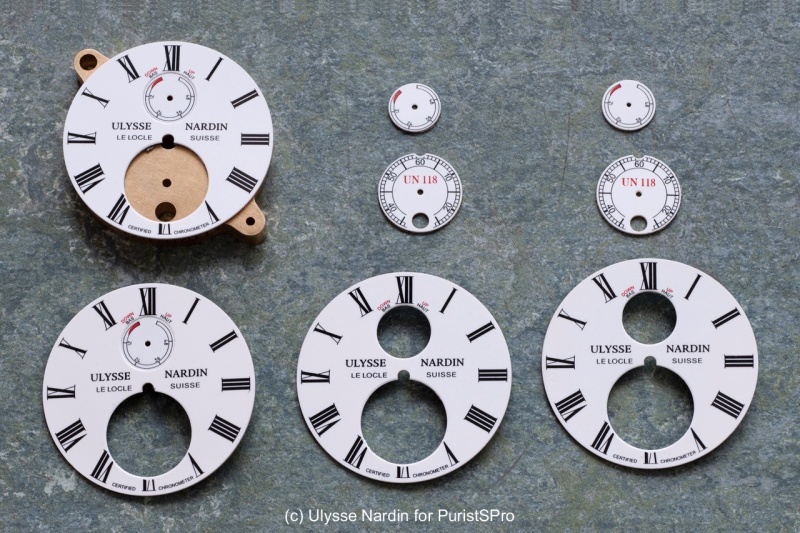
Led through the
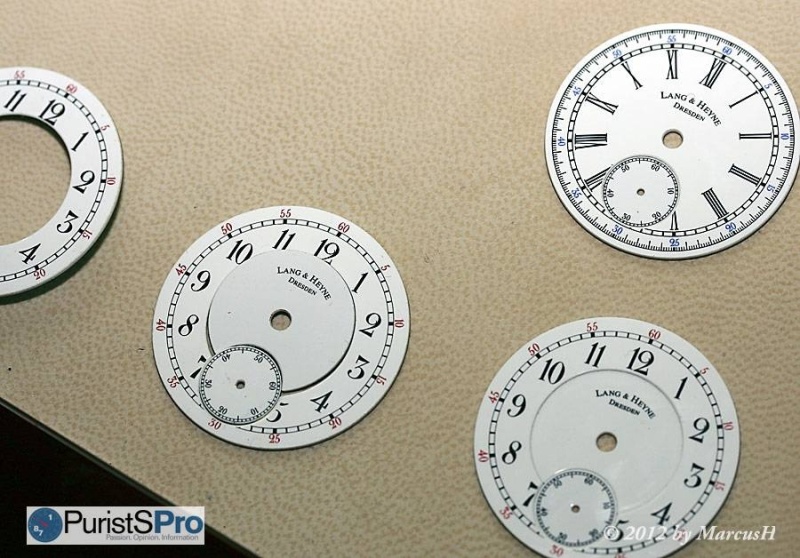
workshop, we witness the production of the new limited edition Marine
Chronometer’s enamel dials. This is noteworthy because of its layered
structure: the power reserve display and the small second are on
separate enamel disks on a lower layer. Consequently, the base dial
needs circular cutouts for these additions, which are enamelled
separately in several productions steps, including their enamel
inscriptions and scales. Afterwards, they are soldered into place under
the main dials.
What are the main production steps of plain enamel dials “à grand feu”?
The
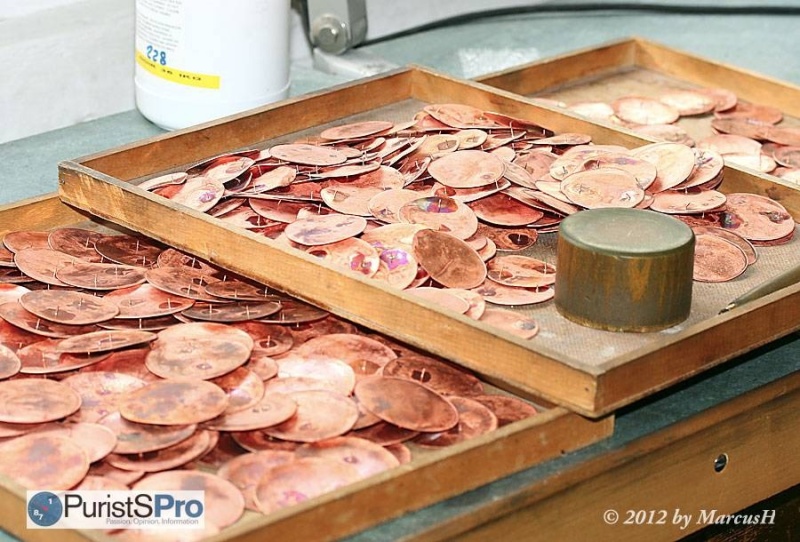
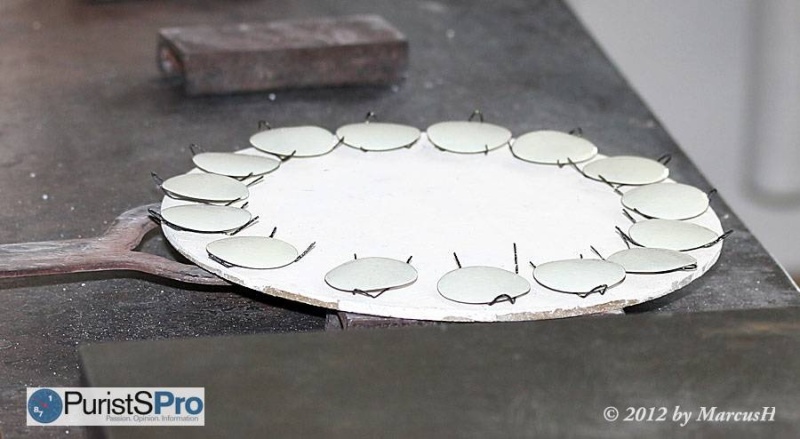
base material are copper disks, precut into standard sizes. At first,
the dial legs are soldered onto the rear side, then a single layer of
enamel is burnt onto the same side. If this would be neglected, the dial
would bend hopelessly out of shape during the later steps of layering
the enamel on the front side.
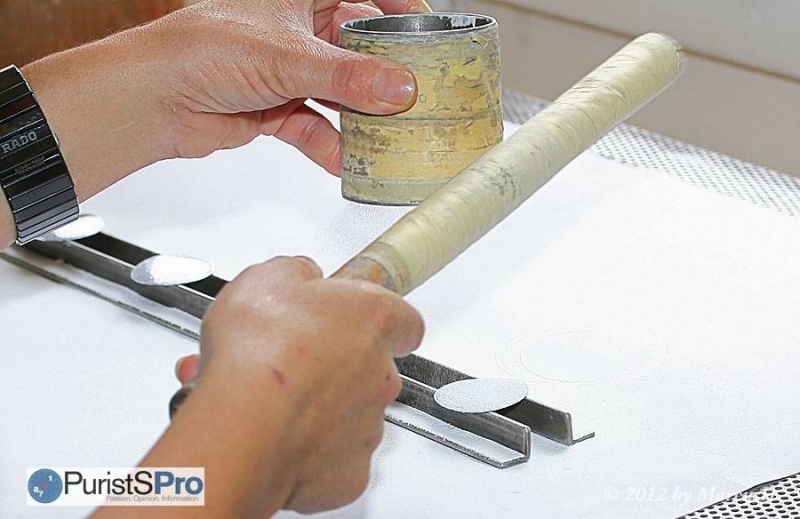
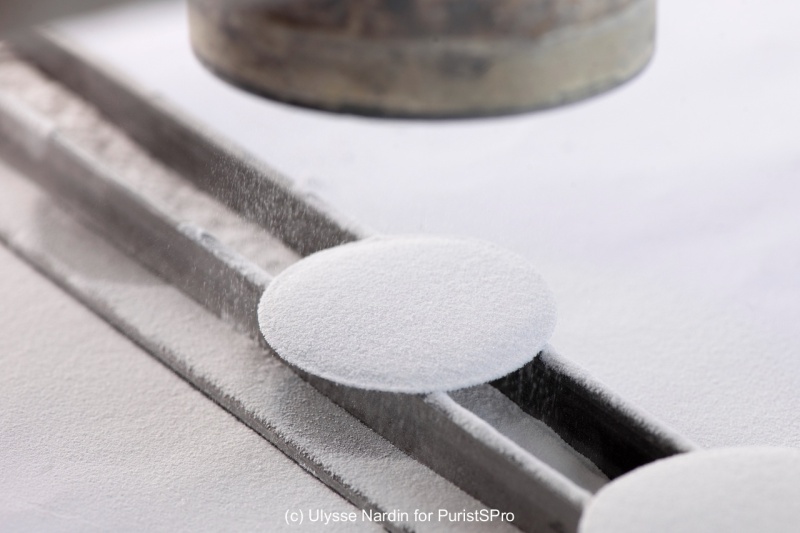
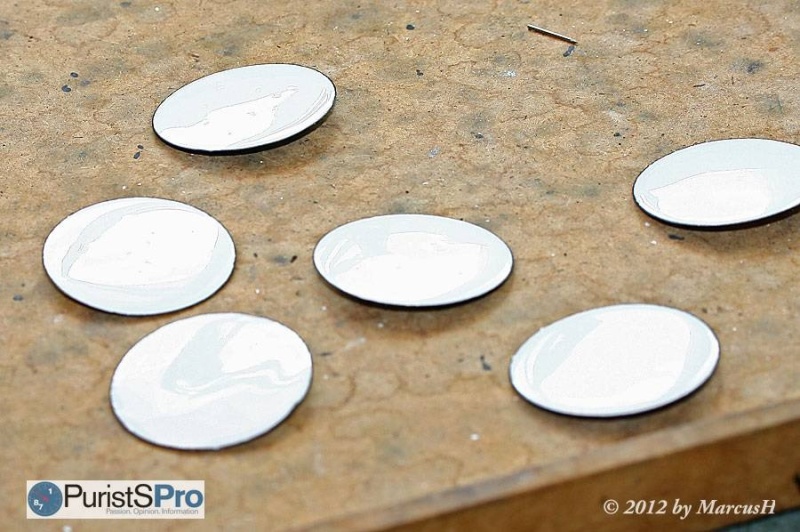
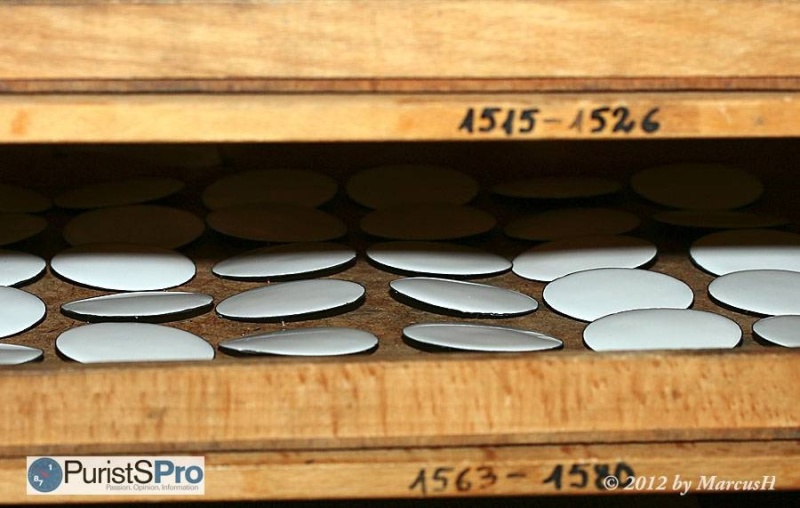
To
achieve the enamel coat, the master enameller dips the copper disks
into a jellylike, inflammable liquid, then she sprinkles the enamel
powder evenly onto the surface, like powder sugar on cookies.
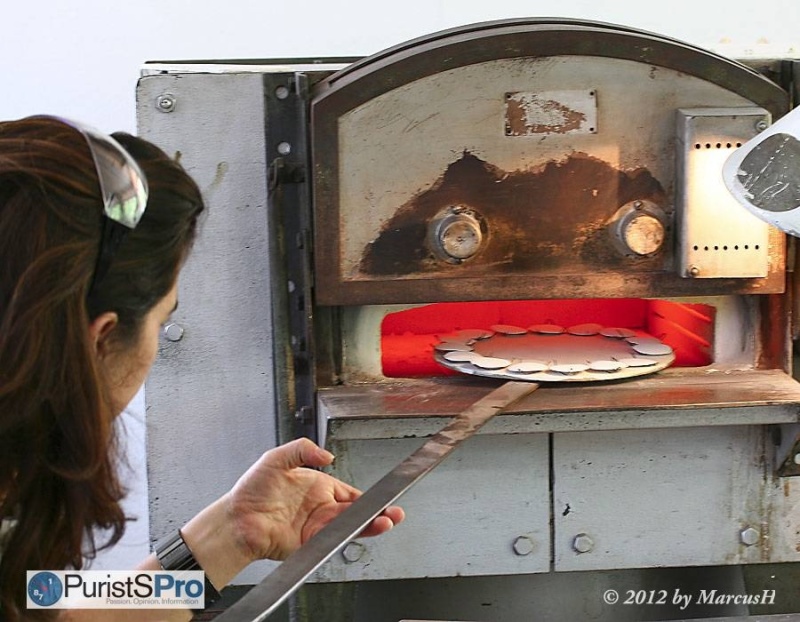
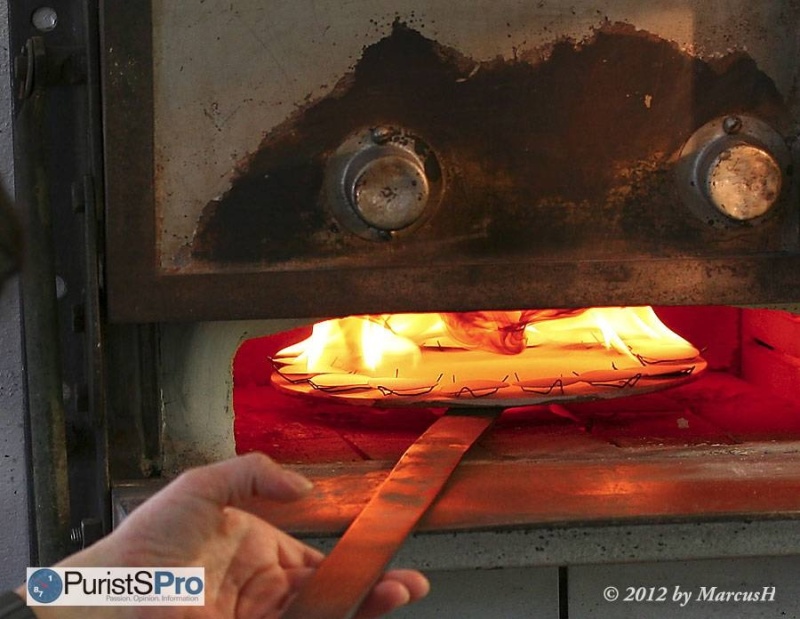
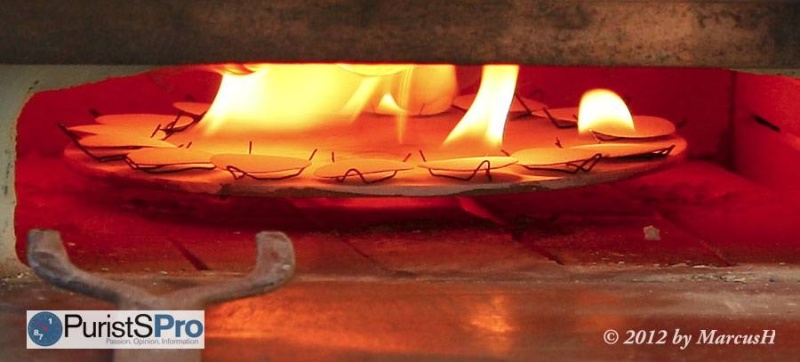
After
insertion into the furnace, which dates from 1947, the liquid brightly
flashes and burns at a high temperature, transforming the silicium,
feldspar and kaoline powder into a hard and glassy substance. The
furnace temperature is about 800 to more than 1,000 degrees Celsius,
depending on the composition of the enamel powder used.
The
duration of the heating process is solely based on the enameller’s
experience, there are no fixed values. It depends on many factors, the
size of the disks, the number of enamel layers already applied, and -
not least - on the day temperature and humidity. The master enameller
needs a good eye and a lot of experience, we had no idea about the right
moment when the disks were to be removed from the furnace.
Layer after layer is thus applied to the dials, until that typical enamel shine is achieved.
Just
as I think these dials should be perfect, I witness with terror how the
enameller starts mutilating them with chisel and hammer! Oh no! Okay,
it is a tiny chisel, and a tiny hammer, but nonetheless I cannot believe
that the result of so much work and handcraft is damaged, if not
destroyed for no apparent reason.
“I told you that it is
impossible to work in a dust-free environment here”, Claude-Eric
hurriedly explains, having seen my bewilderment. “Consequently, every
dial has some dust particles or other tiny flaws that became integrated
into the enamel. What she does is chiselling out all those small spots,
then the depressions are filled with enamel powder and fired again.” -
“And how often does she do this?” - “Until the dial is perfect.”
Slowly I start to realize why watches with enamel dials are so expensive ...
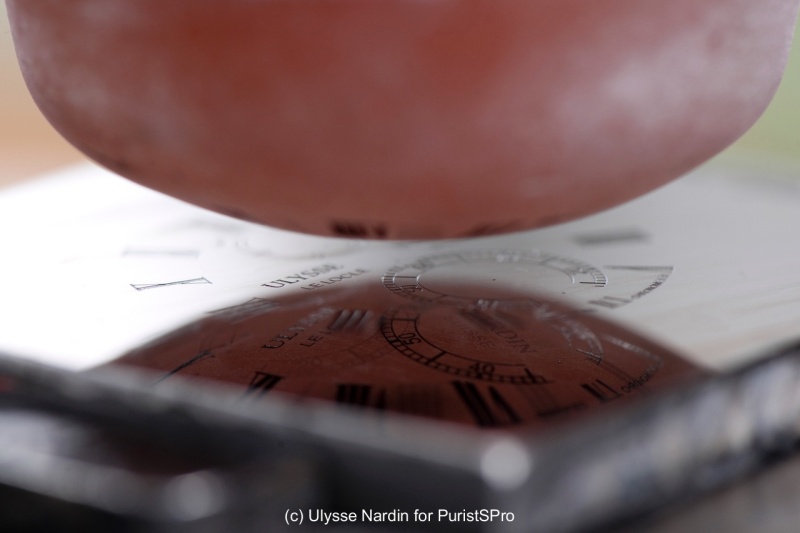
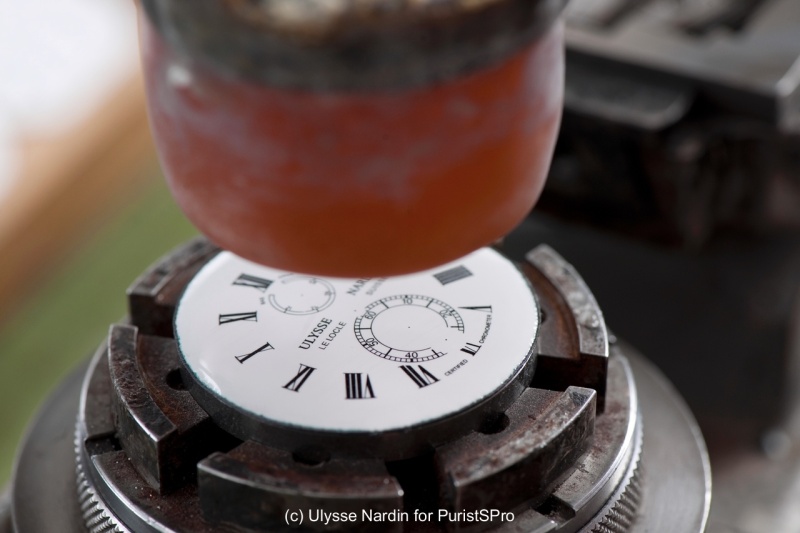
Only
when the enameller is fully satisfied with the quality of the plain
base, the dial is ready for printing the registers and inscriptions. At
Donzé, this is also done with enamel powder that is fired thereafter,
once for every colour used. The printing procedure is done by a
so-called tampon, a flexible stamp picking up the colour from a template
and transferring it onto the dial. This method is common standard in
the watch industry, for printing not only dials, but also date rings,
etc. However, normally the stamp used is made from silicon, which does
not work on enamel. As a consequence, the expert at Donzé is making his
own stamps from gelatine gel.
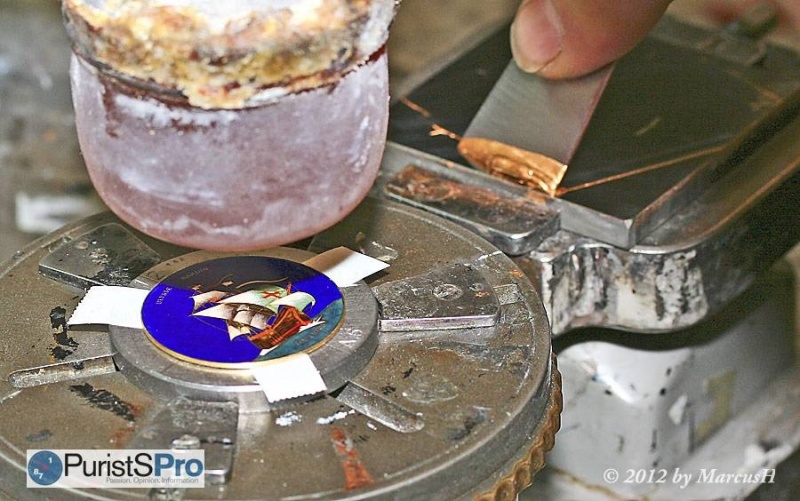
Finally, the copper
disk is cut to the correct size; a most delicate step, since the
brittle enamel coat could easily break and thus ruin the work of hours.
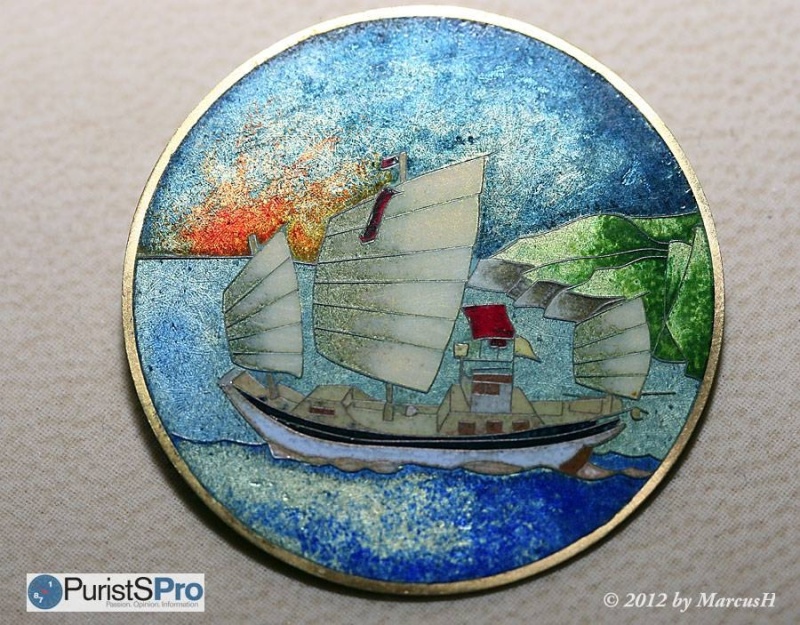
The
best known product of Donzé Cadrans, however, are artistic cloisonné
enamel dials, mostly made for Ulysse Nardin, but also for other watch
manufacturers. This is a most complicated process:
After
the design is decided upon, it has to be divided into segments that
would serve as colour cells for the enamel. This is still done at the
drawing board. Then the finished drawing is scaled to the dial area, to
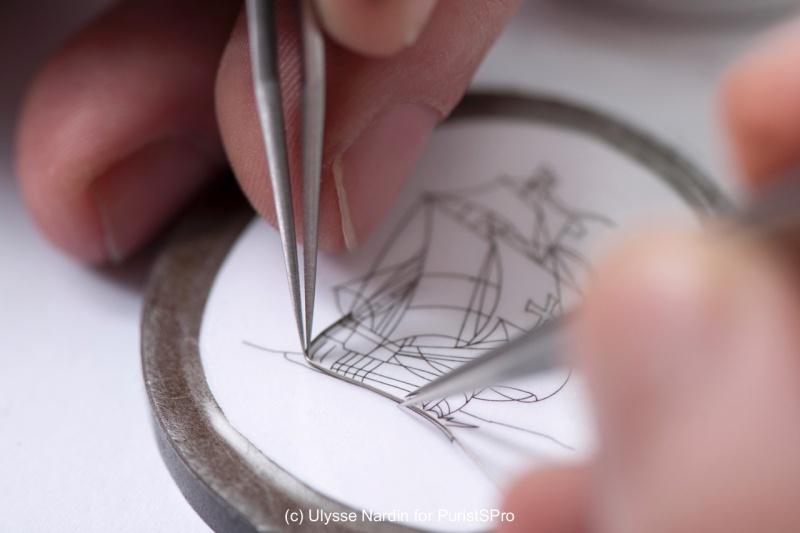
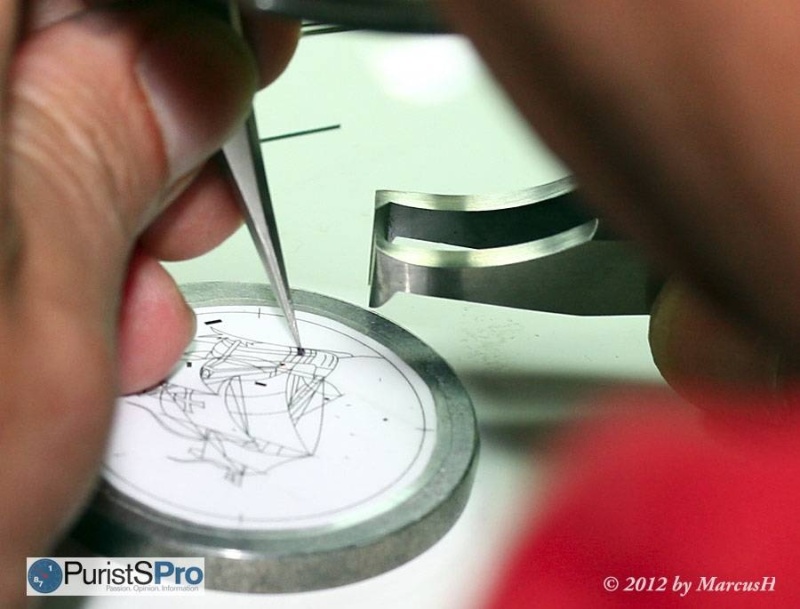
serve as a template. Following the outlines on the paper, the artist
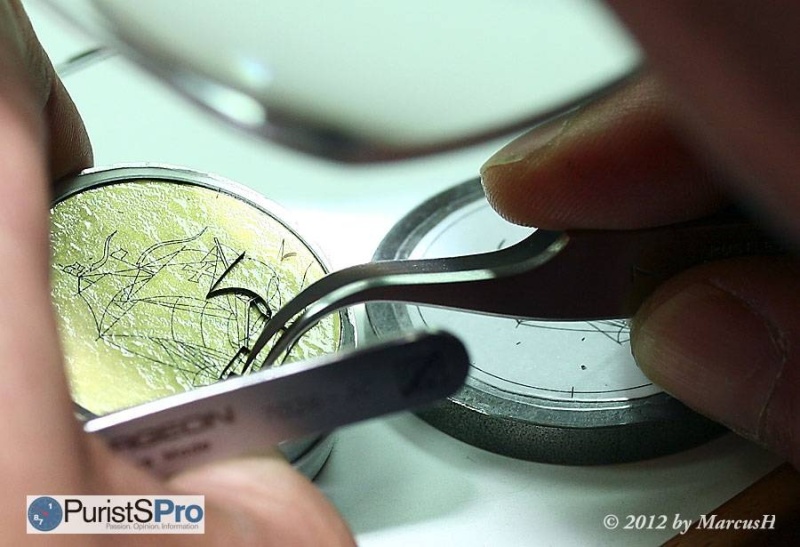
bends hair-thin gold wire with two pliers, to shape the segmental cell
walls of the cloisonné dial.
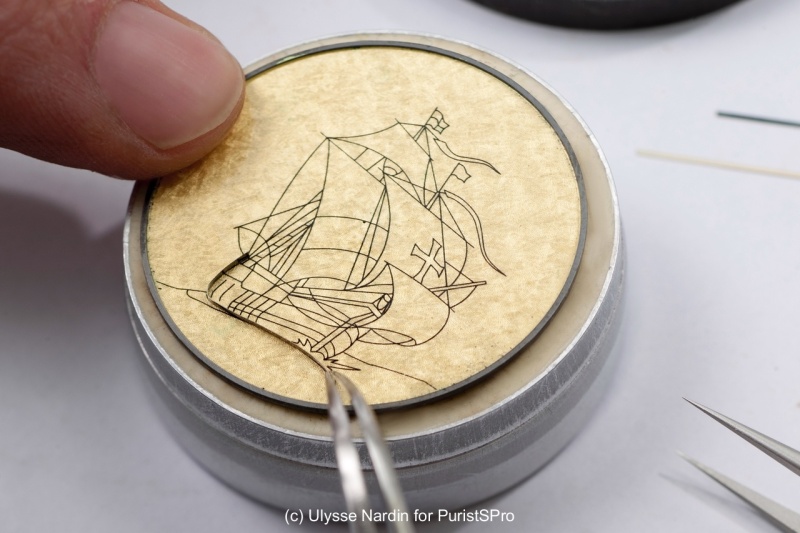
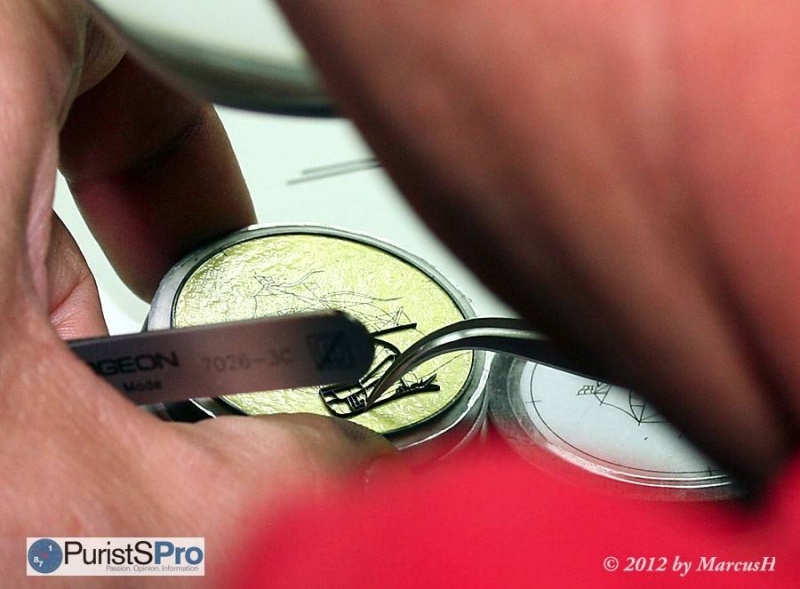
Afterwards,
the gold wire is lightly “glued” to the dial. In other companies, this
is achieved by soldering the wire to the base by a laser. At Donzé,
though, the traditional way is preferred, which necessitates that all
wire cells support each other as a self-supporting construction, like a
house of cards; the few drops of vegetable glue are only there to avoid
that the design collapses when the dial is moved.
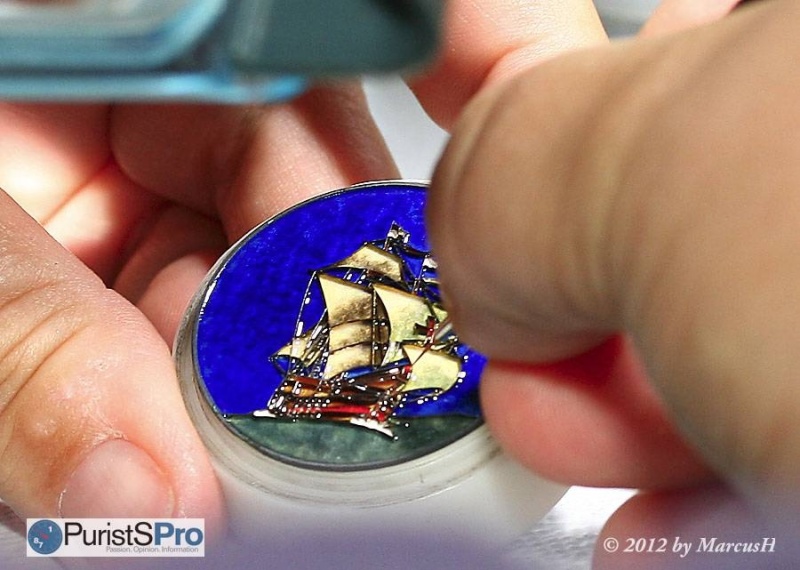
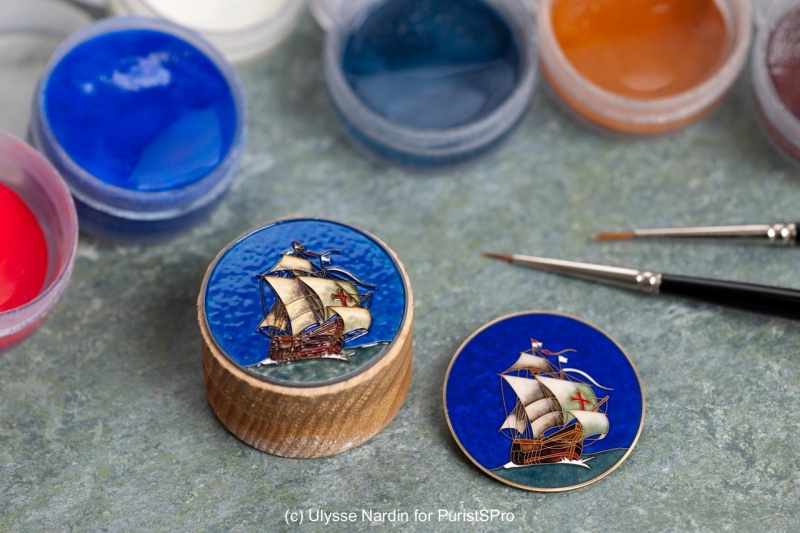
Filling the
cells with colour is the job of a painting artist. “She is a colour
genius”, Claude-Eric praises his employee. “In the furnace, the enamel
colours change their tones, so it is essential to compose the finished
dial in the head, before choosing the appropriate paint. Especially
difficult are combinations of colours: what looks nice after painting,
may be entirely different after firing.”
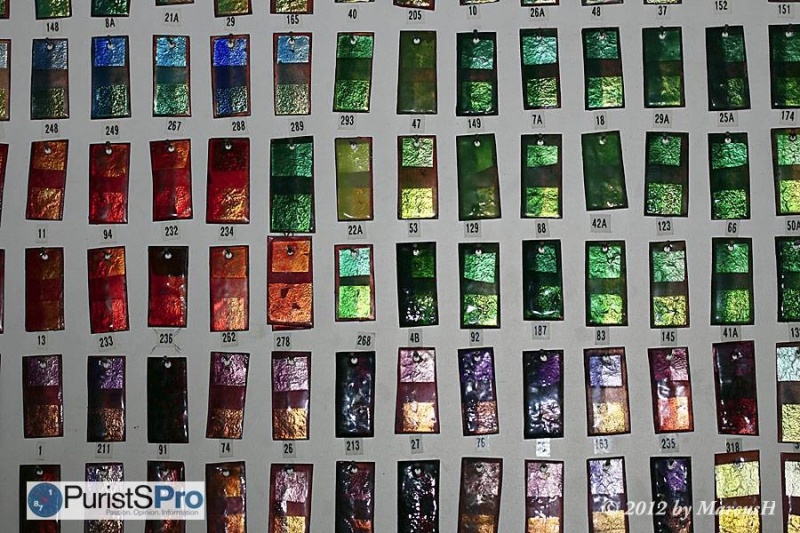
To
avoid unpleasant surprises, a wall of the workshop is covered with
small metal shields, coated with enamel colour in all possible
combinations.
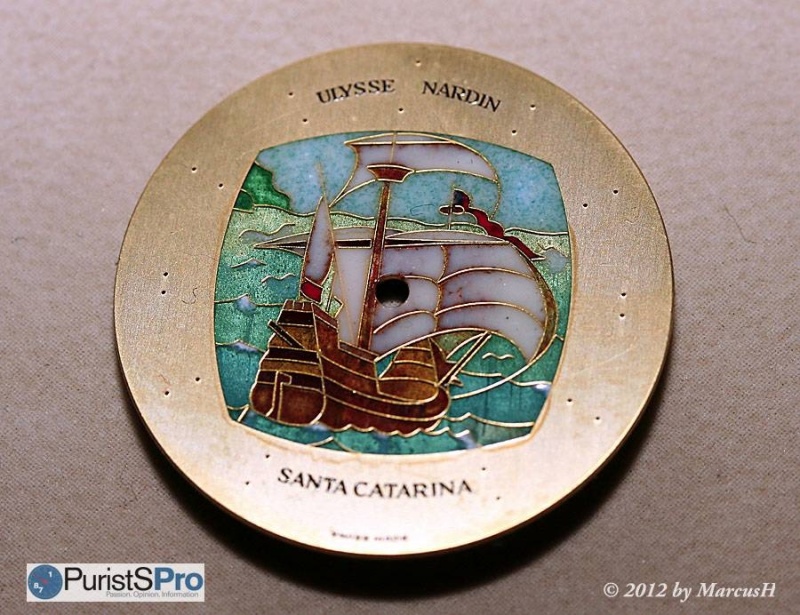
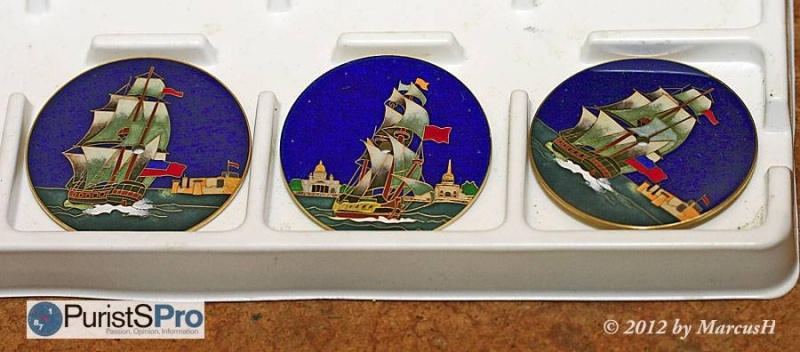
Even
then, a lot of work is in vain sometimes: Claude-Eric produces a
cloisonné dial from a drawer. “When we started to make the new “Santa
Maria” dials, we thought about a slightly different presentation.
Traditionally, our dial ships are sailing in a blue sky. Now we wanted
something more dramatic, a stormy sky with brighter and darker parts.
Only after we finished the dial, with all production steps, we realized
that it was too much - the “Santa Maria” appeared to struggle for
survival, which is not what we wanted to show. So we returned to the
more traditional, but proven colour scheme.”
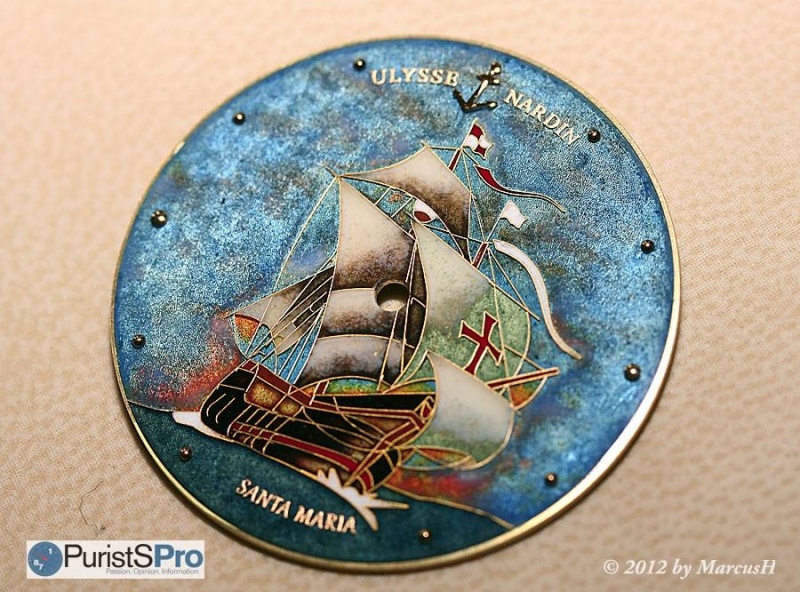
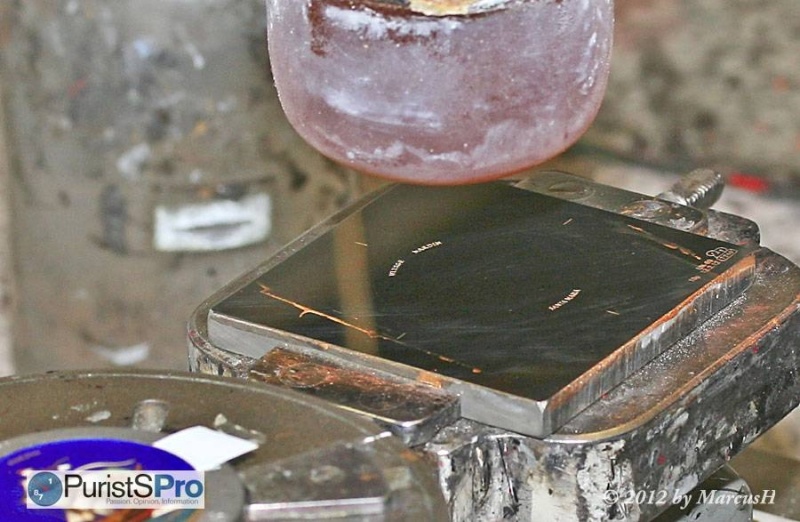
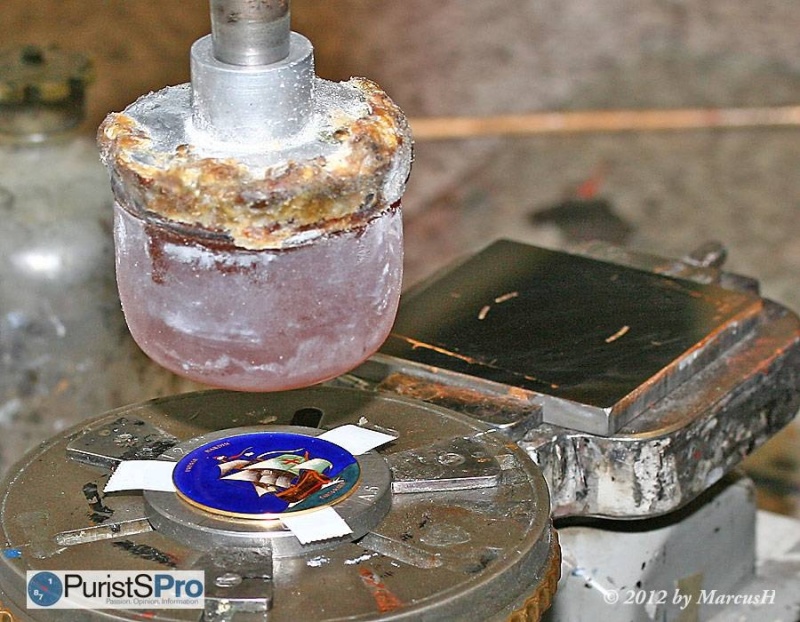
The "stormy" Santa Maria dial that was not adopted for the series
The
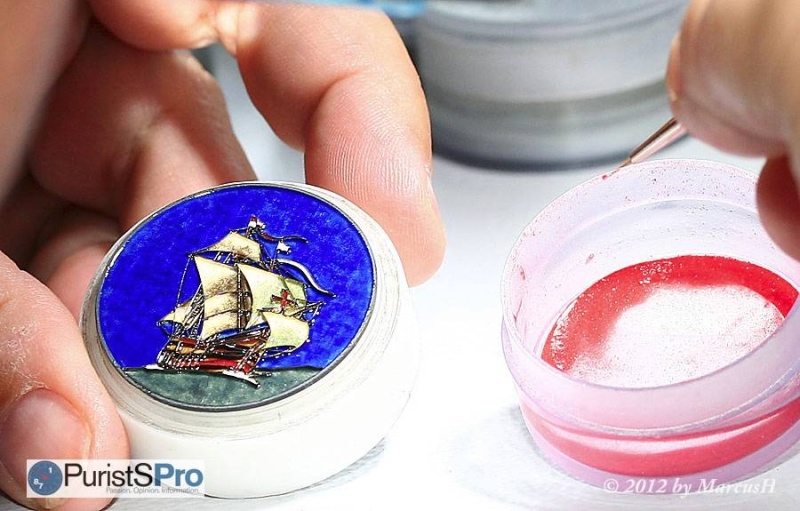
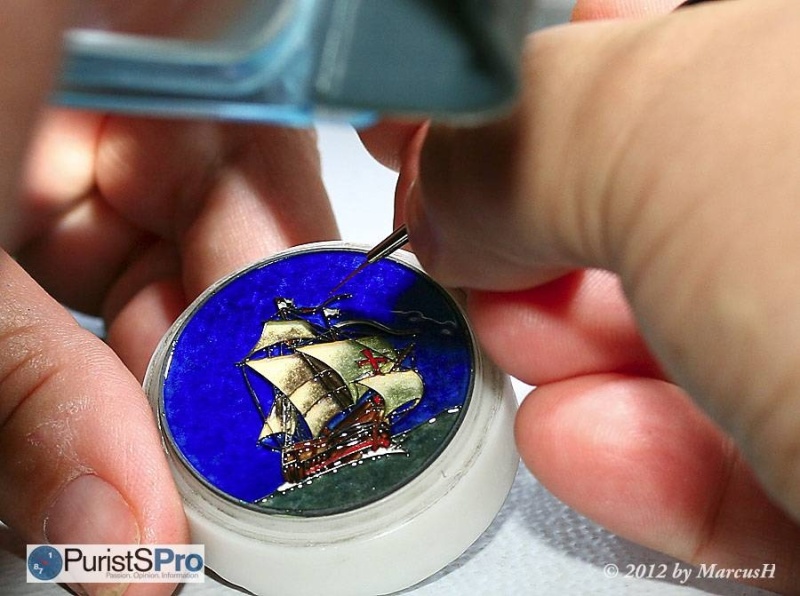
artist uses tiny brushes to fill the cells, sometimes they cannot
consist of more than a few individual hairs. The layers must not be too
thick, otherwise the enamel could crack in the furnace. So the painting
and firing has to be repeated, four or five times, until the coat’s
final thickness is achieved. The projecting gold wires are then
polished, until they are flush with the enamel, resulting in a perfectly
smooth surface.
The
final step for the cloisonné dials is printing, too. This is done with
gold colour that is not fired, but extreme care has to taken
nevertheless: The enamel does not take on enough paint in a single step,
so the printing has to be repeated three or four times. Even the
slightest movement of either the dial or the print template will result
in a print that is out of register.
Exhausted
from so many impressions, and already covered by a thin layer of enamel
dust we say farewell to our host Claude-Eric and this wonderful shelter
of traditional craftwork, where CNC, lasers and robots have no place -
and hopefully will not have one in the future as well.
This message has been edited by AnthonyTsai on 2012-09-05 06:28:39 This message has been edited by MTF on 2012-09-10 07:07:25 Key Points from the Discussion
- Working with fine enamel dust poses potential health hazards similar to silicosis, emphasizing the need for protective measures for workers.
- The report raises a question about the printing process of numerals on enamel dials, asking for clarification on whether elements are integrated into the powder before firing or printed on using a tampon after firing.
- Enamel dials are fascinating and irresistible, but their quality can vary significantly between brands, leading to a question about whether Donzé Cadrans produces different quality dials based on contractual prices.
- The art of porcelain painting, a similar craft, requires extreme attention to detail and immense patience due to the unpredictable outcome from the furnace.
- The post is highly valued for explaining the difficulty of manufacturing enamel dials, making it a valuable resource for understanding this intricate craft.
- Collectors express increased appreciation for their own enamel dial watches, such as the Richard Lange Pour le Mérite, after understanding the skill and work involved in their creation.
Advertisement
Available on the marketplace
374 Ulysse Nardin listings are live on the eBay market and 203 collector listings on the WatchProSite marketplace.
Continue the conversation
This thread is active on the Horological Meandering forum with 34 replies. Share your knowledge with fellow collectors.
Join the Discussion →