Manufacture
MTF's comprehensive post delves into the intricate world of Chopard L.U.C XP Urushi watches, offering a detailed exploration of Japanese lacquer (urushi) and the maki-e technique. This article is invaluable for understanding the artistry and historical significance behind these exquisite dials, providing context for both seasoned collectors and newcomers. MTF not only explains the complex process but also showcases new L.U.C XP Urushi dials, highlighting Chopard's commitment to traditional craftsmanship.


This is a summary of the history and refinement process of Japanese lacquer (urushi) as well as the dial painting (maki-e) technique by Yamada Heiando studio for CHOPARD L.U.C XP Urushi watches . There are also premiere preview photos of two new L.U.C XP Urushi dials or novelties from Chopard.
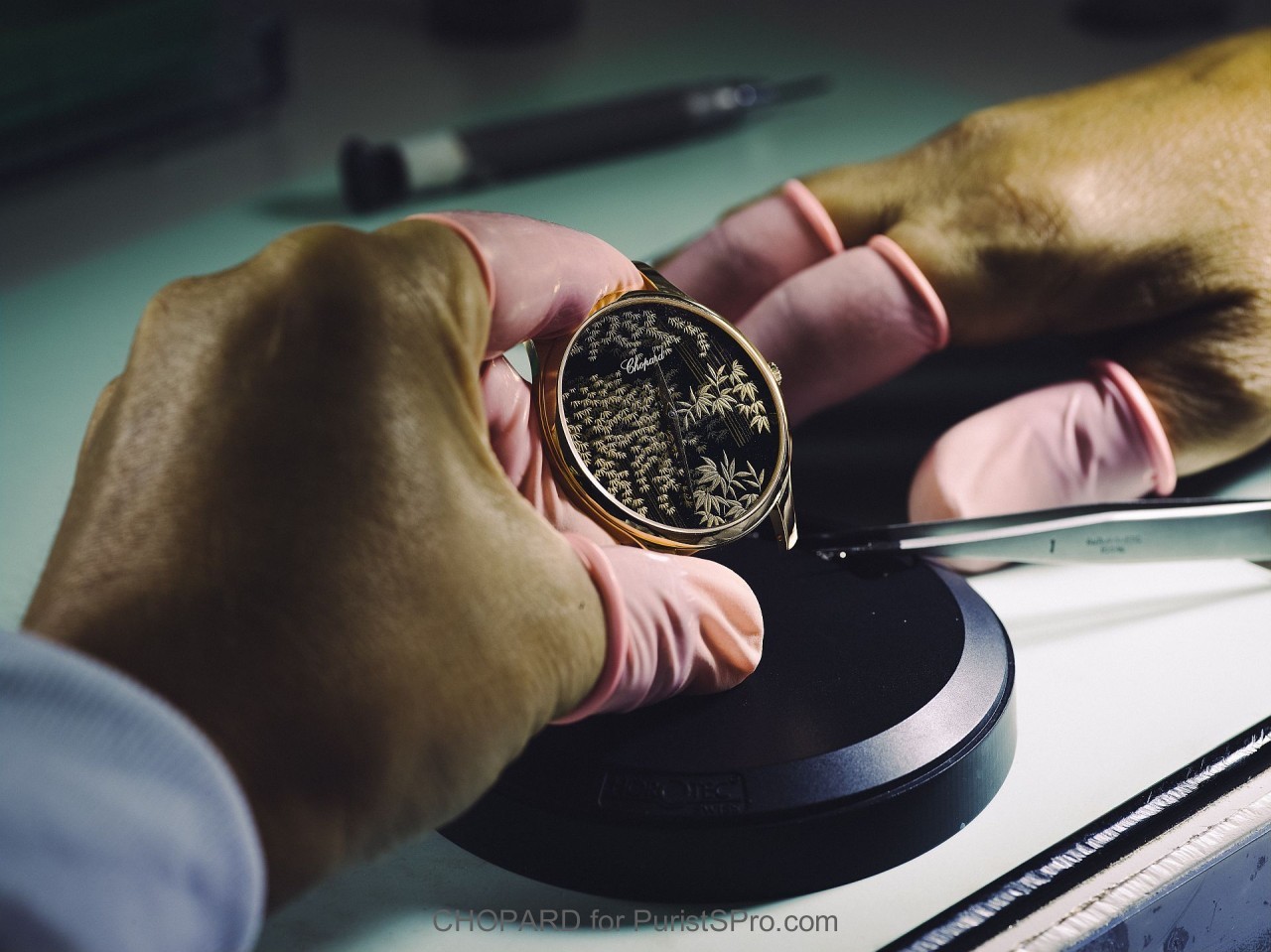
New Chopard L.U.C XP Bamboo Urushi watch
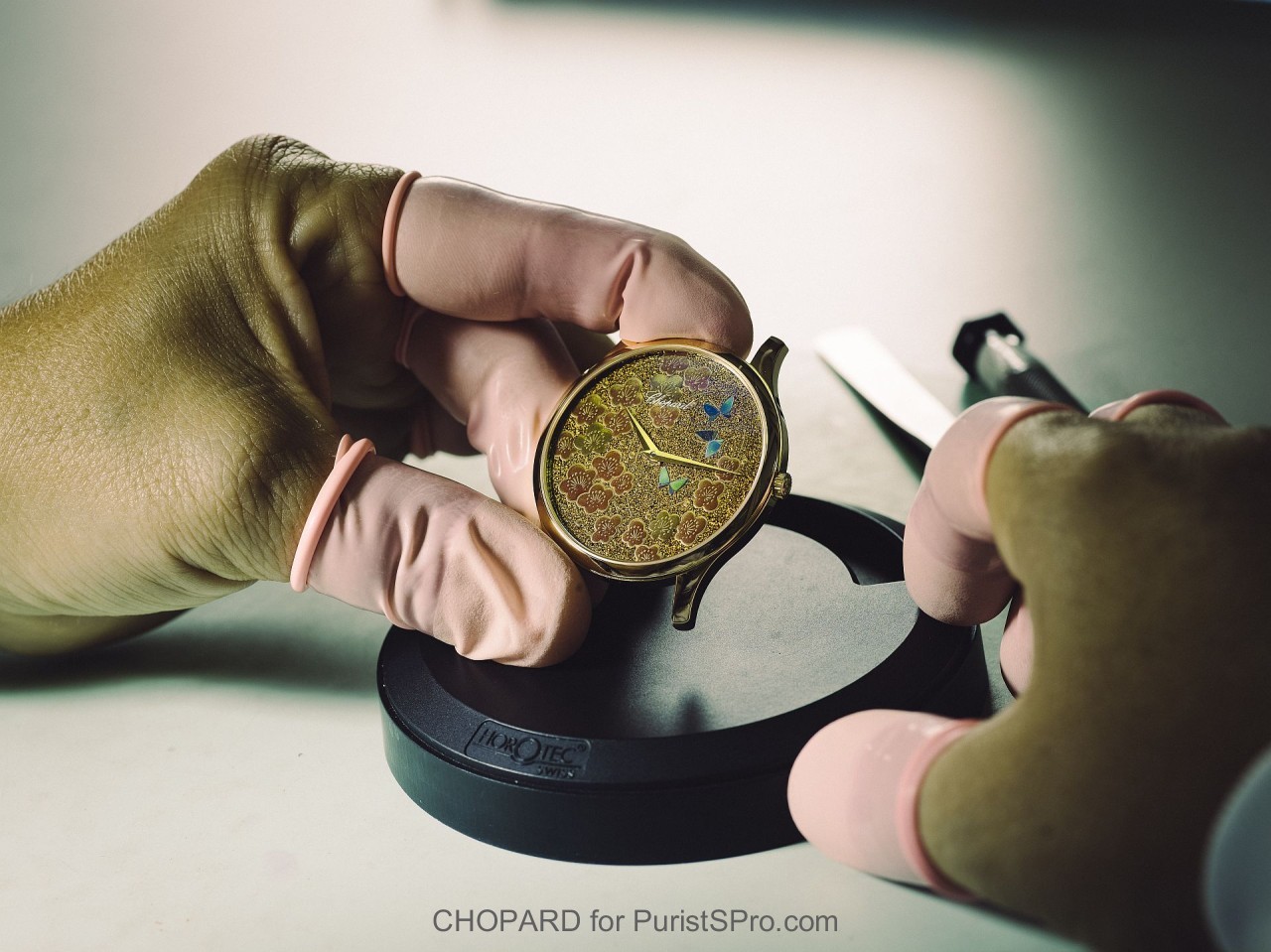
New Chopard L.U.C XP Plum Blossom Urushi watch
GLOSSARY
Urushi: Lacquer from the sap of the lacquer tree

Maki-e: "Sprinkled picture" artwork of painted lacquer, sprinkled with other substances like gold or silver or charcoal ash powder.

Raden: mother-of-pearl chips or powder that is inlaid onto wet lacquer.

Raden mother-of-pearl flakes
History of Urushi
Urushi is the sap of the urushi or lacquer tree that is native to Japan, China, and Korea. Some forms of lacquer sap also originate from Burma and Thailand. Lacquer sap contains a resin that polymerises and becomes a very hard, durable, plastic-like substance when it is exposed to moisture and air. Some people are sensitised and highly allergic to lacquer sap with skin reactions.
It has been taught that urushi lacquer technology was introduced from China to Korea, and from there to Japan. There is evidence that Japan and other Asians used lacquer in ancient times as adhesive but the systematic application process is said to have developed in China. However, Japanese lacquerware has been discovered from the Jomon period (ca 10,500 - 300 BCE), as far back as the Stone Age, affording evidence that lacquer technology also developed independently in Japan.
Stone-age people used urushi sap to mount points on spears and arrows. The Japanese of the Jomon period discovered the durability and lustre of urushi for coating wood, pottery, baskets and bone objects. The introduction of Buddhism in Japan increased the importance of lacquer production because it was used on cloth for Buddhist images.
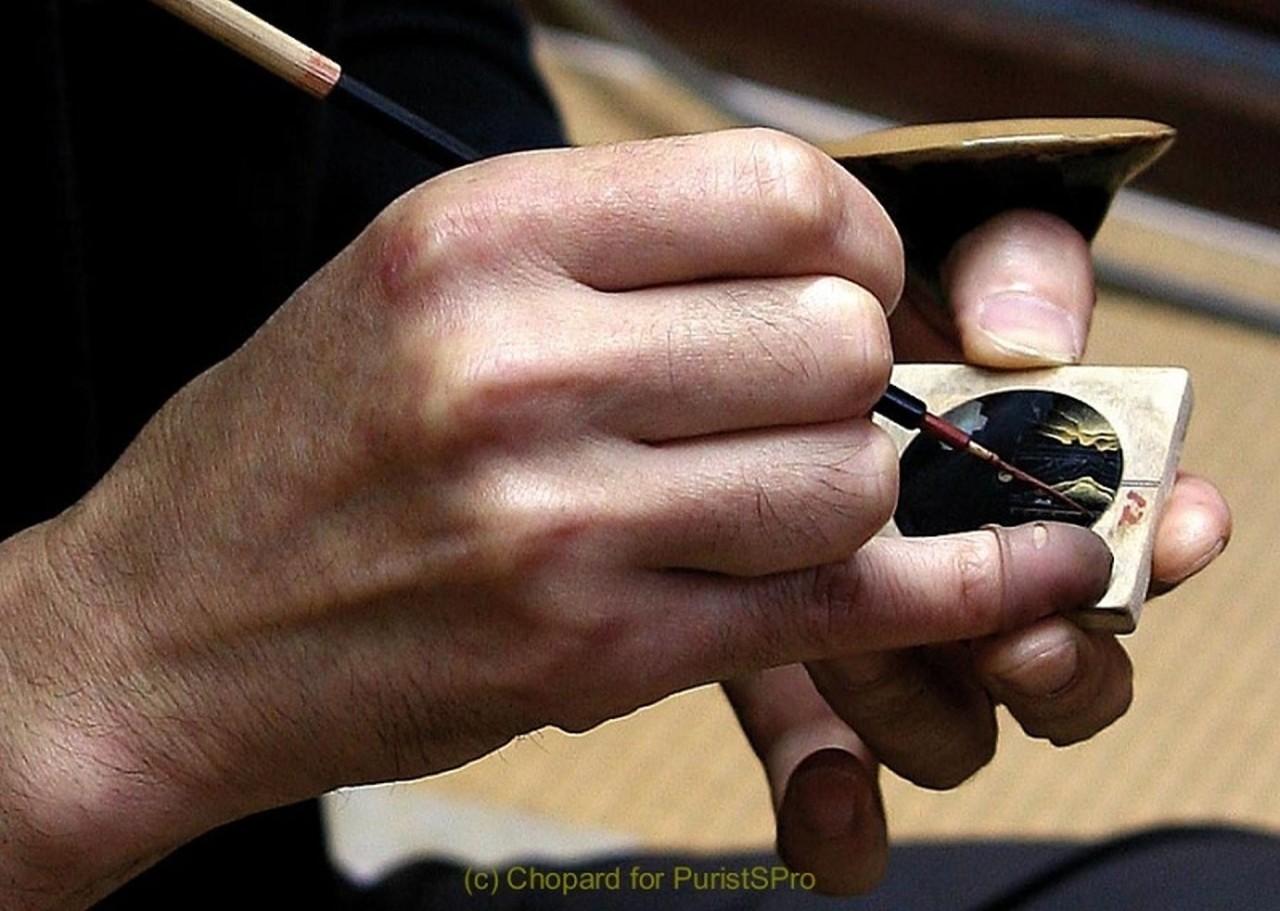
As Japanese culture developed, lacquer techniques were applied to bowls, plates, trays, sake cups, boxes, combs and other objects. As Japanese civilization developed, lacquerware techniques incorporated increasingly refined styles. The Nara period (710 - 794 AD) saw the onset of maki-e decoration technique in which gold "dust" is sprinkled on the lacquer surface. Maki-e means "sprinkled picture".
Urushi has found many uses in Japanese craft and culture forms. Urushi bowls or plates are an essential part of formal Japanese haute cuisine – “kaiseki". Maki-e and raden (mother-of-pearl inlay) techniques were used to decorate furniture, writing implements, toys and make-up accessories. Urushi is also widely used in making the tools and utensils for the traditional Japanese tea ceremony.
During the Heian Period (794 - 1185 AD), urushi appeared at the altars of Buddhist temples and in the making of armour, helmets, swords, and other military implements.
In the Muromachi period (1333 - 1573 AD), urushi started to serve court-nobles for making stationery, such as ink-stone cases.
During the Momoyama period (1573 - 1600 AD), maki-e was admired by one of the greatest unifiers of Japan – Toyotomi Hideyoshi. Then, maki-e began to appear in everyday life of military commanders and the elite.
In the Edo period (1600-1868), personal accessories were made with urushi such as combs, hairpins, bridal furniture, pillboxes, and medicine cases. This was the peak of maki-e technique.

Gold flakes
Urushi in Europe
In 1549, Portuguese Jesuit missionaries arrived in Kagoshima Prefecture on the island of Kyushu. The Jesuits were interested in spreading religion as well as establishing trade. They were captivated by Japanese lacquerware and commissioned craftsmen to make lacquer ritualistic utensils.
In 1609, the first Tokugawa shogun – Ieyasu – granted official exclusive Japanese lacquer trading rights to the Dutch East India Company. In 1610, the first shipment of lacquer (chests, boxes and tables) arrived in Amsterdam. The Dutch were fascinated by the beauty and quality of Japanese lacquerware and started calling it 'japan' like Chinese porcelain was called 'china'.
Europeans tried to discover the secret behind Japanese lacquer technology. This led to a new word – “japanning": to reproduce the amazing lustre of Japanese lacquer ware. The production of Japanese lacquerware for export was very limited and thus the cost in Europe was extremely high. Thus, "japanning" was attempted in Europe. Willem Kick started Europe's first japanning atelier in Amsterdam.
Making Coloured Lacquer with the "Kurome" and "nayashi" processes
The sap that is tapped from cutting a lacquer tree is the source of lacquer. The sap in liquid state cannot be used and must be processed through many steps. Among these steps, the “kurome” process (remove excess moisture) and the “nayashi” process (bring out luster) are particularly important.
After this refining work, an additional process is needed to add colours to the lacquer. In order to bring out the black or vermillion sheen in lacquerware, extra time and effort are required.
The “kurome” and “nayashi” lacquer refining processes
The sap of lacquer newly collected is called “arami”. It is grey-brown in colour and includes some impurities that must be removed. The sap is filtered and the resultant purified lacquer is called “ki-urushi”.
Next, excess moisture content in ki-urushi is removed to thicken it. In past times, the lacquer was exposed to direct sunlight to remove moisture but it was inefficient. Nowadays, the moisture is extracted by using heated wires. This process is called “kurome” and the resultant lacquer becomes semi-translucent brownish-red.
The lacquer is stirred to make the lustre appear during the "kurome” process. This agitation is called “nayashi”. Thus, "kurome” and “nayashi” are performed simultaneously. If sufficient time is allowed for this process, a high-quality lacquer is produced.
Adding colours to lacquer
Lacquer turns to brownish-red after refining. Then, minerals are added to give vermillion or black colour to the lacquer. Traditionally, Japanese lacquerware is vermillion or black in lustre.
Black substances are added to create black lacquer. For example, burnt pine wood produces black soot. Today, fine iron powder is added to create black lacquer. Similarly, vermillion dye (mercury sulphate or iron oxide) is added to produce vermillion lacquer.
Lacquerware in traditional crafts is mainly black lacquer and vermillion lacquer. However, there are other colours available including yellow, indigo, green, for a total of seven colours. These colours are created by adding pigment to the lacquer. This addition of colour needs to be done when you actually apply the lacquer. Coloured lacquer cannot be stored in a tube like paint.
If lacquer is stored by itself, the same condition will be preserved for thousands of years. However, if stored for long periods after colour ingredients have been added, the characteristics of lacquer will alter and not be able to dry.
The characteristics of lacquer vary according to its origin. Lacquer collected in Japan is brownish-red, but lacquer collected in Thailand/Burma is a black rubber-like substance. Thai/Burmese lacquer can be used as black lacquer without adding any special pigment.
Techniques of Maki-e
Maki-e technique is what it literally means, which is, sprinkling gold and silver powders to make pictures.
A pre-drawn pattern must be transferred to the dial base. The transfer is accomplished by reversing the paper and sketching the main lines with lacquer. This is then transferred to the dial by gentle, even pressure on the surface of the paper.

Paper Pattern

Transferring pattern onto dial
Basic Technique

The dial is painted with lacquer. The objective is to cover the base with lacquer or drying the metallic powders on lacquered base. Because of the good adhesiveness of lacquer, powders will stick to lacquer and grow hard. Metallic powders used include gold and silver, but also doré bullion (unrefined silver), tin, and brass. Another layer of lacquer makes it stable. After that, polishing and burnishing is done repeatedly. The lacquers on the top and bottom layers fasten powders like a sandwich; the process is called “powder hardening”.

Implements to apply powders by sprinkling, blowing and brushing
Maki-e, whether low, medium, or high relief, follows the basic technique mentioned above. Using cat- and rat-hair brushes, any area down to a hair-thin line could be painted. Sometimes pigmented lacquer was applied in areas as contrast or highlight to the overall design. This pains-taking and repetitive procedure of application, curing, and polishing extended over weeks or even months.

Brushing excess powder before next coat
The three main types of technique are:
1) Hira maki-e: Low lacquer work where the layers of lacquer and sprinkled substances are polished and burnished between layers. Only areas with picture or powders are covered with lacquer. Hira maki-e is easier and simpler but somewhat monotonous.
2) Taka maki-e: Raised lacquer work with patterns built up with mixture of metal powder, lacquer, charcoal, clay dust etc to make it more three-dimensional. The lacquer that covers the raised shapes is applied onto the motif to produce a relief effect. For the highest relief, four, five, or even more layers could be applied. The final layers of these areas could be made from “bengara” (iron oxide powder), or other pigments mixed with lacquer. Subtle tricks of perspective were created by varying the thickness of certain areas of the design.
3) Togidashi maki-e: Flat lacquer work can only be done on a perfectly clean and smooth surface. The surface has to be rubbed with urushi leaving no pores before togidashi maki-e can be started. The different layers of coloured lacquer, metallic powders, and sometimes shell are painted and dried. Then, different areas are polished at varying depths to expose those coloured layers and form the final image. Black lacquer without oil is painted over the metal powder decoration as an additional coat, applying many layers and worked into a smooth design and then covered with black lacquer. The surface is ground down just enough to reveal the hidden design. In the final step, lacquer covers the whole surface, and after burnishing the lacquer coat with charcoal, the surface will be quite smooth. Togidashi maki-e is colourful but flat.
Top artists can combine different methods into an art piece. For example, mountains in the distance need taka maki-e, while the sky needs togidashi maki-e. Trees in the foreground may be represented by taka maki-e and the sea or river may need togidashi maki-e. The difficulty here lies in burnishing flat and raised parts of the designs at the same time. This is where an artist show his/her mastery using the combination technique: shishiai togidashi maki-e.

Painting Butterflies and Plum Flower motifs

Gold powder sprinkling tools

Gold powder sprinkles applied 
Brushing excess gold powder
Notice the butterflies are inlaid with raden (mother-of-pearl).


Final Colouring 
After each layer, the dial is dried and polished by hand before more painting

Finest rat tail hair brush is used for delicate details .
The best brushes are made of the finest hairs at the tip of a rat's tail. Cat hairs are also used.
Bamboo Dial
Casing up the new Chopard L.U.C XP Urushi watches
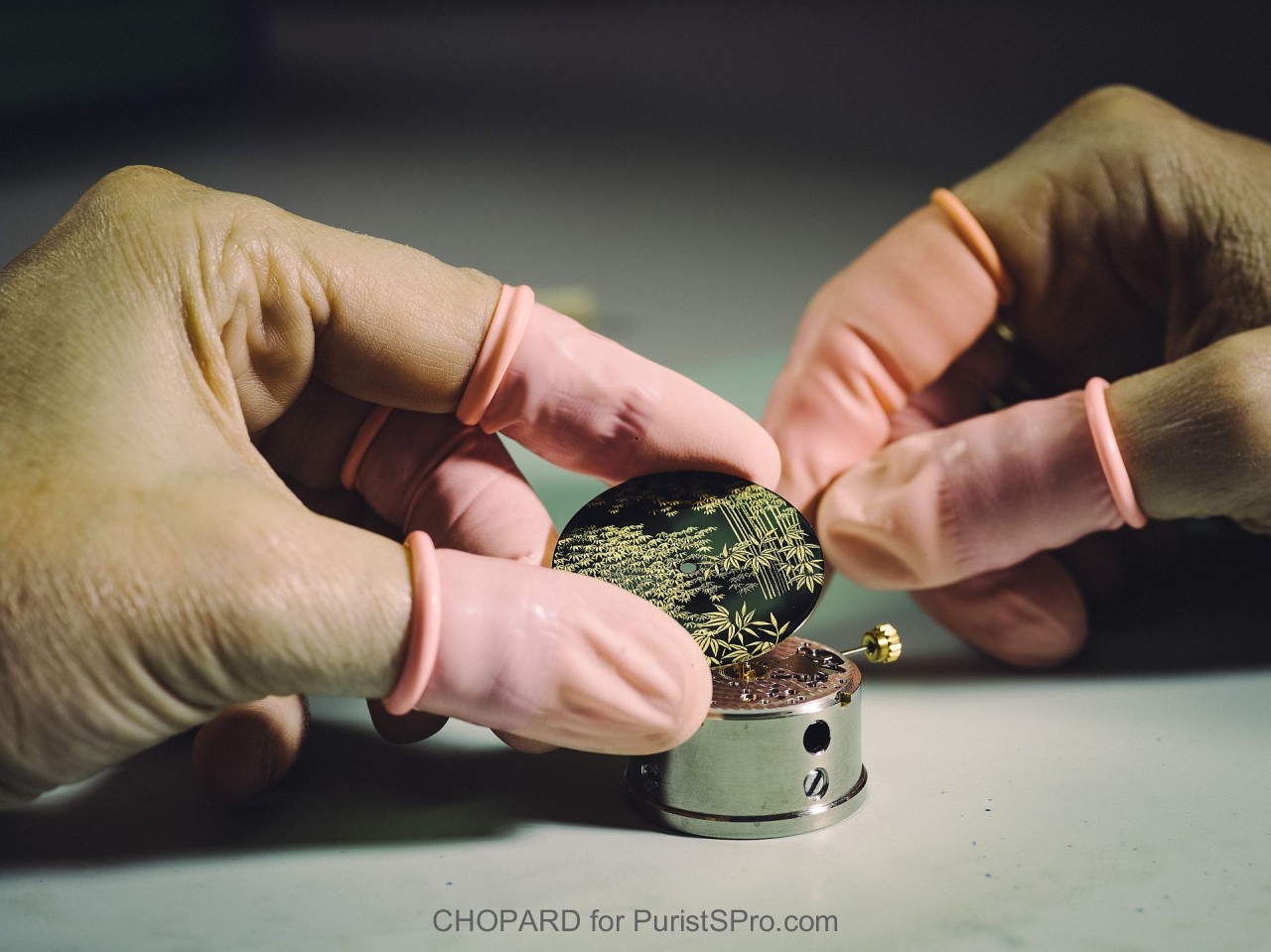
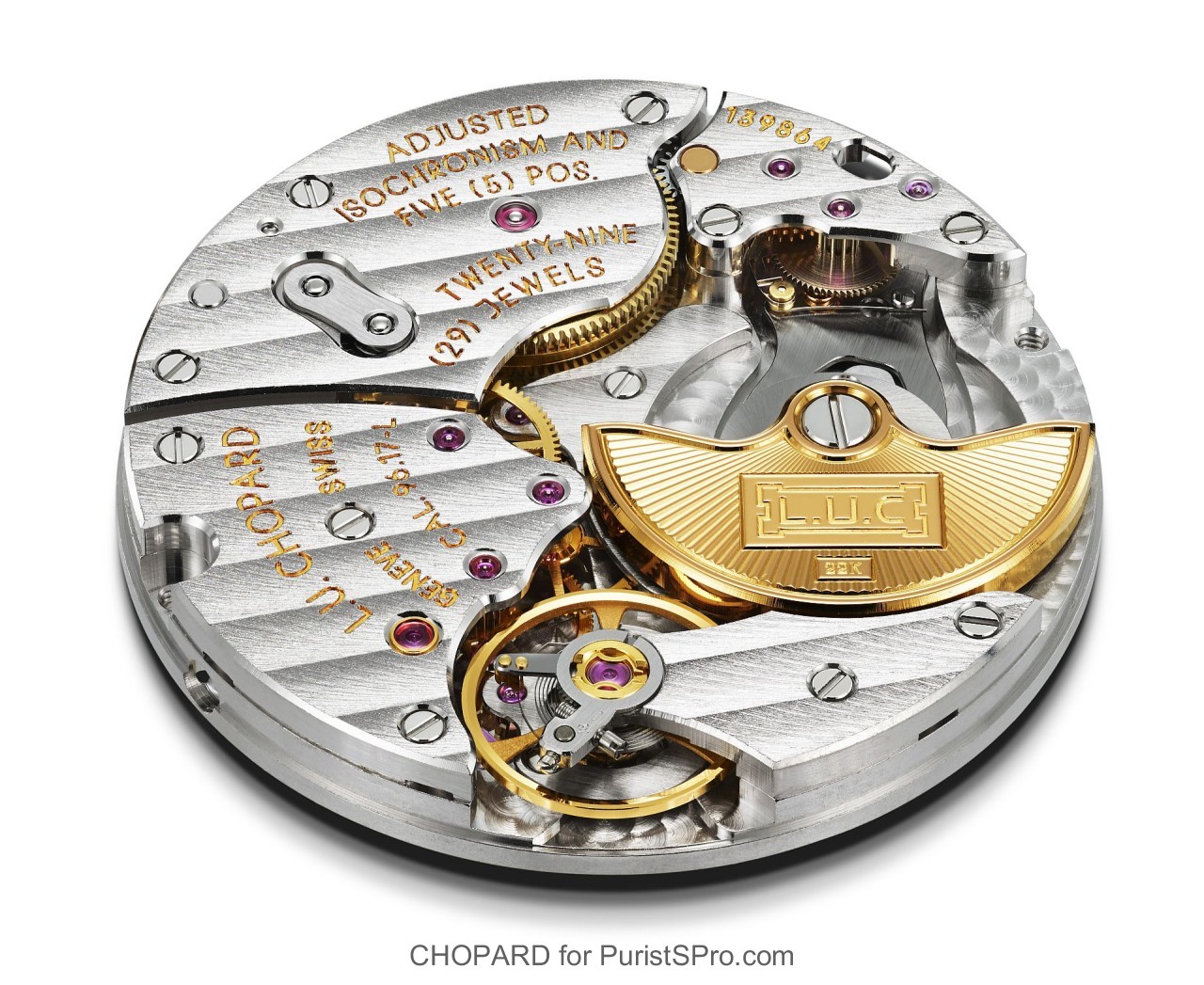
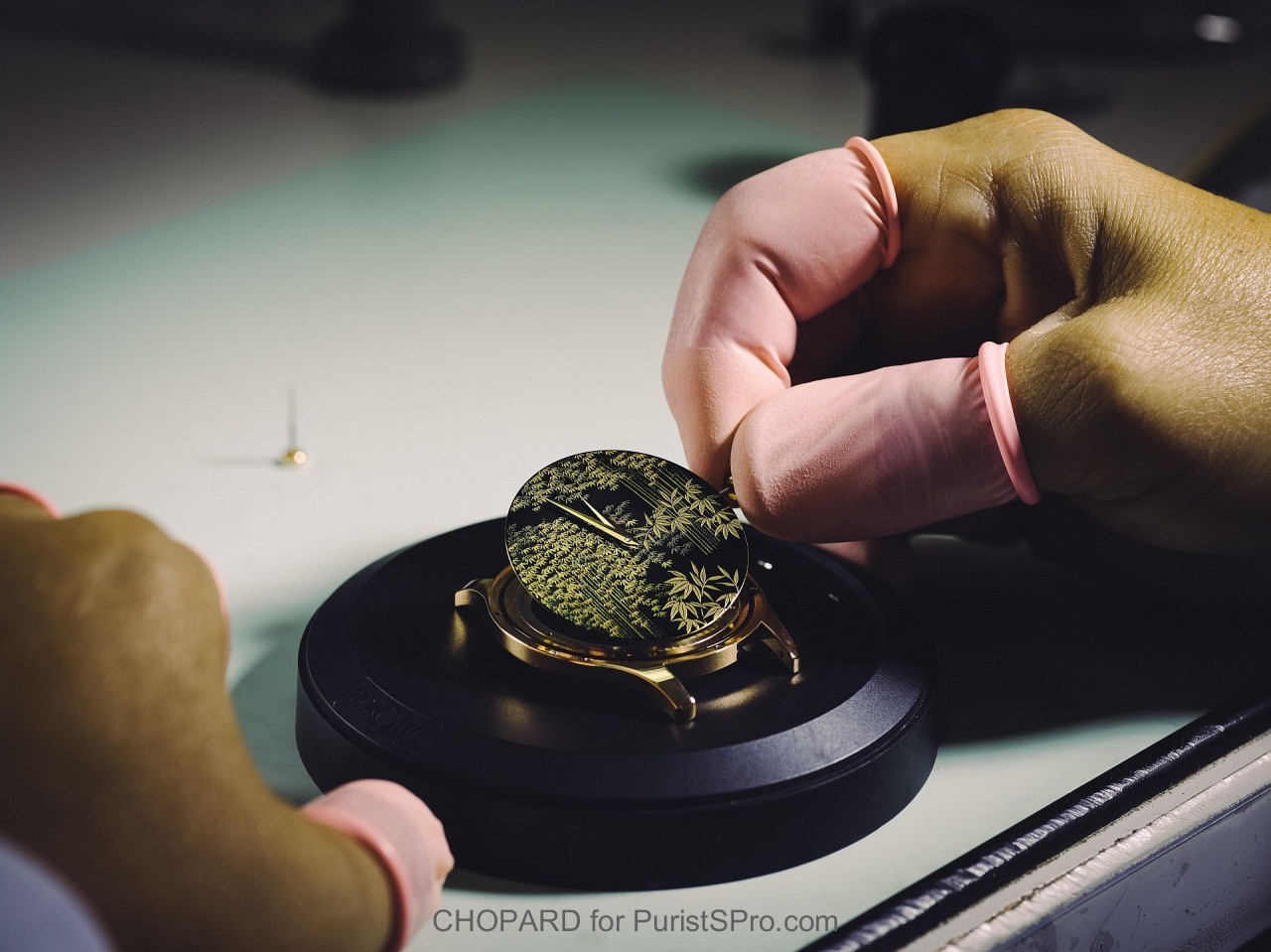
Hands added to dial
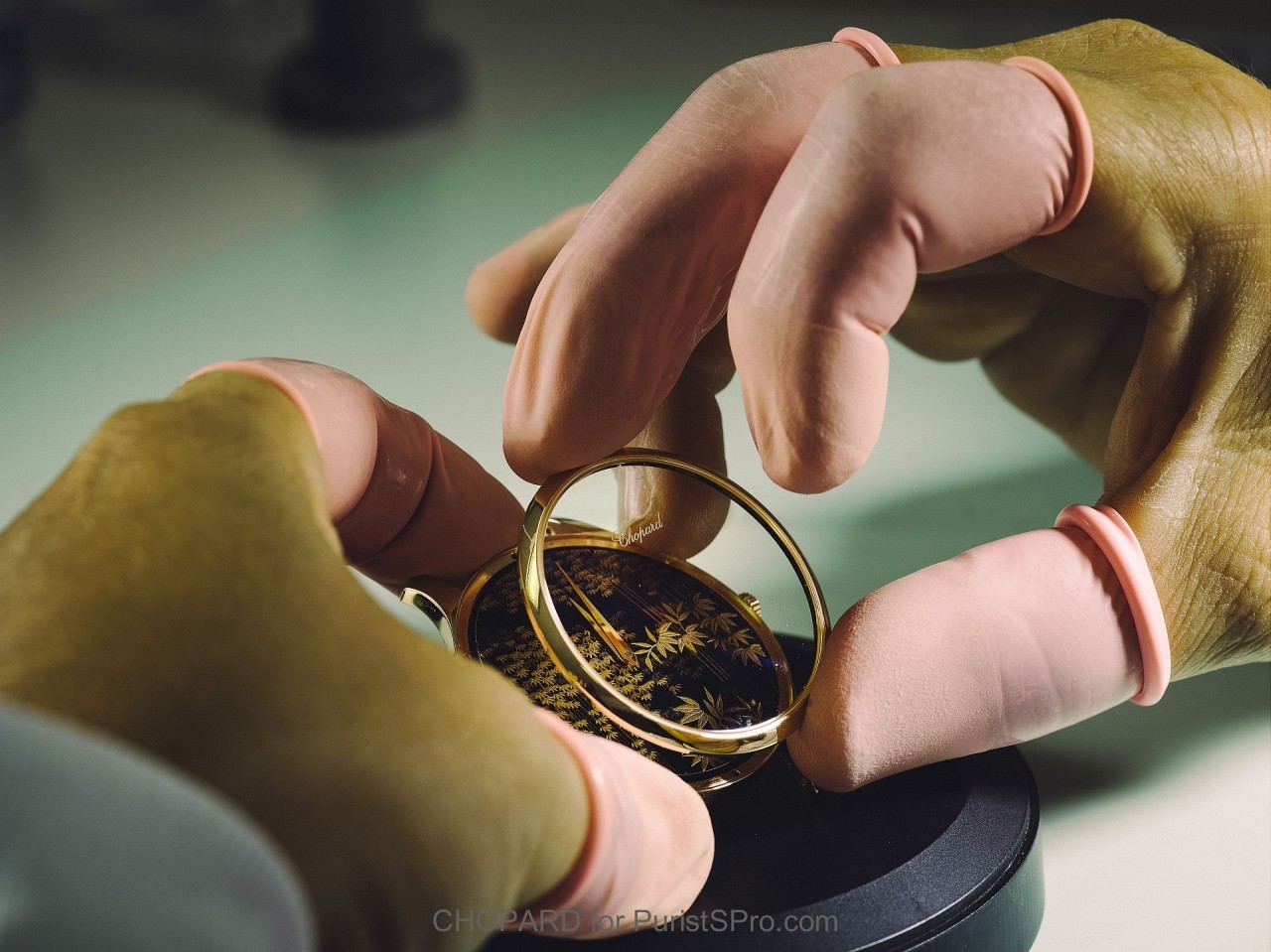
Bezel and watch sapphire glass attached
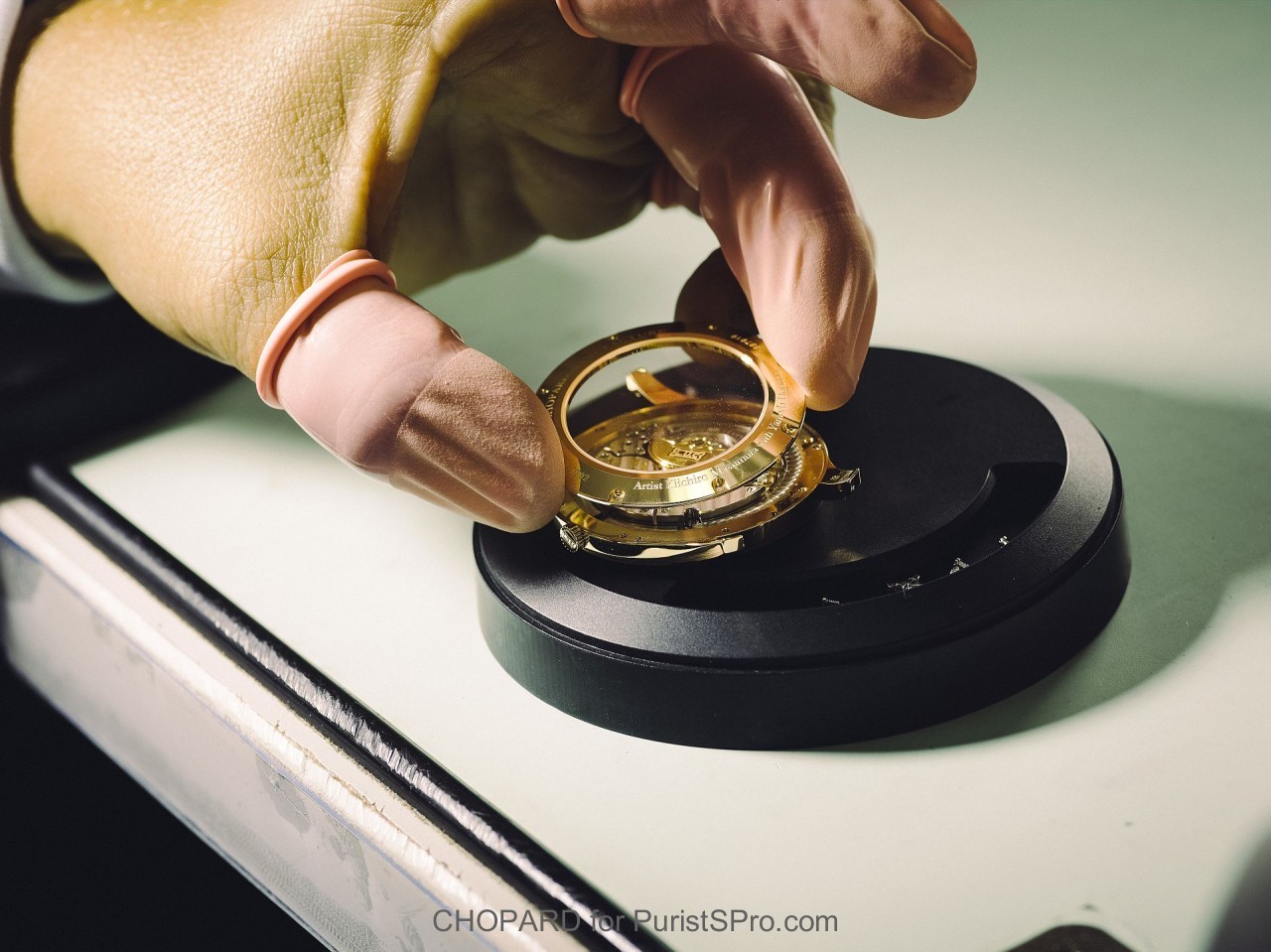
Case back sapphire glass attached
************************************************************************************************************************************************
YAMADA Heiando
Yamada Heiando opened its first lacquerware boutique in 1919.
Founded by Konosuke YAMADA, the studio is a proud purveyor of tableware to the Japanese Imperial Household and its products feature regularly in Japan's international embassies. Yamada Heiando cherishes the rich tradition of lacquerware as well as the skills and universal aesthetic sensibility inherited from traditional artisans. At the same time, Yamada Heiando is dedicated to the design of new products that capture the values of contemporary life.
The dial of a wristwatch is extremely thin and presents further difficulties than usual to the craftsman. There is no room for thick build-up of taka maki-e but the image still has to portray three-dimensional visual effect. Similarly, the thickness of multiple layers of lacquer for togidashi maki-e is also restricted. Thus, the artist must design and apply special techniques for dial making.
Previously, Mr Yamada, CEO of the studio was interviewed by PuristSPro; READ the INTERVIEW
Yamada Heiando agreed to answer more questions:
PPro=PuristSPro
YH=Yamada Heiando
PPro: Is the dial base made of wood, resin or metal? Metal would be most difficult.
If the dial base is either stainless steel or brass, you need to apply several thin coats of urushi.
As well as hardening at room temperature, urushi has another hardening point at the higher temperature of 80-150°C. Do you use yakitsukeho (firing-on method) if the dial is metal?
YH: The dial base we use is brass.
First of all, paint the dial with lacquer as a first coat. On top of that, we apply another coat of lacquer which you can see as the base of the dial.
We use yakitsuke technique at a temperature of about 150°C in order to make Urushi and brass stick very firmly.
PPro: Urushi does not dry but hardens at a temperature of 25°C and a relative humidity of 70 %. Do you use a special oven where it hardens?
YH: We do not use a special oven. Since the dial is small, we use a box.
The box allows a controlled condition of appropriate humidity.
PPro: Some companies use urushi that is mixed with rice powder or lead white powder, so it can be shaped for the takamaki effect . Do you use charcoal powder instead of rice powder at Yamada Heiando?
YH: Usually those materials are used for raising the lacquer strokes for takamaki-e.
In the case of the Chopard watch dial, there is a height restriction between the dial and watch hand. Therefore we need to express the three-dimensional appearance with only urushi and a light sprinkling of powders including charcoal..
PPro: Do you use lacquer from Japan (Rhus verniciflua tree), China (Rhus succedanea tree) or Cambodia (Melossorreha lappifera tree)?
Does Yamada-Heiando have a supplier or make your own materials because you use so much? e.g. nayashi and kurome processes.
YH: For the maki-e of the dial we use lacquer from China.
We use small quantity of lacquer for maki-e and so we purchase a tube of lacquer from a local urushi craft supplier.
PPro: It is said that hiramaki-e takes 24 steps (20 days) and takamaki-e takes 36 steps (40 days) for pens. is this correct for watch dials too?
YH: It might be correct for watch dials, but for pens it would take more time since the height of the pen's maki-e could be higher.
For our dials, we need 30 days. Including time taken for the first base coating of the dial, it takes 45 days.
PPro: One confusing thing for collectors is that the Chopard watches are engraved “Artist Kiichiro Masumura with Yamada Heiando” but we only see Master Minori Koizumi. My interpretation is that Grand Master Masumura is a consultant but the work is performed by Master Koizumi. With so many steps to make maki-e, are the important steps performed by Master Koizumi and the simpler steps done by assistants? Or does Master Koizumi do everything....mix, paint, dry, polish, sprinkle, polish again etc?
YH: Master Masumura provides technical guidance and is editorial-supervisor; the dials are made by Mr. Koizumi.
It is absolutely a Heiando product and it does not mean that only Mr.Koizumi will make the dials in the future. Mr. Koizumi is the top maki-e craftsman of Heiando and at the moment, only Mr. Koizumi is able to paint. However, there is another craftsman growing to the level of Mr. Koizumi, and so the productivity of the dial would possibly increase with these two craftsmen.
At this moment every single process is done by Mr. Koizumi. This is his style of work; he must do everything by himself.
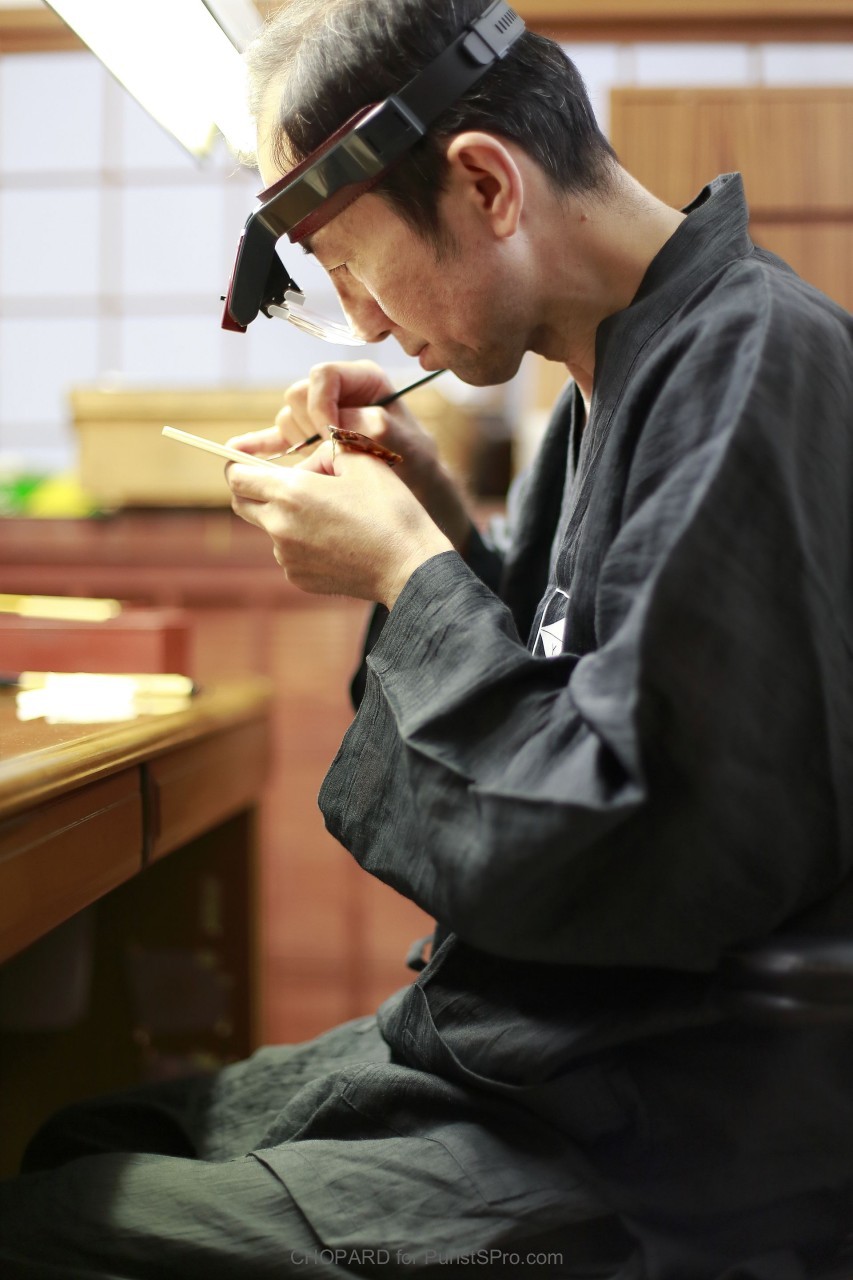
Master Koizumi
PPro: If an edition is 50 pieces of the same design, how long does Yamada Heiando take to produce?
YH: About 20 pieces a month is our productivity and so if we do our best it would be about 2 months.
However, the time depends on the design difficulty (e.g. for an easy design, 30 pieces a month and for a difficult one, it is 15 pieces a month).
PPro: Hypothetically, how many designs can Yamada Heiando complete per year if each design has 50 pieces?
YH: We guess it may be 5 or 6 designs.
?
PPro: Collectors worry about the future. Does Master Koizumi have apprentices who can continue the technique?
How long does it take to train to ‘basic artist’ and then to ‘master grade’?
Do you have spare dials in case of damage?
Can you repair lacquer work?
YH: Mr. Koizumi does not have apprentices, but as mentioned above, we cultivate a craftsman capable of making the same level of his maki-e. To have the same level of Mr. Koizumi's technique, talent is absolutely needed, and at least 10 years of training would be necessary.
Since the dial is covered by the case of the watch, we do not expect serious damage.
In case of damage, it would be more likely to replace the dial rather than to repair it but it depends on the situation.
We suppose that craftsmen with the same level of technique as Mr. Koizumi will not disappear from Japan, but maki-e is part of a picture, therefore there would be subtle difference in touch even though the level of maki-e technique is the same.
In that sense, although being equal in quality, the dials made by another craftsman may still have small differences from those made by Mr.Koizumi.
PPro: Thank you.
YH: PuristS are welcomed.
*********************************************************************************************************************************************************************************************************************************
Previous Chopard Urushi dials by Yamada Heiando
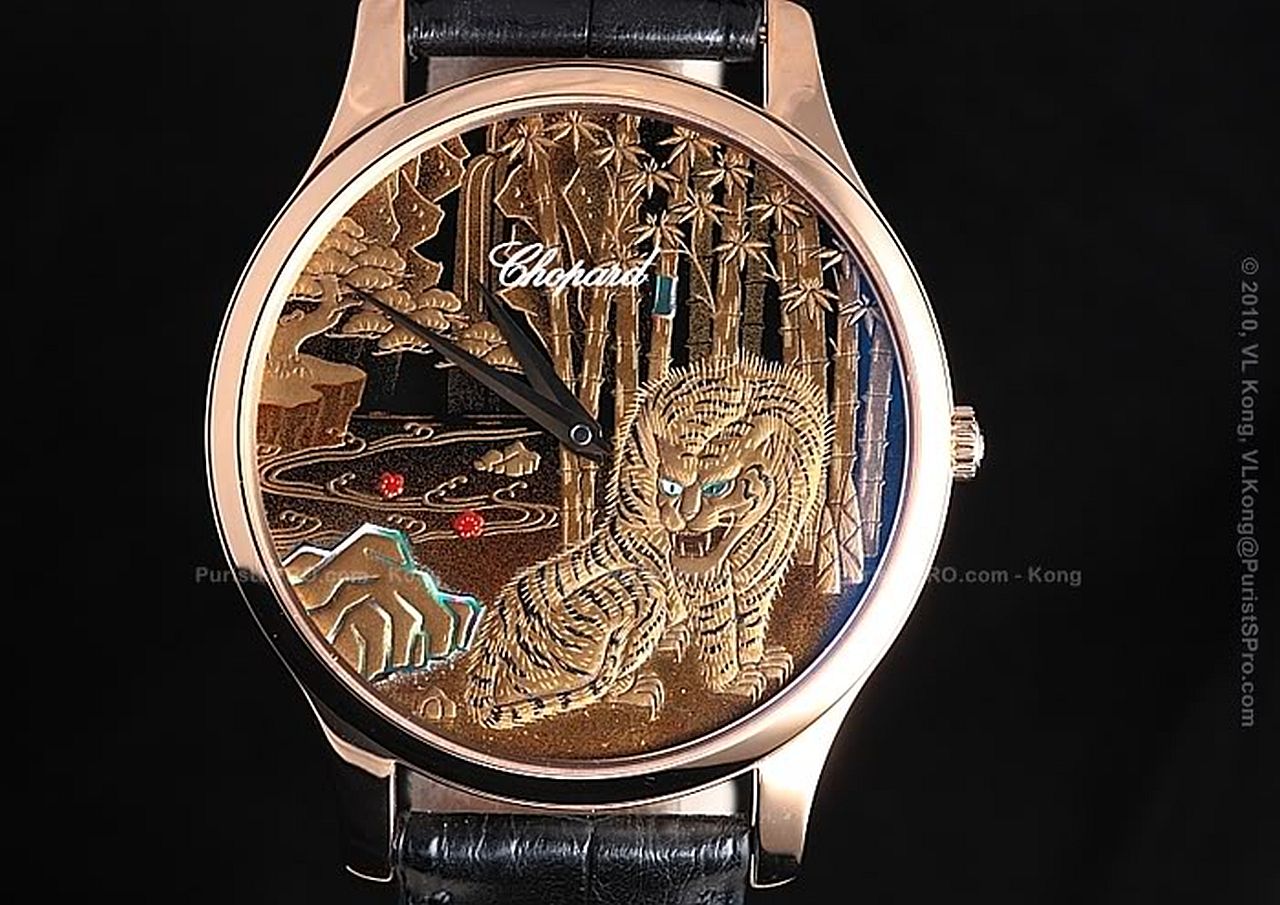
Crouching Tiger
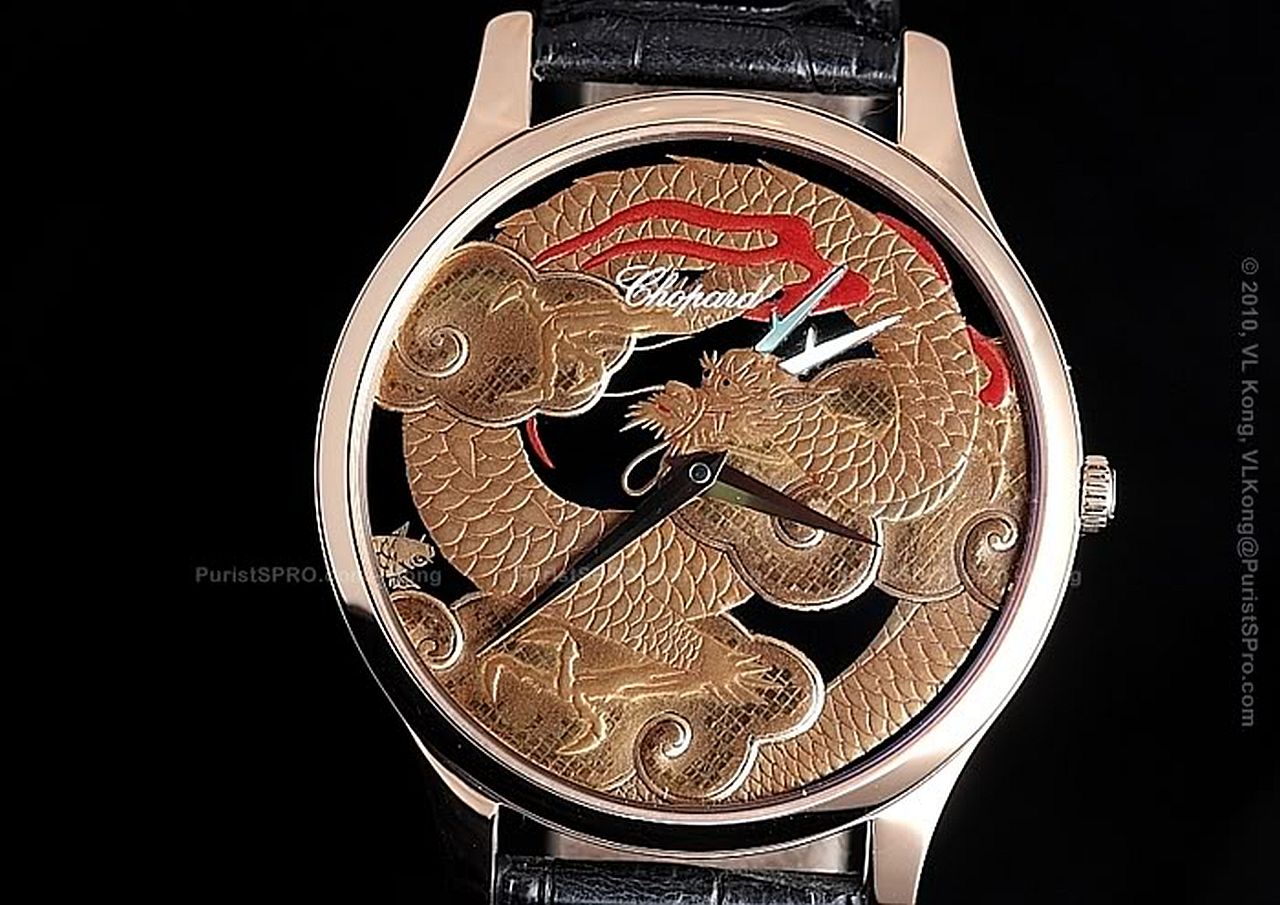
Horn Dragon
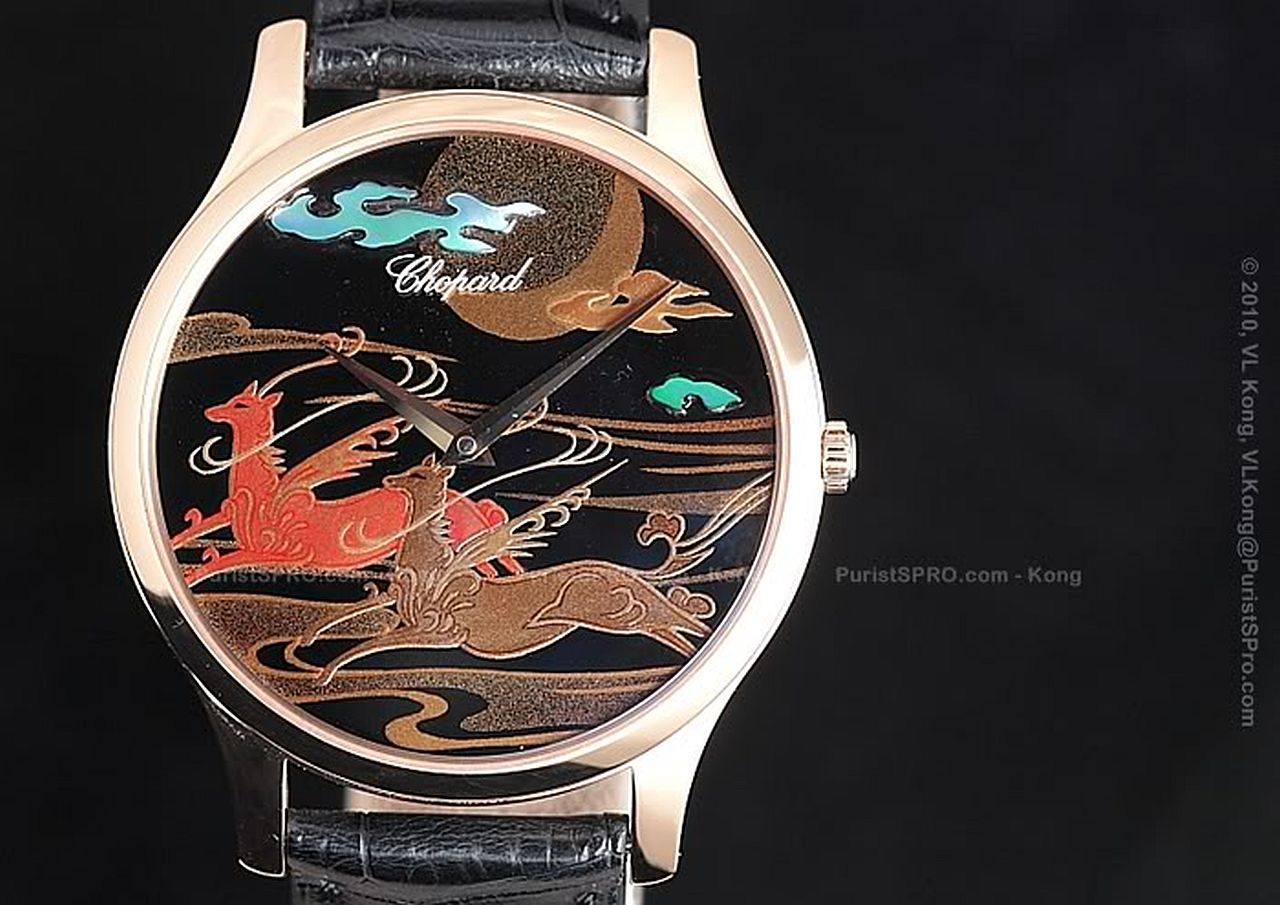
Kirin in Moonlight
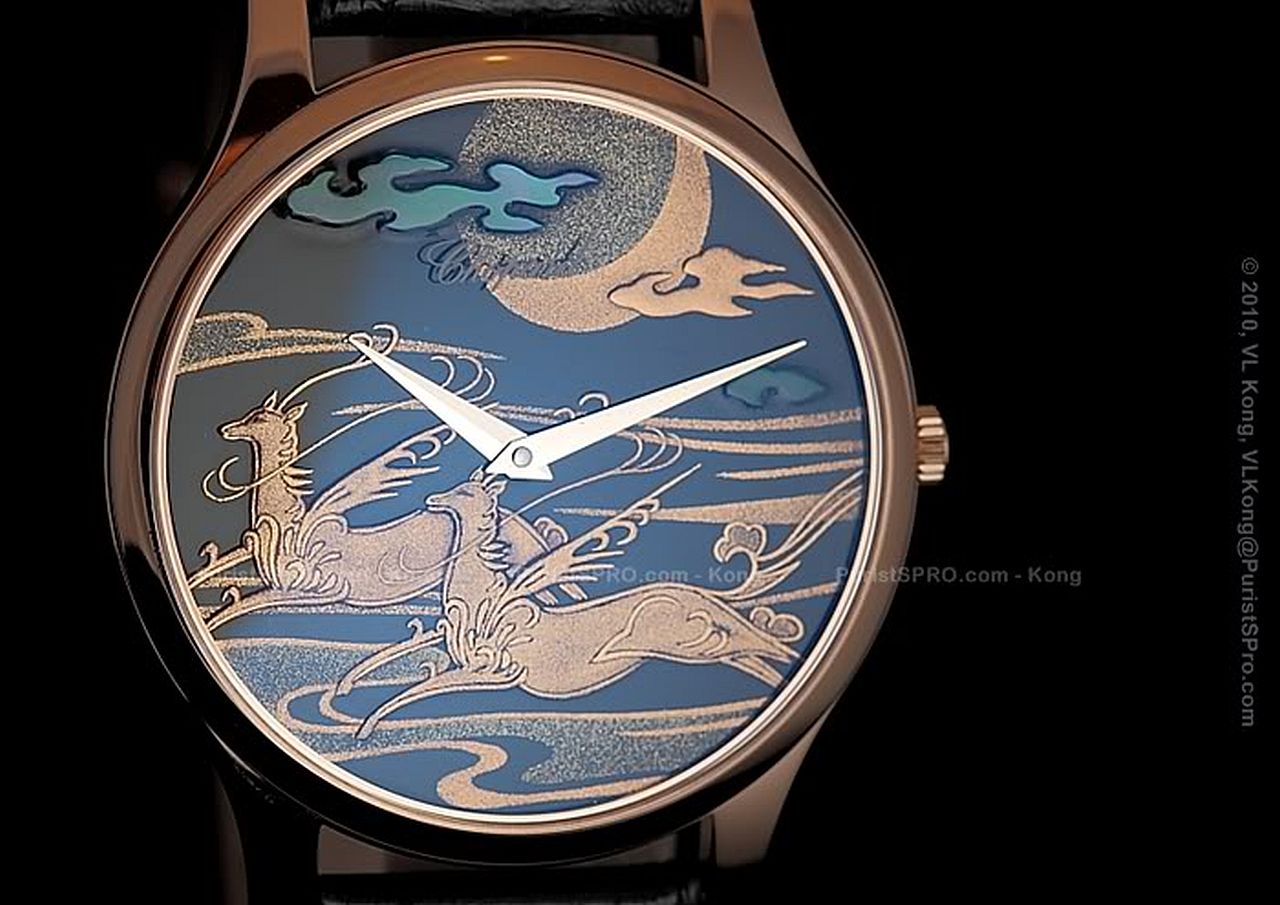
Kirin in Moonlight as light changes
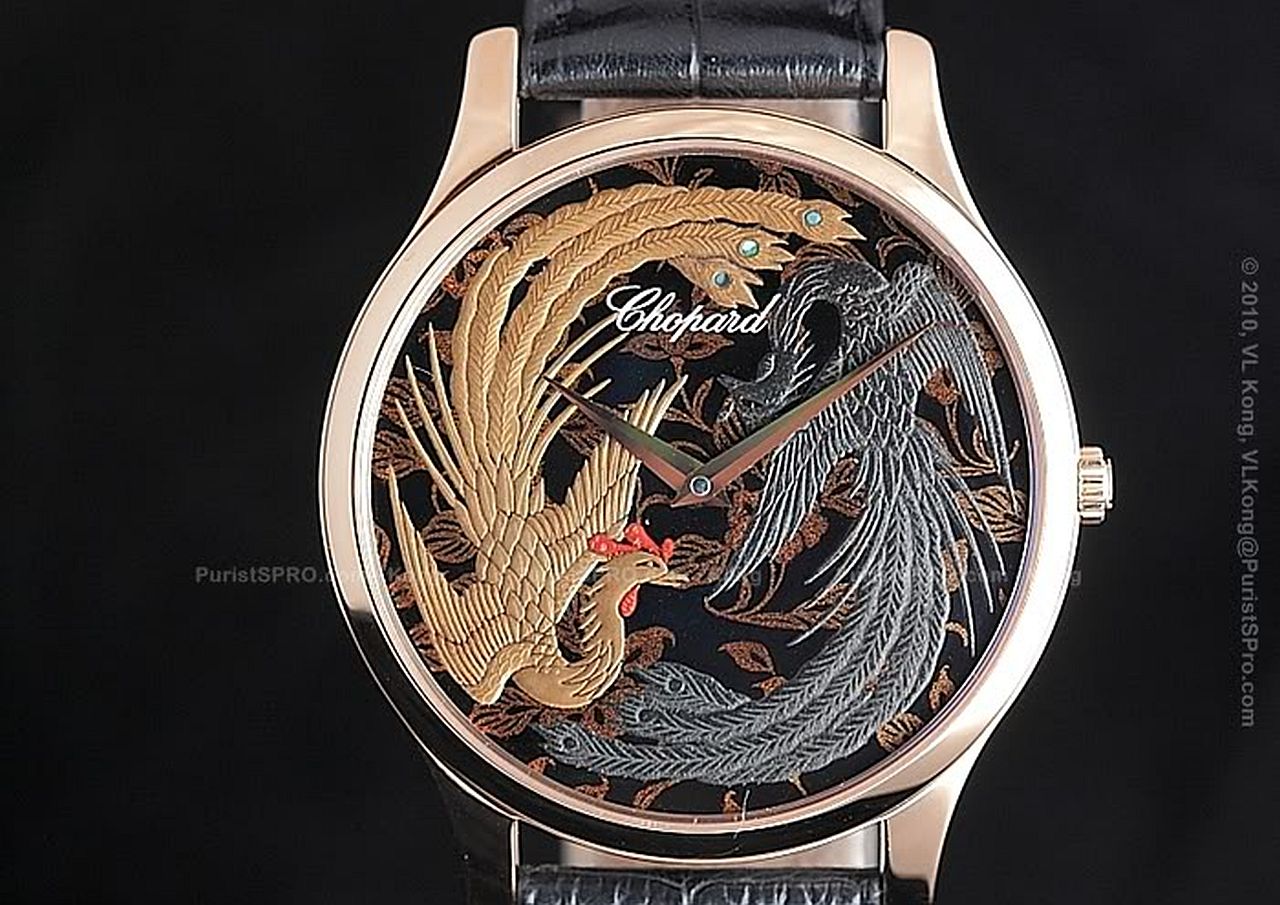
Phoenix Day and Night
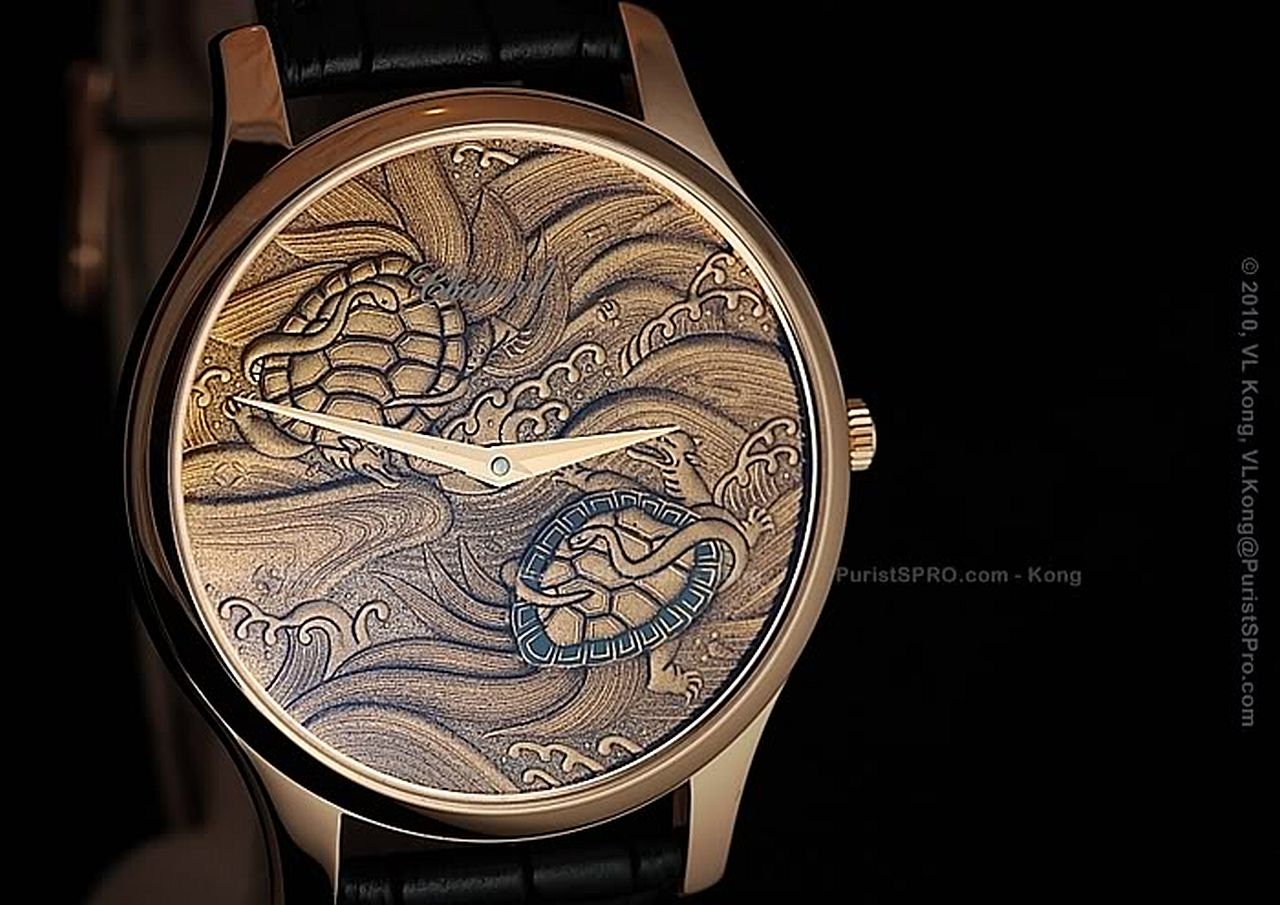
Treasured Turtle Snake
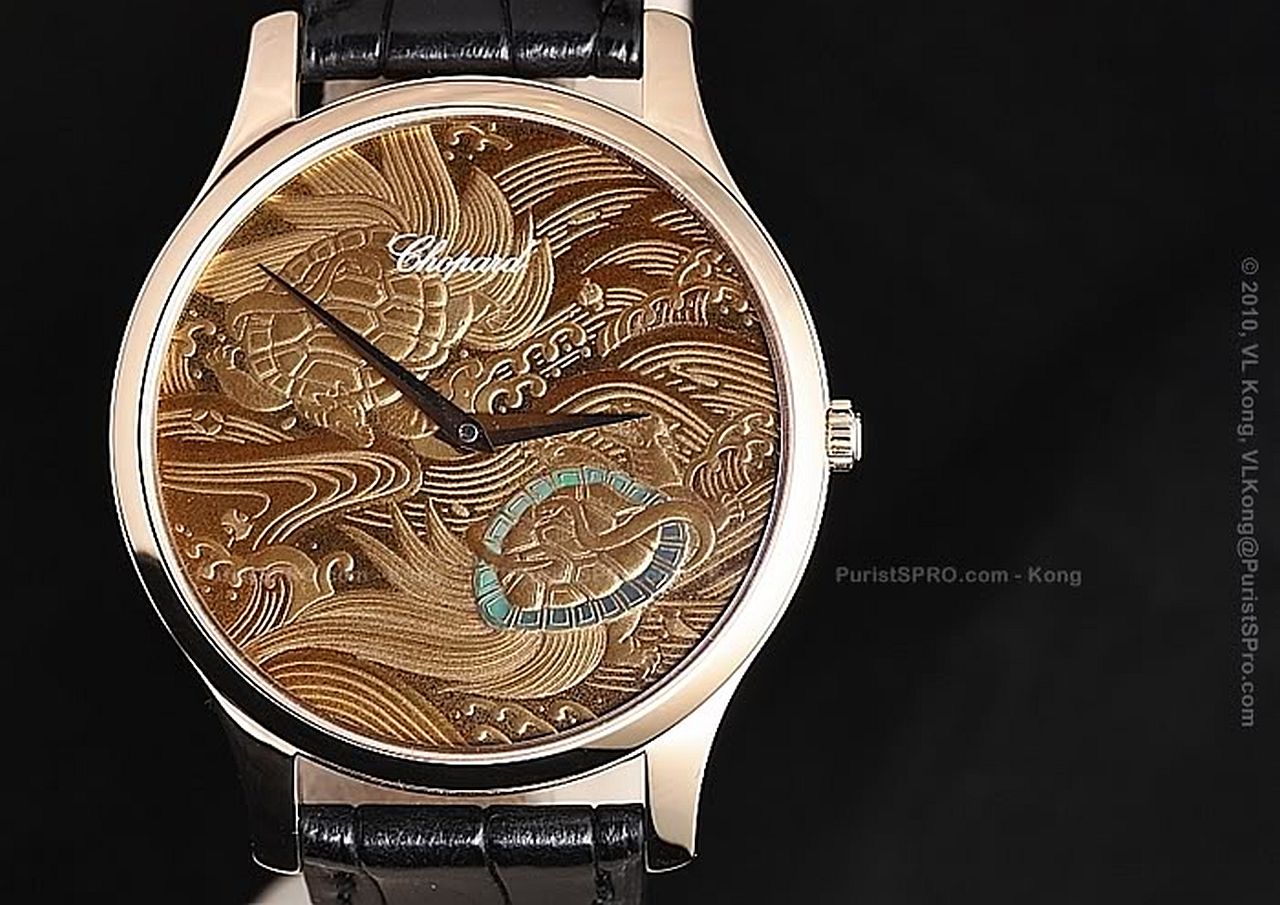
Treasure Turtle Snake as light changes
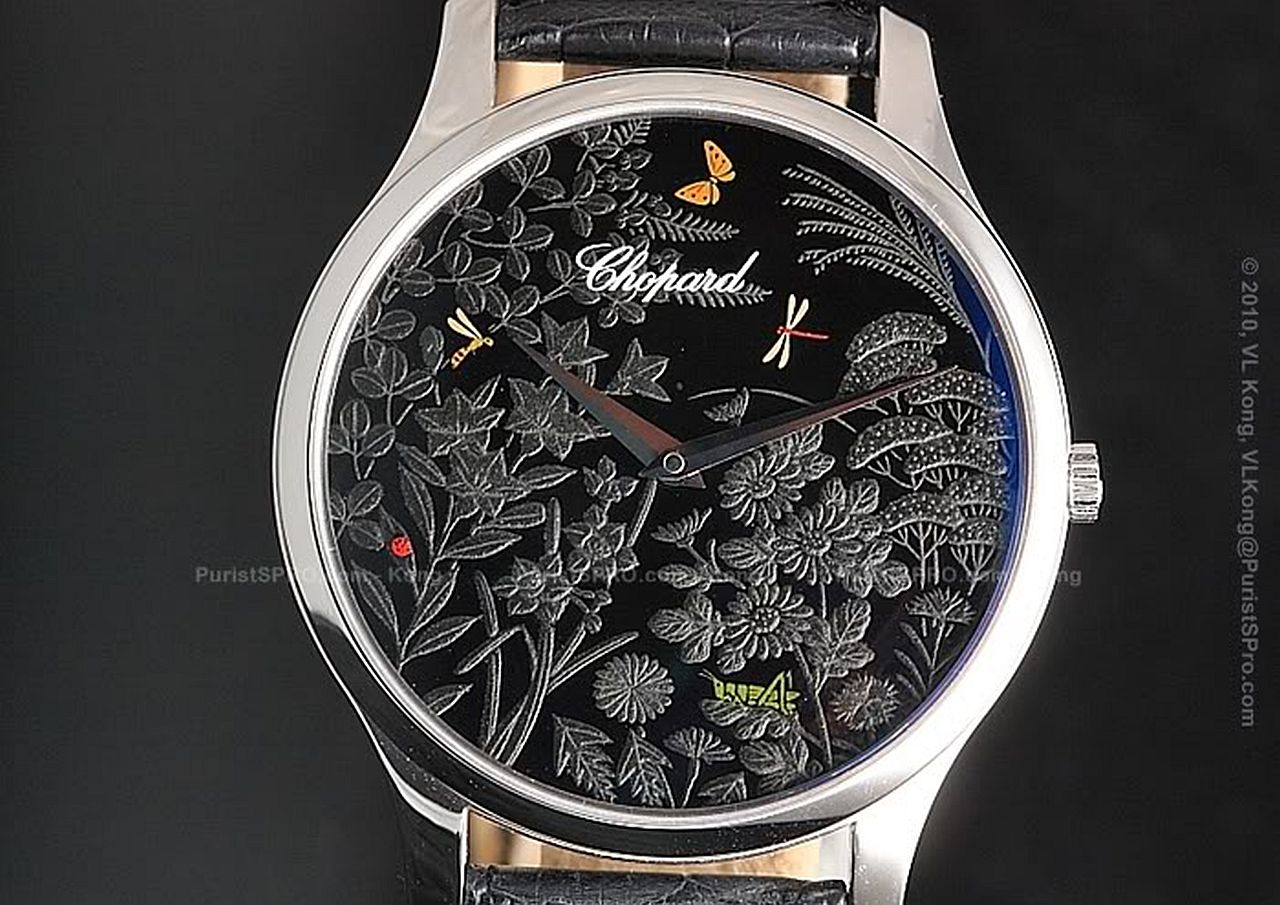
Ultimate Universe (with Chopard Bee)
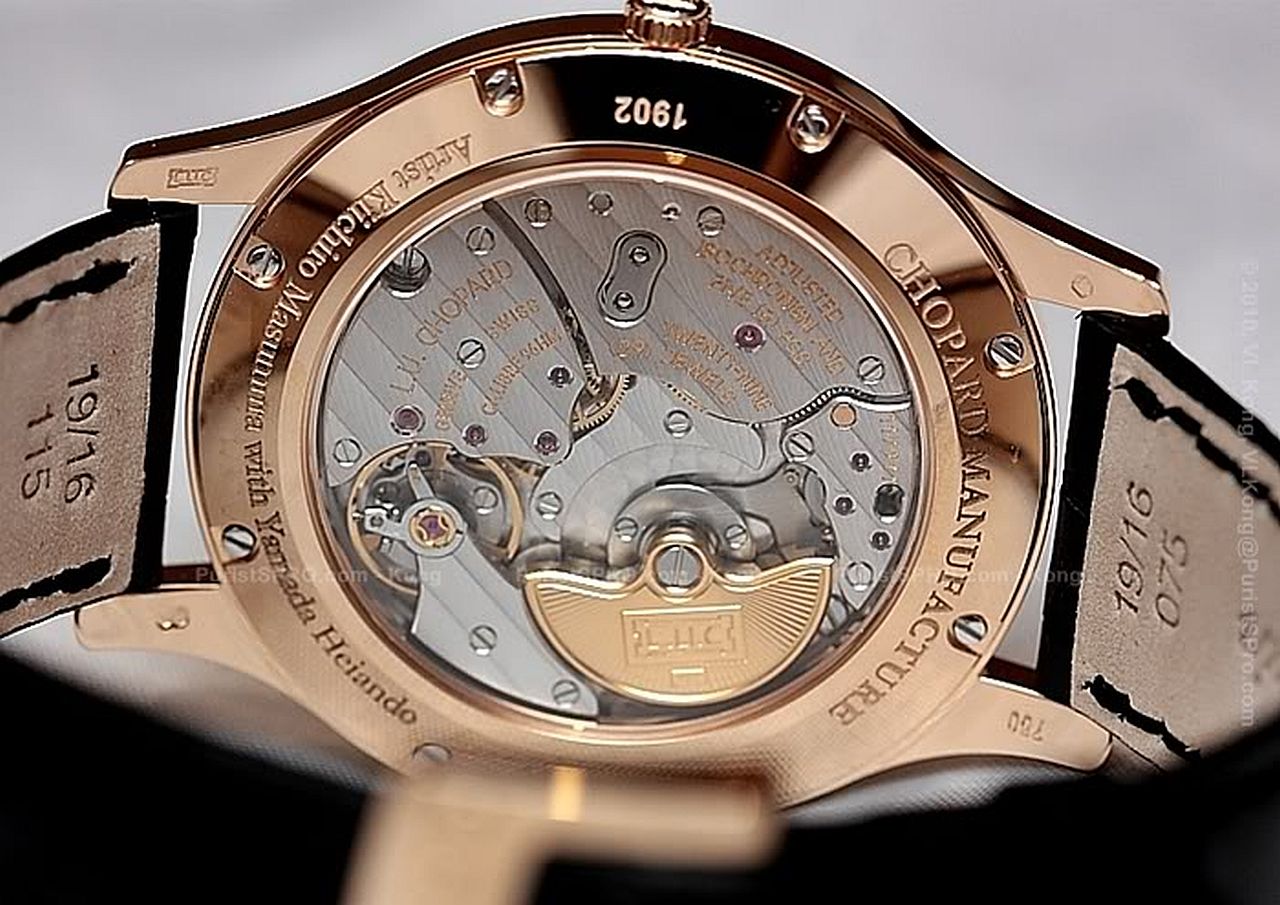
Original Urushi watch series L.U.C XP movement
Dr M. Teillol-Foo; 2015
I've read a lot of articles about Urushi lacquer and Maki-e. Some are watch related, many are pen related. So I thought I already knew something about Urushi and Maki-e. Well, I'm humbled. This is a fantastic post! A treasure trove of information. And it makes me appreciate these Chopard pieces even more! I already know the technical movements of these Chopard pieces are equivalent to the big three in Switzerland after visiting the factory with you a few years ago. The artwork on the dials is ex
Yamada Heiando, Japanese Lacquer Association, Cultural Tourist Boards and Maki-e Pen expert. Chopard provided the photographs from the studio. Thanks for your comments. Regards, MTF
On the ancient art of Japanese Urushi! As an Asian, I am proud to see Asian traditional arts being showcased in fine watches like Chopard\'s LUC Urushi range. We all know the beauty of Western Enamel dials but here, I think we have our own tradition from Asia on these beautiful Chopard watches. The Kirin is nicer than I thought especially how it plays with light. Last year I seriously considered getting one of these LUC Urushi watches but I was looking at the Horse for my Chinese zodiac sign and
Robin, I believe every gentleman must have at least one dress watch. Not a watch that he assigns as pretty enough for Sundays but an extra flat mechanical simple time-only watch. Some people even go as far as to ban dates and seconds hands. But elegant does not mean boring....so a maki-e dial allows some glamour for men, without the diamonds. It is also unisex for contemporary couples to share. I should not show old models as they may be sold out but if you can find some of these....... Peacock,
The depth of the dial is amazing. Thanks for sharing MTF. I prefer the bamboo for the new releases. Something about the peace of bamboos in our culture attracts me to the dial Cheers Robin
jungle also !! BTW, when I showed the photo of this jungle dial to the wife of my good friend who is in the watch business, she reminded me that lions do not live in the jungle. LOL !! Cheers, Gordon
This thread is active on the Chopard forum with 12 replies. Share your knowledge with fellow collectors.
Join the Discussion →