
Collection
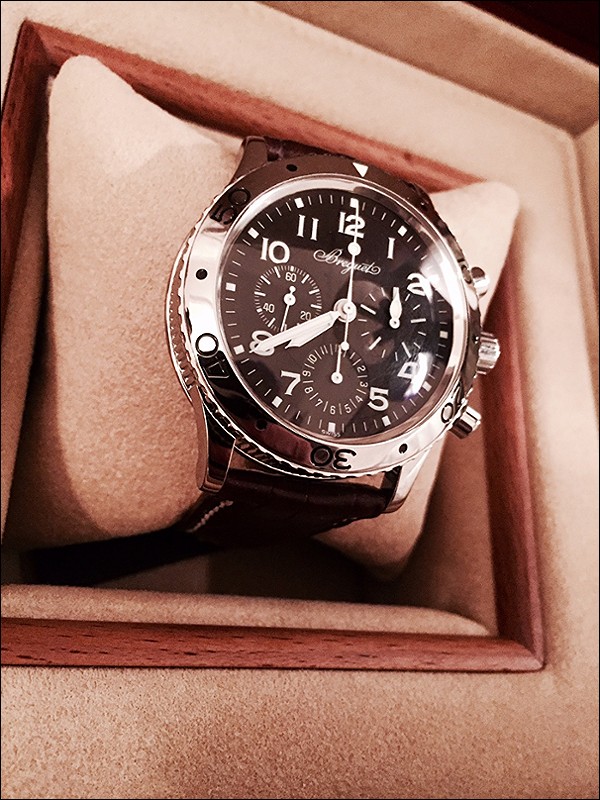
de Owar shares a deeply personal connection to his Breguet Aéronavale, tracing its significance back to his adventurous great-grandfather. This article explores how a family legacy, intertwined with aviation and a discerning sense of style, guided his choice of this iconic pilot's chronograph. It highlights the enduring appeal of watches that resonate with personal history and timeless design.

Precious things must have a story, with roots deep into our legacy, so this is mine.
My great-grand father used to be a gifted architect and a wealthy man - at least till the end of WWII - with diverse interest in very different things, such as legerdemain, contemporary paintings, old hand-guns (the latter was revealed after his death even for his family members, who spent a long night at the local police station as a consequence), and the girls at the Orfeum in Vienna, just to name a few.
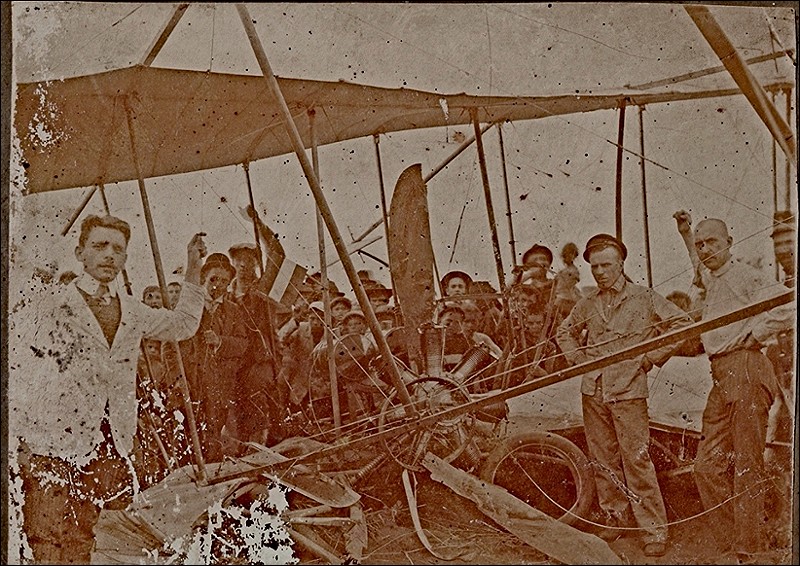
But his biggest love might have been his airplane, he built with his brother around 1912. Fortunately, from my point of view, at least, it was seriously damaged at the very first intent, after flying a few meters, just a few feet above the ground, and he survived this accident with a few superficial abrasions on his arm and forehead, such as the the world war a bit later when he was the single survivor of his troop in the Isonzo valley.
For me, therefore, it was obvious, when my less adventurous love for watches forced me to find a decent chronograph for my small collection, that I have to find a piece, that my great-grandfather would also appreciate, with his unbelievable sense of style and love for mechanical things. I was born 8 years after his death, and never had the chance to know him, but I have a strong vision about him, through his works and his story. This selection criterion immediately eliminated anything for the faint hearted, with any corners cut, or fancy and show-off things made for the nouveau riche.
The pilot theme was obvious, so my possible choices could be IWC, Hanhart, and since I haven't been truly satisfied neither of them, the type 20/XX.
Even though the predecessor of my watch was released in the 50's, he still lived and worked in those years and he could have known these excellent watches, also somehow popular beyond their purposeful military life. In addition, an onboard Breguet instrument could've served his own airplane, since Breguet was a supplier of such instruments from 1910.
I was also looking for something classy and timeless, not too modern, rather traditional, that already won't age by time, just stands still, preserving its core value, just like the churches, halls and villas he had built, while everything else was deteriorating around.
And now, when the wait is over, keeping this timepiece in my hand, I must say, that my great-granddaddy would be truly impressed!
Finally, I have to thank all of you, for your help in choosing the right timepiece. I'd also like to thank the kind help to the Breguet Boutique staff in Vienna and Baraka here in Budapest. Special thanks goes to KMII for his friendly support, when I had a visit in Vienna, looking forward to meeting you in Budapest (Anyway, this time I skipped the Orfeum, I don't know if it still exists  )!
)!
The Patek Philippe reference 3800, introduced in 1981 and available from 1982, represents a significant evolution of the Nautilus line. Positioned as a mid-size alternative to the original reference 3700, it offered a more versatile wearing experience while retaining the distinctive porthole-inspired case design. This reference was notable for being the first Nautilus to feature an in-house automatic movement, marking a shift in Patek Philippe's manufacturing strategy for the model. It was produced until 2006, allowing for a wide array of material and dial variations over its production run.
The case of the reference 3800 measures 37.5 mm in diameter, a reduction from the larger 3700. It was produced in various metals, including stainless steel, yellow gold, rose gold, white gold, and platinum, often paired with integrated bracelets or leather straps. The watch is powered by the in-house automatic caliber 330 SC, which features a central rotor and provides a power reserve of approximately 48 hours. A sapphire crystal protects the dial, and the watch offers water resistance suitable for daily wear.
For collectors, the reference 3800 appeals to those seeking a more understated and wearable Nautilus compared to its larger predecessor. Its long production period resulted in numerous dial configurations, including black, blue, and white, with different hour marker styles. The 3800/1A-001 and 3800/1A-XII are specific stainless steel variants that highlight the model's enduring appeal in its original material. Its status as the first Nautilus with an in-house movement also adds to its historical importance within the brand's catalog.
... A favorite of mine too. Thank you so much for sharing with us about your adventurous and gallant Great-grandpa! My own example says hello- Cheers! Abel. This message has been edited by Subexplorer on 2015-12-09 11:16:41
it's been you, who first suggested, I should've gone for the type XX!
what a great shot! I still have to figure out, how to make a good picture of mine.
And finally decided. Bravo. So, now, happy to see that you are in Heaven. Best, Nicolas
Congratulations on getting it. I enjoyed your story and the connection you've established between your family history and the Type XX. These connections make the acquisition and use even more special. Cheers, John
And thank you for sharing your story to go with it - these are what make particular watches special for us. Now looking to seeing it live in the near future! I am sure you will derive decades of enjoyment from it
This thread is active on the Breguet forum with 16 replies. Share your knowledge with fellow collectors.
Join the Discussion →


