Kong
[Moderator]
7855

Montblanc Nicolas Rieussec Chronograph Anniversary Edition 1821 – 2011
Two Centuries of Chronograph History- Montblanc Nicolas Rieussec
Chronograph Anniversary Edition 1821 – 2011: A homage to the inventor of
the chronograph
2011 will be a special year for the chronograph, which celebrates two centuries of chronograph history where the Nicolas Rieussec Chronograph Anniversary Edition, a strictly limited collection of 190 watches in eighteen carat red gold, 90 watches in eighteen carat white gold and 25 watches in 950 platinum will be launched.
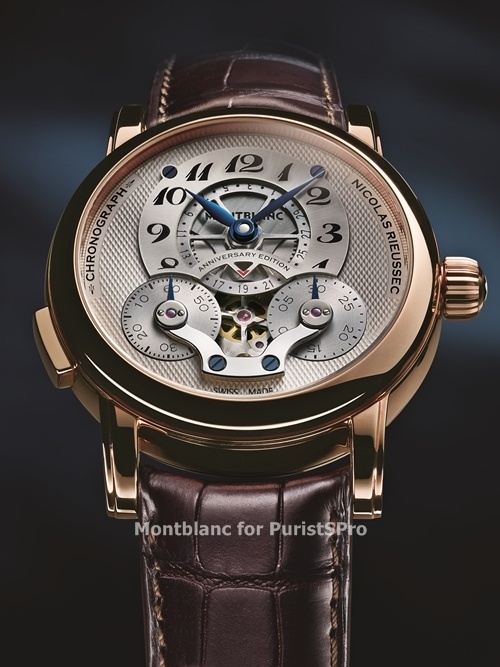
Nicolas Rieussec Chronograph Anniversary Edition - Rose Gold Version
The Nicolas Rieussec Chronograph Anniversary Edition will be a tribute to Nicolas Rieussec, the inventor of the first chronograph and “time-writing” device. In 2008, Montblanc first paid homage to the inventor of the device by dedicating its innovative Montblanc Nicolas Rieussec Chronograph to the ingenious watchmaker.
The Rieussec chronograph is the first chronograph where time display does not interact with the chronograph function, enhancing legibility of both indications and endowing a strong, unique look. As on the original chronograph from 1821, the chronograph hands do not rotate above the dials; instead, remaining motionless while the seconds-disk and minutes-disk turn underneath them.
With this, Montblanc created a new face to the chronograph combining tradition with innovation.
Typically Montblanc Nicolas Rieussec
Unmistakably the most eye-catching feature of the new Anniversary Edition is its subtle and pure, yet classique guilloche pattern which distinguishes every Montblanc Nicolas Rieussec Chronograph. An hours-circle displays the ordinary time of day: this subdial is off-centred toward the “12 o’clock” position of the main dial and held firmly in place by blued screws.
The unique “smiling” V-shaped bridge holds the ruby counter-bearings for the two chronographdisks: the subdial at the left can tally up to sixty elapsed seconds, while the disk at the right can count a maximum of thirty elapsed minutes. Below the hour-hand and minute-hand turns a finely skeletonized date-disk. The aperture in the dial beneath the date-disk offers a view into the depths of the mechanisms of this new chronograph and reveals components of the disk coupling and the periphery of the dial is adorned with a finely grained guilloche pattern known as “grain de seigle.”
A Chronograph Manufacture Movement
The MB R110 calibre assembled from 263 individual parts unites all the important features of the history of the chronograph. These include classical column-wheel control, as well as a modern and nearly friction-free vertical coupling which prevents wear when the chronograph function is allowed to run for a lengthy period of time. The rapid-reset mechanism with indicators that can be reset clockwise or counter-clockwise without affecting the position of the minutehand is extremely practical for travellers who journey from one time zone to another.
The hand-wound Montblanc manufacture movement has two barrels which together amass a 72-hour power reserve with an impressive sapphire crystal back. To enhance precision and assure the stability of the watch’s rate, the balance has a moment of inertia of 12 mg/cm2 and oscillates at a pace of 28,800 semi-oscillations per hour (4 Hz).
The History of the Chronograph
Born in Paris in 1781, Nicolas Mathieu Rieussec established a watchmaking business on the Île de la Cité and was appointed watchmaker to the royal court in 1817. At a horserace in 1821, he unveiled a new segment in watchmaking – a movement that powered two enamel dials, positioned above this one and calibrated with scales for the seconds and the minutes. This was the first time in the history of horology that an instrument could measure precise short time intervals. The running times of the individual horses and the time differences were literally written on the dials, and for the first time ever, the timekeeper could reliably capture the running times of all participants in the race without having to take his eyes off the sporting event to glance at his watch whenever one of the horses crossed the finish line.
The directors of the Parisian racetrack were so enthusiastic about Rieussec’s chronograph that they made it their official time-measuring device. The French patent office was similarly impressed and accordingly granted a patent on the invention of the first genuinely practical chronograph to Nicolas Rieussec on 9th of March in1822.
2011 will be a special year for the chronograph, which celebrates two centuries of chronograph history where the Nicolas Rieussec Chronograph Anniversary Edition, a strictly limited collection of 190 watches in eighteen carat red gold, 90 watches in eighteen carat white gold and 25 watches in 950 platinum will be launched.
Nicolas Rieussec Chronograph Anniversary Edition - Rose Gold Version
The Nicolas Rieussec Chronograph Anniversary Edition will be a tribute to Nicolas Rieussec, the inventor of the first chronograph and “time-writing” device. In 2008, Montblanc first paid homage to the inventor of the device by dedicating its innovative Montblanc Nicolas Rieussec Chronograph to the ingenious watchmaker.
The Rieussec chronograph is the first chronograph where time display does not interact with the chronograph function, enhancing legibility of both indications and endowing a strong, unique look. As on the original chronograph from 1821, the chronograph hands do not rotate above the dials; instead, remaining motionless while the seconds-disk and minutes-disk turn underneath them.
With this, Montblanc created a new face to the chronograph combining tradition with innovation.
Typically Montblanc Nicolas Rieussec
Unmistakably the most eye-catching feature of the new Anniversary Edition is its subtle and pure, yet classique guilloche pattern which distinguishes every Montblanc Nicolas Rieussec Chronograph. An hours-circle displays the ordinary time of day: this subdial is off-centred toward the “12 o’clock” position of the main dial and held firmly in place by blued screws.
The unique “smiling” V-shaped bridge holds the ruby counter-bearings for the two chronographdisks: the subdial at the left can tally up to sixty elapsed seconds, while the disk at the right can count a maximum of thirty elapsed minutes. Below the hour-hand and minute-hand turns a finely skeletonized date-disk. The aperture in the dial beneath the date-disk offers a view into the depths of the mechanisms of this new chronograph and reveals components of the disk coupling and the periphery of the dial is adorned with a finely grained guilloche pattern known as “grain de seigle.”
A Chronograph Manufacture Movement
The MB R110 calibre assembled from 263 individual parts unites all the important features of the history of the chronograph. These include classical column-wheel control, as well as a modern and nearly friction-free vertical coupling which prevents wear when the chronograph function is allowed to run for a lengthy period of time. The rapid-reset mechanism with indicators that can be reset clockwise or counter-clockwise without affecting the position of the minutehand is extremely practical for travellers who journey from one time zone to another.
The hand-wound Montblanc manufacture movement has two barrels which together amass a 72-hour power reserve with an impressive sapphire crystal back. To enhance precision and assure the stability of the watch’s rate, the balance has a moment of inertia of 12 mg/cm2 and oscillates at a pace of 28,800 semi-oscillations per hour (4 Hz).
The History of the Chronograph
Born in Paris in 1781, Nicolas Mathieu Rieussec established a watchmaking business on the Île de la Cité and was appointed watchmaker to the royal court in 1817. At a horserace in 1821, he unveiled a new segment in watchmaking – a movement that powered two enamel dials, positioned above this one and calibrated with scales for the seconds and the minutes. This was the first time in the history of horology that an instrument could measure precise short time intervals. The running times of the individual horses and the time differences were literally written on the dials, and for the first time ever, the timekeeper could reliably capture the running times of all participants in the race without having to take his eyes off the sporting event to glance at his watch whenever one of the horses crossed the finish line.
The directors of the Parisian racetrack were so enthusiastic about Rieussec’s chronograph that they made it their official time-measuring device. The French patent office was similarly impressed and accordingly granted a patent on the invention of the first genuinely practical chronograph to Nicolas Rieussec on 9th of March in1822.
Press Release
Montblanc Nicolas Rieussec Chronograph Anniversary Edition 1821 – 2011
Two Centuries of Chronograph History- Montblanc Nicolas Rieussec Chronograph Anniversary Edition 1821 – 2011: A homage to the inventor of the chronograph 2011 will be a special year for the chronograph, which celebrates two centuries of chronograph histor...

They should have thought putting a picture of the case back,at Montblanc.
It is worth the look! Best, Nicolas.

In Singapore: we get to see this and part of the MIH exhibits
Soon, in Singapore we get to see this watch as you said, "Have a look". But also some of the 200 year history of chronographs with exhibits from the MIH (horology museum at la Chaux de Fond). Then, we may have some opinion of the watch. Regards, MTF