Marcus Hanke delivers a comprehensive report from Baselworld 2011, focusing on Vogard's innovative timepieces. He details the brand's unique world-time mechanism and introduces the 'Datezoner' chronograph, which synchronizes date indication with its world time display, a significant development in travel watches.
Basel 2011 Novelty report
Vogard
by Marcus Hanke
The
small company of Mike Vogt has become well-known for its clever
mechanism for a world-time watch. It permits to set the hour hand by
rotating the massive bezel, and to synchronize it by this with any
desired time zone.
This year, Vogard presents its first
chronograph, of course combined with the unique time zone/world time
mechanism. What makes the chronograph called “Datezoner” so special is
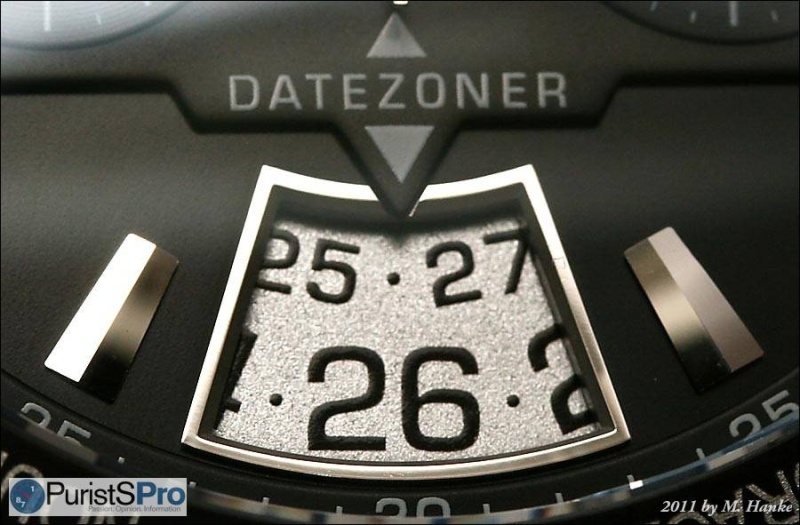
its date indication, which is synchronized with the world time display.
For any given time zone, it is thus possible to read not only the time,
but also the date. This is important if the referenced time zone lies
across the date border.
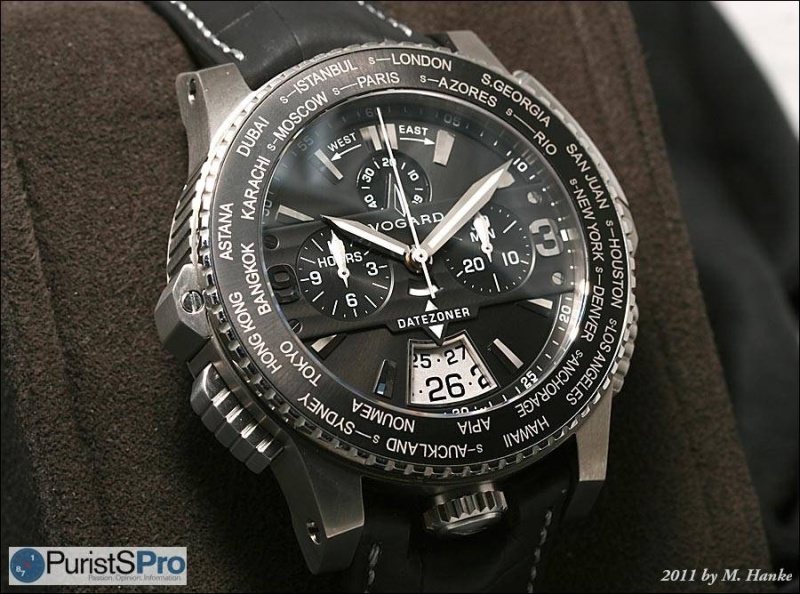
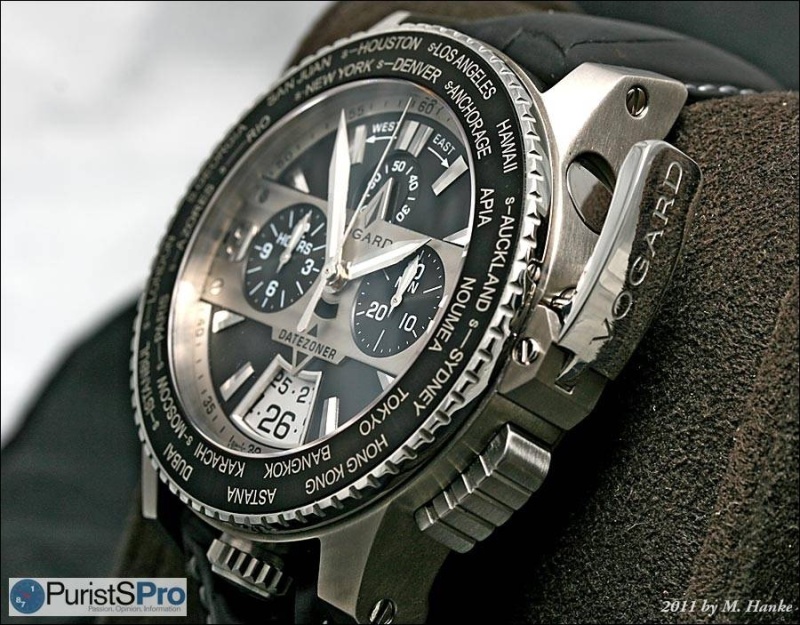
The side view shows the typical locking mechanism of the timezone bezel
This
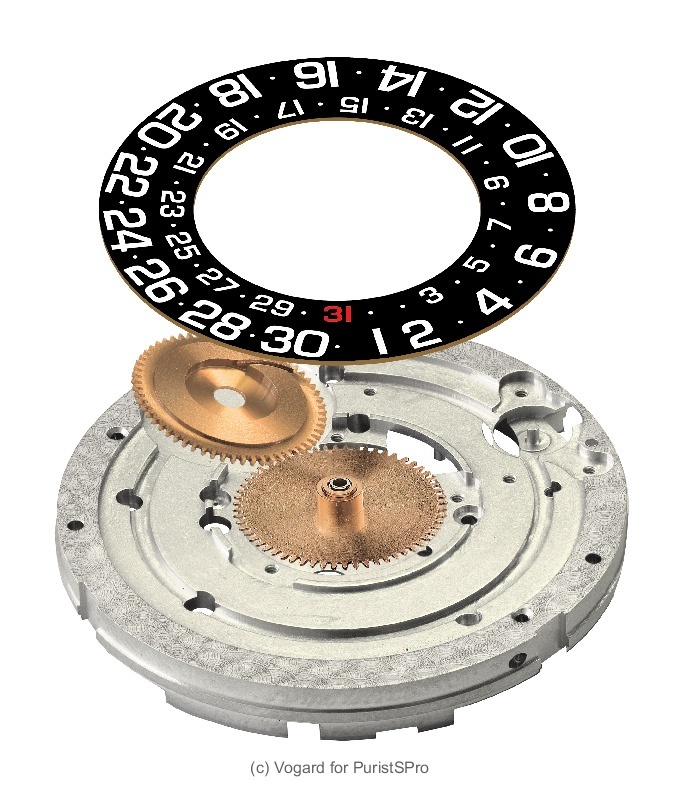
synchronisation is the the result of a massive development effort: AHCI
master Andreas Strehler designed a special sync wheel, that lies in an
inclined layer and connects the time zone mechanism with the date wheel.
I
personally like that the date indication is not placed somewhere in the
middle of the dial - as is so often seen on oversized watches. Instead,
Vogard decided to present it as some kind of pseudo big date: the even
days of the month are printed in smaller size onto the inner circle of
the date wheel, while the odd day numbers are printed very large, onto
the outer section. So even if the presbyopic watch owner should have no
problems to decipher the current date. Additionally, the date window
perfectly matches the watch’s generally bold design.
The
permanent second is executed as a small revolving disk, that works more
as a function control, rather than a subject of accurate reading. The
chronograph is based on the well-known Valjoux 7750, however in an
unusual configuration.
The winding crown is located at 6, which
unfortunately makes it necessary to use specific straps. After
realizing, that the classic Valjoux 7750 has been rotated by 90 degrees,
the unusual layout of the “Datezoner” looks more familiar again. Yet
Vogard invested a lot of own know-how and manufacturing competence into
the watch: producing the bridges, wheels and pinions for the world time
mechanism is an effort that should not be underestimated, not to mention
the time- and money-consuming development. I like this unusual watch
very much; it is an attractive travel watch with large dimensions (48mm
diameter); yet these do not appear artificially inflated, at least. And
due to the fact that there is no winding crown at 3, that could
painfully dig into the back of the hand, the “Datezoner” is not
uncomfortable to wear.
The case consists of titanium carbide, and several attractive dial variants are offered.
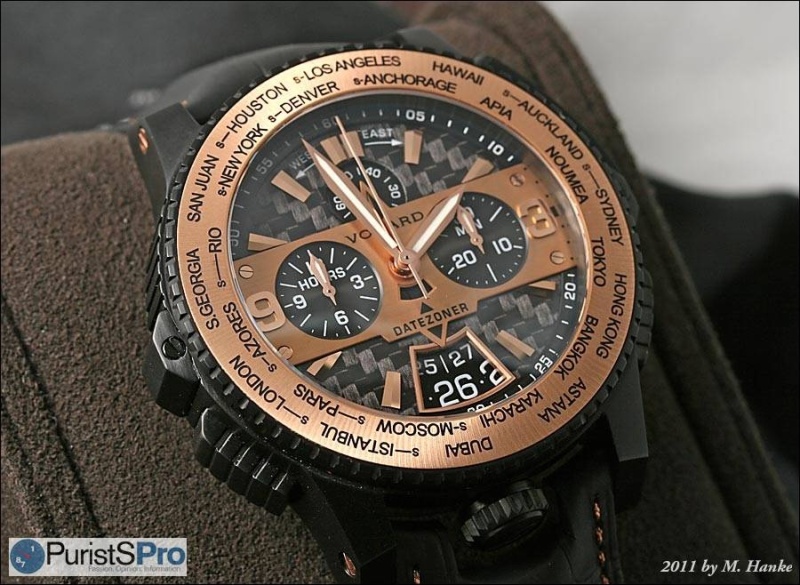
Datezoner in black DLC stainless steel /18k pink gold and carbon fiber/gold dial
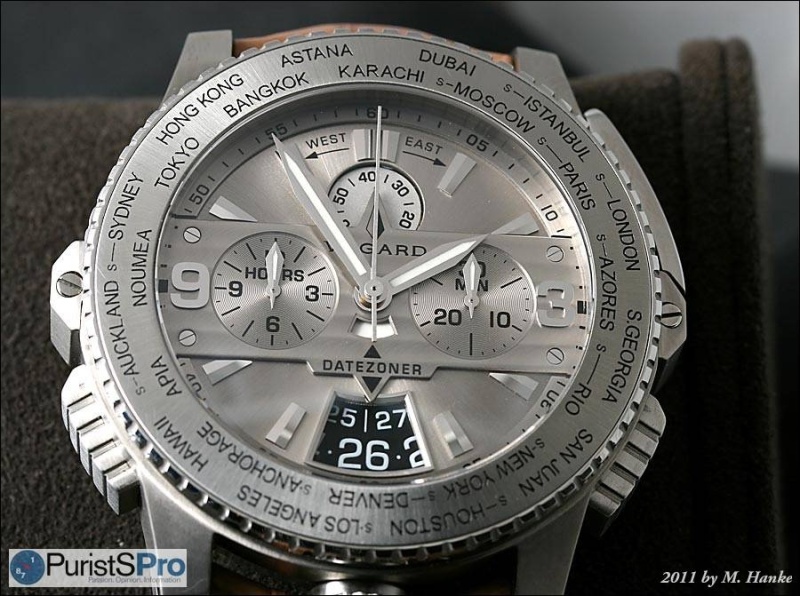
Datezoner in stainless steel with silver dial
Besides
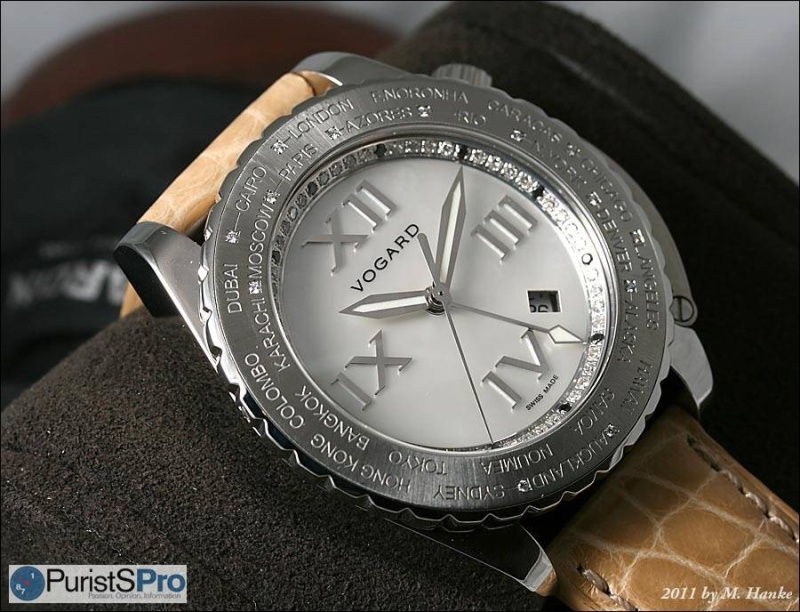
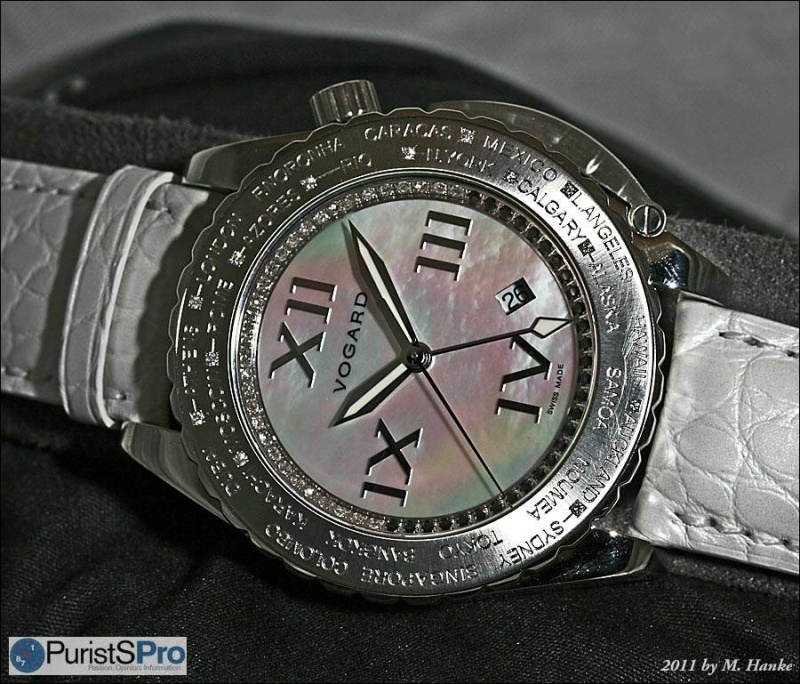
the “Datezoner”, Vogard also presents a very nice ladies’ version of
the time zone watch without chronograph. The revolving bezel is kept in a
natural metal surface, with the markings for the daylight saving time
being indicated by diamonds. I like especially the way how the Roman
numerals reproduce the font of the company logo. Presumably unwanted is the wrong Roman numeral at 6, which in fact is the 4. Hopefully, Mr. Vogt gets the cost of the dials reimbursed from the dial supplier ...
Finally,
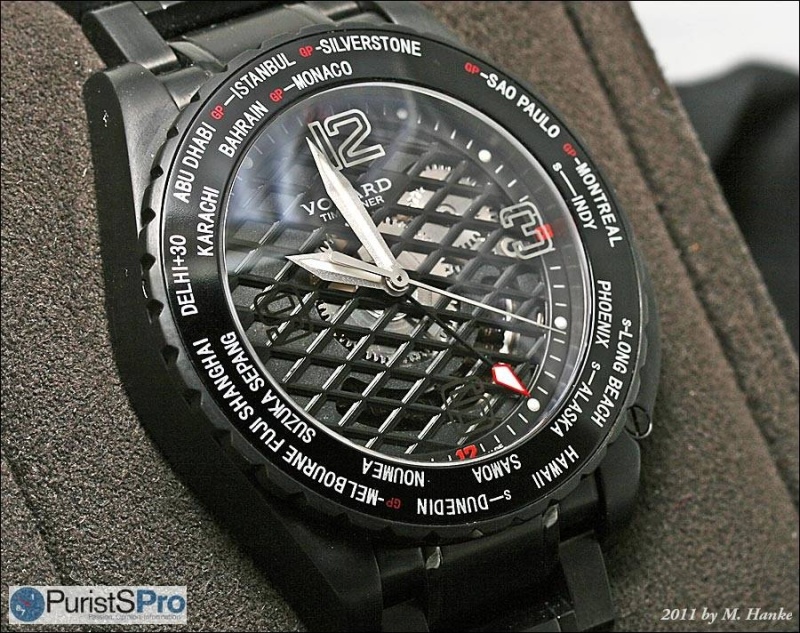
there are a few other worldtimer watches, such as the “Radiator F1”,
clearly influenced by the formula 1 motorsports: Its dial shows a
radiator grid, through which the mechanism can be seen operating. The
43mm case is treated with titanium-carbide. On the bezel are the names
of the major racing circuits.
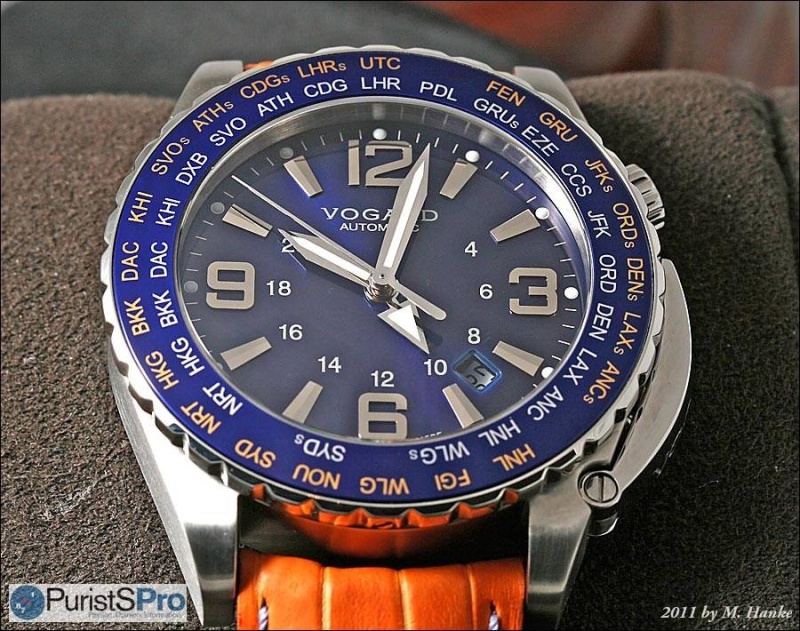
The
“Licensed Pilot” has a bright blue dial, a separate 24 hours hand, and
lists the time zones as IATA codes of airports located therein.
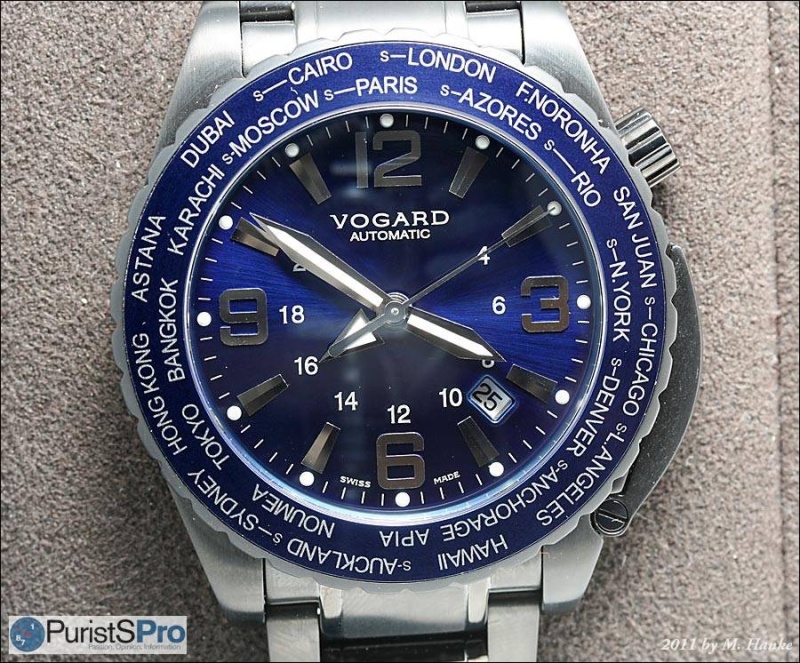
For
those who - like me - are not familiar with these codes, the “Licensed
Pilot Bluecity” has a more legible ring with city names, but keeps the
highly attractive blue outfit.
This message has been edited by Marcus Hanke on 2011-04-18 04:35:38 This message has been edited by Marcus Hanke on 2011-04-19 13:27:22 This message has been edited by Marcus Hanke on 2011-04-20 00:34:07