Vintage
Jay (Eire) provides a detailed and personal overview of the Seiko 6105-8000, distinguishing it from its more famous successor, the 6105-8110. His post offers valuable historical context and collector insights into this often-overlooked vintage diver, making a case for its unique appeal amidst new reissues.
Disclaimer: The accuracy of the below is not guaranteed, there are numerous more knowledgable and reliable sources than I on Seiko Divers and the 6105 references. If you notice any glaring errors please don’t be shy in highlighting, similarly please chime in with any additional information which might be useful to others interested in this reference.
—————————————————————
With Baselworld just around the corner and all the speculation about what’s coming from Seiko this year I thought I’d post a little note on perhaps my favourite Seiko diver of them all, the 6105 - 8000 (or 8009 depending on which market the watch was for).
Of course since I started putting together this post Seiko did in fact announce the arrival of the modern 6105 BUT (as expected) it was not the 6105-8000 which I favour, it was it’s younger, larger, movie star brother the 6105-8110. Anyway, I thought it was still worthwhile make this post especially now as this new release will likely cast the original 6105 in a shadow as the new piece will capture all the attention.
——————————————————————
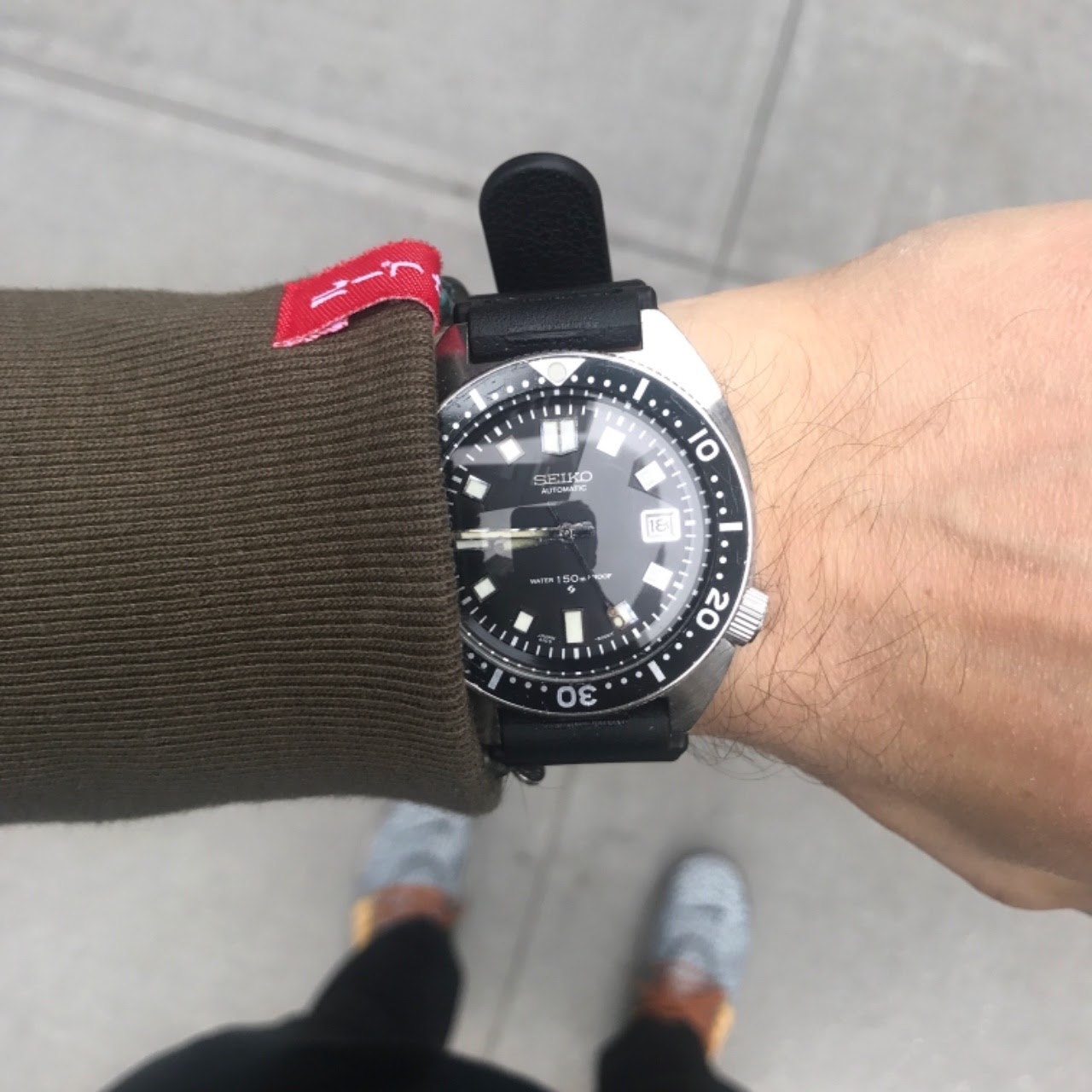
The 6105-8000 was released in 1968 and is known by some as Seiko’s “2nd Diver” as it was this watch that was the direct replacement for the 62MAS which was Seiko’s first dive watch released just 3 years before in 1965.
The 6105-8000 had a shortish run also, from 1968-1970. In 1970 Seiko launched its larger and more famous asymmetrical brother the 6105-8110 (or 8119 depending on the market). All in all the 6105 ran from 1968-1977 across two different case designs.
Of course the 6105-8000 wasn’t actually Seiko’s second dive watch as a little earlier they had released the first in the line of the “Professional” series, the 6215 which had an increased depth rating of 300m and from all accounts was a little more water tight than the 62MAS (which was from what I’ve read in various places known to spring the odd leak!). The 6215 was replaced a year later with the 6159 which was pretty much the same watch except with a high beat 36000 bph movement.
———————————————————-
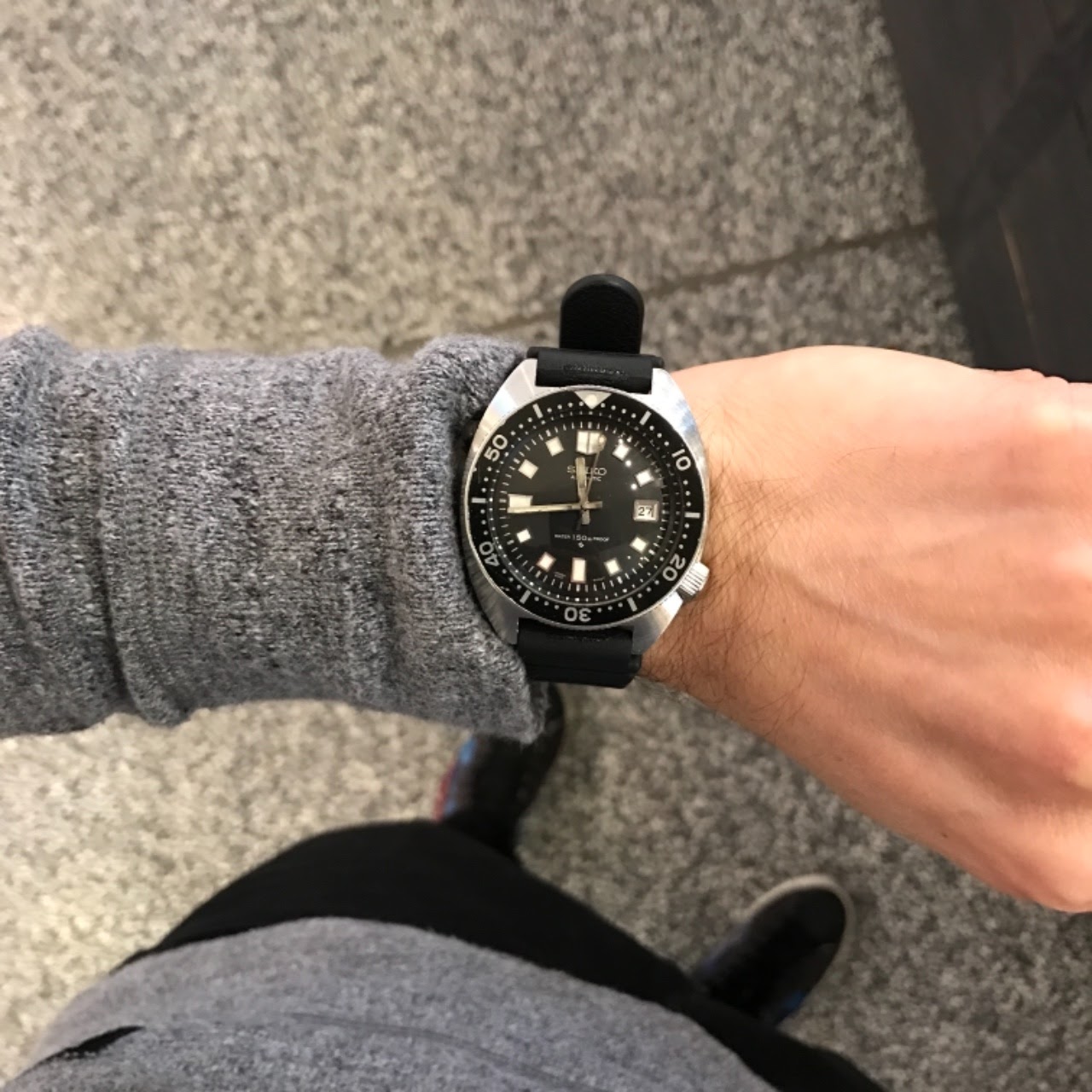
So back to Seiko’s “2nd Diver” (which was really its 4th dive watch right?), this was the watch which introduced us to the world of the oval shape cased dive watch (41mm for the -8000, the 8110 was 44mm) and perhaps solidified the crown placement at 4 as a calling card of the Seiko diver for years to come.
Aside from the crown placement the other interesting tidbits on the crown are first that it was signed “SEIKO”, which as far as I am aware from what I’ve read elsewhere was pretty unusual for Seiko at that time, second is that the crown wasn’t a screw down and third the seal on the crown was permanently integrated and so once worn down you apparently may not want to try getting wet!!!
The movement of the 6105 (cal.6105A and cal.6105B) was automatic with 17 jewels and beating at 21,600 bph. It could not be manually wound, so starting it up from a little sleep requires a nudge. The difference between the cal.6105A and cal.6105B I believe is that the A was non hacking while the B did hack.
The dial and hands; for a diver as one would hope the applied markers are super clear and legible against the black dial. They are pretty chunky really, with surrounds in brass and lume filled. There’s a minute track printed on the dial in white, again super legible.
The hands are pretty normal, thicker stick shaped with lume fill. But then you see the sweep seconds hand and it’s got a little detail that would always be a hook for certain watch lovers.
I’m not sure what the correct term for the shape of the seconds hand might be (I’ve seen it referred to as “arrowhead” in some places but that doesn’t sound right to me) but as you can see from the picture it has two lume filled areas close to the tip with the inner being white while the outer area has a little dash of colour (red originally but now mostly looks orange to the eye). Like the Omega Ultraman with the dash of colour on the central seconds hands I’m sure this little detail was just enough personality for some owners in what was otherwise a very utilitarian watch.
And then there’s the “mung”, the technical term for the discoloration of the lume plots you generally see on many of Seiko Divers from this period. I’ve read in some places that this “mung” was due to a combination of how these watches were stored and the relative humidity of the environment. Anyway, it seems my watch got away relatively unscathed as I’ve seen numerous 6105 with lume plots that are essentially all black “mung” at this point.
In terms of dial markings I think the only point to note is that there seems to be two variations of dial in existence for the -8000, mine which shows “WATER 150M PROOF” and another which I believe is rarer showing “WATER 150M RESIST”. A similar variation existed on the dials of the 6105-8110. As a quick side note there are some watches where this dial marking is matched on the case back with a similar reference to “PROOF” or “RESIST” but as you’d expect there is also a mash up with dial using one term, case back another. To finish off the dial markings there is a SUWA symbol just under the depth rating and to the left of the 6 marker the stacked text of “JAPAN 6105” and to the right “-8000T” which is the reference to the case.
Finally the black bezel on the 6105 is bi-directional. I’ve read elsewhere that the original retaining clip on the 6105 was somewhat of a step back compared to the 62MAS. The reasoning offered was that the retaining clip for the 6105 was basically a c shape and so only made contact (pressure point) at three places whereas the 62MAS used a octagonal shaped clip which obviously had more contact points and was therefore more secure/solid in feel. Honestly, without a side by side it’s all the same to me. Especially so for the “desk diving” assignments that my 6105 accompanies me on!!!
—————————————————————
As some of you will know while I’m very much a fan of vintage Seiko, the Divers are not my focus and this 6105 is one of only two vintage Seiko Divers I own (the other being a 6306).
Neither were watches which involved a dedicated search, rather they were each “happened upon” while seeking out some other vintage (Grand) Seiko. Despite the randomness of the acquisition the 6105 is definitely become a favourite, it’s extremely wearable for a smaller wrist and has oodles of character.
The Rolex Oyster Perpetual reference 6105 represents the brand's Bubble Back series from the 1940s. This 32mm timepiece demonstrates Rolex's automatic watchmaking during the decade, featuring the caliber A.10 movement with 42-hour power reserve.
The stainless steel case measures 32mm in diameter and houses an automatic caliber A.10 movement. The watch displays a silver dial beneath an acrylic crystal, framed by a smooth bezel. Water resistance extends to 50 meters, and the timepiece is fitted with a leather strap.
This reference appeals to collectors interested in mid-20th century Rolex automatic watches and those focusing on the Bubble Back series specifically. The 32mm case size and silver dial configuration place this reference within the smaller format offerings of the Oyster Perpetual range from this production period.
Hello Jay, Thanks very much for sharing. Regards, Bob S
Thanks for the dedicated review of one of my favorite seiko divers. I think the smaller toneau case makes it more wearable, and it’s a case shape many brands still use. I also found my 6105-8110 by chance but has become a staple in my collection. Best. René
Great review thank you. I am a big Seiko fan of the period to include the 62mas. So much history. Below the 6105-8000 with proof on the dial and water proof on the caseback. Note specifically water space proof not waterproof Below is the Seiko 6105-8009 with resist on the dial and water resist on the case back.
This one, the -8000 was the right choice and it does get a decent amount of wrist time.
. . . that's dedication! I've multiple issues of the same reference when it comes to Omega chronometers, but all have different dials and case materials. Long an admirer of Seiko divers; would like to have an SKX013 if it could be had with a movement made in Japan. Art
I had one 6105-8110, but after that I had the oportunity of buying 2 more of my birth year and month, and I couldn’t resist...
This thread is active on the Seiko forum with 12 replies. Share your knowledge with fellow collectors.
Join the Discussion →