Complications
AndCavanaugh's deep dive into Patek Philippe's Caliber R27 Tourbillon movement offers a rare glimpse into the early iterations of this horological marvel. His meticulous examination of the movement's evolution, from its unique yellow gold third wheel to the silent strike governor, provides invaluable context for understanding Patek Philippe's innovative spirit in minute repeaters. This article highlights why the R27 Tourbillon remains a cornerstone for collectors and enthusiasts alike.


In 1989 Patek Philippe launched their first “in-house” repeater movement: caliber R27. The R27 comes in two flavors, self-winding and tourbillon. This was the first time Patek used a silent strike governor in a standalone repeater. This system was developed in the late 1800s but was mostly found on cheap repeater watches.
In the tourbillon version, the third wheel is made of gold, and shaped like the wheel of a rounding-up machine. Making wheels out of gold isn’t all that unusual, however, the gold alloy is normally pink (high copper) or white (high nickel/zinc), for better properties. Patek used a yellow gold allow here, which is a little weird.
Anyway, the first R27 with tourbillon was 1’903’000, which is still owned by Patek Philippe. The next was obviously 1’903’001, then 002, etc…
000 to 002 do not have the gold octopus wheel, instead its just a plain brass wheel. There are other differences too, the tourbillon bridge was brass instead of polished steel, the titanium tourbillon cage isn’t polished, and the jewel for the center wheel is missing the gold setting.
I don’t have any pictures of 003, but 004 does have the steel bridge and gold third wheel. A lot of R27 tourbillon movements have been made, but I think there are only 3-4 of these rough early ones, and one is in the Patek Philippe Museum.
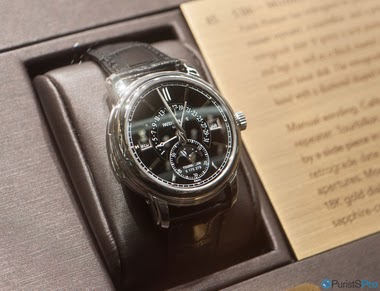
The R27 TO is currently used in ref 5303, 5207, 5316, and 6002 Sky Moon Tourbillon. Engagement question: why doesn’t the Sky Moon Tourbillon have seconds hand coaxial with the moon phase like the 5316?
The Patek Philippe Reference 5016 stands as a highly complex grand complication within the brand's offerings, distinguished by its combination of a minute repeater, tourbillon, and retrograde perpetual calendar. This reference is a testament to Patek Philippe's mastery of horological complications, integrating three significant functions into a single timepiece. It represents a pinnacle of traditional watchmaking, appealing to collectors seeking a comprehensive display of mechanical artistry beyond simpler perpetual calendar models. Its inclusion of a minute repeater and tourbillon elevates it significantly within the grand complication category.
Crafted with meticulous attention to detail, the Reference 5016 typically features a case made from precious metals, housing a sophisticated manual-winding movement. The intricate caliber is visible through a sapphire crystal case back, allowing appreciation of the tourbillon and the finely finished components. The watch's dimensions are carefully considered to accommodate its complex mechanism while maintaining a wearable profile. The power reserve is substantial, reflecting the efficiency of its movement design, and the crystal is consistently sapphire for durability and clarity.
This reference appeals to serious collectors who value the integration of multiple high complications. Its rarity and the complexity of its construction make it a significant piece in any collection of grand complications. The 5016 is recognized for its technical achievement and its position as a flagship model demonstrating Patek Philippe's capabilities in creating watches that combine both acoustic and visual horological marvels. It occupies a distinct place among the brand's most elaborate timepieces.
interesting post on the movements ! Did you have to spend much time on the research ?
This might end up as part of something larger on caliber R27 in general, or as something on tourbillons, since the R27 TO is by far the most produced Patek tourbillon movement.
I believe the 6002 has the base movement rotated roughly 30 degrees clockwise, such that the crown is relocated to 4 o'clock. Thus the tourbillon cage is now shifted to 7 o'clock (dial side). Maintaining a seconds hand at 6 o'clock will require an auxiliary geartrain to connect the tourbillon cage shaft from 7 to 6 o'clock, provided if there's even space under the moonphase disc for that. Regards, skyeriding
of finishings than the one on the left. I wonder if it is because the 1st one is a kind of Ebauche and the other one a fully refinished movement ?
Only 3 or 4 of the 1000+ of these movements Patek has made look like the left. These are just very, very early versions of the movement. This change happened in 1992, while Patek dropped the Geneva seal in mid-2009. Here's one with the better decoration and the geneva seal.
This thread is active on the Patek Philippe forum with 7 replies. Share your knowledge with fellow collectors.
Join the Discussion →