Discussion
Miranda initiates a discussion on the enduring legacy of Patek Philippe, attributing its premier status to consistent technical excellence and a commitment to generational servicing. The post highlights Patek Philippe's historical resilience during challenging periods for the Swiss watchmaking industry, particularly its serial production of grand complications.


For over 175 years Patek Philippe have enjoyed a status that certainly very few can share at the top table of haute horology. What make Patek Philippe so great? I get asked this all the time. The answer is relatively simple- consistency. Patek’s reputation has been made over decades, including a period when most of the Swiss watch making industry was left in ruins. Remember, in the 1970’s whilst everyone else was trying to survive, and the death of the mechanical watch was upon the industry, Patek were probably the only manufacture that was making perpetual calendars, perpetual calendar chronograph, on application minute repeaters. Whilst other great makes would make such grand complication in extremely limited series, it was Patek Philippe that serially produce them, right from the dawn of the wristwatch with esteem references such as the 1526 and 1518 followed the extraordinarily beautiful references 2499 and 2497, 3448/50.
Combine this technical excellence with movements finished to a level that just was not matched by other manufactures and you see this reputation has been hard earned.
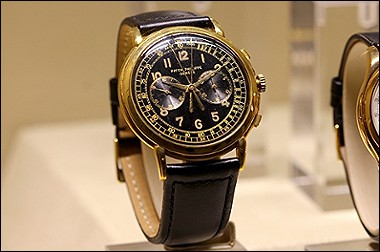
Patek of course were also the first to produce the split seconds chronograph, a complication they have become synonymous with. And they were the first to produce super complications as demonstrated in my exceptional watch series.
What also made Patek unique was the fact they would ensure the servicing of their timepieces not just for your lifetime, but for continuing generations. There is no watch that has ever left the manufacture they will not service or repair or produce an archive record. Remember before it was en vogue to make archive certificates, it was Patek Philippe who were the only manufacture to authenticate and verify their creations.
Hence the advertising of merely looking after one of their timepieces for the next generation was born. The ethos behind this founded from their ability to keep alive their watches from generation to generation. It certainly was not about sealing watches in plastic and locking them in safes.
They are unfortunate victims of their own success in many ways. If collectors now put away their beloved possessions rather than do the right thing- wear them, it can hardly be the fault of the manufacture.

The Patek Philippe Reference 1518 holds a significant place in horological history as the world's first perpetual calendar chronograph produced in a series. Introduced in 1941, it established a foundational complication for the brand, preceding other notable perpetual calendar chronographs such as the 2499 and 3970. This reference is recognized for its pioneering role in combining these two complex mechanisms in a wristwatch.
This reference was primarily offered in yellow gold, with a limited number produced in rose gold and an even smaller quantity in stainless steel. The case typically measures 35mm in diameter, housing the manual-winding caliber 13''' Q. The movement features a column-wheel chronograph mechanism integrated with the perpetual calendar complication. The dial often presents with applied Arabic numerals or bâton indexes, and a tachymeter scale on the outer periphery.
For collectors, the 1518 represents a landmark Patek Philippe reference, highly sought after for its historical importance and rarity, particularly examples in alternative metals. Its design language and technical sophistication set a precedent for subsequent perpetual calendar chronograph models, making it a cornerstone for understanding the evolution of this complication within the brand's catalog.
Open a window and let some of that stuffy 175 year old air out. Most refreshing brand to come along in years--certainly the one that pushes the envelope. Some companies are leading the future, while others live in the past. RM makes 4400 per year. PP 44,000. RM true high end sports watches meant to be worn. PP delicate dress watches. RM starts in the $100k range. PP starts in the $20k range. Two completely different brands selling completely different watches to completely different consumers (a
But RM has not prove itself they dont even have their own movements. They are great in marketing strategy but dont think it will last for next 150 years. Just my thought
Only thing I know in 150 years we will all be dead. I live for today, not 150 years from now.
But they are definitely different and launched a whole tsunami of wanna be watches Best Imran
And I don’t have a problem with RM watches. I think they are a fantastic fashion statement.
This thread is active on the Patek Philippe forum with 98 replies. Share your knowledge with fellow collectors.
Join the Discussion →