Review
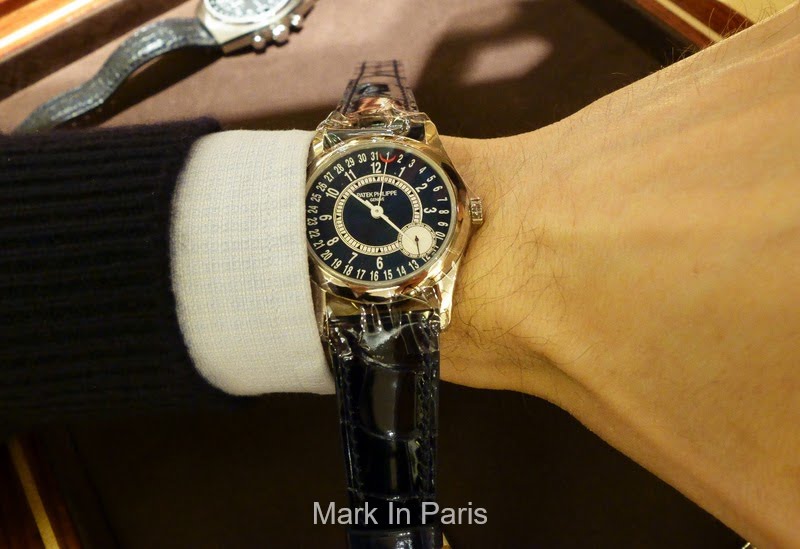
Mark in Paris delivers a hands-on review of the Patek Philippe Calatrava Ref. 6000G with a blue dial, highlighting its unique position within the Calatrava line. He emphasizes the watch's gorgeous dark metallic blue dial and its contemporary, casual aesthetic, which sets it apart from more traditional references.


The Patek Philippe 6000G is quite a very unique reference in the Calatrava line, mainly because of the dial decoration: whether with a rose gold case/brown dial or white gold/classical grey dial or this contemporary casual but very beautiful dark blue dial launched in 2015.
The first thing that we notice is the dark metallic blue dial, which looks absolutely gorgeous. Indeed, the combination of the 37mm white gold case, especially with its very nice classical design (no crown guards as they disappeared from the last collection and definitely not very "a-propos" for a more casual and contemporary style) with the smooth and refined rounded bezel (quite different from other references which have a concave bezel), gives a little touch of warmth to this unusual Calatrava.
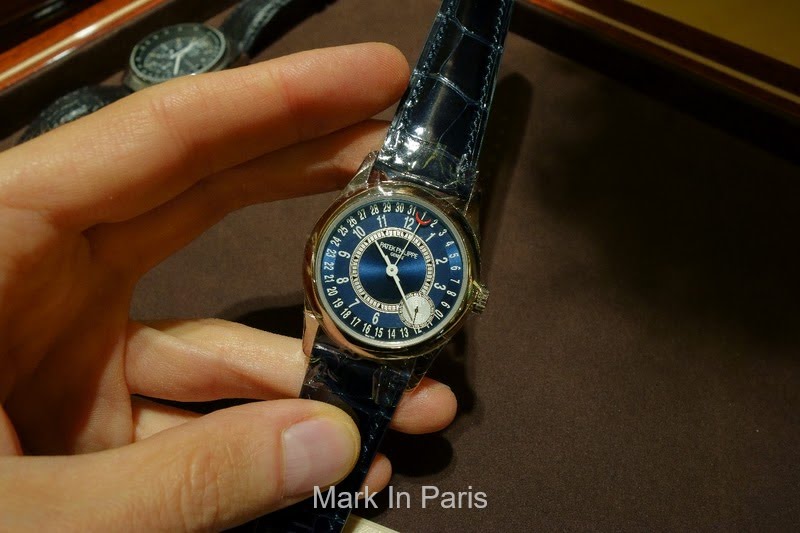
I'm not really a ‘blue dial’ guy; it’s just a matter of personal taste but I like this one very much, certainly because of the deep blue color. It is absolutely beautiful with a little metallic hue and much darker than the blue dials of the 5270G, 5070P, 5905P or even the 5200G to give you an idea.
Of course, the dials of these 6000 references are well known for their special decoration. It is a white printing, thus more visible, more casual and hence, a less classical layout. It is quite a "technical" and more graphical decoration compared with the usual numerals we find on traditional references because of the placement of the Arabic numerals. Furthermore, with their unique shape and flat ends, the hands are painted white as well, to add to this coherent casual atmosphere.
This dial is quite unique with four different textured areas of decoration. There are three blue sunburst patterns (Date, Hour and center) with micro-grooves on the minute ring and small second sub-dial. This plays a lot with the blue metallic color to bring much activity from light reflections on the dial.
This dial makes it a very versatile watch with a very elegant touch as well. I think this is the kind of dial you want to look at, several times a day, just for the pleasure (like the Nautilus's). It is, of course, very different from the traditional layout but it works perfectly and is very coherent, as a whole.
Patek Philippe has an exceptional mastery of dial making and a very wide diversity of color and finishing. This element, as for case shapes, is something that makes each Patek Philippe watch very different from its cousins.
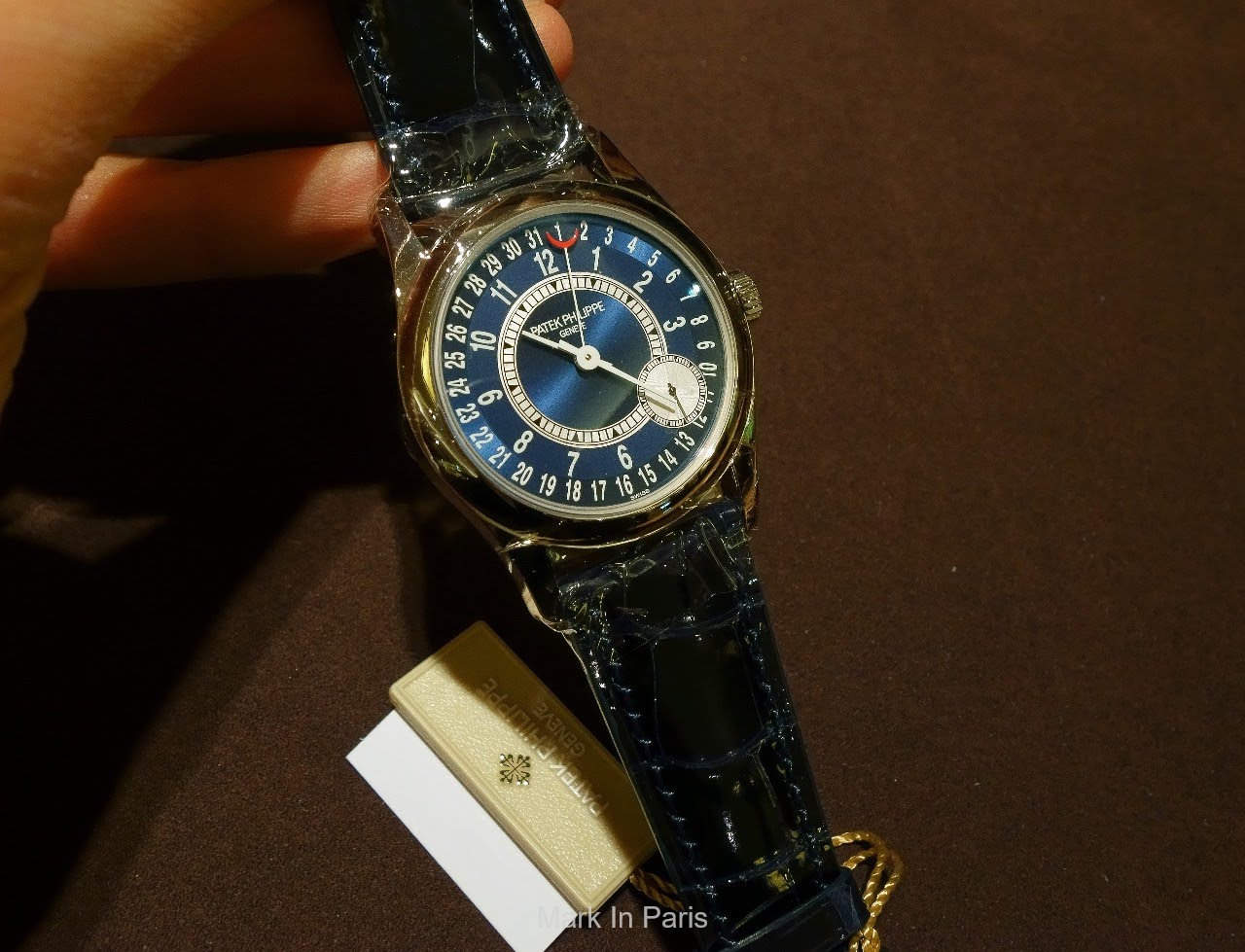
The date is no longer displayed in a window but via a chapter ring at the edge of the dial and is perfectly legible, thanks to the red hand.
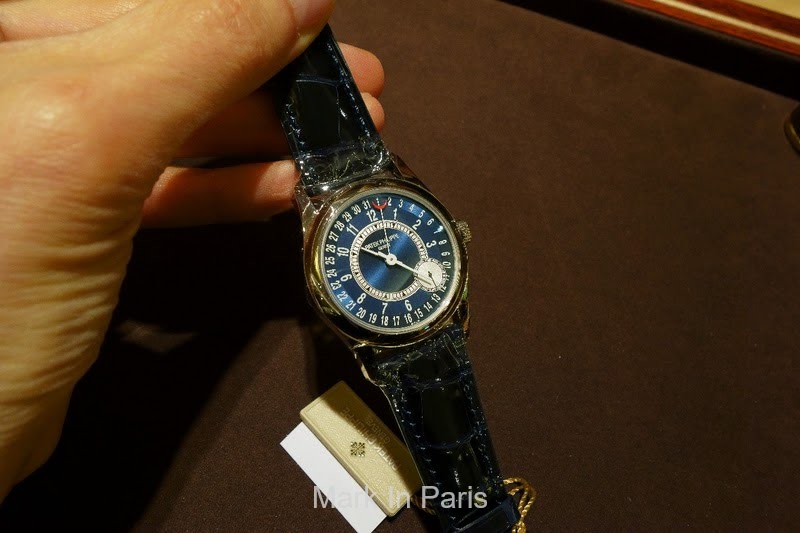
What I liked a lot was the addition of a very dark blue strap. The main central part is nearly black but you notice a blue hue on the sides, near the stitches. I noticed in recent years that Patek Philippe has improved significantly the color choices for straps, stepping aside from the usual Burgundy and dark Browns. It is provided with a nice and thin, white gold folding clasp with Calatrava buckle.

This reference houses the beautiful and thin caliber 240 (with Spiromax or Silinvar hairspring) with micro-rotor (which is a good thing as the watch is only 37mm wide), thus the small second is positioned at 4 o'clock.
CONCLUSION
Everything is perfect in this simple watch. Not too simple because of the original dial layout and printings; with a very attractive and strong blue color (not too dimmed), a nice rounded bezel, a perfect size and the 240 caliber.
If you are looking for a blue-dialed, more sporty Calatrava watch, this is a watch you definitely must try.
This reference, in that combination, is really something to consider as an all-around watch, more modern, matching casual wear, of course but remaining elegant and refined with the white gold's shine and dark metallic blue dial. Finally, the casual aspect comes more from the white markings and hands' shape rather than from the blue color.
I don't think this is the reference that people think about trying but I think you should!
Thanks for reading!
Cheers, Mark
The Patek Philippe reference 5070, part of the Complications collection, marked a significant return for the brand to large-format chronographs. Introduced in 1998, it was the first non-perpetual calendar chronograph produced by Patek Philippe since the reference 1463, which ceased production in the early 1960s. Its design drew inspiration from a unique Patek Philippe aviator's watch from the 1940s, characterized by its prominent case and dial layout, yet reinterpreted for a contemporary audience. This reference established a new aesthetic direction for the brand's chronographs, moving towards more substantial case dimensions.
The watch features a 42mm case, initially offered in 18k yellow gold, housing the manual-winding Caliber CH 27-70. This movement, based on a Nouvelle Lémania ébauche, was extensively finished and modified by Patek Philippe, meeting the brand's stringent quality standards. It provides a power reserve of approximately 55 hours. The dial, in this specific configuration, is black, protected by a sapphire crystal, and the watch is water-resistant to 30 meters. The fixed bezel frames the dial, and the watch is typically fitted with a leather strap.
Reference 5070 appeals to collectors interested in modern Patek Philippe chronographs that combine traditional movement architecture with a more contemporary case size. Its limited production run and the subsequent introduction of variants in other precious metals contribute to its collectibility. The reference represents a distinct period in Patek Philippe's chronograph history, bridging vintage inspirations with a new era of larger watch designs.
I tried the same model several months ago. The blue dial is beautiful. Unfortunately the dial lay out didn't really sing to me, but it's still a handsome looking watch.
we really see the blue color as it should. In deed, the layout is something not many will like. I think that a collection needs some of these pieces: a special design but which brings a unique touch to a brand. Thanks for your input Luis Cheers, Mark
My wrist. A friend's watch. It's interesting that, although the dial layout did not sing to me, I enjoy wearing this reference very much, no matter what dial color it comes. Cheers, Luis
but some may like it. Too casual for me on a Calatrava.
and I totally understand your position. Thanks Bob! Cheers, Mark
I'm totally tired with the blue dials everywhere. Many years ago I applied this with blue dial but Patek refused. Later I understood that the blue was already in production plans. Now every brand is making blue dials and those become a fashion. Thus, I'm not interested anymore. Best, Kari
This thread is active on the Patek Philippe forum with 14 replies. Share your knowledge with fellow collectors.
Join the Discussion →