
Innovation
Mark in Paris commemorates the 10th anniversary of the Patek Philippe Ref. 5350, the second timepiece from the brand's Advanced Research program. This article highlights Patek Philippe's commitment to innovation, detailing the groundbreaking Silinvar® technology and its impact on watchmaking precision.


Early in this millennium, Patek Philippe created a new innovation department tasked with developing new technologies and new materials. It was called the Advanced Research program.
Some of the main problems that watchmakers have faced for centuries, since the adoption of the traditional Swiss lever escapement, are related to lubrication, mechanical wear and temperature compensation.
At the end of the 19th century, the "Invar" alloy was created resulting in a material minimally influenced by temperature fluctuations. Today, the Silinvar® material that could address contain all the issues mentioned above is, in fact, a kind of oxidized Silica developed by CSEM (Centre Suisse d'Electronique et de Microtechnique) in Neuchatel, under the auspices of a joint group composed of Patek Philippe, Rolex and the Swatch Group.
From that point, the Patek Philippe's Advanced Research department elaborated the first visible patented element of the Advanced Research program, the Silinvar® escape wheel in 2005 (see picture here below), which was integrated in the first Advanced Research watch, Reference 5250 in white gold (39mm, based on ref. 5146). More precisely, it was housed in the 315 S IRM QA LU SI® caliber, denoting an Annual Calendar with a Central seconds hand, Power Reserve Indicator and Moon phase indicator.

That was the beginning of a courageous program showing that Patek Philippe, beside its wide historical legacy, is also looking towards the future, not wanting to stand still and be complacent about progress and technology provided by the 21st century.
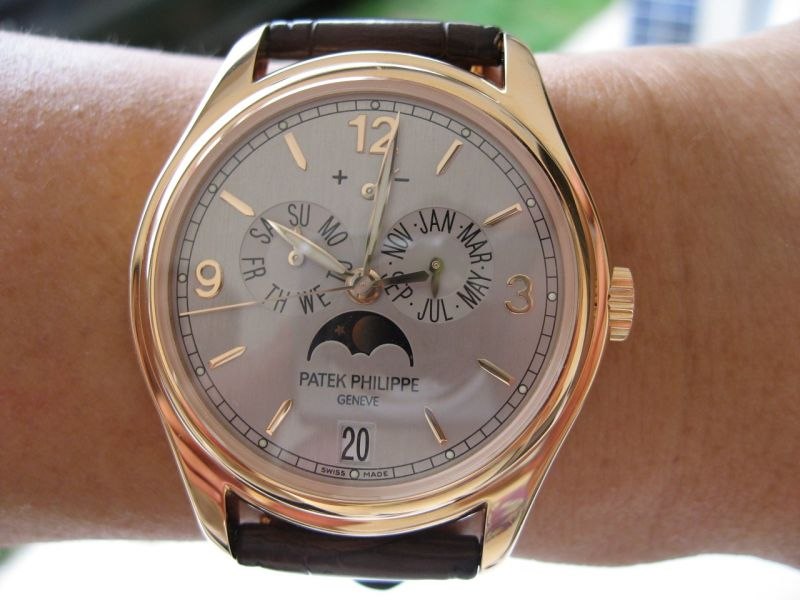
This year is the 10th anniversary of the Ref. 5350 that was launched only one year after the seminal Ref. 5250. This 5350 case is made of rose gold and Patek Philippe added the Spiromax (Silinvar® spiral) to the previous escape wheel (introduced in the 5250G as the flat hairspring element of the program) that is still in the caliber 324.

The 5350 was issued as a 300 piece edition.
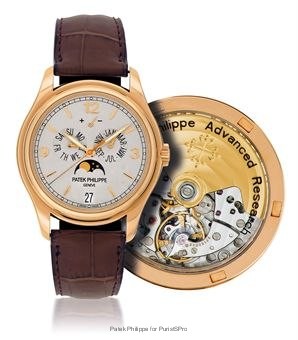
The advantages are better isochronism, amagnetic properties, temperature compensated and lighter (less damage issues) thus a higher precision keeping, which we all seek in the field of watchmaking.
This is a 5350R wristshot of one of our member:
The technique used for crafting these hairsprings makes them all identical, needing no individual setting and adjustment for precise function. On the other hand, it needs very high grade industrial techniques to get them perfect without needing any correction.
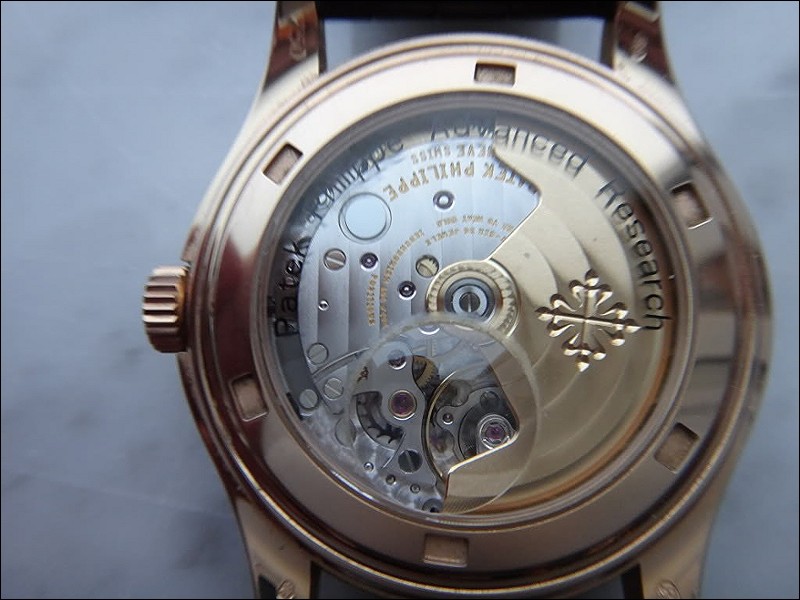
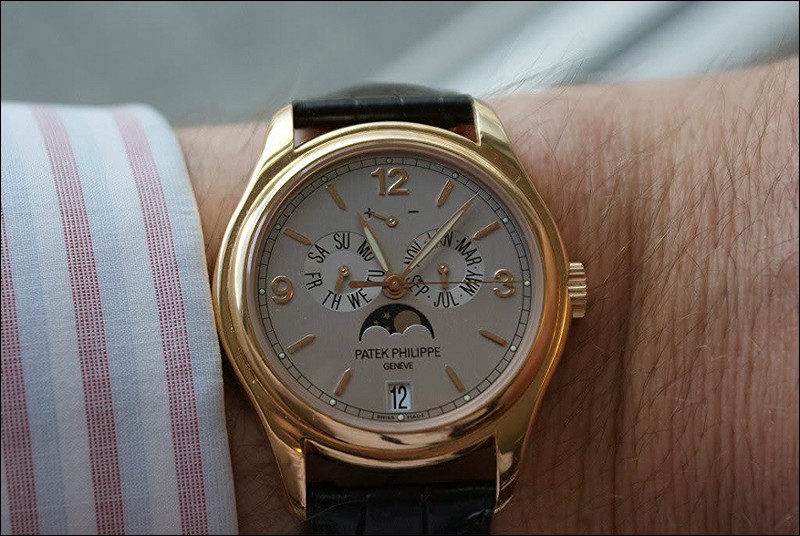
And another couple of pictures of the 5350R belonging to another fellow purist:
Happy 10 years birthday!
Cheers, Mark
PS: More
details about the Advanced Research program in the recap article posted here: www.watchprosite.com
The Patek Philippe Annual Calendar Moon Phases reference 5146, introduced in 2005, represents a significant offering in the brand's annual calendar complication lineage. This reference succeeded the popular 5035 and 5036 models, refining the aesthetic and technical presentation of the annual calendar with moon phases. It is characterized by its balanced dial layout, integrating day, date, month, moon phase, and power reserve indications in a legible and harmonious arrangement. The 5146 was produced in various precious metals, establishing itself as a core model within Patek Philippe's complicated watch collection for many years.
This particular iteration of the 5146 is presented in an 18k yellow gold case, measuring 39mm in diameter. It houses the self-winding Patek Philippe Caliber 324 S IRM QA LU, a movement known for its reliability and precision, visible through a sapphire crystal case back. The movement provides a power reserve of approximately 45 hours. A domed sapphire crystal protects the dial, and the watch is water-resistant to 30 meters, suitable for everyday wear but not for swimming or diving.
The reference 5146 appeals to collectors seeking a sophisticated daily wearable complication from Patek Philippe. Its annual calendar mechanism requires adjustment only once a year, at the end of February, offering practical convenience. The model was available with several dial variations and case materials throughout its production run, which concluded around 2020. The yellow gold variant with a silvery opaline dial offers a classic and understated presentation, aligning with traditional Patek Philippe aesthetics.
It is good to know Patek invests in technological marvels that make their watches accurate and sturdy. Thanks for the post. So buying a brand new Patek is a good idea cause of these technological breakthroughs. Cheers. Geross.
Thanks for the very informative post. It is good to read maisons that have such a long history of fine craftsmanship also emphasising on innovation and forward looking technologies Kudos to Patek Philippe and a good reminder to me why they are who they are today Cheers Robin
This involvement in caliber development is something we also see in the 29-535 caliber (chronograph). Patek is IMHO a step forward in terms of caliber improvements if we look back at the 240, the 29-535 (5170, 5270...), the 28-520 (5960, 5980...), the Advanced research.... Cheers, Mark
We still have a very traditional brand and design but they bring imporvements in several calibers in a discreet way. I think it helps digging, without altering the DNA of the brand. I'd like to see a new reference from the AR program... why not a 28-520 as a base in a 5960 Thanks for your nice comments Robin! Cheers, Mark
Thanks Joe! Cheers, Mark
I love the Patek 5550 but I was not able to get one. I was wondering if there are any more Advanced models in the pipeline? just curious.
This thread is active on the Patek Philippe forum with 8 replies. Share your knowledge with fellow collectors.
Join the Discussion →


