Innovation
Mark in Paris commemorates the 10th anniversary of Patek Philippe's first Advanced Research watch, the Ref. 5250, highlighting the brand's pioneering use of Silinvar® technology. This article delves into the origins and evolution of Patek Philippe's Advanced Research program, a crucial initiative for addressing traditional watchmaking challenges.


Hello Gentlemen,
This is a 10Th anniversary review of the 5250P Advanced Research Patek Philippe.
In early 2000, Patek Philippe decided to create a new innovation department which would aim at preparing the future in developing new technologies and working on new materials. It was called the Advanced Research program.
Some of the main problems watchmakers are facing since the beginning of the traditional Swiss lever escapement we've been knowing for centuries are related to lubrication, wear and temperature compensation issues.
In the end of the 19th century, the "Invar" alloy was created and allowed to obtain a material indistinctly influenced by temperature fluctuations.
Today, the Silinvar® material which could help containing all the issues mentioned above is in fact a kind of oxidized Silica developed by the CSEM (Centre Suisse d'Electronique et de Microtechnique) in Neuchatel, upon the impulse of a joint group composed of Patek Philippe, Rolex and the Swatch Group.
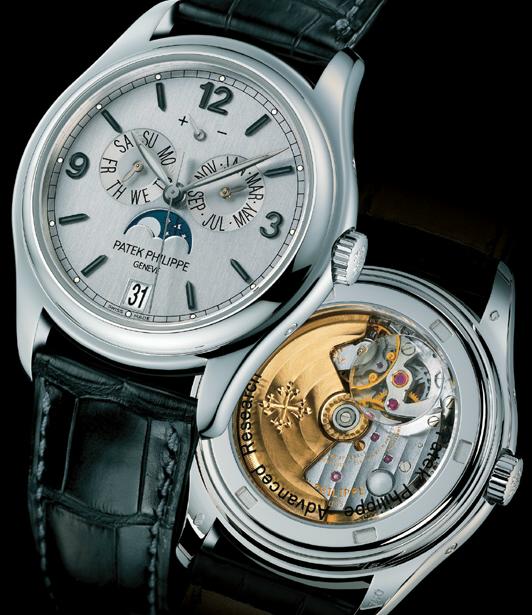
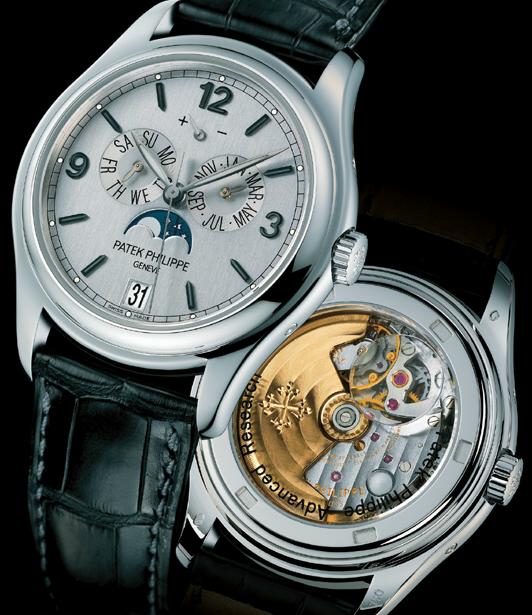
From that point, the Patek Philippe's Advanced Research department elaborated in 2005 the first visible patented element of the Advanced Research program, the Silinvar® escape wheel, which was integrated in the first Advanced Research watch, the 5250 in white gold (39mm, based on a 5146).

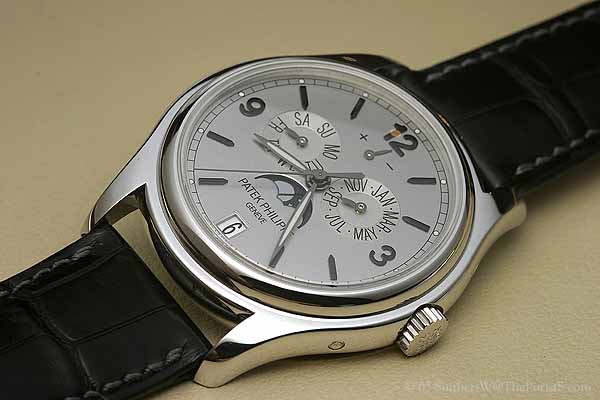
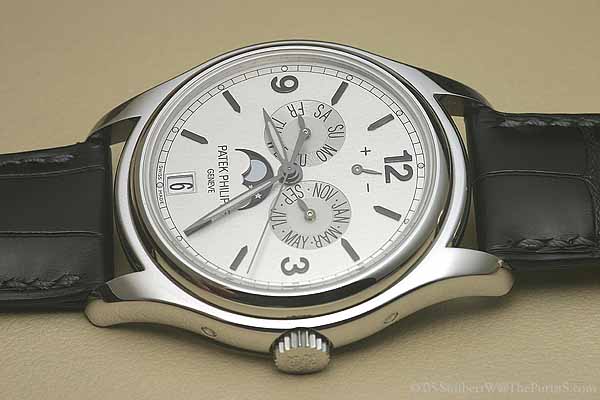
The watch has a little sportier touch, as do all the Advanced Research watches by the way: darkened numerals and markers with the vertically brushed metalic dial:
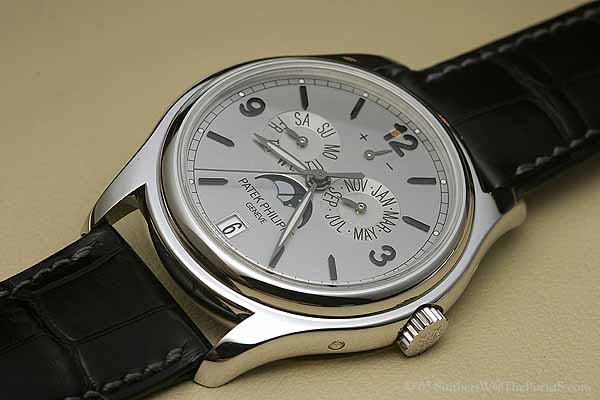
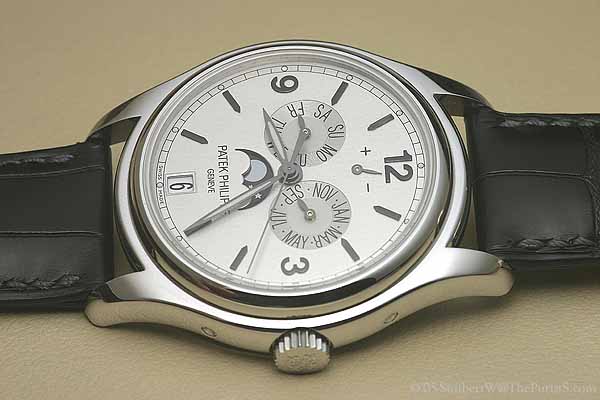
More precisely, it was housed into the 315 S IRM QA LU SI® caliber, which means it was an Annual Calendar with a Central second hand, a Power Reserve Indicator and a Moonphase disk.
This watch was produced in 100 pieces and held the first escape wheel created in Silinvar®.
Here is the back side of the 5250 with its specific loup added to the sapphire caseback:
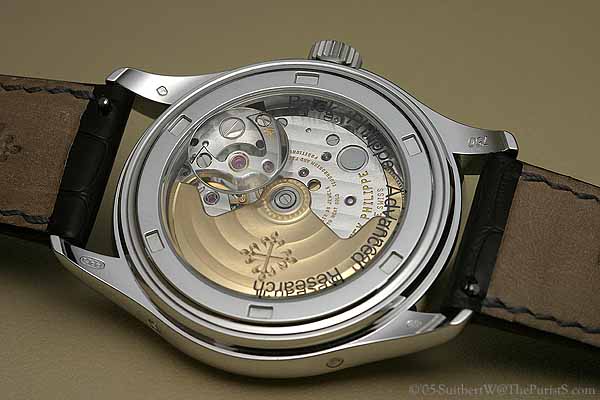
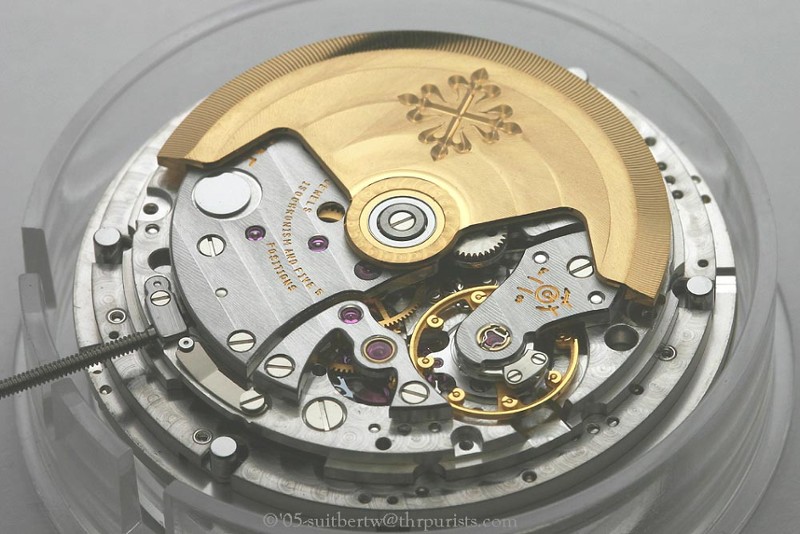
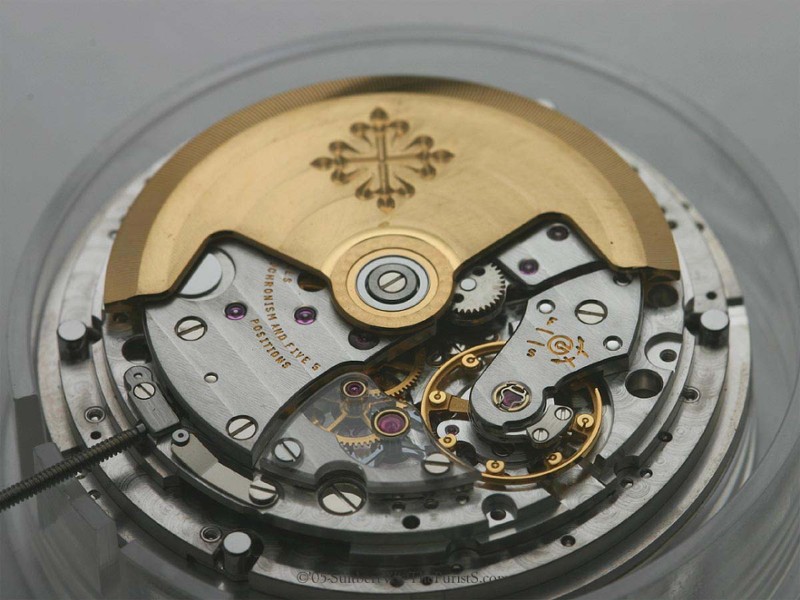
It was hence the beginning of a courageous program showing that Patek Philippe, beside its wide historical legacy, is also looking toward the future, doesn't want to stand still and considers we should not ignore progress and possibilities provided by the 21st century.
This year is the 10th anniversary of the 5250G and I think it is a kind of landmark for the brand which deserves to be celebrated and which is the beginning of much more to come in that field.
As it is a rare bird, it is difficult to find live pictures but our friend SuitbertW shared the arrival of this watch at the time so I thought I could share them here.
Happy 10 years birthday!
Cheers, Mark
The Patek Philippe Annual Calendar Moon Phases reference 5146, introduced in 2005, represents a significant offering in the brand's annual calendar complication lineage. This reference succeeded the popular 5035 and 5036 models, refining the aesthetic and technical presentation of the annual calendar with moon phases. It is characterized by its balanced dial layout, integrating day, date, month, moon phase, and power reserve indications in a legible and harmonious arrangement. The 5146 was produced in various precious metals, establishing itself as a core model within Patek Philippe's complicated watch collection for many years.
This particular iteration of the 5146 is presented in an 18k yellow gold case, measuring 39mm in diameter. It houses the self-winding Patek Philippe Caliber 324 S IRM QA LU, a movement known for its reliability and precision, visible through a sapphire crystal case back. The movement provides a power reserve of approximately 45 hours. A domed sapphire crystal protects the dial, and the watch is water-resistant to 30 meters, suitable for everyday wear but not for swimming or diving.
The reference 5146 appeals to collectors seeking a sophisticated daily wearable complication from Patek Philippe. Its annual calendar mechanism requires adjustment only once a year, at the end of February, offering practical convenience. The model was available with several dial variations and case materials throughout its production run, which concluded around 2020. The yellow gold variant with a silvery opaline dial offers a classic and understated presentation, aligning with traditional Patek Philippe aesthetics.
With the Freak... Best, Nicolas
Patek was only the first brand using the Silinvar alloy in its escapement, they never claimed to be the first one to use Silicon. It is not the alloy used by UN if I remember well. They went for another type of Silicon-based material. UN has also been pushing forward the developpement of its first attempts with the diamond coating treatment later on, to improve a perfectible reliability. I think it was 2001 for the first Freak and 2005 to 2007 for the improved Silicon and diamond technics escape
I was right when I first saw your Kari post :)) Good work, as always, looking forward to reading your nice posts, Mark. Rgds Raymond
You are right, the composition of the material may be different. UN used diamond with silicon in 2007, and diamond in 2005. Now the question is to know if it is a good choice... Some watchmakers told me that silicon was great for accuracy, but if you won't to make some adjustments, a conventional solution is much better. Best, Nicolas
and especially the servicing or replacement issues in several decades from now. Yet, I imagine the positive point is that, like in any experimental sectors, we may not know today what it will lead to in the future (and maybe not Silicon-based this time). Maybe it is a waypoint toward other better solutions we wouldn't have found if these brands did make this kind of "exploration". I find it an exciting topic :) Have a nice sunday Nicolas. Cheers, Mark
I'm glad to be part of this adventure, it is exciting. Thanks for mentionning and have a great sunday Raymond :) Cheers, Mark
This thread is active on the Patek Philippe forum with 28 replies. Share your knowledge with fellow collectors.
Join the Discussion →


