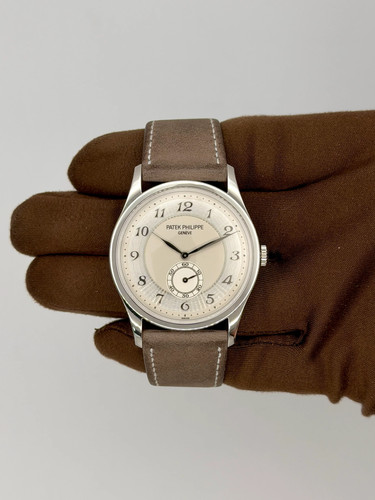
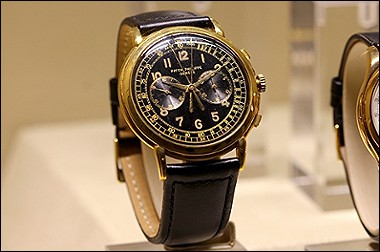
Baron - Mr Red offers a compelling review of the Patek Philippe Reference 5196P, a modern Calatrava that bridges the gap between vintage aesthetics and contemporary wearability. His analysis delves into the watch's design merits, such as its manual wind movement and two-tone dial with Breguet numerals, while also critically examining its drawbacks, particularly the movement's size relative to the case.
I have a passion for vintage Calatrava. I didn’t start out aiming to build up a collection of such pieces, but it did evolve into a collection. Over the course of this year, I have reviewed several in my collection. My collection, overall, is about half vintage and half modern (i.e 1990s onwards). I do not own a modern Calatrava, so I thought it might be useful to review a modern current production Calatrava that definitely piques my interest. The 5196P.
The mother of all Calatrava models is the Reference 96. This was first produced in the early 1930s and continued through to the 1970s. That is an incredible production run for a reference. The Reference 96, however, came with a case size of just over 30mm, and for the modern era it became clear that a new Calatrava was needed. Of course, there have been many iterations between the 1930s and 1970s that addressed this issue. The Reference 570, known as the Grand Calatrava, was released in the late 1930s with an almost identical dial layout to the Reference 96, but with a case size of around 35mm. In its day, this 35mm reference was seen as very large and radical. But for the new millennium, something bigger still was required. One such offering was the Reference 5196.
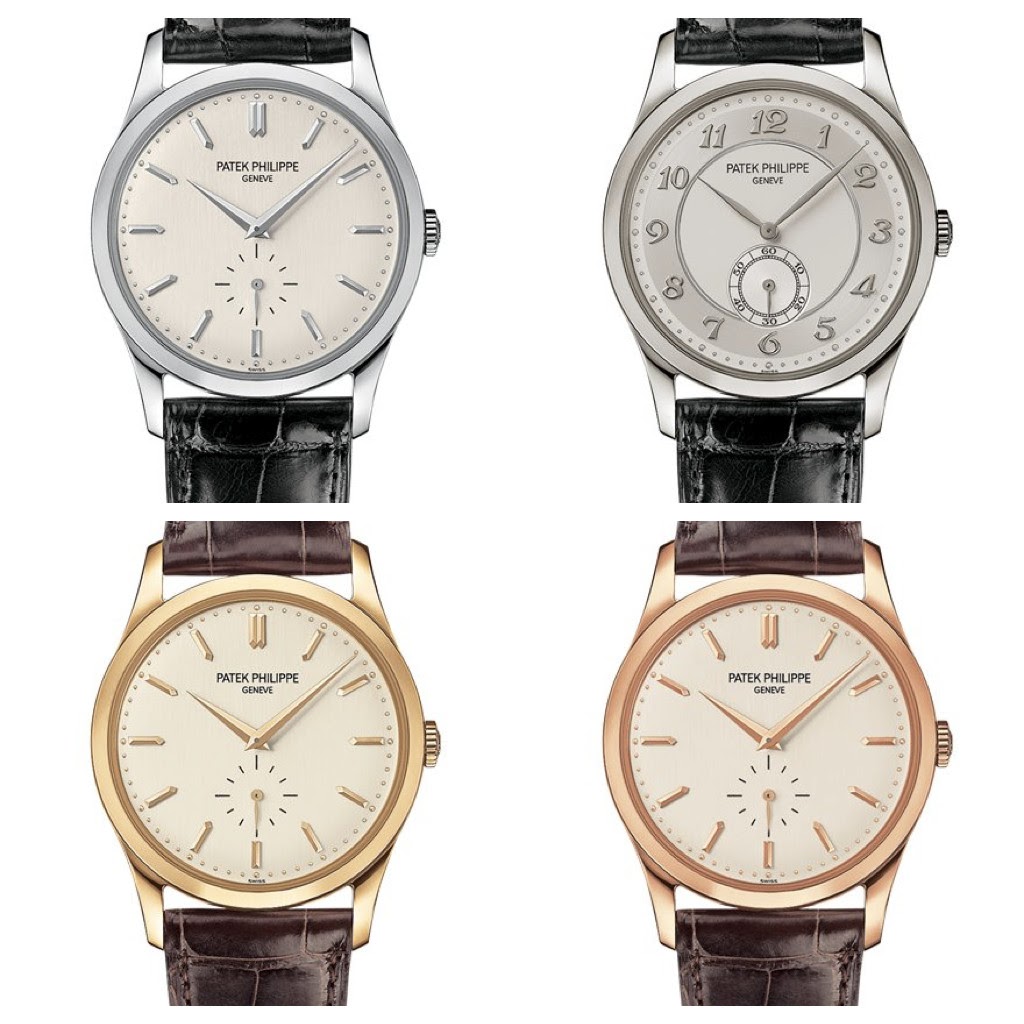
Coming in four precious metals, the 37mm case of the 5196 offered a modern rendition of the Reference 96. The white, yellow and rose variants were all similar in dial approach, but the platinum variation was markedly different. It is often the case that Patek Philippe will depart from a reference genre for platinum, and that is very much the case for the 5196P. I am comparing the dials of the four variations in the following image. Such a difference in approach. Three very similar andthe platinum standing out as very different. Even the hands were changed. Whereas the golds are very distinctly elegant and formal, the platinum version features enough variation to make it usable both formally and casually.
What do I like about it? - I like the fact that it is a manual wind watch. Its just a personal preference for this type of watch. With a 44 hour power reserve, its very usable.
- I like the fact that it is a platinum variation. I own no platinum Calatrava, so adding one like this would certainly fit the profile of my collection.
- Two tone silver/grey dial is very attractive to my taste. In different lights, the nuance of the dial and its texture plays around into many forms. Also, the dial itself has many areas of interest. The dial is almost comparmentalised into different zones. Fascinating to look at.
- Breguet numerals are a taste issue. I don’t like Roman for example (and that has ruled out many former Calatravas for me). I love Breguet numerals.
What are the drawbacks? - The biggest drawback is that the movement is way too small for the case. The 215PS calibre has a diameter of 21.9mm compared with a case size of 37mm. The practical drawback from this is that the second hand is too close to the centre of the watch. Further, for a see-through case back, the movement would look quite strange.
To deal with this issue, Patek Philippe chose to make a feature of the sub-dial, ensuring that it is quite bold and most clearly having it not bite into the 6 marker. For the case back, the 5196s have solid casebacks. In this modern era, most watches now have visible case backs because it is seen as part of the attraction of ownership to be able to view the movement. This would not work for the 5196, so it is one of the very few (if not only) production watches that has a solid case back. In this sense, it is the last of its era, and I find that quite attractive. Would I prefer that it had a bigger movement that fitted the case better and had a crystal case back? Yes. But at the same time, I really find the solution that Patek Philippe found for the 5196 to be a good one.
On the wrist, the watch feels and looks fantastic. As a modern Calatrava that is versatile enough to be used formally or casually, the 5196P certainly ticks a lot of boxes. For me, I see it as a watch that would need to be featured amongst possible modern targets.
About the Patek Philippe Calatrava Ref. 570
The Patek Philippe reference 570 is a classic Calatrava-style dress watch, representing a significant period in the brand's production of time-only pieces. It is distinguished by its clean lines and minimalist aesthetic, embodying the traditional design principles that Patek Philippe is known for in its non-complicated watches. The reference 570 was offered in various metals and dial configurations, making each example unique within the broader series of Patek Philippe's round cased watches from the mid-20th century.
This particular example features an 18k white gold case with a diameter of 38mm. It is fitted with a sapphire crystal, protecting a silver dial. The watch is powered by a manual wind movement, reflecting the common practice for high-end dress watches of its era. The water resistance is rated at 30 meters, typical for a watch of this type and period.
The reference 570 appeals to collectors seeking a pure expression of Patek Philippe's watchmaking heritage, particularly those interested in the brand's foundational dress watch designs. Its various iterations, including different case materials and dial finishes, offer a range of options for discerning collectors. The enduring appeal of the 570 lies in its understated elegance and its representation of a specific era of Patek Philippe's design philosophy.
Specifications
- Caliber
- 27 SC
- Case
- 18k white gold
- Diameter
- 38mm
- Dial
- Silver
- Water Resist.
- 30m
- Crystal
- Sapphire
About the Montblanc Calatrava Ref. 5196
The Montblanc Calatrava reference 5196 is a notable example within the Calatrava collection, distinguished by its adherence to traditional design principles while offering a contemporary size. It represents a period where the brand refined its classic offerings, providing a balanced option for collectors seeking a dress watch that combines historical aesthetics with modern wearability. This reference is often considered a direct descendant of earlier, smaller Calatrava models, updated to suit evolving preferences for case dimensions. It maintains the collection's reputation for understated elegance and precision.
This particular reference features a case crafted from 18k yellow gold, measuring 37mm in diameter. It is typically fitted with a manual-winding mechanical movement, reflecting a preference for traditional watchmaking. The watch is protected by a sapphire crystal, ensuring clarity and scratch resistance. The design emphasizes clean lines and a refined profile, consistent with the Calatrava's established identity as a quintessential dress watch. Its construction focuses on durability and aesthetic longevity.
For collectors, the 5196 appeals to those who appreciate a classic, time-only watch without additional complications. Its 37mm case size positions it as a versatile option, larger than some vintage pieces but still within the traditional dress watch spectrum. The yellow gold case and absence of a date window align with a purist approach to watch design. This reference stands as a solid choice for individuals seeking a well-proportioned and elegantly simple timepiece from a respected manufacturer.
Specifications
- Caliber
- Cal. 215 PS
- Case
- 18k yellow gold
- Diameter
- 37mm
- Dial
- Silver
- Water Resist.
- 30m
- Crystal
- Sapphire