Patek Philippe 5123R Calatrava Review
Review

Patek Philippe 5123R Calatrava Review

By foversta · Jul 9, 2012 · 33 replies
foversta
WPS member · Patek Philippe forum
33 replies32796 views6 photos
f 𝕏 in πŸ’¬ βœ‰ πŸ”—

Foversta offers a detailed analysis of the Patek Philippe Calatrava Ref. 5123R, examining its aesthetic ties to historical references like the 2526 and 2573, while also critiquing its mechanical design. The author highlights Patek Philippe's ability to create new watches that feel timeless, but also points out the challenges of integrating a small movement like the 215PS into a larger case. This review provides a critical perspective on how Patek Philippe balances heritage with modern design in its Calatrava line.

The most impressive characteristic in Patek Philippe is without any doubt the high number of references that make up the catalogue for a brand whose production is estimated at 45,000 pieces per year. Take for example the 2 or 3 hands simple watches: Patek Philippe offers a wide range of proposals which is getting broader in 2012 with the unveiling of the 5123R.

By discovering the Calatrava 5123R, I didn't have the feeling to be in front of a novelty of this year. Because it is the main force of Patek Philippe: with constant reminders of the past, each new watch gives the impression of never having left the catalog. There is something extremely comforting in this approach that responds perfectly to the expectations of the clients who like to create links between today and yesterday references.


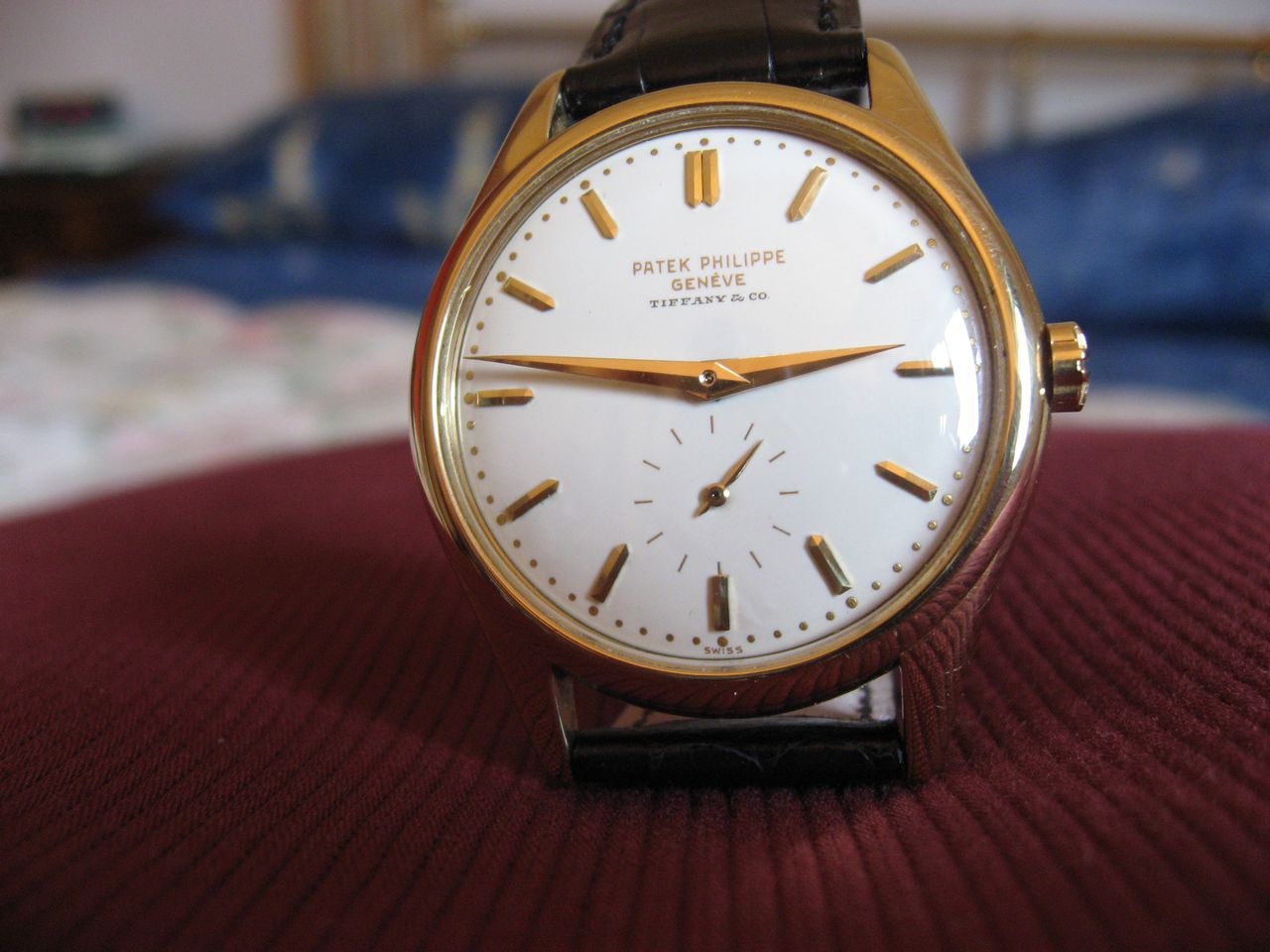
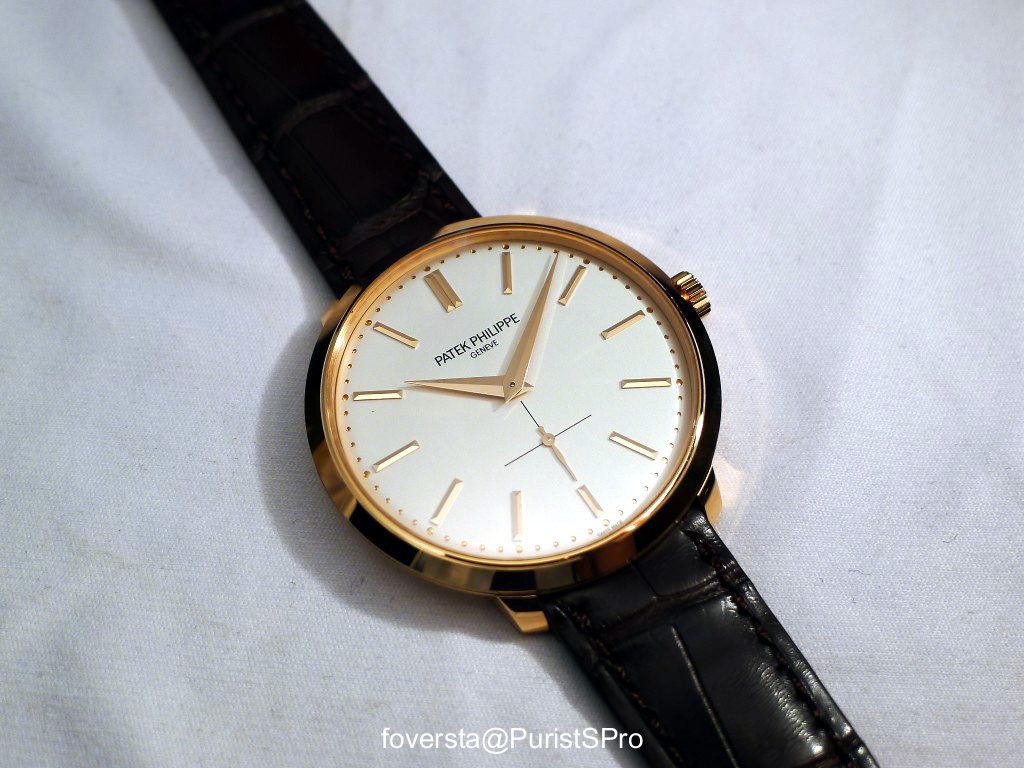
From an aesthetic point of view, the 5123R can be considered as a reinterpretation of the Calatrava 2526: Dauphine hands, the minutes track, the shape of the indexes,  they all bring back the purity of the dial of this famous reference. In the watchmaking world, it is very complicated to do it simple. Patek Philippe however doesn't have this kind of problem because its rich history is an inexhaustible source of inspiration and the 2526 constitutes the quintessence of the 3 hands watch.

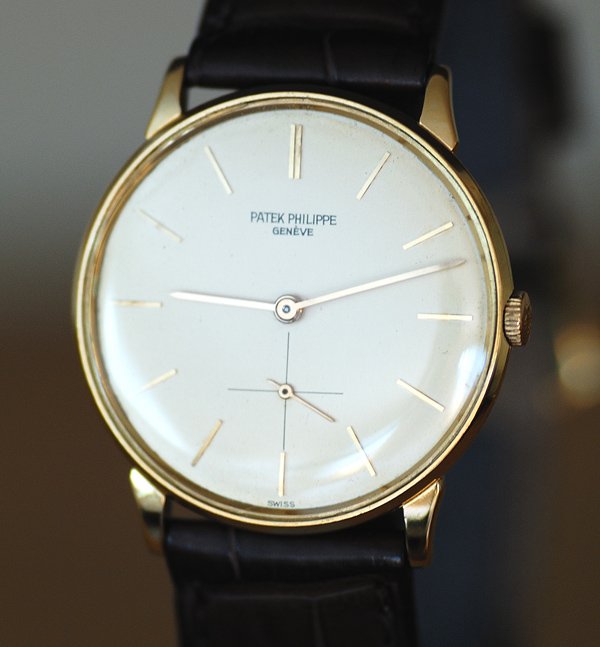
At this stage, I know that some of you don't agree with me about the 2526 inspiration and that other reference like the 2573 due to the second hand display and even the case shape. But again, it is another asset for Patek Philippe: each of us can find the link with the past he wants to find.

The 2573:


Credit: Guille

The 2526:


Credit: Fabios

Back to the 5123R:


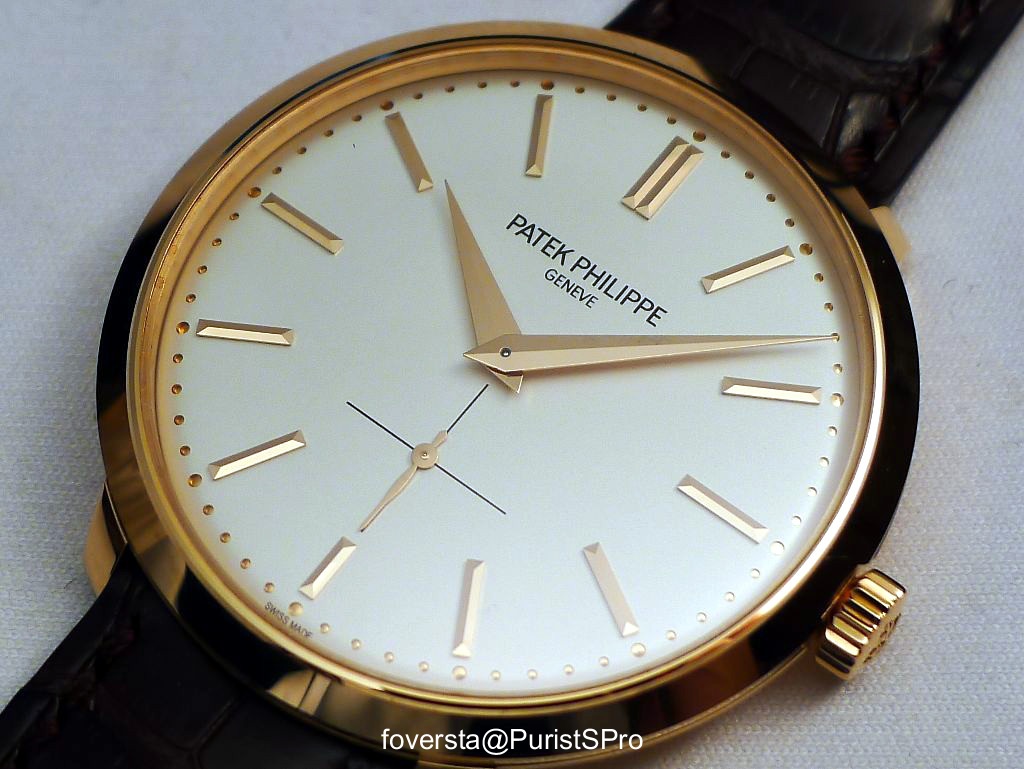
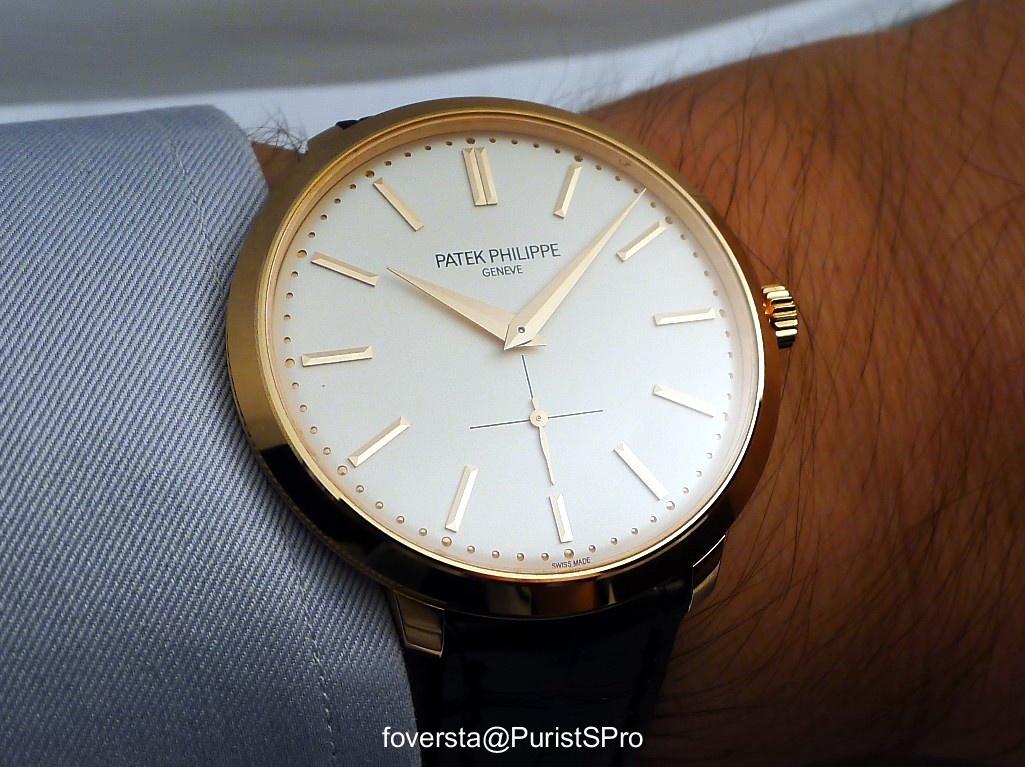
The silver opaline dial (and not an enamel one unfortunately as it was often the case for the 2526) has a deep elegance, the Dauphine hands tell the time with a very refined way over applied gold indexes which provide the necessary touch of volume. The second hand is very discrete, its sector being materialized by the crossing of two extremely fine perpendicular lines. This effect of style, while commonly seen in the past, is not harmless here and shows great skill from the Patek Philippe designers. This subtle sector tries to  hide dial side the main problem of the 5123R: the movement size which is too small. While this problem appears clearly on the 5196 which uses the same caliber, it tends to fade on the 5123R while the case of the latter is bigger (38 mm vs 37 mm for the 5196).


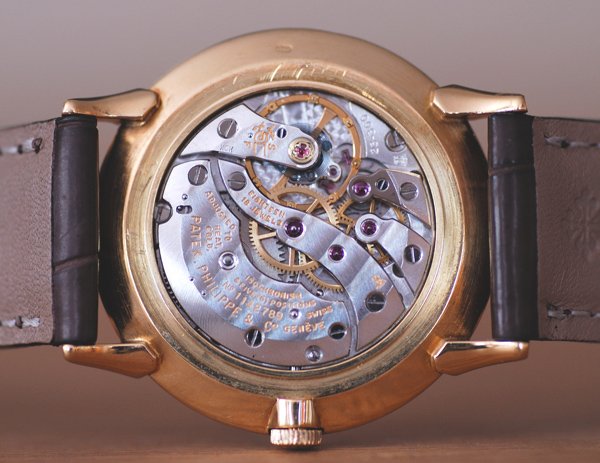
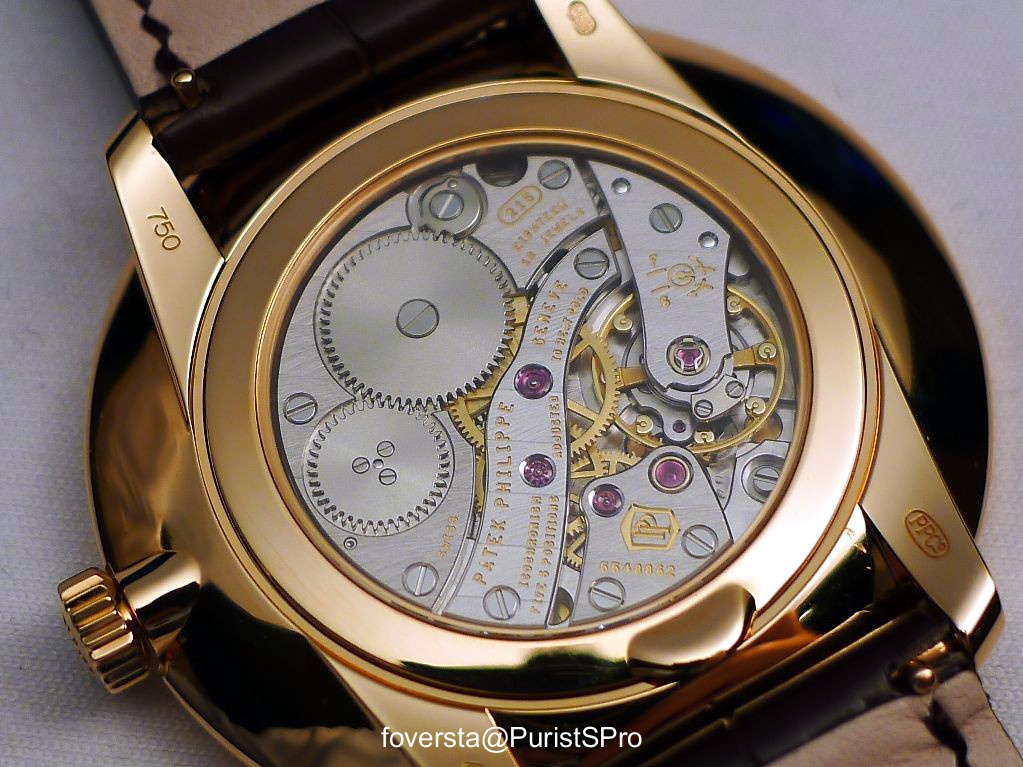
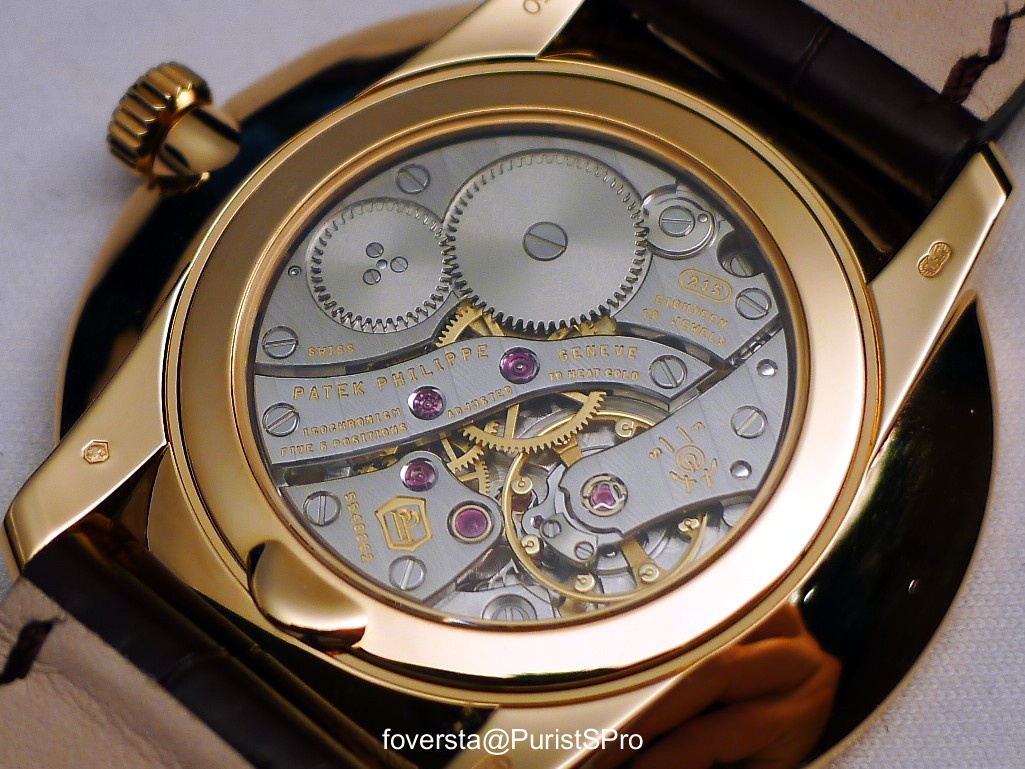
If the 2526 resemblance is quite obvious from the aesthetic point of view, it is  absolutely not the case from the mechanical point of view. The 5123R is a handwind watch in which we find the venerable and old 215PS. This movement is of course excellent, it has powered with efficiently many watches for several decades. I love its lay-out, the shape of its bridges and its performance is after all very acceptable. It features the Gyromax balance, a power reserve for 44 hours with a frequency of 4hz (which is quite unusual for this type of movement)  and all this, in a very contained size. If the thinness (2, 55 mm) is an asset in the context of a dressed watch, the 21.9 mm diameter is more problematic. To fully understand the difficulty to make the movement visible, you must realize that the 215PS is naturally found in 31 mm cases and Patek Philippe was even obliged to hide it with a solid caseback  in the context of the 5196 in order to avoid the view on the encircling ring.


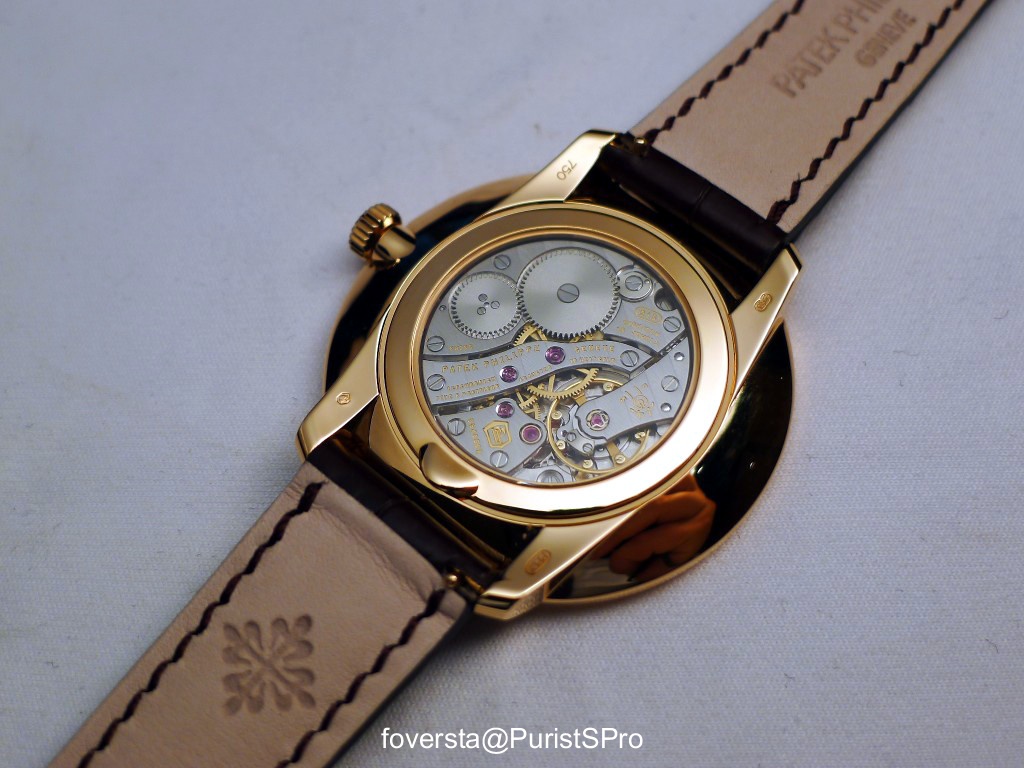
All the Patek Philippe talent was to manage to create an opportunity from this concern: the movement is too small? Not a problem, we adapt the case! And so the 5123R uses with a rose gold case  with amazing curves which we have the pleasure to discover after the first glance. The diameter of the back is considerably reduced from the 38 mm (excluding crown) dial side. When the watch is turned over, the movement size is not anymore shocking. However, this unusual case shape may be surprising. The lugs as seen dial side seem to be very short while their actual size is far from being small.


When I put the watch on my wrist, these considerations were faded due to the charm of the dial is and the overall elegance which gives some power of seduction. I find it most convincing than the 5196. But I also believe that Patek Philippe has reached the end of the process with the 215PS. While the competition has been very active in renewing handwind movements (I'm thinking about Vacheron with the 4400 or  about Lange & SΓΆhne with the L051.1 and L093.1  which are more adapted to the context of today cases), Patek Philippe still remains stuck with its 215PS. Time has come to find a worthy successor to this proud movement and to design new simple watches with will be balanced both dial and movement sides. The Patek Philippe prestige and power of attraction  are so out-of-competition that the Manufacture has to be very careful not to do it too easy. It is a feeling that cannot be excluded when we analyse this 5123R.


Many thanks to the Patek Philippe France team.


About the Patek Philippe 2526 Ref. 2526

The Patek Philippe Reference 2526 is notable as the brand's first serially produced automatic wristwatch. Introduced in 1953, it marked a significant technical advancement for Patek Philippe, housing a self-winding movement at a time when manual-wind mechanisms were still prevalent. This reference is recognized for its clean aesthetic and robust construction, establishing a foundation for future automatic timepieces from the manufacture.

The watch features a 35 mm case, available in 18k yellow gold, 18k rose gold, or platinum. It is powered by the caliber 12-600 AT, an automatic movement with a Gyromax balance and a solid gold rotor, offering a power reserve of approximately 40 hours. The crystal is acrylic, protecting a silver dial that often features enamel. The case design is characterized by its smooth bezel and often includes a screw-down case back, contributing to its water resistance.

For collectors, the Reference 2526 is highly sought after due to its historical significance as Patek Philippe's inaugural automatic model. Variants exist with different dial configurations, including those with applied indexes and small seconds, which can vary between the gold and platinum versions. The presence of original bracelets, particularly on rose gold models, can also add to its collectibility, as these were less common than leather strap configurations.

Specifications

Caliber
12-600 AT
Case
18k Yellow Gold, 18k Rose Gold, or Platinum
Diameter
35 mm
Dial
Silver
Water Resist.
30m
Crystal
Acrylic

Key Points from the Discussion

Advertisement
The Discussion
VI
vitalsigns
Jul 9, 2012

I very much like the watch; however, I remain uncertain about the abbreviated lugs. Cheers, John

CO
COUNT DE MONET
Jul 9, 2012

Have not seen it, but by using my experience with Pateks so far: it will be another unbalanced Patek. To put the 215 in a 38 mm case and trying to make the case look smaller by using a bizzare shape and short lugs does not work for me. The dial will be vast looking. The indices are to long and do not really hide, again, the fact that the watch is simply too big. I found the 5196 also disappointing as it felt already like a plate on the wrist: unbalanced. The only worthy holder of the 215 is the

AM
amanico
Jul 9, 2012

This is and this is not a problem, from my point of view. This is a problem because if Patek wants to use such a small movement in their watches, they should, maybe, think about releasing a smaller case, around 34 / 35 mm. What? There will not be demand for that? See JLC with the MUT... Not big sales, but enough to justify this 34 mm in the catalog. Now, put a solid case back, and like with the 5196P, you have a superb watch. So we really need to see the movement? How the amateurs of Belle Horlo

WH
whit
Jul 10, 2012

But, I'm with the Count on this one. The case design does not appeal to me in the least. Case lugs, the bezel and the dish-like case back leave me cold. Maybe Patek should just re-introduce the 2526 instead of a new interpretation of a classic which frankly, misses on many points. There was a time when a reference was no longer available, it was not discontinued but just no longer in production. Given the interest in the classic pieces, it would seem Patek would consider production of classic st

BR
Bruno.M1
Jul 10, 2012

It is WAY too narrow. looks like a 16 mm strap for woman :-(

BR
Bruno.M1
Jul 10, 2012

because the people I know don't want these tiny watches anymore A dresswatch is prefered to be between 40 and 42 mm. Ofcourse I know some people still like or even prefer 35 or 36 mm but they are the minotity, just like only 10 or 15 % will prefer 46 and more Create a poll ( maybe a moderator should make one ... Nicolas ??) and let the people choose between these options 33 mm and smaller 34 - 35 mm 36- 37 mm 38 - 39 mm 40 - 41 mm 42 - 43 mm 44 mm and more I'm pretty sure the majority will vote

Advertisement

Continue the conversation

This thread is active on the Patek Philippe forum with 33 replies. Share your knowledge with fellow collectors.

Join the Discussion →