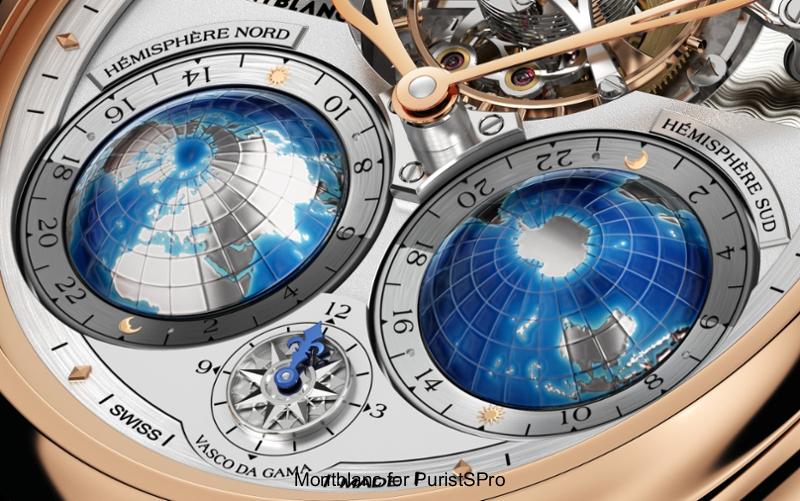
Jrwong23's detailed exploration of the Montblanc Tourbillon Cylindrique Geosphères' worldtime and double timezone functions provides crucial insights into this grand complication. This post, Part Two of a series, meticulously breaks down the intricate mechanics and artistic execution of the watch's unique 3D globes and their interaction with the rotating 24-hour discs, offering readers a deeper understanding of its horological ambition.
Other than having a cylindrical tourbillon as a grand complication
(covered in Part One of my post), the Montblanc Tourbillon Cylindrique
Geosphères can also features a double timezone and a worldtime feature
(although as Nicolas mentioned, it is hard to really read the globes as a
worldtime – it is a lot more artisanal than functional per se in terms of the
worldtime function).
Functions:
Double time zone and Worldtime explained The two beautifully handpainted globes on the dial are
actually fixed to the movement and they do not move. It is the two 24-hour
worldtime indicator discs with a day/night indicator that rotates once per day
around the two globes. The discs poetically illustrate the passage of day and
night around the two hemispheres, with the silvery rhodium plated part of the
disc depicting Day and the black rhodium plated part depicting night.
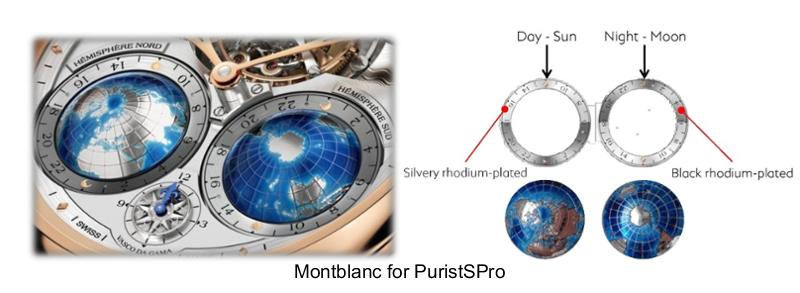
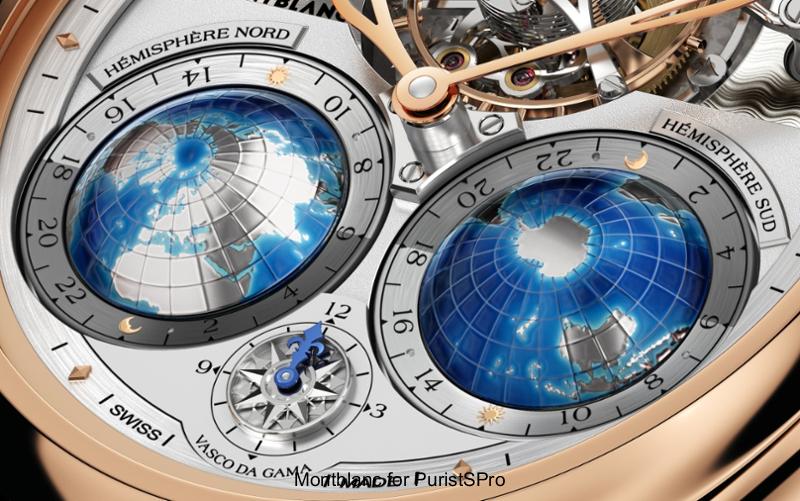
The disc on the Northern Hemisphere turns clockwise whereas
the disc associated with the Southern Hemisphere globe rotates anti-clockwise.
Using the meridians of longitude, the owner of this watch can read the current
hour in various cities or parts of the world, although to be honest as
discussed, it is not so legible and one has to estimate the location of the
city on the map and hence estimate the time on that city. For this reason, I
personally feel the worldtime function is more artisanal (from all the live
pictures and testimonies of those who saw the watch in the metal, the globes
and the whole dial is beautiful!) than functional.
The Home time, local time and 24 hour discs around the two 3D
globes all move together as time passes. The worldtime around the two discs can
be set through the crown whereas the home time (at 6 o’clock is adjusted independently
through a dedicated home time corrector.
Time zones globally are either expressed as positive or
negative offsets from the Universal Time Coordinated (UTC). By tradition,
London is the timezone of reference, marked by <<0>>, symbolized by
the white meridian of longitude on each of the 3D globes.
In addition, for this watch, the time zones can also be
referenced on the case back and determined by adding or subtracting the number
of hours specified by the UTC time offset, ranging from UTC – 12:00 in the west
to UTC +12:00 in the east. The picture below illustrates how this works.
Personally, I feel this feature won’t be used by the lucky owners of this watch
– it is too cumbersome. If I were one of the lucky owners, I will just stare at
the beautiful dial and watch the cylindrical tourbillon dances J
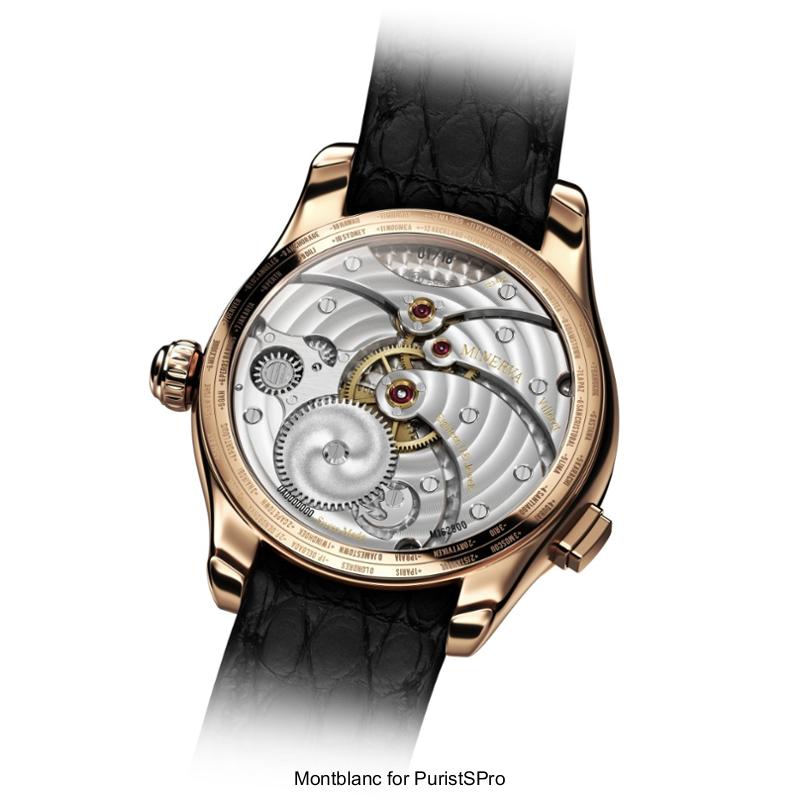 The caliber
MB M68.40
The caliber
MB M68.40
Some technical details of the movement provided by Montblanc
below:
Movement: MB M68.40
Features: Manually wound movement with 1-minute cylindrical
tourbillon Home and Local time display, Worldtime and Day/Night indication for
each hemispheres
Technical Features: 288 components
18'000 semi-oscillations per hour (2.5 hertz)
Screw balance, Ø 14.5 mm; 59 mg.cm2
Power reserve: Approx. 48 hours
Thickness: 10,50 mm
Diameter: 38,40 mm 16 lines 3/4
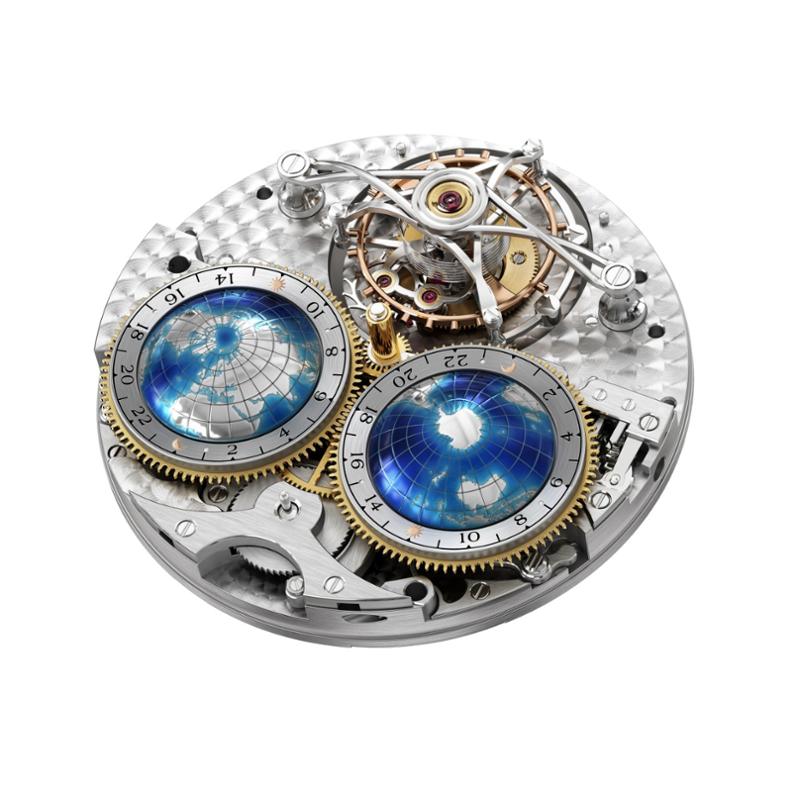
The movement on both the back and the dial side is breathtaking from
these pics. I am sure if I can see them in person with a loupe, it will be an
awesome experience! I will be covering on the 3D globes handpainting and various aspects of the artisanal craftsmenship in another post with more details

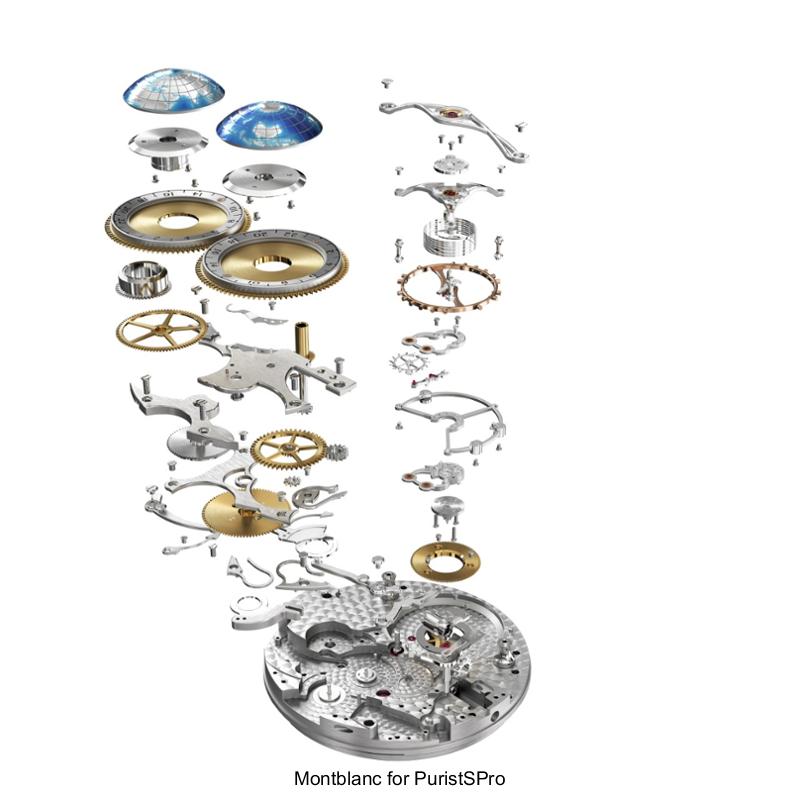
See the components below. There are 73 parts dedicated to the
Worldtime function (left side) and 91 parts for the cylindrical tourbillon (right stack of components).
I feel the hand-made
artisanal finishing of the Montblanc Tourbillon Cylindrique Geosphères deserves
a separate post on its own and will write about it in Part 3 of this series of
posts. There is just so much to share about this part (my favorite aspect of
any Montblanc Villeret watch is indeed their artisanal qualities from movement
finishing to the crafting of the dial). There are some nice pictures which
Montblanc has shared so stay tuned for Part 3!
Cheers
robin