Trilogy of Elements: Sea - Air - LandComparison review of watches by Mido, Oris and Tissot
by Marcus Hanke

Three entry range, Swiss made watches from well-known brands with long tradition. For the air, I offer an Oris Big Crown Timer aviation-style watch, for the sea, a typical diving watch, the Tissot Seastar, and for the land, the Mido Multifort in brown and green. While the Mido and the Tissot are listed at clearly under 1,000 Euro (Mido: around 800 Euro, Tissot: around 700 Euro), the Oris is more expensive, with a list price of 1,600 Euro. However, even that can considered as entry into the world of mechanical Swiss timepieces.

Unlike the many novice brands that are currently starting their business by means of crowd-funding their first developments, the three brands presented here all have a long tradition in their field: The Tissot Seastar was launched as Tissot’s diving watch already in the 1960s and became one of the classic diving watch lines. Oris equipped pilots with their famous “Big Crown” watches during World War II, and Mido, famous for its iconic “Commander”, has launched its first “Multifort” collection as early as 1934.
I chose these three watches for a comparison review not only because of their stylistic interpretation of the three elements, but also because of their technical similarity, and the movements used. So let us look if we can eventually find a winner.

However, I consider it necessary to clarify that the Tissot Seastar I chose for the review is the version offered between 2011 and 2014 (but it can still be found NOS rather often) and equipped with ETA’s standard movement of many decades, the cal. 2824. In early 2015, this watch was replaced by a variant with the newer ETA cal. C07.111, dubbed “Powermatic 80”, but with only tiny external changes. Only this year, Tissot presented a successor with the same movement, but altered design. While I would have been able to include a Powermatic Seastar in this test, I wanted to show the differences between the two movement generations, the ETA 2824 and the Powermatic, that is also used in the Mido Multifort.
Case, crystal and crown:
While the diving Tissot comes in 42mm a steel case rated to a depth of 300 meters, the Mido withstands a pressure of up to 10 bar (100 meters), and the Oris only to 30 meters, as a consequence of its unique case construction. Both the Mido and the Oris cases are 44mm wide and coated with a PVD colour; the Oris in gun metal grey, and the Mido in a somewhat weird “stone washed” grey, trying to simulate long and extensive wear. While only 1mm thinner (12mm vs. 13mm), the Mido appears a lot flatter and larger on the arm as the Oris. The Tissot is 13mm thick as well.


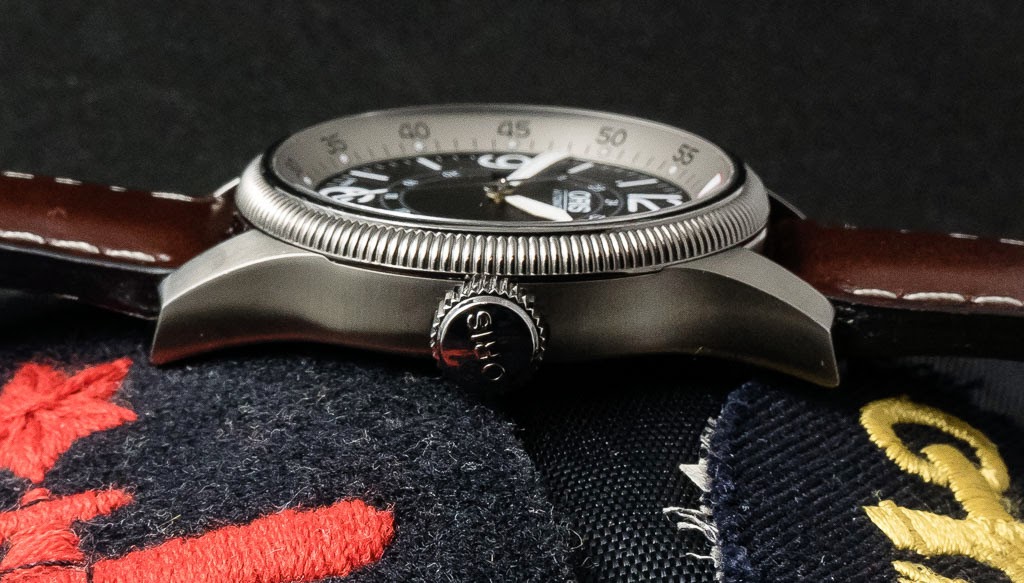


While the case design of the Mido is very sober, one could even be tempted to call it “simple”, the Oris Big Crown offers a bidirectionally revolving ring with markers as part of the dial. Therefore, using the coin-edged bezel ring to turn this ring also moves the slightly domed crystal. This follows the classic way of marking bezels on old pilot watches, which - as a consequence - were never water tight. I pay respect to the effort invested by Oris to make this construction watertight at least to 30 meters, which makes the watch perfectly fit for everyday wear. I would not wear it for swimming or taking a shower, though.

The most complex case design clearly is offered by the Seastar, which has very distinct outlines and many small design details that make fun to discover at close inspection. The diving bezel is rotating with solid and firm clicks and offers a good grip. On the left case side, the Tissot offers a helium valve, which is, I admit, rather useless for the practice of hobby divers. Unlike Mido and Oris, the Tissot also offers a good protection of the crown.


All three watches feature sapphire crystals on the top, with anti-reflective coating on the Mido, uncoated on the Oris and Tissot. The casebacks also have crystals, the Oris has a mineral crystal in the back.
The crowns of the Tissot and the Oris are screwed down, not so on the Mido. Especially the latter is a joy to use for winding and setting the watch. It is big and easy to grip and to pull. Also the Oris crown clearly pays tribute to the tradition of a “Big Crown”.
Dial and hands:
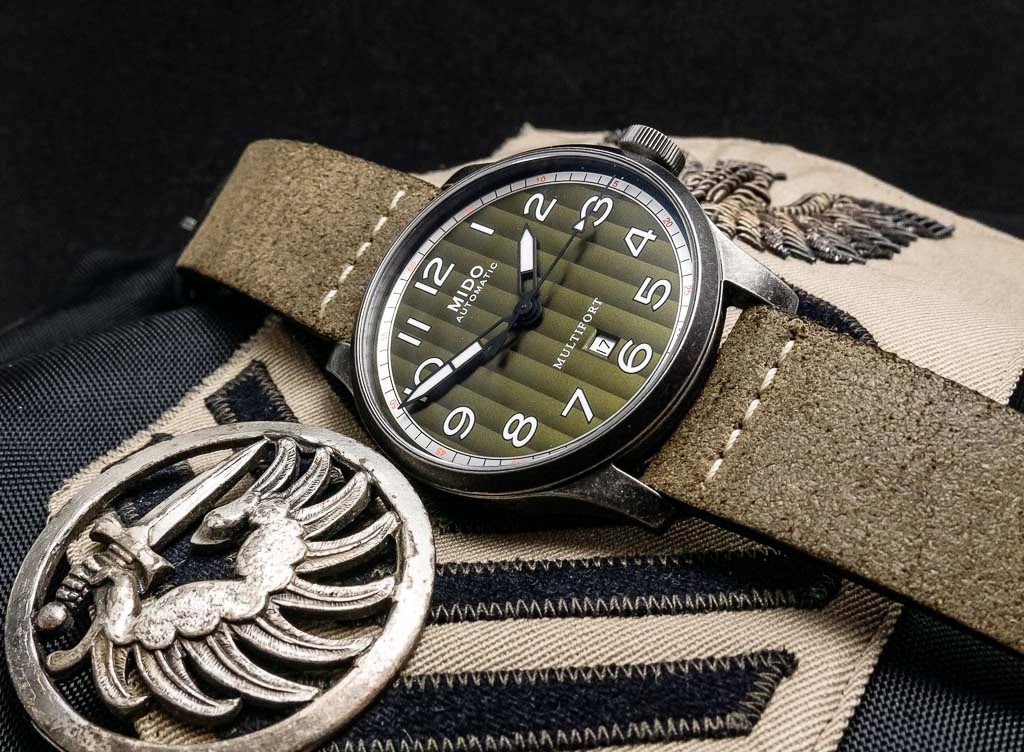
The dial is the major design feature of the Mido Multifort: Its surface has stripes similar to the Geneva stripes used to decorate movements. As a consequence, the Multifort massively changes its looks depending on the light falling on the dial: from near-blackish green to a brightly shining pattern of green lines. A silver minute register ring with red numerals attractively complements the expression. The Arabian numerals, coated with white luminous substance, are huge and together with the large black hands, also with white SuperLuminova, they offer a perfect legibility under all light conditions. Only the black second hand appears a bit anaemic with its tiny dot of SL. What I cannot understand, though, is the the date window at 6, or better: the fact that the date numerals on the ring are printed so tiny that they use only roughly half of the space offered by the date window itself. On the Mido website, interestingly, this is not the case, and the digits are much larger there.


The Oris Big Crown Timer is less a classic pilot watch, but rather reproduces the style of on board aviation instruments. The revolving marker ring is silver, the rest of the dial black. This is very attractive and makes the watch appear smaller on the wrist. However, the silver ring has no contrast with the luminous centre marker.

Normally, it is not a reason for joy when a large watch uses a small movement. In this case, however, this is an advantage, since the windows for the weekday and the date do not interfere with the oversize numerals at 9 and 3. The white lacquered hands have plenty of SuperLuminova, so legibility is also perfect on this watch. Like the Mido, the Oris’s running second hand appears a bit meagre, so you normally have to actively search for it.

From a diving watch, the wearer is justified to expect perfect legibility. The Tissot, however, is the weakest of the trio in this respect. Reason for this is the use of orange-tinted SuperLuminova whose performance is only a fraction of the white SL’s. However, I knew that beforehand, but deliberately chose the dial with the black/orange colour combination. There were - and still are - many other configurations available, with better legibility. At daylight, though, there are no problems at all. The unique snakehead design hands (discontinued on the most recent 2018 model) are very clearly identified even at a very quick glance, as is the bright orange second hand.

The quality of the finish is very good on all three watches. Given that they are placed in the entrance range, the execution can even be rated as excellent. The lacquered hands have quite tidy edges, without any remnants of lacquer clogging as teardrops. On the dial surface and the hands are barely and dust particles, none of them being visible with the naked eye. Also a tiny scratch on the Oris dial needs the correct angle of light and a 10x magnification to be noticed. All prints and date window edges are clean and faultless. I have seen several much more expensive watches with clearly inferior quality of finish.


Movements:
As already mentioned, the Tissot Seastar chosen for the review is equipped with an ETA cal. 2824. This was the standard movement for cheaper watches for many decades. Robust, easy to repair with most watchmakers worldwide being well able to service and repair it. Its proven record still makes it highly popular with the watch enthusiasts today. Aside the individualised rotor, the movement itself is without decorative finish, as it fell from the assembly line.

A few years ago, the Swatch Group started to introduce new movements in all quality segments, phasing out the proven cal. 2824 and 2892 movements. Their successors are no complete new constructions, but rather iterations of their predecessors. Consequently, the layout of the wheels and geartrain is very similar. The successor of the cal. 2824 is dubbed “Powermatic 80”, indicating its prolonged power reserve of 80 hours. This has been mostly achieved by the reduction of the beat frequency from 4 Hz to 3 Hz (21,600 A/h), but also the use of low-mass plastic components in the escapement. Especially the latter causes some reservation with both watchmakers and watch enthusiasts, but only time will tell if this is really a reason for concern or not. The common designation as “Powermatic 80” shall not hide the fact that there are many different variants of this movement. As an example, the newer Tissot Seastar has a version with 23 jewels, the Mido Multifort reviewed here a version with 25 jewels, and there is a dedicated chronometer version with a silicium escapement as well. Meanwhile, all entrance level Swatch Group brands have replaced the 2824 with the Powermatic: Certina, Tissot, Hamilton and Mido.
The Powermatic in the Mido is undecorated, too. Leaving the altered rotor design aside, the most apparent difference with the cal. 2824 is the lack of a regulating mechanism like the Etachron. The new Powermatic movements are regulated in an automated process during production, and can be regulated thereafter only by means of two screws within the balance wheel, similar to Patek’s system. It is more finicky than the Etachron, and will cost the watchmaker more time. With that effort, though, even better regulation results should be possible.


Finally, the Oris uses neither of the two, but a copy of the ETA 2836, produced by Selitta under the designation SW 220. Unlike the the other movements, it also offers a weekday display and is widely used by Oris. Its cosmetic finish is rare as well, only the red rotor typical for Oris timepieces makes it somewhat unique.


Accuracy:
Mechanical watches of the inexpensive entrance range normally do not enjoy an individual regulation, but are regulated in a fully automated procedure during the manufacturing (well, many expensive watches, too, are not regulated individually by hand). Consequently, one should not expect miracles. Astonishingly, though, my experience shows that many of those watches perform very well, often even within the specifications of the Swiss chronometry lab, the COSC.
The three watches reviewed here appear to vary massively: The ETA 2824-equipped Tissot Seastar disappoints at first sight, with a huge gain of 18 seconds per day. However, when checking the daily rates it becomes clear that the movement is quite well adjusted in all positions, but only poorly regulated. The difference between the rates is very small, and since the average daily rate and the performance worn on the wrist 24/7 is the same, it should be possible for any watchmaker to simply use the Etachron quick regulator in order to improve the Tissot’s performance. This was exactly what I have done, and my watchmaker had no trouble to regulate the watch an average daily rate of 2.4 seconds, and the average gain when permanently worn of under 4 seconds per day. This is indeed an excellent value. I would like to add, though, that the Powermatic 80-equipped successor I tested was extremely accurate already out of the box.

Compared with the 18 seconds-gain of the Tissot in its original condition, the other two watches performed significantly better, at least at first glance. The Oris’ Selitta SW 220 movement gains more than 13 seconds per day as average in the various positions. Surprisingly, the daily gain when worn on the wrist all the day was a lot smaller, a bit over 3 seconds per day. The reason could be a large difference in power output of the mainspring when fully wound, which is the common state when worn all the day, and partially unwound. Additionally, it is worthy to note that the movement’s Etachron regulator is already set at full minus position, so it will be very difficult to further slow down the watch. In this case, I prefer the originally worse performance of the Tissot, because it was easy to remedy.

The Mido and its Powermatic 80 movement is very stable in its performance and fully within the COSC limits. Also the daily behaviour is very good. However, I found it to be more susceptive to changing activity patterns during wear. A very active day resulted in a larger loss of around 3 seconds, while typical office days with barely any movement at all brought the daily change to zero. So the watch is running faster when less power is stored in the mainspring. This is also confirmed by the long-term accuracy over a period of three days (72 hrs). Left in the position dial up, the watch would gain 4 seconds during the first 24 hours, after having been fully wound. On the second day, the gain was already twice as much, 8 hours, and on the third day it was fast by another ten seconds. So if you leave the watch on the table over a full weekend, it will have gained more than 20 seconds when you put it on again.


The blue pillars demonstrate the COSC limits
Strap and clasp:
Not astonishing for watches of the lower price range, all three watches are delivered with straps and simple tang buckles. The Tissot is available with a steel bracelet at only a small surcharge, for the other two watches, no bracelets are offered.
Appropriate for a diving watch, the Tissot comes with a soft rubber strap and a very solid steel clasp. If you want to replace the strap with OEM straps, note the uneven lug distance of 19mm.

The Oris has a very high quality brown leather strap with rubber lining and white contrast stitching. Its buckle is PVD coated in the same colour as the case.

Finally, the Mido’s strap, made from some unidentifiable material, that could be leather, but also some synthetic material, nicely matches the (artificially) worn look of the watch. However, the effort to produce this look was unnecessary, since after only a few times use, the strap already starts to look worn - naturally. The buckle, too, is PVD coated in the “shabby” look.

Summary:
Do we have a winner? As always in the nature of things, the three contestants each have their strengths and weaknesses, so any final decision has to be influenced by personal preferences and aversions.
In my opinion, the Mido Multifort is relying too much on its spectacular dial. With 44mm, it is simply a bit too large. That the Multifort line also offers almost identical versions in 42mm shows that there are no technical or layout reasons dictating the large diameter. The tiny date display within a much larger window also adds to the impression of a certain sloppiness in the design. Plastic parts in the escapement, on the other hand, are a matter of individual priorities, as is the regulation to the minus side, causing the watch to lag behind.
The Oris Big Crown Timer has both technical and layout reasons for its 44mm diameter: the interior rotating marker ring and the windows for weekday and date that should not cut into the bold numerals. From a technical point of view, the Oris is the most interesting watch, its quality is impeccable. However, neither that nor the sophisticated case construction with the rotating bezel/crystal and the necessary gaskets justify a price twice as high as that demanded for the other two watches. Especially the mediocre performance of its movement that is not likely to be easily improved by a watchmaker makes the Oris the loser of this comparison.
This leaves the Tissot Seastar as the winner in my book. For a highly attractive price, Tissot delivers high quality not only of materials and finish, but also of a design that combines individual style, uniqueness and practicability. The originally poor regulation of its movement could be quickly rectified, due to the simplicity of the 2824’s regulating device. But also with the Powermatic 80, the Seastar is a very good choice with no real weakness, but many strengths.