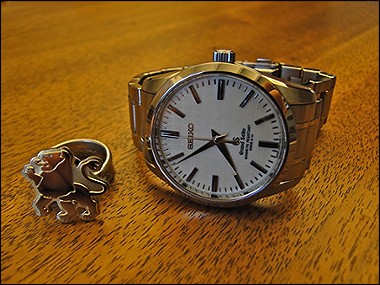
BigFatPauli conducts a compelling long-term accuracy test of Grand Seiko's Spring Drive movements, comparing a 9RA2 and a 9R65 over nearly a month. His examination goes beyond mere technical specifications, exploring how these movements maintain their precision over time and whether such extreme accuracy truly matters in daily wear. This article offers valuable insights for collectors interested in the real-world performance and longevity of Spring Drive technology.
Hi All,
I want to preface this with I'm not a measurebater. I generally don't really care about accuracy so long as it is "good enough". What's good enough? Enough that I don't notice in day to day life. That's my metric.
But I was curious....
Grand Seiko released the new 9RA2 a little while back with a reported accuracy of ±10 seconds per month (±0.5 second per day) which is an improvement over their older 9R65 movement which they spec at ±15 seconds per month (±1 second per day). I have also been curious to see how Spring Drive maintained accuracy over time - that is to say, when a SD movement ages, how does it fair? I know SD has its fans and its... not so fans... So I wanted to know, for my self, how well do they hold up. Albeit, this is a small sample size of just 2 watches.
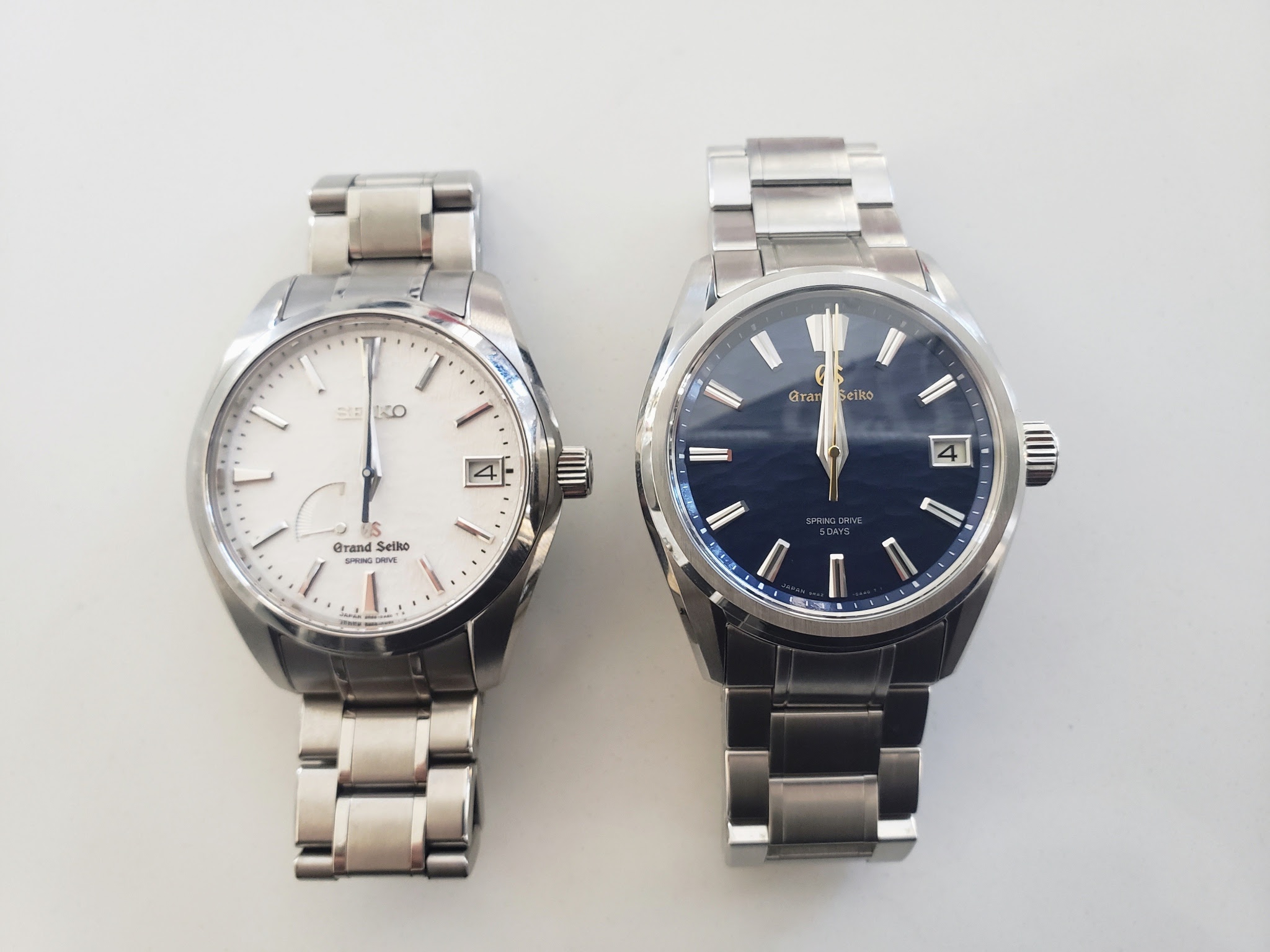
Here is a 9RA2 and 9R65 side by side, synced as close as I could get them to
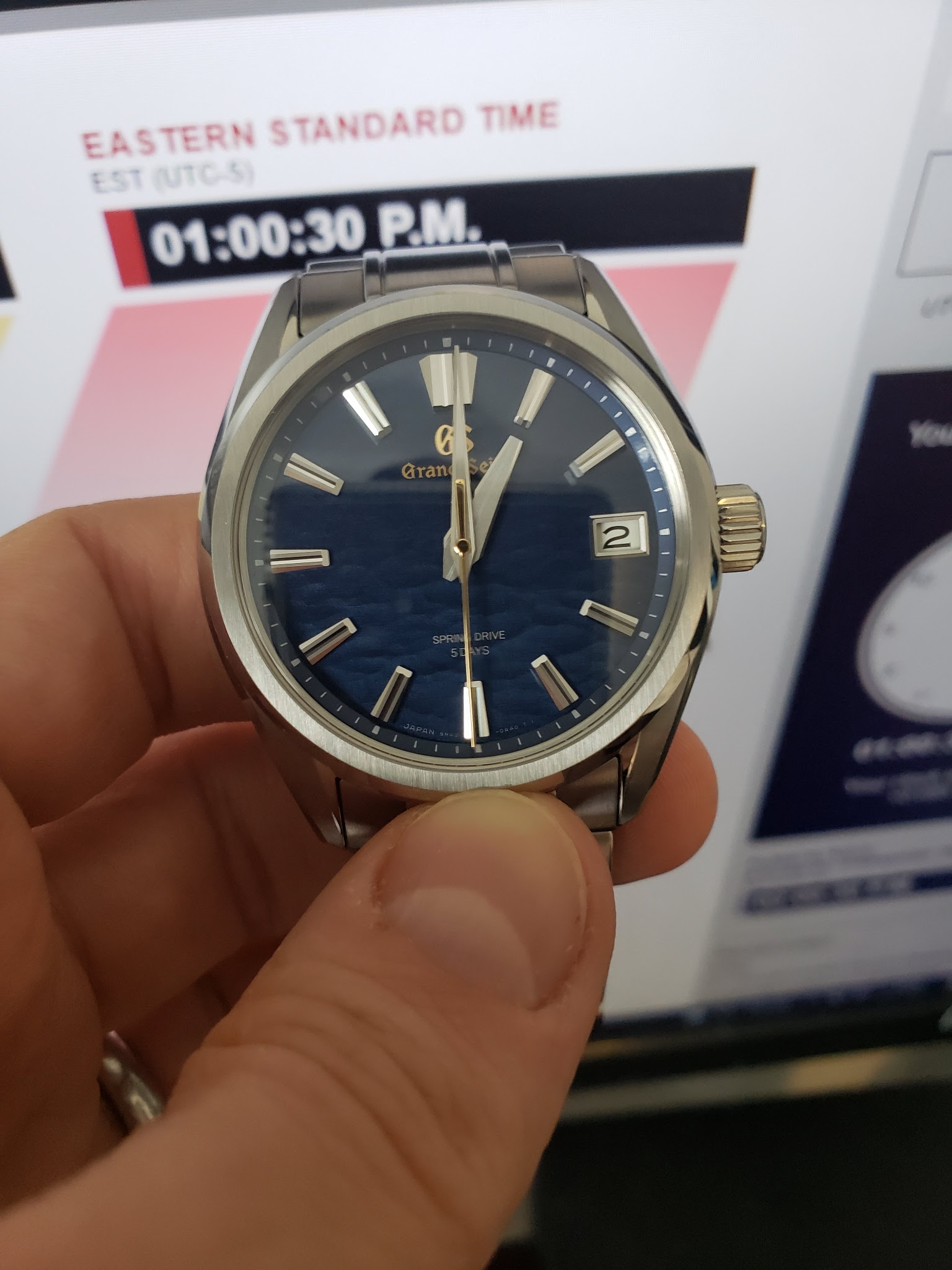
time.gov on January 4, 2022 at noon. I took this photo about 0.5 seconds too late but they are synced just about perfectly.
I wore the two in rotation, to keep them both running, alternating the days for the month.
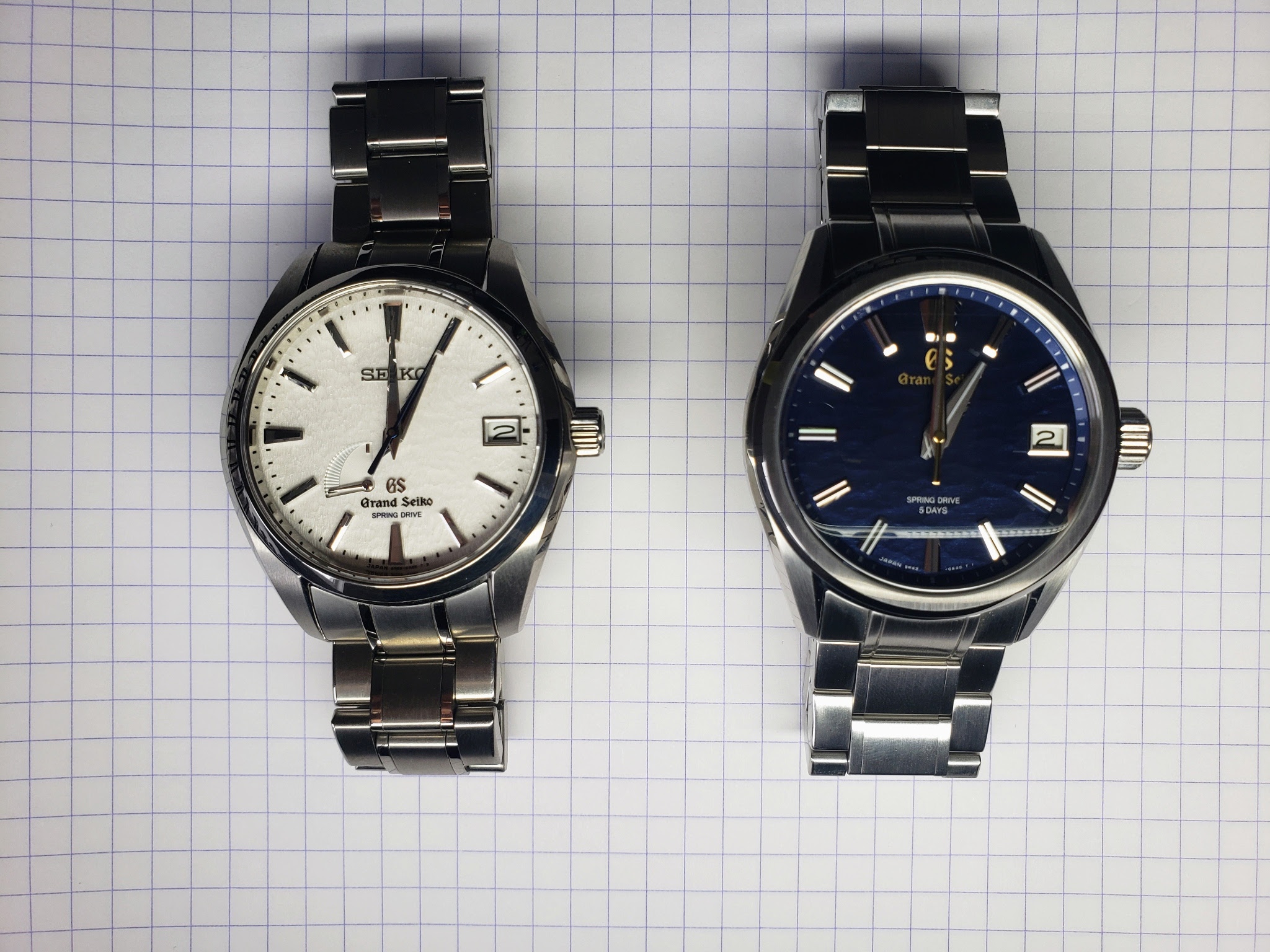
29 days (and 1 hour, oops) later:
Taken at 1pm on February 2, 2022. We can see the 9R65 is almost 5 seconds fast versus the 9RA2.
The 9RA2 is, incredibly, spot on!
My particular 9R65 was bought new by me on July 16, 2013 and it has not been serviced. 9 years, no service, -4 seconds a month. Both calibers, old and new, performed extremely well in my books.
I think this level of accuracy, though neat, is really not what is important when it comes to a watch. There are so many things that make a great watch, well, great that accuracy is only one small part. But it is nice to see that the SD is just as accurate as advertised and seems to remains so over time. It turns out that Seiko was really on to something with this whole quartz revolution

What about servicing? I suspect a SD movement would be subject to all the same physical perils as a regular movement as it ages: gear wear, "gunk" build up, drying oils, etc, all of which can impact the accuracy of a mechanical watch and could also impact a SD movement. That said, how many mechanical watches are +4 seconds a month... After a decade? I suspect few to none would be the answer.
The SD was accurate, in fact just as accurate as one would expect of a new 9R65, in spite of having most of the same wear and tear downfalls of a traditional watch and not serviced - Why? I have my suspicion. If you look how the SD works, according to Seiko's site, it says:
"The IC compares the reference signal from the quartz oscillator with the revolution speed of the glide wheel, and intermittently applies a magnetic brake when it detects that the glide wheel is operating too fast. This regulation of the glide wheel is transmitted to the gear train, ensuring that the watch hands move with precision."
(https://www.grand-seiko.com/ca-en/about/movement/springdrive)
So, the way I envision it, as a regular movement ages tolerances wane, in part because the gear train gets harder to "push" (dried up oils=less lubrication). A traditional Swiss lever escapement has no way to actively adapt and compensate for this. The system is, essentially, "dumb". It just keeps ticking the way it always has, even through the input power has changed.
In the case of SD, however, at the final step - the escapement - the speed of the flywheel is measured and then pulled back (braked) to the correct speed. Regardless of what happened in the watch up to this point, so long as it is running at a minimum speed the IC will slow it down to the correct one. Basically, it is self correcting!
Consider it this way. If you turned the IC off in a SD movement and let the movement run, it would just spin out in a matter of seconds, much like a Swiss lever movement would without an escapement. Let's say the flywheel spins, just for a number, at 100X the speed it should without the IC working to brake its speed. Once we activate the IC, it sees the wheel spinning at 100X and brakes it down to 1X.
As the movement ages and less force reaches the flywheel due to dirt, dried oils and a fatigued main spring, if we turn off the IC now the flywheel may spin at only 75X. Turn on the IC and it, again, slows it down to 1X. Basically mitigating the impact of wear (until the watch actually can't run anymore).
At least, this is what I think is happening and if that is the case, that's a pretty clever solution to something, as far as I know, can't be fixed in a mechanical watch.
The closest thing I think of in the mechanical world is a fusee and chain;
Wiki
Which only compensates for the reduced torque as the mainspring unwinds and does not adapt to differences in force as the movement ages. It is also pre-calibrated and can not adapt on the fly.
In the end, I was a fan of SD before and I'm a fan of it now. I know some feel, like a hybrid engine, it garners the problems of a quartz and a mechanical movement but in my experience it instead garners the advantages of a quartz and a mechanical movement.
Final thoughts? SD has it's advantages, and arguably some disadvantages, but I think it's really something special based on performance and I am glad to see a company think outside of the box by combining something old and something new to, in my case, create something blue dialed.
Best,
-Paul
P.S. I apologize for the cruddy image quality- I only had one shot to take them! As well, this content is a repost of mine from the Canadian forum.
This message has been edited by cazalea on 2022-02-04 15:11:25