Reference Guide
crown comfort provides an in-depth exploration of Girard-Perregaux's iconic ww.tc World Timers, tracing their evolution and highlighting key models. This detailed look offers valuable insights into the challenges of combining complex complications like world time and chronograph on a single, legible dial, a feat GP achieved with distinction.


The fascination of World Timers
World Time clocks and watches are something fascinating to me. I like the way they show us the time zones around the globe and I find it very practical to just check the time in Tokyo or Los Angeles with one look. Producing a World Timer in a wrist watch presents numerous challenges. The most difficult part in my view is to design a harmonious dial that is easy to read and pleasing to the eye. The ones that most succeeded on that in he past were classic time-only world timers such as the vintage Breitling Unitime or the classic Patek 5110

Watch credit: Breitling: UBIK, Patek: Baron
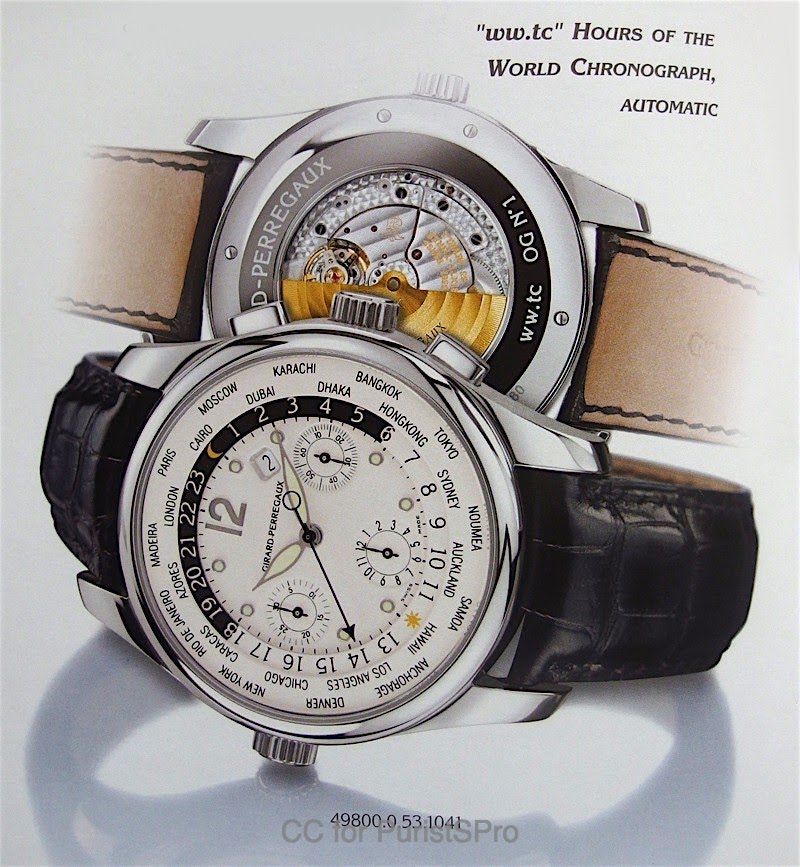
Adding more functionality to a world timer dial has rarely been attempted and a good modern design that is coherent and legible that combines World Time function and Chronograph can really be attributed to GP’s release of the ww.tc in the year 2000.
But more on that later.
Famous World time clocks
First let’s take a little excursion to World Time clocks and historic pieces. There are some World Time clocks that have a personal association with me:
There is the well-known World Clock in Berlin, Alexanderplatz. A monstrous, possibly quite ugly piece of metal and concrete.

To me it was always a symbol of the hypocrite East German, communist ruled government, trying to impress the world with a monument, depicting a cosmopolitan spirit while most of the places on Earth were unreachable for its citizens. A symbol of a failed state.
Another World Clock that has a part in my life is the Geochron Boardroom wall clock.

When I started my professional career, the company I worked for had a policy that in every office around the world, the main meeting room/board room would have a Geochron World Clock on the wall. When I was sent out to Korea to open an office there, I of course purchased that World Clock for the meeting room and since then I had a fascination with it.
Finally, even the city I now live in, has a World Clock in its main pedestrian area.

So it seems the World Clock theme is following me around wherever I go.
GP World Timers prior to ww.tc
Before we explore the vast area of GP’s ww.tc, let’s have a very quick look on what happened in that area before the ww.tc. There are no World Time wrist watches in GP’s history of the 50s or 60s unfortunately (at least I’m not aware of any). There have been a number of pocket watches displaying multiple time zones, but no real world timer as we know them today.

Girard-Perregaux Pocket Watch from 1860, displaying 5 time zones
However, in the 1990s, GP did release a first World Time wrist watch, the GP 90.

Not often seen anymore, here you have the city ring on a rotating outer bezel and a rotating 24h sapphire ring on the dial. But let’s now look at the ww.tc as we know it.
The inception of the ww.tc Chronograph
In the year 2000, Luigi Macaluso worked with the team on creating a true World Timer within the Classic Elegance line. With his passion for motor racing, adding a Chronograph to the World Time function was conceived. That’s how the ww.tc (world-wide time control) started its life as Reference 49800, a 43mm case in solid gold with a rotating city ring operated by a crown at 9 and a rotating 24 hour time display ring, allowing to read the time in 24 time zones simultaneously. In addition, Ref 49800 featured a Chronograph with 3 registers (central seconds, 30min and 12h counters) and a deep sitting date window at 1:30h.

The movement is based on the inhouse automatic caliber 3300 with Chronograph function added and a special gear train on the dial side to rotate the 24 hour ring.

Caliber GP033C0 is a self-winding 13” caliber with 63 jewels 28,800 vph and a 46h Power Reserve.
The evolution of the ww.tc model
Since then, many different versions of case material and dial combinations of Ref 49800 had been produced.
In 2006, the ww.tc Chronograph received its first major overhaul. While the case size remained at 43mm, a few subtle changes to the lugs and in particular to the crowns and pushers had been made. Having owned both versions, Ref 49805 achieved a new level of comfort on the wrist. While I always had issues with the larger crown at 9 on the original model, the now much thinner crown removed that discomfort completely and I can very happily wear the 49805 for a long time. With the 49805 also the buckle width changed from 16 to 19mm which given the 22mm lug size allowed for a less tapered and easier to operate strap and improved the masculine look.
Until today, the case of the 49805 is to me the reference for the World Time Chronograph. In 2011, the Reference changed to 49815, which slightly increased the thickness of the case but overall remained almost identical. Prior to that Reference 49820 with a ceramic case was introduced, where the Chronograph also featured a Fly-back function. So in total 4 ww.tc Chronograph References of the classic ww.tc were produced.

However, GP did not stop with the Chronograph function. In 2005 another version with small seconds and power reserve (Ref 49850) was introduced, featuring a smaller 41mm case. In 2009 that model received also a major overhaul, dropping the Power reserve to only feature a small seconds dial at 6 (Ref 49850 and Ref 49865)

Photos credit: Blomman
As mentioned, the ww.tc line is a vast topic and there have also been many (maybe too many) special and limited editions of the basic ww.tc with or without Chronograph. More on that in the next section about special releases.
First I just want to mention a few other versions:
Haute Horlogerie:
90280: in 2006 a Perpetual Calendar was added to the World Timer. No Chronograph function, but the PC was integrated into the smaller 41mm case
99350: A Tourbillon with 3 golden bridges visible through a sapphire case back is likely the pinnacle complication of the ww.tc line
Ladies Versions:
49860: various versions with small seconds and power reserve, mostly set with precious stones was available since 2007 in a 41mm case, so quite large for Ladies
Jewelry/Enamel:
49870: a few releases with enamel inner dial and/or precious stones had come to the market from 2008 onwards.

Special and Limited releases
I admit I do have mixed feelings about the abundance of Limited Editions produced for the ww.tc. On the one hand, a World Timer presents a great opportunity to customise the dial with a special city and release it as “Limited Edition”, on the other hand, they all are essentially the same watch, so there is a disconnect between exclusivity and what is called a limited edition.
Ironically, my very first ww.tc was a Limited Edition “Club Italia”.

Limited to 100 pieces but there was an identical dial version only having “Paris” as the CET city. There have been quite a few more, like a Berlin edition, a Praha edition etc. and this is by no means a complete list.
The most important and most successful special release was the Financial Time Control “FTC”. Not a limited edition (although there have also been some limited edition of the special edition, but I digress), with additional colours and lines and a red arrow at 9, the FTC displays the opening hours of the major bourses around the globe. I honestly couldn’t care less about that and even if I would be a trader, I think today you can trade 24h on the computer, but then it really adds something unique and cool to the watch and the dial.
The FTC versions were available both with Chronograph and the small seconds/power reserve references.

Cut in the line, ceasing the classic ww.tc and bringing a World Timer ww.tc to the Traveller line
In 2013/14, a major cut in the ww.tc line took place. While the classic ww.tc was phased out, GP introduced a new Traveller line with an entirely new case design and a 44mm case diameter. Beside various complications, a ww.tc Chronograph version was also introduced to the Traveller. The most prominent feature of those had been the sculptured dials depicting longitude and latitude.

Reference 49700
Some critique was voiced by the community about the case and the lug design and in my view the arrow-shaped rotor was also not an improvement. This Reference only shortly stayed in production before this line was completely phased out under the new executive management in 2016.
Shift from Traveller to 1966 ww.tc
In late 2016, GP brought us back the ww.tc. It is now coming as a time-only/small seconds World Timer in the classic dress watch line of the 1966 in a moderate 40mm case. Right now we have a choice of silver dial in either a steel or pink gold case. The result is a very clean look. You could almost argue GP went too far ending up with a look a little bit too unspectacular. However, on the wrist that thought goes away quickly. I think the character of the 1966 ww.tc is completely different than previous ww.tc (always a good argument to own both). That can be a plus but could also be seen as a break in consistency.
Especially, the pink gold 1966 ww.tc has made a lasting impression with me.
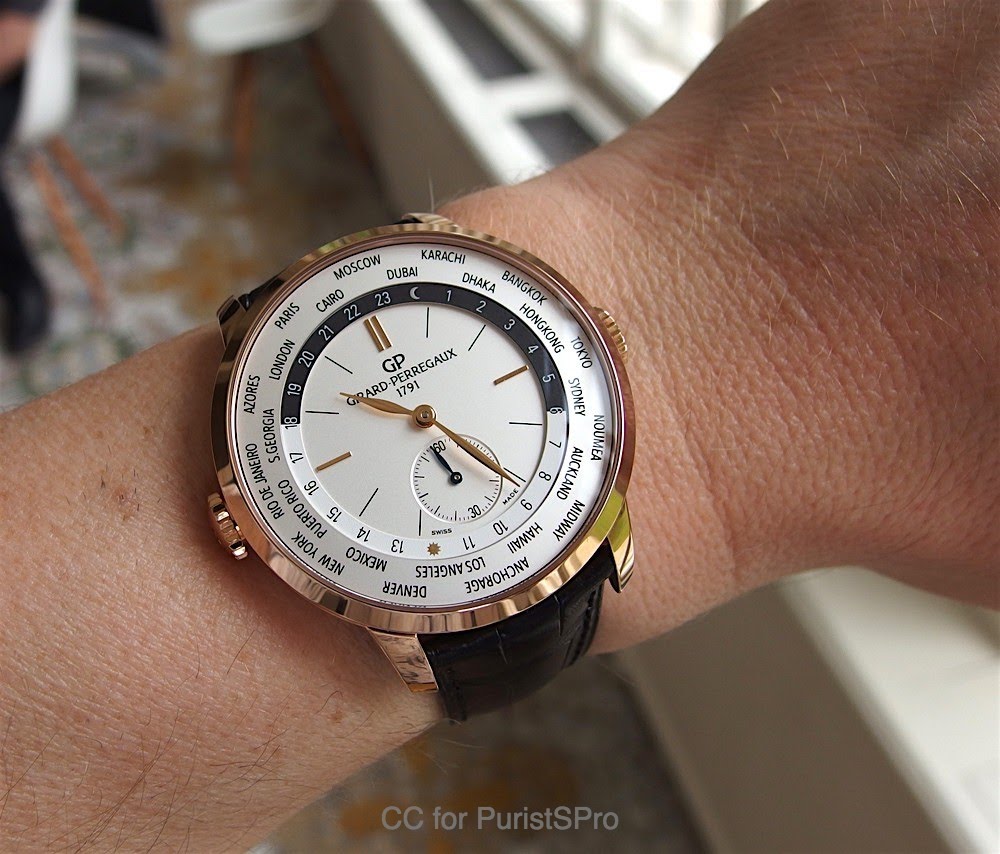
The Steel can be quite cold looking but then it opens up the 1966 and the ww.tc line at a more affordable price, which I wholeheartedly support.

I see a lot of potential to expand the 1966 ww.tc with more versions, different dial colours, different case materials. I personally don’t see the Chronograph function coming back to the 1966 ww.tc but perhaps we will see other complications added.
Future/Speculation/Wishes
So looking into a crystal ball, what can we expect? Assuming the 1966 ww.tc will be a success (for which I have no doubt), I do expect additional versions coming out in the following years. I could certainly see again a white gold option and some contrasting dial colours other than the all silver.
As far as complications are concerned, I’m quite doubtful that it would make much sense. The elegance of the thin and small case of the 1966 ww.tc would probably be lost, but if I had a wish, then I would love to see an enamel world map version being released.
Another possible evolution could be around the crown at 9 o’clock. While it is a prominent feature of the ww.tc, a pusher solution like it is available with the 1966 Dual Time, could greatly enhance practicality.
Finally, my personal choice(s)
My personal choice for the ww.tc has been the ww.tc Chronograph Financial with Panda dial (49805). For me, I always liked the combination of World Timer with the Chronograph as this was the original ww.tc and is recognized unmistakably as a GP. The Financial function adds colour and interest to the dial and the Panda has a special look that makes this a classic sports watch in my view. Along with the heft of the 43mm case, a strong, masculine watch as I like them.


But is there more? Is there a holy grail of GP ww.tc? One could say that the 3 Bridge Tourbillon could fit that bill. On the other hand, if I ever manage to get a 3 bridge Tourbillon into my collection, I honestly want to see it all the time and not just through the backside. So perhaps the Perpetual Calendar? In general, I’m not a huge fan of Perpetual Calendars, so while I appreciate the overall complication in a relatively small case, this is not the grail ww.tc for me.
The one grail of the ww.tc for me has got to be the Tribute to John Harrison. Why? Because I always admired John Harrison for his pioneering work, I had a few Sea Hawk John Harrison watches before, but first and foremost, the name John Harrison in association with a World Timer has just historic dimensions. It was Harrison’s work that laid the foundation for Longitude and universal time with different time zones.
And then there is this gorgeous enamel dial, depicting the journey of the H4 watch, undertaken by John Harrison’s son. A true grail watch for me.


The enamel is handcrafted by GP with the Champlevé method, carving the contours into the gold-based dial and then filling the colours with enamel paint, followed by a double baking and polishing process. The outcome is simply stunning. Some time ago, I also handled a Patek 5131R and the feel of the enamel world map on a World Timer is something very special.
On the wrist that watch just comes to life:


I hope you enjoyed that little journey into the GP ww.tc world and feel free to show your ww.tc’s or your grail dream ww.tc.
CC
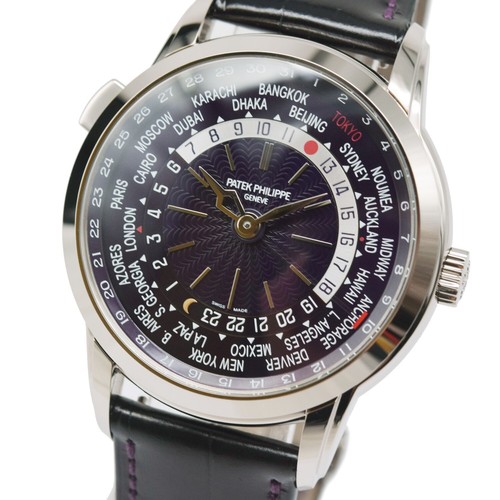
The Patek Philippe Complications reference 5131 is a World Time model, distinguished by its cloisonné enamel dial depicting a map of the world. This reference is part of a series that showcases Patek Philippe's expertise in both horological complications and traditional decorative arts, offering a functional travel watch with significant aesthetic appeal. It represents a continuation of the brand's long-standing tradition of producing World Time watches, updated with contemporary design elements and a self-winding movement. The 5131 is recognized for its intricate dial work, which varies depending on the specific metal and region depicted.
The watch features a 39.5mm case, available in various precious metals, housing the self-winding Caliber 240 HU. This movement provides a power reserve of 48 hours and drives the World Time complication, allowing the wearer to simultaneously view the time in 24 different time zones. The case is fitted with a sapphire crystal, ensuring durability and clear visibility of the detailed dial. Water resistance is rated at 30 meters, suitable for everyday wear. The fixed bezel frames the intricate dial, contributing to the watch's refined profile.
As a World Time model with a cloisonné dial, the 5131 appeals to collectors who appreciate both technical sophistication and artisanal craftsmanship. Its limited production and the unique hand-finished nature of each dial contribute to its desirability within the secondary market. The reference fits into Patek Philippe's Complications collection as a high-end travel watch, offering a distinctive alternative to more traditional time-only or chronograph models. Variants typically involve different precious metal cases and corresponding enamel map depictions.
Kudos my friend Truly enjoyable read As for GP and 1. There is a fountain of inspiration in that area so many nice versions in the end I would go after one that padj has..seconds only 2. I like "first" series of by GP best 3. That Harrison is made for you...perfect fit Yours D P.S. My grail would be Green of course
and of course, you had to pick the green one. Trouble is, that is a piece unique, so not an easy achievement There was however a 49800 Chronograph with pink gold case that also had a green 24h ring, not limited. Perhaps a more achievable alternative.
Absolute marvel Pic taken by Purist
I bought my WW TC in white gold in 2002 and loved it. I still wonder why I sold it in 2005. Maybe because I started to see too many different LE, variations... But I still love the combination of a world time and a chronograph. Some years later, in 2009, if my memory serves me well, I saw the WW TC time only, in steel, no date. And it was love at first sight. But like you, this is the John Harrison version with its superb enamel champlevé dial who won my heart. In 2011 or 2012, the 3 GB Tourbill
2,850 Patek Philippe listings are live on the eBay market and 1721 collector listings on the WatchProSite marketplace.
This thread is active on the Girard Perregaux forum with 38 replies. Share your knowledge with fellow collectors.
Join the Discussion →