Vintage
PeterCDE introduces the Girard-Perregaux Vintage 1966 Palladium, a limited edition timepiece that pays tribute to the brand's significant chronometry achievements. This article delves into the historical context of chronometry and GP's role in advancing precision watchmaking, culminating in the Centenary Prize of the Observatory of Neuchâtel in 1966. PeterCDE's detailed presentation highlights the blend of modernity and heritage in this special release.


Dear enthusiasts,
it is with great pleasure to present a very special limited edition combining the brand´s modernity and great past:
The Vintage 1966 - Palladium
Tribute To The Centenary Prize of the Observatorium Neuchatel

(very first prototype of the new model)
The latest creation by Girard-Perregaux is a member of the "Vintage 1966" (or reference 49525), which pays homage to the many innovations produced by the Manufacture in the sixties.
The Manufacture already had its own research and development team at that time, an extremely rare phenomenon in the world of watchmaking. Its dynamism gave rise notably to two revolutionary inventions. In 1957, the Gyromatic movement finally enabled the manufacture of small automatic watches with a high level of reliability. In 1965, at a time when the highest frequencies did not exceed 21,600 vibrations per hour, Girard-Perregaux presented a mechanical movement oscillating at a frequency of 36,000 vibrations per hour. In 1966, Girard-Perregaux received the Centenary Prize of the Observatory of Neuchâtel for this extremely high-precision mechanism.

(advertisement in 1966/67)
This didn´t came by surprise or easily - among watchmakers, chronometry is regarded the crown of watchmaking ever since. As stunning as complicated watchmaking may be, with all the wonderful and breathtaking complications it brought to life, doing something in utmost perfection never has been easy. And there´s no more fierce challenger than time itself - in high precision watchmaking, even the tiniest fault will be obvious when it comes to timing results.
Therefore the seemingly simple task of creating accurate watches never has been taken lightly for more than 200 years. Since John Harrison changed the world of nautical navigation by means of his "H1" to "H4" clocks, Breguet´s invention of the Tourbillon and Guillaume´s invention of ELINVAR metal springs, a lot of scientific research and watchmaking development was invested to improve timekeeping on a general base.
And where´s research, there´s competition as well.
The official timekeeping institutes Kew/Great Britain, German Naval Institute in Hamburg or the swiss observatories in Neuchatel and Geneva provided the platform to submit exceptionally accurate timekeepers for official certification and competition. In a time when particularly accurate timekeeping was regarded the ultimate sign of excellence and in no way a common feature of a watch, it´s been up to specifically prepared one-off movements by the most famous brands to set the pace in watchmaking.
All the efforts required to create a wrist-sized observatory-capable chronometer might be best represented by a figure: between 1900 and 1970, certainly millions (if not many more) wristwatches came to life. But only about 5.500 wrist-sized watches received the official certification of a swiss Observatory. This may tell; truly accurate watches made to stand the most crucial timing tests ever are exceptionally rare and for each there are at least hundreds of thousands that couldn´t compete.
Therefore it´s been one of the highest honours for any brand to be awarded the Observatory Prize for submissions and for decades such has been a main buying argument for customers.
This is documented in a variety of advertisements; almost all brands successfully submitting watches for the chronometric trials proudly presented their awards in subsequent years.
In the 1950´s, a revolution silently made it´s way.
Since then, a common way to improve accuracy of especially "race-trimmed" competition chronometers used to be implementation of an exceptionally large balance. A large balance tends to swing more equally than small balances, which improves the timekeeping. And this led to the creation of especially constructed movements only for timekeeping competition purposes; the famous Peseux 260 may be one example, but there are others by leading brands such as Patek Philippe as well.
In mid 1950´s, a different approach came up. Not enlarging the diameter of the balance was king, but increasing the beat rate of the movement. That´s based on a surprisingly simple idea: the faster the balance swings, the less disturbing effect small influences will have.
This new "fast-beat" or "High Frequency" concept was subject of several prototypes by several brands in a joined project.
But it was not before 1965 to present the very first serial-produced wristwatches featuring such a movement. And this honour goes to Girard-Perregaux!
Subsequently, the new "fast-beat" chronometers turned out to be a new benchmark. These movements allowed for timing results only known by especially produce one-off observatory chronometers - and this with a watch made to be worn!
It was indeed a revolution; a wristwatch allowing for the then unknown precision and chronometric performance comparable to Formula-1 race cars, but without the need for specific cost-intensive fine-tuning of a most delicate movement made to be submitted for timing tests only.
In 1966, Girard-Perregaux submitted the very first batch of "Observatory Chronometers" to Observatory Neuchatel.
No other brand before dared to submit watches actually produced for the markets to an Observatory Competition. And there are some indicators these pieces actually passing all tests and winning Girard-Perregaux a Prize in the competitions was not only a surprise for the Observatory!
A revolutionary development indeed, best described by another figure: most brands actively participating in the timing competitions submitted 10-20 movements for the Observatory. But in 1967, Girard-Perregaux managed to have 632 movements certified by the Observatory Neuchatel!
The new beat rate of 36.000 vibrations per hour did proof itself in a way not possible to oversee, applauded both by the Observatory and even the brands competition then.

(advertisement with Observatory Chronometers and certificates)


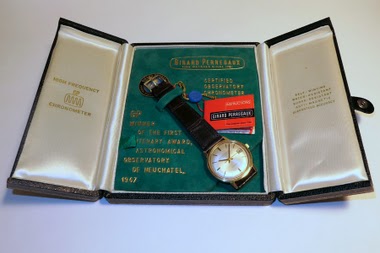
(Girard-Perregaux "Observatory Chronometer", 1966)
Such development deserves a special honour and in 1967, Girard-Perregaux was awarded the "Centennial Prize" of the Observatory Neuchatel. This has been given out only once and it´s certainly the highest honour for a watch brand in the chronometric field.
This may provide the background for a special new edition paying tribute to this great past of the brand - and the famous watches then!
Combining past and presence, the new Vintage 1966 "Palladium" carries on the torch:


(Girard-Perregaux observatory-certified chronometers of 1961 (left) and 1966 (right) with prototype of "Vintage 1966 Palladium")
The new model embodies several features which set it apart from regular "Vintage 1966" models:
- the use of a Palladium case, a precious metal of the Platinum family
- the use of a special dial, finely brushed in the way these were common in the 1950´s and 1960´s
- the special commemorative engraving on the back
- the limited edition of 250 watches only.
Please feel kindly invited to follow a presentation kindly submitted by Girard-Perregaux in the next part.
With sincere thanks to Girard-Perregaux Switzerland!
Greetings from Germany,
Peter
History and background of the new model, in slides kindly provided by the brand:
the white dial variant: the blue dial variant: the back engraving:
enlarged views:
curious as to why the seconds hand on one model is shorter than the other.
The real thing - a beauty for sure: Thanks for your interest! Greetings from Germany, Peter
Hi Peter, Awesome post. I need to spend a while reading through but I wanted to give you a big thank you. Bill PS I will try to give some more intelligent feedback once my brain absorbs the many post you put up.
This thread is active on the Girard Perregaux forum with 16 replies. Share your knowledge with fellow collectors.
Join the Discussion →