Dxboon presents an in-depth look at the Girard-Perregaux Le Corbusier Trilogy, a collection celebrating the iconic architect. This post delves into the inspiration behind these unique timepieces, highlighting the deep connection between Girard-Perregaux, Le Corbusier, and their shared birthplace, La Chaux-de-Fonds. The author, with a background in art history and architecture, provides rich context for this exceptional watch and art collaboration.
“You employ stone, wood and
concrete, and with these materials you build houses and palaces: That is
construction. Ingenuity is at work. But suddenly you touch my heart, you do me
good. I am happy and I say: ‘This is beautiful.’ That is architecture. Art enters in.”
Vers une architecture, Le Corbusier, ed. G. Crès, 1923
Our friends at GP shared with us some more pictures of the exciting
new
Le Corbusier Trilogy of watches. GP has a history of great watch + art
(architecture) collaborations. I particularly like this one because I
am a student of art history and architecture. Le Corbusier (né
Charles-Edouard Jeanneret) is, of course, one of the most influential
and important architects of all time. Not only was he a pioneer of
modern design, but he was an urbanist who was very concerned about the
living conditions and quality of spaces inhabited by denizens of large,
crowded cities. Le Corbusier understood that great architecture, like
all great art (including watches), elevates our spirits; enriches our
souls.
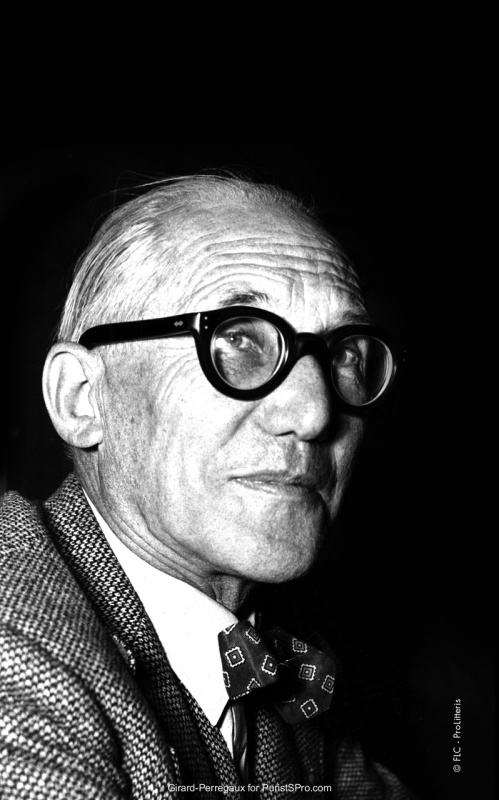
The man himself, Le Corbusier.
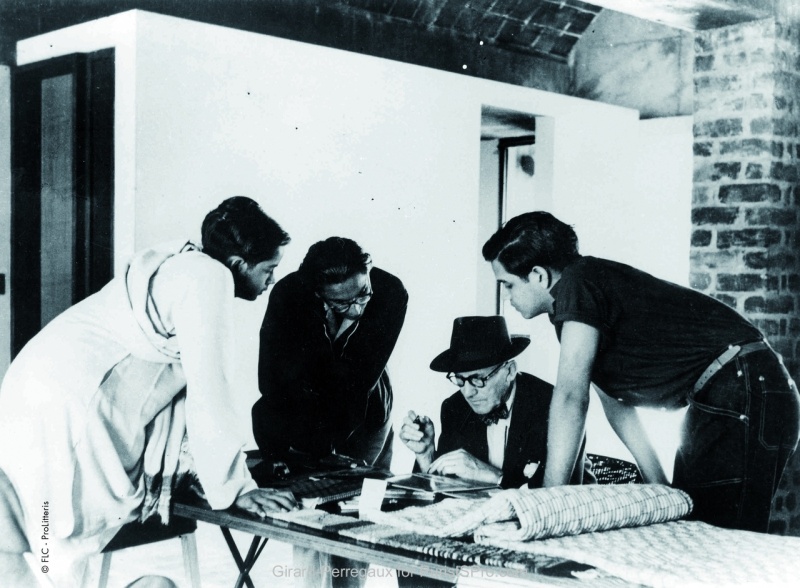
Le Corbusier at work.
Like
us all, Le Corbusier was undoubtedly influenced in some fashion by the
place of his birth and the town where he grew up. High in the Jura
Mountains of Switzerland, 1,000m above the sea, and a few kilometers
east of France, sits the small town of La Chaux-de-Fonds — for centuries
the wellspring of an almost unbelievable congruence of genius.
La Chaux-de-Fonds (photo from Wikipedia).
Among
those born here: Le Corbusier, acclaimed automaker Louis Chevrolet; and
poet/novelist Blaise Cendrars, who was an integral writer in the
modernist movement. The aesthetic movement L’Art Nouveau was refined in
La Chaux-de-Fonds — as the old village gave way to a modern city at the
start of the 20th century. "Style Sapin," a regional Art Nouveau
variant, emerged here, and was exclusive to the burgeoning industrial
watchmaking center. The beauty and ingenuity of La Chaux-de-Fonds'
architecture, and its urban plan have led to its designation as a UNESCO
World Heritage site.
Girard-Perregaux, in cooperation with
Foundation Le Corbusier, celebrates the genius inherent to La
Chaux-de-Fonds by arranging for their gifted watchmakers to employ gold,
sapphire crystal, steel and even concrete to reinterpret the work of
the great Modernist in a series of exceptional new timepieces. This
sublime project is the quintessence of more than a century of communal
history between the Jeanneret and Girard-Perregaux families. Mere
happenstance? Hardly. It is, rather, serendipity at its most poignant —
the seemingly inevitable result when genius takes up residence in close
proximity to genius. The very nature, in other words, of La
Chaux-de-Fonds.
Le Corbusier’s life took him well beyond the
shadow of the Jura, of course; he traveled the world designing
buildings — and, in some cases, entire cities. Fittingly, he was part of
the multinational team of architects that designed the headquarters of
the United Nations Secretariat Building in Manhattan — a metaphor, in
glass, reinforced concrete and steel, for his own global citizenship.
The
Girard-Perregaux Le Corbusier Trilogy, however, reflects the three
places that most embodied the concept of home to the man himself, who
once observed that “the home should be the treasure chest of living”: La
Chaux-de-Fonds, Paris and Marseille.
The model selected by
Girard-Perregaux for the basis of the Le Corbusier Trilogy is the
Vintage 1945, the year Le Corbusier published one of his most famous
works, Les Trois Etablissements Humains (The Three Human Establishments)
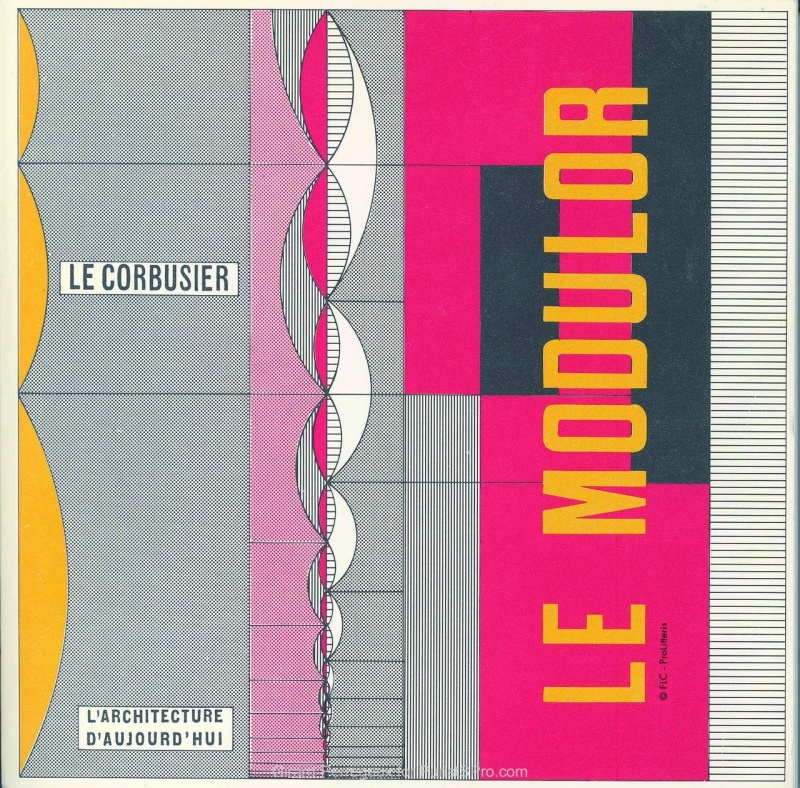
and devised his anthropometric scale of proportions the Modulor. Le
Corbusier described the Modular as a "range of harmonious measurements
to suit
the human scale, universally applicable to architecture and to
mechanical things."
And now onto the three special watches in the Le Corbusier Trilogy.
Vintage 1945 Le Corbusier — La Chaux-de-Fonds
In a marvelous
coincidence, Charles-Edouard Jeanneret’s hometown, La Chaux-de-Fonds,
happens to be the world capital of watchmaking. Before the world knew
him by his pseudonym, Le Corbusier, the young Charles-Edouard spent his
formative years in the town’s School of Art, training as a sculptor and
engraver.
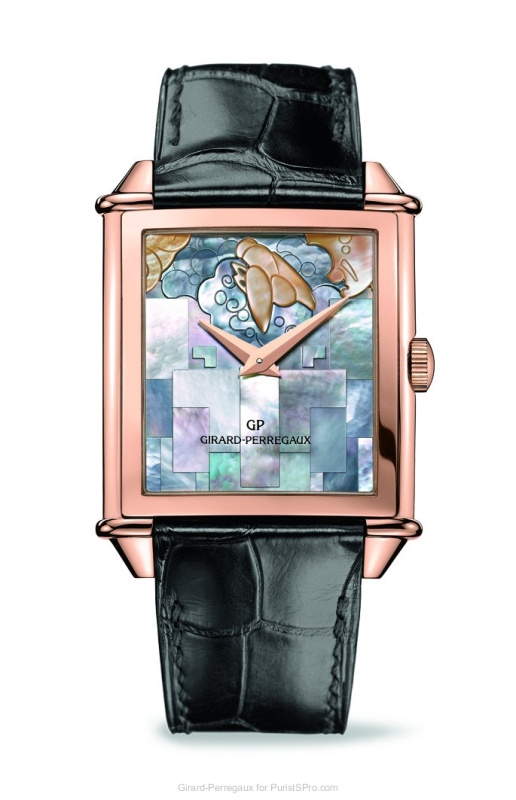
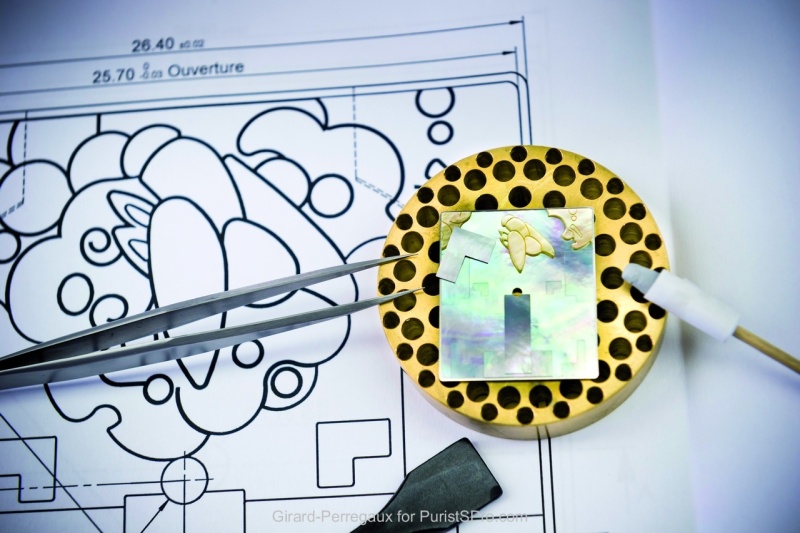
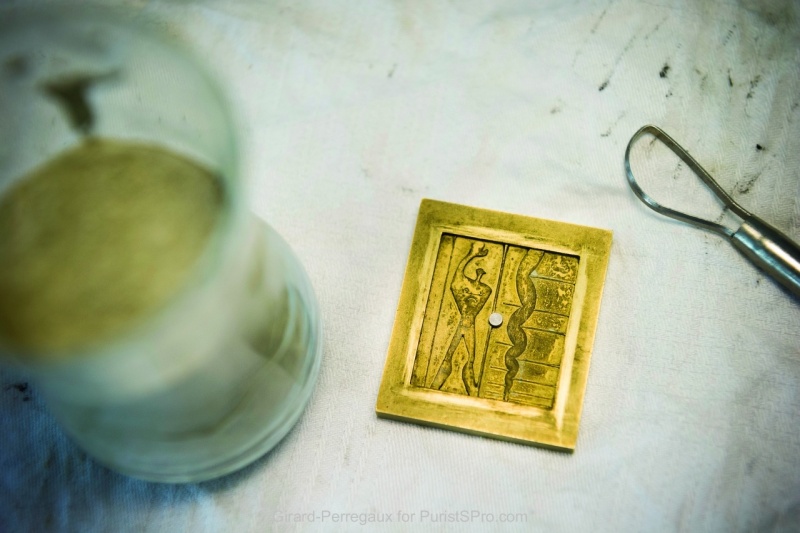
Inlaid Mother-of-Pearl Dial Girard-Perregaux’s
craftsmen pay tribute to an early Le Corbusier work by faithfully
reproducing it in a bas-relief of mother-of-pearl — a nod to both the
piece itself and to Le Corbusier’s beginnings as a sculptor and
engraver.
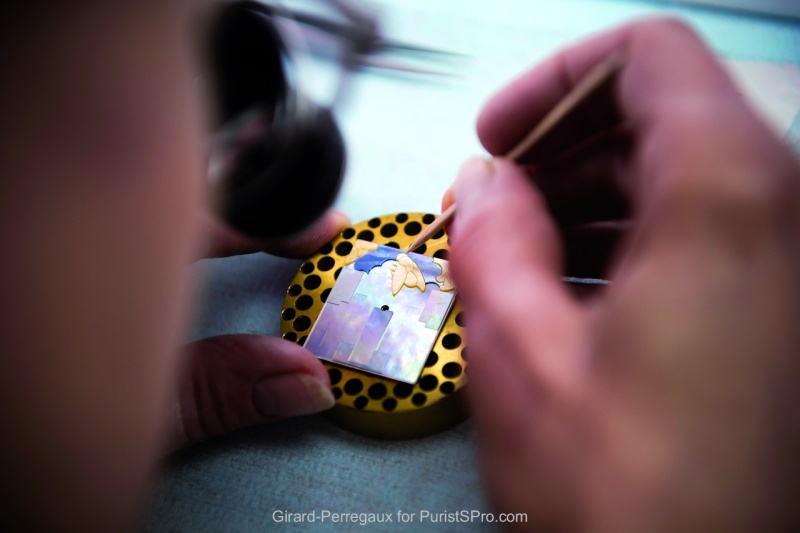
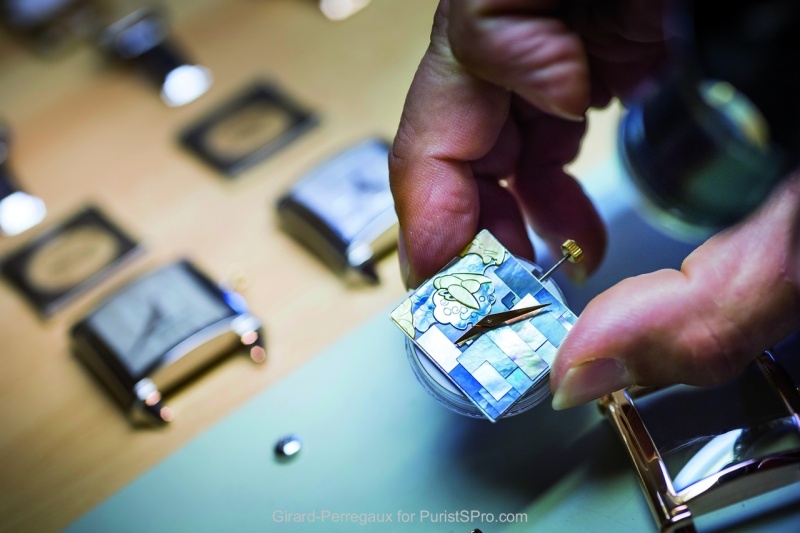
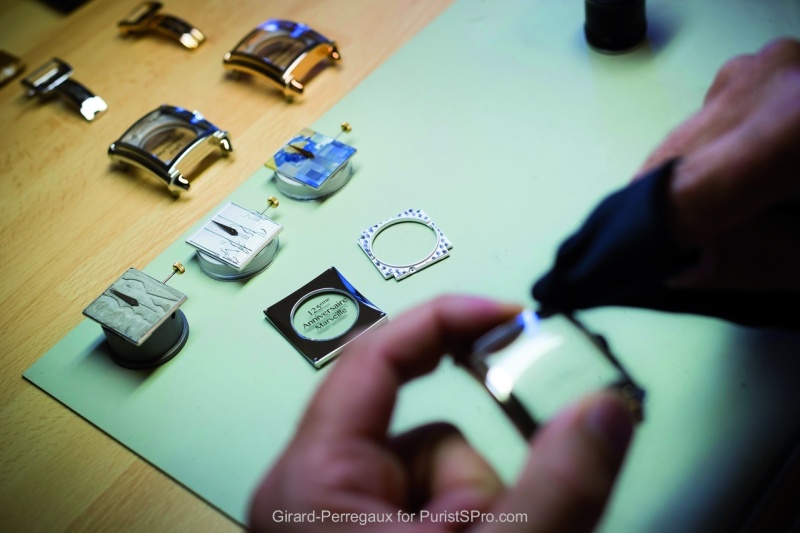
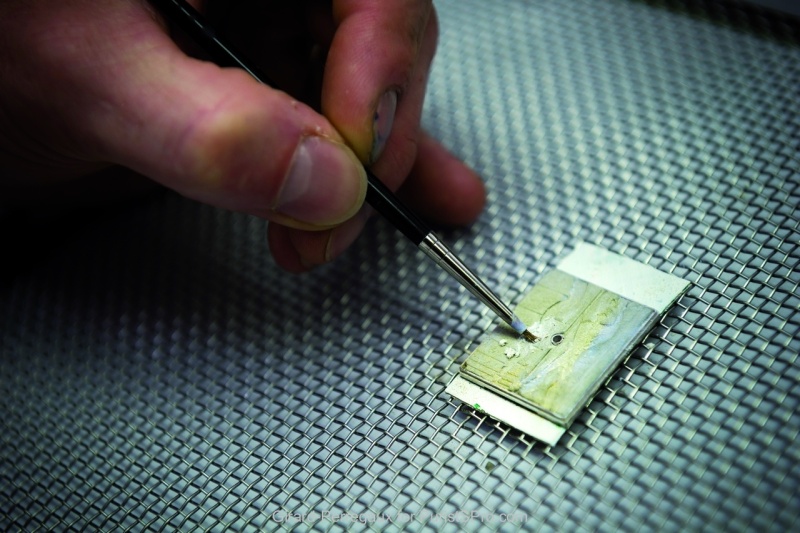
Seven exacting days are required to produce each dial,
requiring mastery of multiple skills: design, sculpture, polishing and
varnishing. The foremost challenge was to preserve the integrity of the
original work’s five colors — necessitating considerable patience and
meticulous attention to detail.
CASE
Material: Pink gold Dimensions: 36.20 x 35.25 mm Crystal: Anti-reflective sapphire Case Back: Sapphire crystal, secured by four screws Water Resistance: 30 meters
MOVEMENT
Girard-Perregaux GP3300-0078, automatic Calibre: 11½ ”’ Frequency: 28,800 vibrations/hour (4 Hz) Jewels: 26 Power Reserve: Min. 46 hours Functions: Hour, minute Limited To: Five pieces Reference: 25880-52-103-HKBA
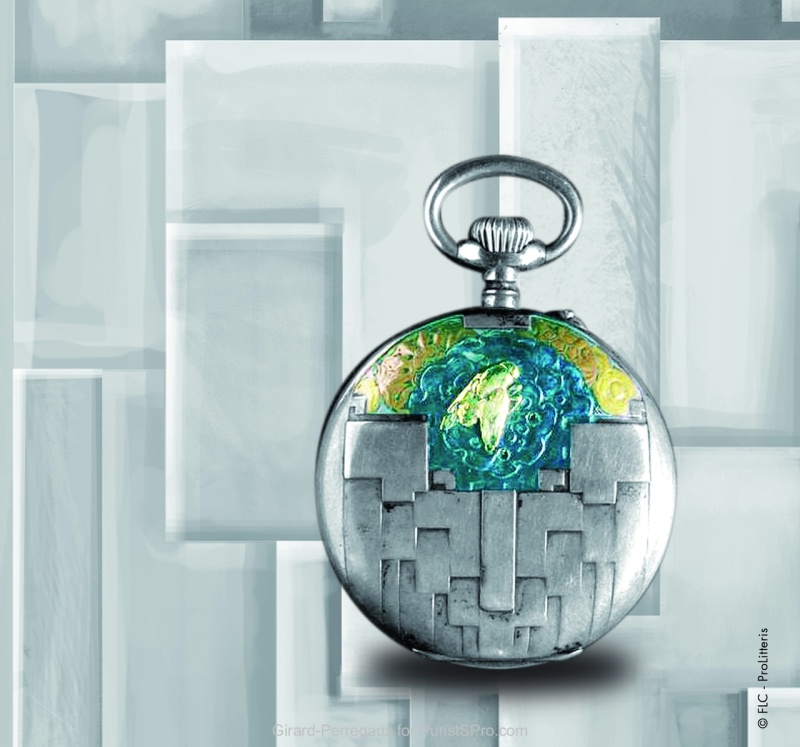
Original inspiration for the first piece in the Le Corbusier Trilogy.
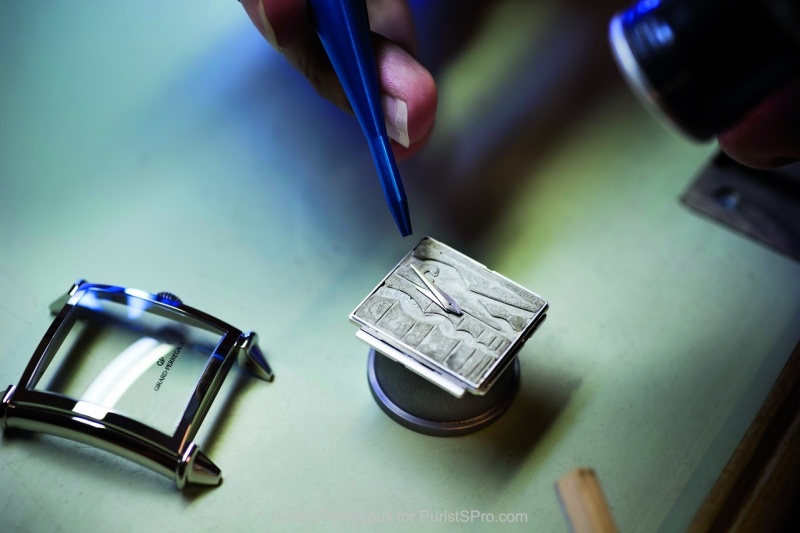
Some making-of photos detailing the meticulous and painstaking creation of the mother-of-pearl dial follow.
Vintage 1945 Le Corbusier — Paris
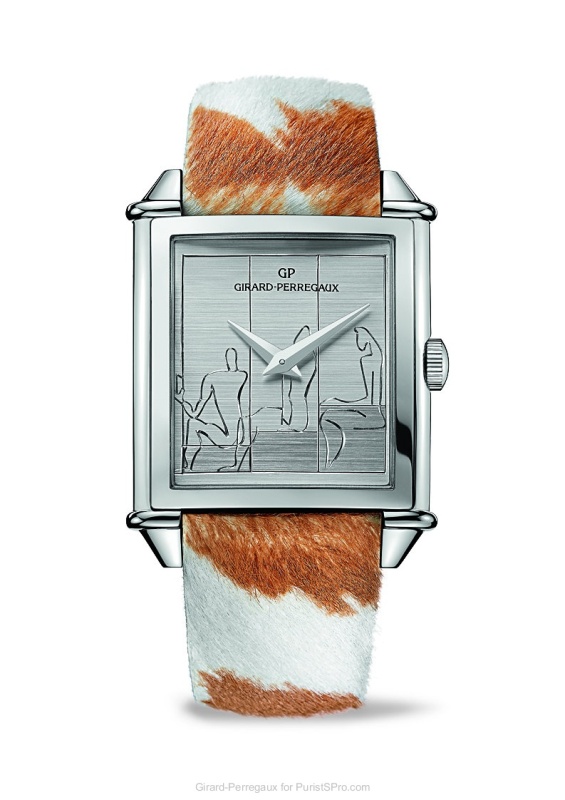
(Don't you LOVE the strap? I adore it!)
Charles-Edouard Jeanneret
arrived in Paris in 1917. Three years later, he assumed the nom
d’artiste “Le Corbusier.” His timing was propitious; Paris was becoming
the global center of the cultural movement known as ‘Modernism’, and Le
Corbusier’s painting and architecture alike embraced it, emphasizing
elemental geometric forms — “space and light and order,” as he put it. Although
he’s now celebrated along with Mies Van der Rohe or Walter Gropius as a
pioneer of modern architecture, Le Corbusier applied his theories about
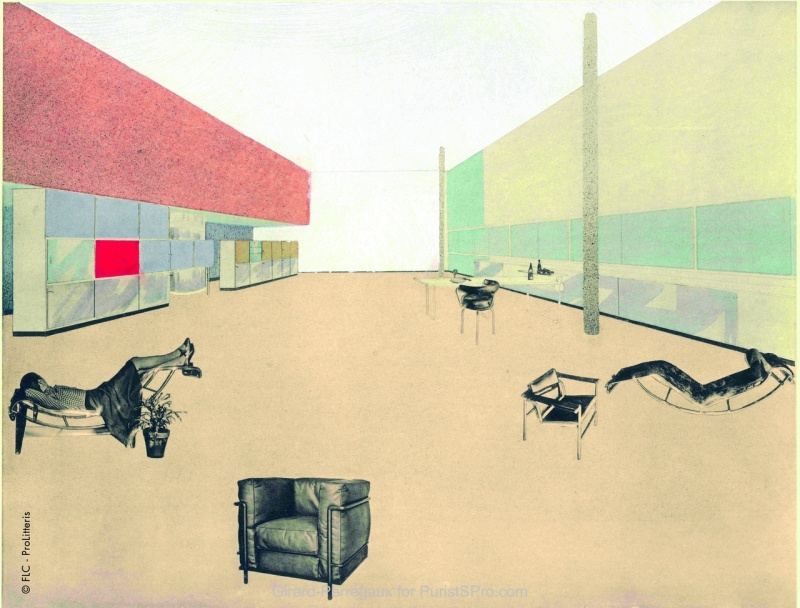
shape to the decorative arts as well. In 1929, along with his cousin
Pierre Jeanneret and Charlotte Perriand, Le Corbusier debuted Le Grand
Confort at Paris’s Salon d’Automne. Among the pieces shown was his
iconic furniture, constructed from a then-unique combination of steel,
tanned leather and rawhide.
Metal Dial The second
limited-edition Girard-Perregaux timepiece in this series commemorates
Le Corbusier’s contributions to the decorative arts by focusing on
materials — pairing a steel case with a cowhide strap to evoke the Le
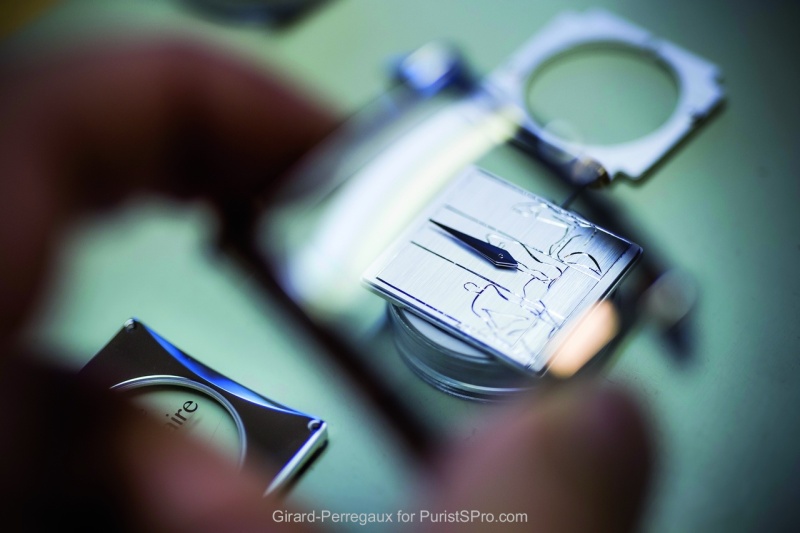
Corbusier chaise longue. The hand-engraved dial reflects his Modulor
system of architectural proportion, based on the male figure (human
scale) and the “Golden Ratio,” as well as his applied perception of
light.
CASE
Material: Steel Dimensions: 36.20 x 35.25 mm Crystal: Anti-reflective sapphire Case Back: Sapphire crystal, secured by four screws Water Resistance: 30 meters
MOVEMENT
Girard-Perregaux GP3300-0078, automatic Calibre: 11½ ”’ Frequency: 28,800 vibrations/hour (4 Hz) Jewels: 26 Power Reserve: Minimum 46 hours Functions: Hour, minute Limited To: Five pieces Reference: 25880-11-102-HKBA
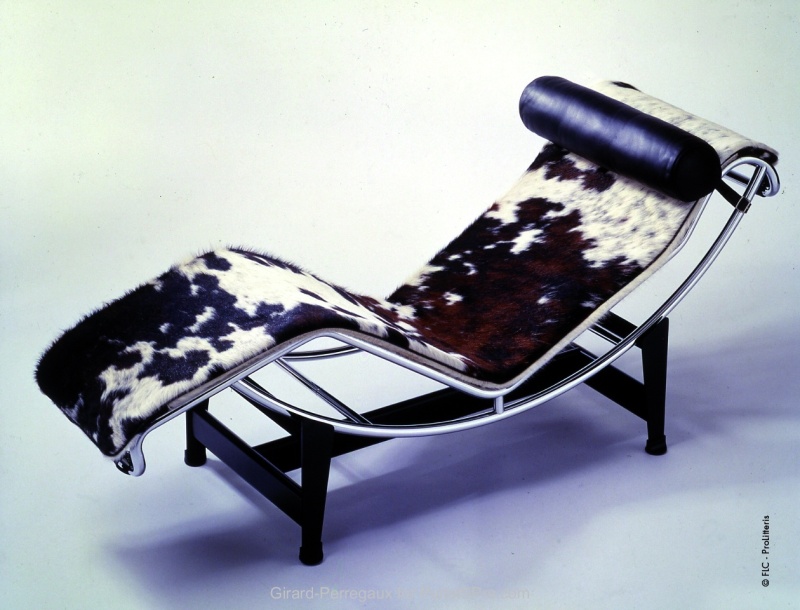
The
famous chair which inspired the second watch in the Le Corbusier
Trilogy. This chair may seem commonplace now, but it was
earth-shattering upon its debut. The strong design still seems fresh,
and modern today. That's a hallmark of great design -- does it
translate well across time? Does it remain relevant from a visual and
design perspective decades after inception? In this case, the answer is
a resounding, YES!
Classic Le Corbusier!
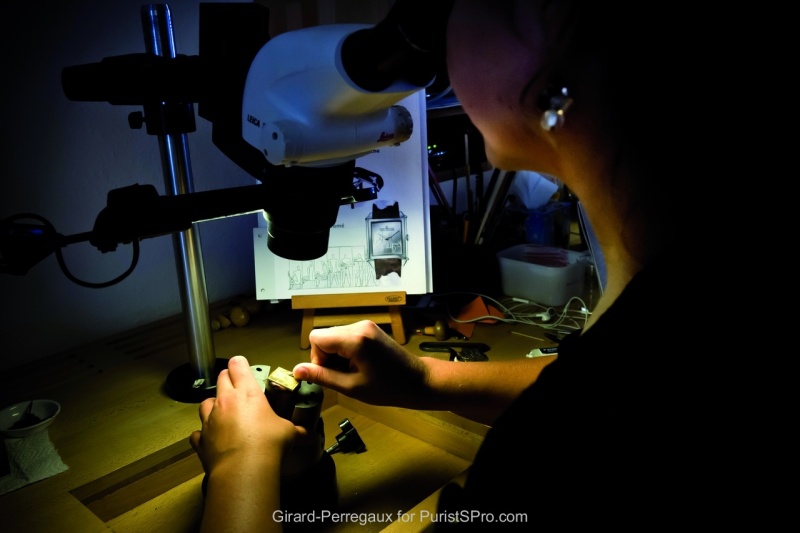
Hand-engraving the metal dial below.
Preparing to encase the watches.
The superb dial causes light to dance in unexpectedly beautiful ways.
Vintage 1945 Le Corbusier — Marseille
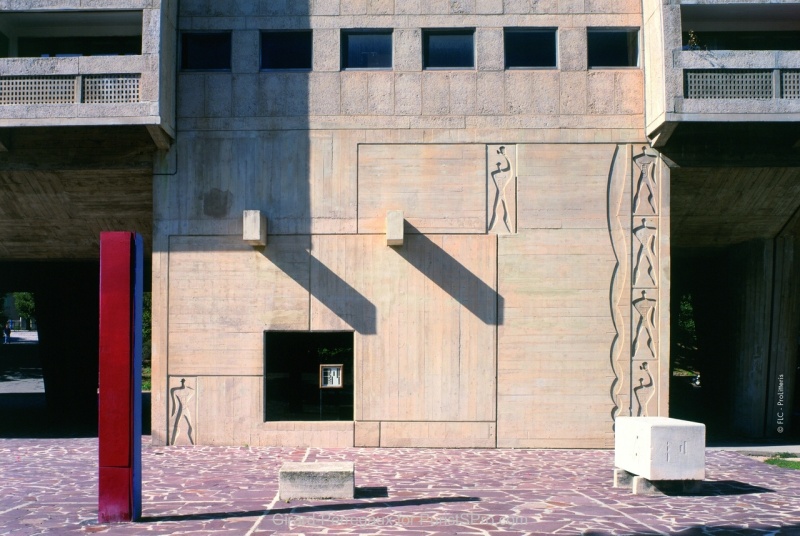
Arguably Le Corbusier’s
most important late work — and certainly his first significant postwar
structure — is the Cité Radieuse (“Radiant City”), an Unité d’Habitation
(“Housing Unit”) in Marseille, France. Although it was conceptualized
earlier, the Marseille building was built from rough-cast reinforced
concrete (steel and concrete) — a signature Le Corbusier material —
between 1947 and 1952 to help alleviate a severe housing shortage at
that time. The colossal 12-story complex accommodates some 1,600
residents and was the inspiration for several similar Unités
d’Habitation throughout France, as well as in Berlin — all designed by
Le Corbusier and given the same utilitarian name. The Unité d’Habitation
was a prime example of the Modulor philosophy — and the design and
proportions of the Marseille watch dial are an homage to the Modulor
anthropometric scale.
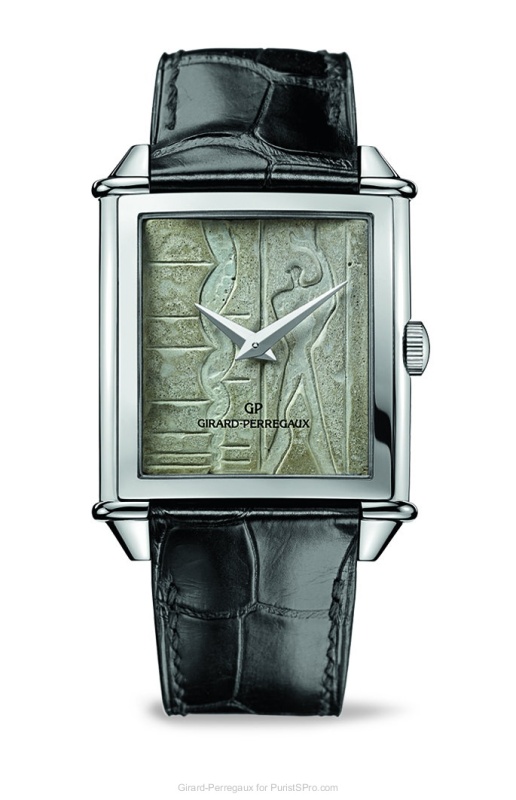
Concrete Dial We end, appropriately,
where we began: with careful attention to raw materials — in this
instance, concrete — that become stirring works of art. For this last
component of the Le Corbusier Trilogy, Girard-Perregaux developed a
concrete dial requiring three days to pour, dry and meticulously
hand-finish. Concrete is an exceptionally uncommon material in
watchmaking now, as it was in construction when Le Corbusier used it to
build Cité Radieuse. The result is an unparalleled interpretation of Le
Corbusier: a seamless blend of watchmaking and architecture.
CASE
Material: Steel Dimensions: 36.20 x 35.25 mm Crystal: Anti-reflective sapphire Case Back: Sapphire crystal, secured by four screws Water Resistance: 30 meters
MOVEMENT
Movement: Girard-Perregaux GP3300-0078, automatic Calibre: 11½ ”’ Frequency: 28,800 vibrations/hour (4 Hz) Jewels: 26 Power Reserve: Minimum 46 hours Functions: Hour, minute Limited To: Five pieces Reference: 25880-11-101-HKBA
This is my favorite of the three Le Corbusier Trilogy pieces! I think the concrete dial is wonderful, and inspired!
The building that served to inspire the last of the Le Corbusier Trilogy watches.
Prepping to pour the concrete.
Cleaning the concrete dial. Creating the dial takes three days.
Adding the hands after the concrete has been finished.
Below, a short video from
Girard-Perregaux highlighting this collection and the works of Le
Corbusier which inspired it.
It's very interesting to see the
watchmakers at work in the footage. I particularly enjoyed the insight
into the creation of the Vintage 1945 Le Corbusier — Marseille (the
concrete variant).
Thank
you to our friends at Girard-Perregaux for sharing these materials.
This is one of the most interesting and beautifully realized
collaborations between the work of a renowned artistic figure and a
watch manufacture that I have encountered.
Cheers, Daos
About the Girard-Perregaux Ref. Vintage1945
The Girard-Perregaux Vintage 1945 line, introduced in 1994, draws inspiration from historical models, specifically a 1945 Art Deco piece. This collection is characterized by its rectangular or tonneau-shaped cases and a design language that evokes mid-20th century aesthetics. The Vintage 1945 series quickly became a cornerstone of Girard-Perregaux's offerings in the 1990s, reinterpreting classic forms with contemporary watchmaking standards. It represents a significant period for the brand in re-establishing its heritage-inspired collections.
Early models in the Vintage 1945 series typically featured stainless steel cases, though gold variants were also produced. The case dimensions varied depending on the specific model, often presenting a balanced profile suitable for dress wear. These watches were frequently equipped with automatic movements, showcasing Girard-Perregaux's in-house capabilities or finely finished outsourced calibers. The crystal was commonly sapphire, ensuring durability and legibility, while water resistance was generally suitable for daily wear rather than aquatic activities.
For collectors, the Vintage 1945 series appeals to those interested in neo-vintage watches that successfully blend historical design with modern execution. The 1994 introduction year marks it as one of the earlier and more influential lines from Girard-Perregaux's resurgence in the 1990s. Its various iterations, including time-only, small seconds, and later complicated versions, offer a range of choices for enthusiasts seeking a distinctive rectangular watch with a clear lineage.
Specifications
Caliber
GP3000
Case
Stainless Steel
Diameter
28mm x 28mm
Dial
Silver
Water Resist.
30m
Crystal
Sapphire
Key Points from the Discussion
The concrete dials are particularly captivating, and there is curiosity about how these unique dials will age over time, potentially developing distinct patinas and crazing.
The collaboration between Girard-Perregaux and the Le Corbusier Foundation showcases remarkable creativity, successfully capturing the essence of Le Corbusier's work through modernist dial designs.
The use of materials like steel and concrete for the dials is a great idea, and the Vintage 45 case serves as an excellent 'vehicle' for associating art and horology, achieving perfection in this execution.
The watches are praised for their ability to be distinctly unique yet cohesive as a group, reflecting Le Corbusier's architectural principles.
The Paris and Marseille versions of the watches are particularly appreciated for their minimalist aesthetic, aligning with Le Corbusier's design philosophy.
Advertisement
The Discussion
PI
pingtsai
Oct 12, 2012
Great post Daos!
Thank you for the additional pictures. I've always loved Le Corbusier's architecture and modern design pieces. It's interesting how each watch is distinctly unique but the group is cohesive as a whole. Very cool.
DX
dxboon
Oct 13, 2012
The Vintage 45 case worked brilliantly for this collection.
I really love the creativity that was shown here by GP. They really captured the essence of Le Corbusier in these watches. As a fan of the man, I am pretty wowed by these timepieces! Cheers, Daos
AM
amanico
Oct 12, 2012
The Paris and the Marseille are real masterpieces.
I love the steel andthe concrete dials, this is great idea! The Vintage 45 is a good " vehicle " to associate Art and Horolgy. In this case, it works at the perfection. Best, Nicolas
DX
dxboon
Oct 13, 2012
The concrete dial is awesome!
I also like the engraved steel, but the concrete just captures my imagination. I'd love to see these 5 concrete pieces in 20 years. It would be interesting to see if any aging takes place on these dials. Each one would be beautifully unique, no doubt. Cheers, Daos
SA
Sandgroper
Oct 13, 2012
Thank you so much Daos, I really enjoyed.....
reading your article, very nice master piece watches this are, really love the Paris and Marseille versions for their minimalism. Thank you again. Kind regards. Francois
DX
dxboon
Oct 13, 2012
Thank you!
I'm glad you enjoyed the additional material about these Le Corbusier watches. They are absolutely fascinating pieces, that have done a great job in capturing the feeling of Le Corbusier's work. The modernist dials are very well executed, indeed. Cheers, Daos
Continue the conversation
This thread is active on the Girard Perregaux forum with 16 replies. Share your knowledge with fellow collectors.