Complications
Blomman Mr Blue's 2014 review of the Girard-Perregaux Constant Escapement L.M. offers a crucial look into one of modern horology's most innovative movements. He meticulously explains the constant force escapement, a rarity that redefines precision by delivering consistent power to the oscillator. This piece remains highly relevant for understanding groundbreaking technical advancements in watchmaking.


Girard-Perregaux Constant Escapement L.M. reference: 93500-52-731-BA6D
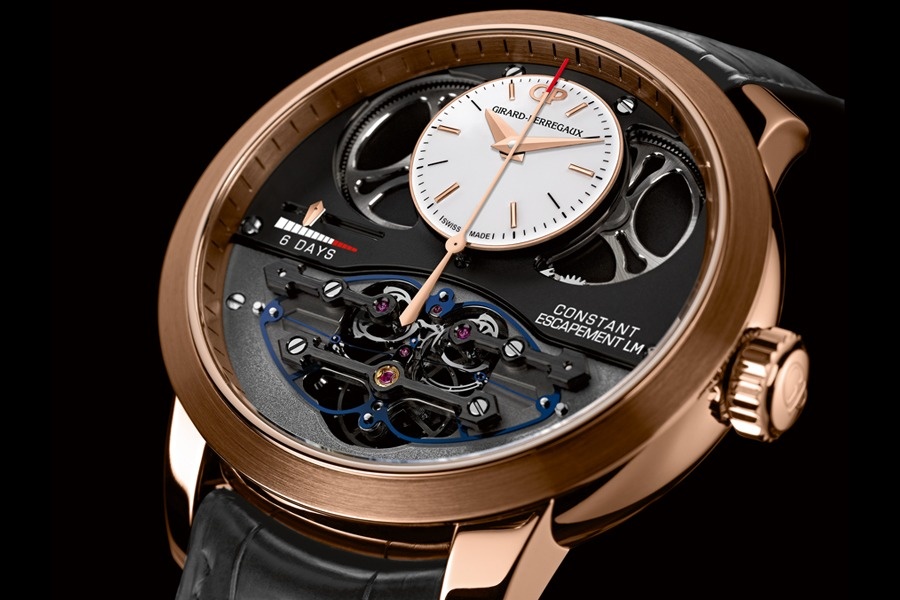
This is a review I have had a lot of trouble writing. Not because I don’t like the watch or anything like that…
The problem is that to understand this watch you need to understand more how the force in a mechanical watch movement works.
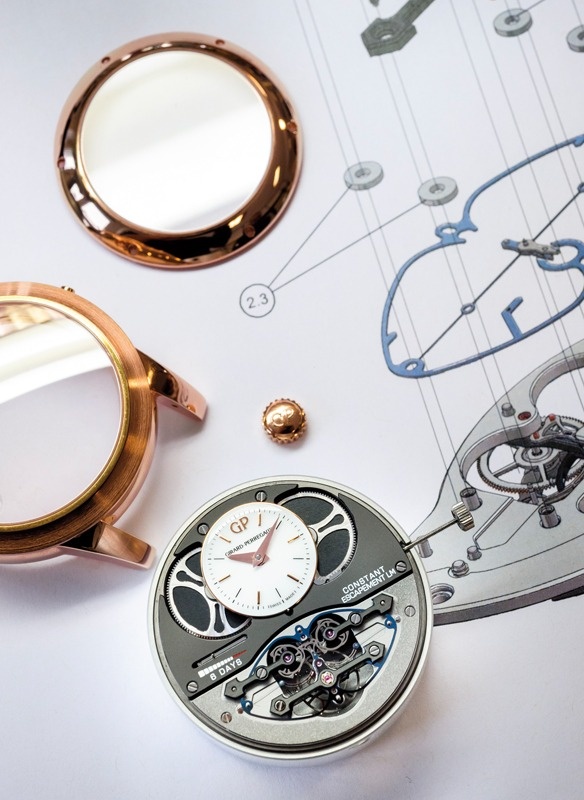
At first glance the Constant Escapement L.M. looks very similar to many other Grand Complication watches from any of the big brands…
Big, 48.00 mm in diameter and 14.63 mm high. Pink gold case, see through case back, dark dial with a white sub dial and with a lot of different design element on the dial…
That is where the similarities stops!
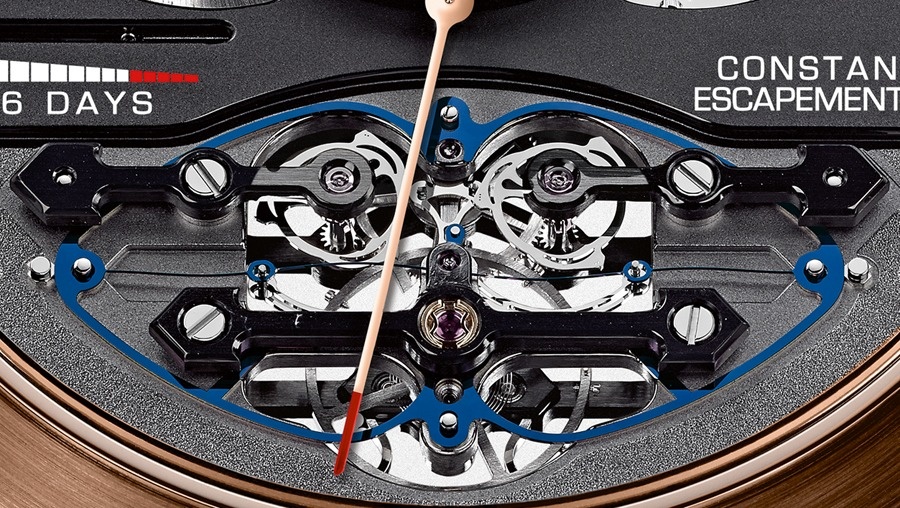
First of all the CE is not a “Grand Complication” in traditional terms of functions: Off-centred Hour and Minutes, Central Second and Linear Power reserve (one week).
The complication is the movement itself or more specific. The Constant Escapement is a completely new architecture of the escapement that is pioneered, a rarity in the world of watchmaking.
In mechanical movements you have the barrel, gear train, escapement and balance wheel. A fully wound traditional movement will have high amplitude that will vary over time until it stops because of the diminishing provided by the barrel as it unwinds.
This makes it difficult to maintain a stable accuracy over the moment’s full power reserve. To achieve constant amplitude hence constant rate over time you need constant power delivery to the oscillator
Several different Manufactures have developed different systems trying to achieve this.
BUT, what separates the Constant Escapement from those is the way that Girard-Perregaux worked on the escapement itself (not a device included before the escapement like a fusee and chain or a remontoir) and the solution imagined to redesign the escapement.
The idea is as brilliant as it is simple, simple in terms of theory (not in development)…
If you have tried to bend a playing card or a blade and then flipped it so that it bends over in the other direction, then you would have noticed that the blade will flip at the exact same position each time and that the force that is released at the moment the blade flips over and the move of the blade will be the same each time.
And voila – you have a constant-force escapement.
This is a simplified explanation of the theory. Now try to make the blade small enough to fit into a wrist watch and work with the precision that is needed in the mechanics of an escapement!
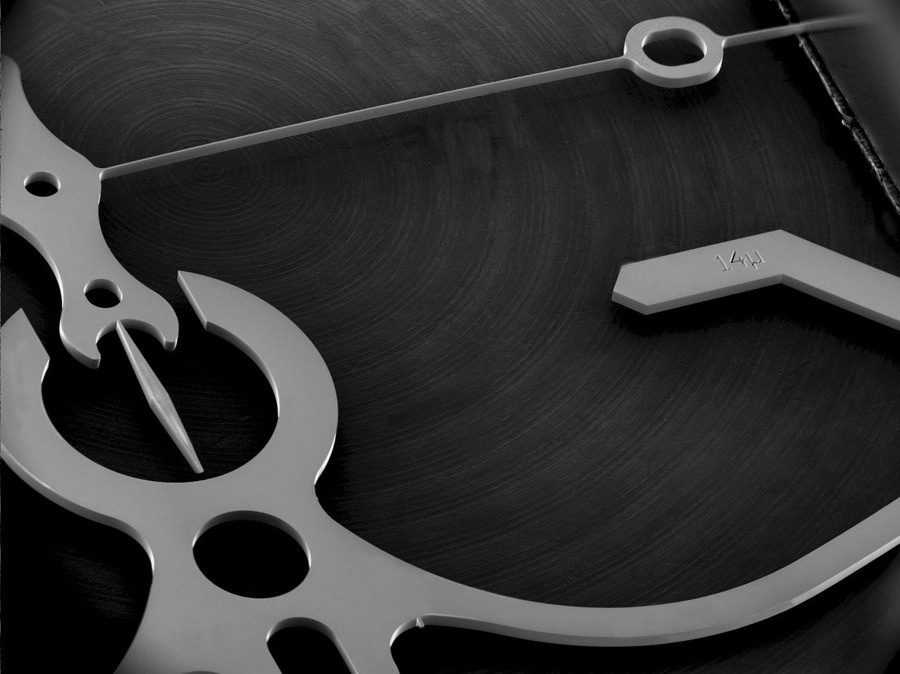
By using an extremely thin silicon blade GP managed to achieve this.
The silicon blade 14 microns thick stores the energy up to an invariable threshold bordering on instability, and then transmits all the energy instantaneously.
Two escapement wheels operate alternatively. Each time the blade buckles it sends a constant impulse to the oscillator, which means constant amplitude and constant rate.
The constant-force escapement makes the driving force supplied by the escapement is constant despite the decreasing torque of the mainspring as it unwinds.
With regards to aesthetics, this watch has a lot of the GP DNA. The brushed bezel, curved lugs, superb finish.
As always Girard-Perregaux uses a lot of symmetry in their design.
The twin barrels located symmetrically under the hour/minute dial. The “butterfly” shaped Constant Escapement centred under the dial, the three bridges…
It is a feast for the eye! 
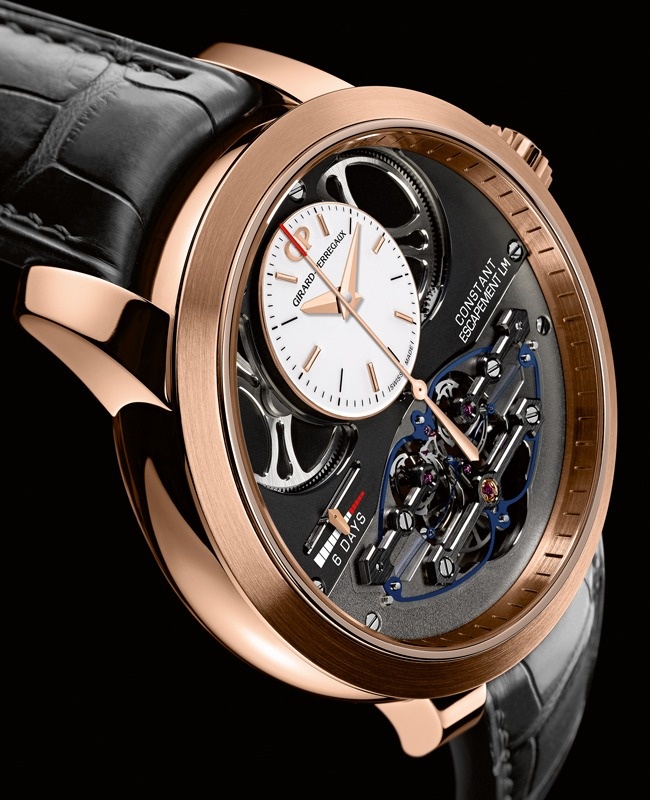
The varnished white dial and dauphine hands give the watch a very classic look and easy to read time.
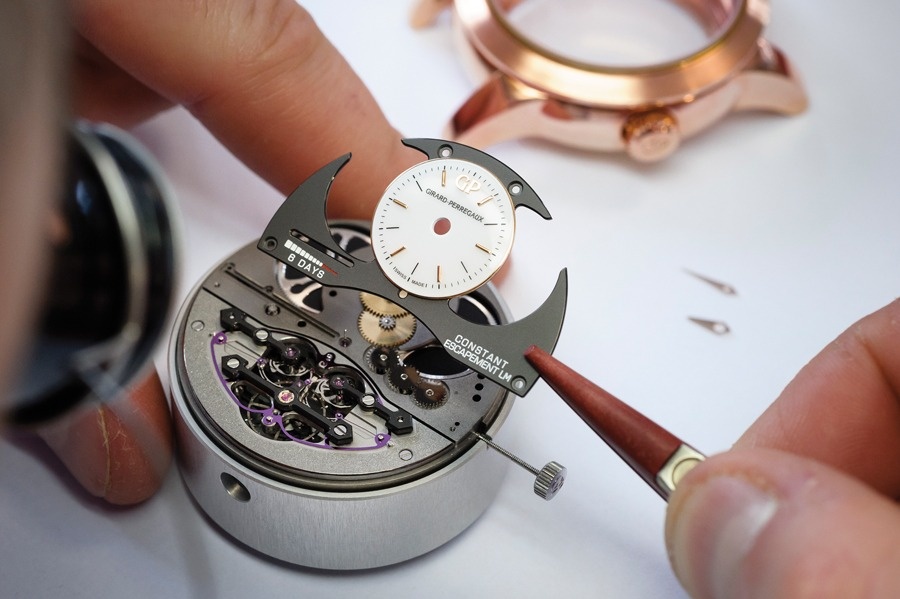
The slightly doomed crystal we also see in other of GP high end watches.
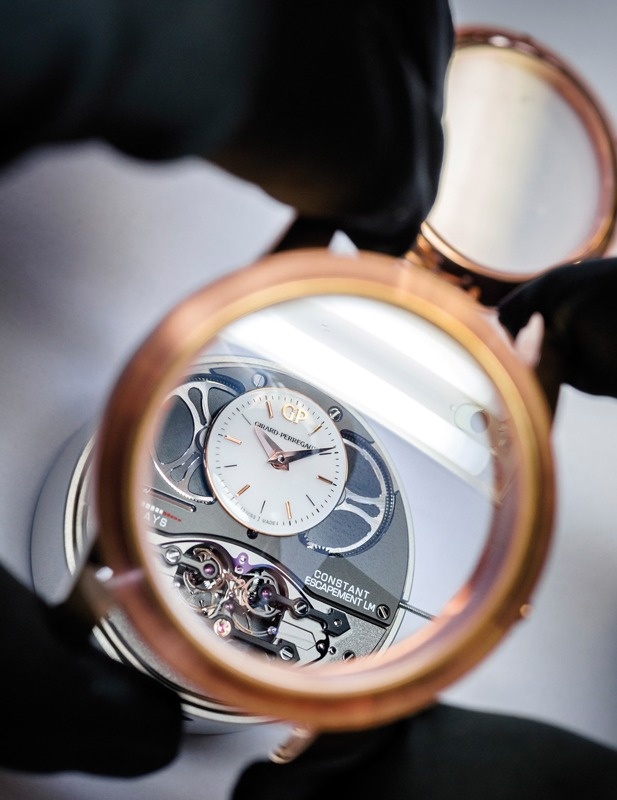
Open case back, again with a very symmetric design. Beautiful movement!
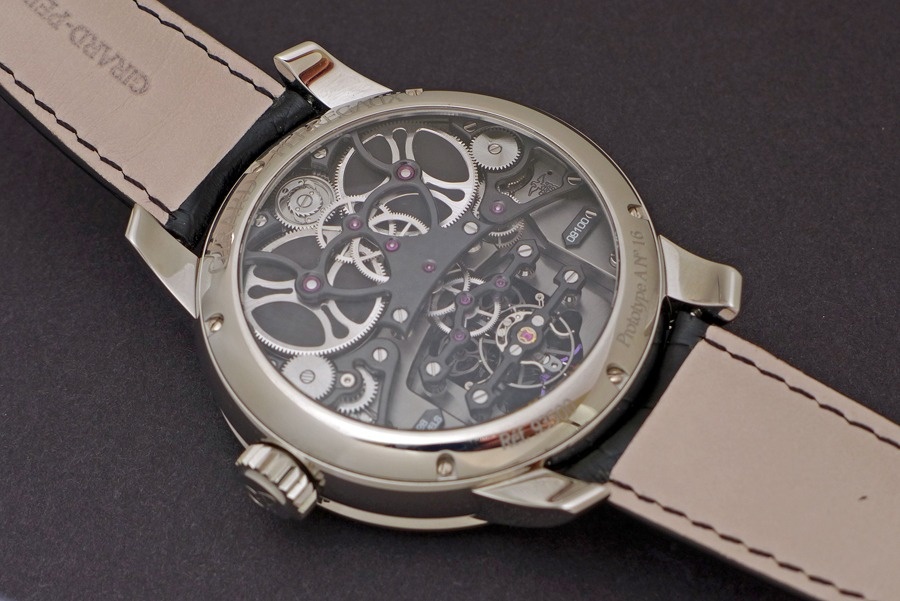
Not long ago Fx posted an comparison post of this PG version vs last year’s WG.
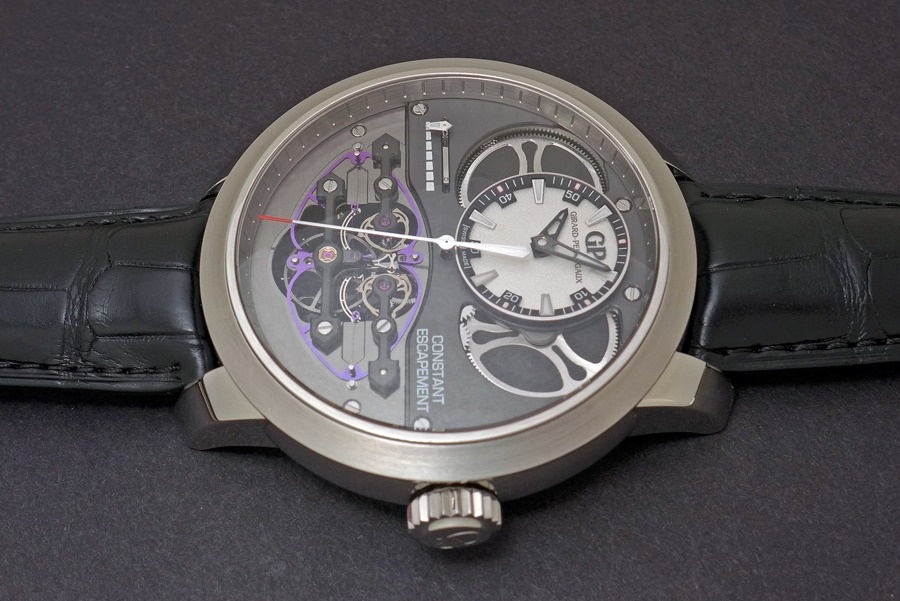
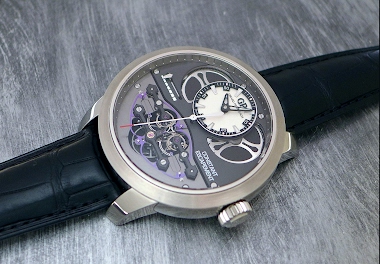
This year’s PG version.
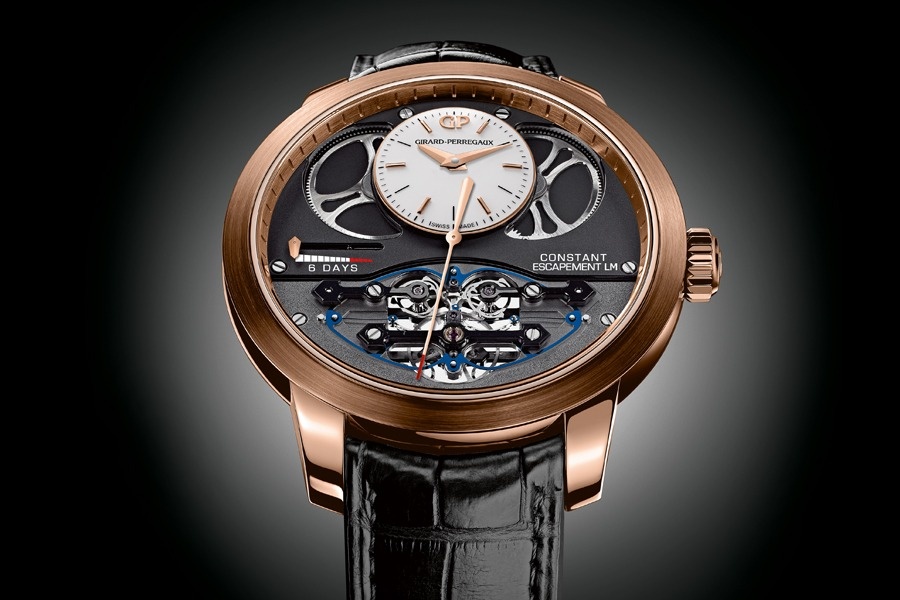
Personally I find the PG version much more appealing. It is warmer, gives a less technical impression and I much more prefer the dial on the PG instead of the WG version.
My problem with a watch this size is normally that the lugs goes outside the wrist. Due to the shape of the lugs, that is not a problem here, the curved lugs stays in good position on the wrist. I just need to learn to wear the watch higher up on the wrist so that the crown don’t eat my hand (see WS below).
Some data:
Case: 48 mm in diameter, 14.63 mm high, brushed/polished, Pink Gold.
Open case back, Water resistance: 30 meters
Manual movement GP09100-0002, 28 jewels, 21.600 vph/3 Hz, Power reserve one week.
Movement dimensions: 39.20 mm, 271 components.
Functions: hour, minute, central second, linear power reserve
Black alligator leather strap, PG folding buckle.
Winner of the prestige 2013 Grand Prix d'Horlogerie de Genève
So, which version do you prefer? Last year’s White Gold?
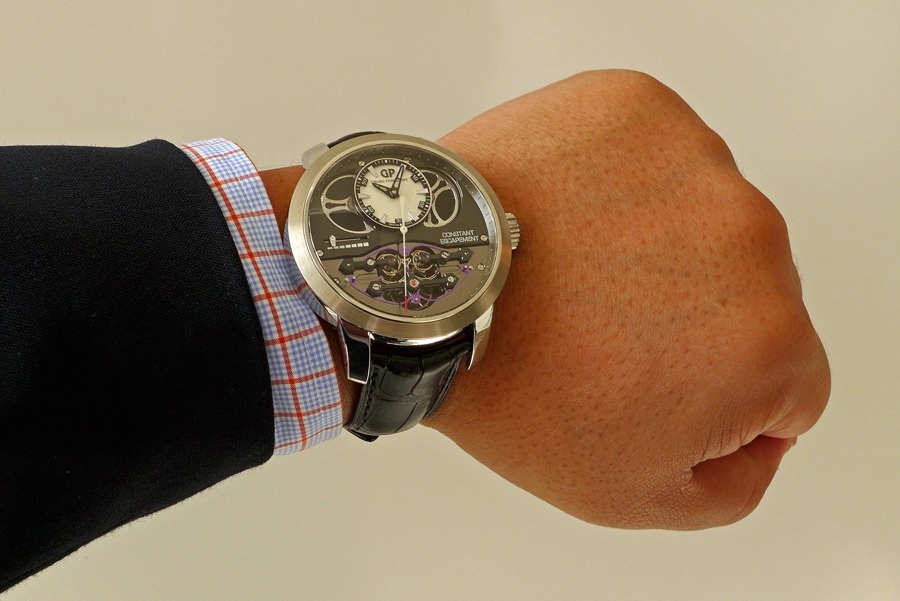
Or this year’s Pink Gold version?
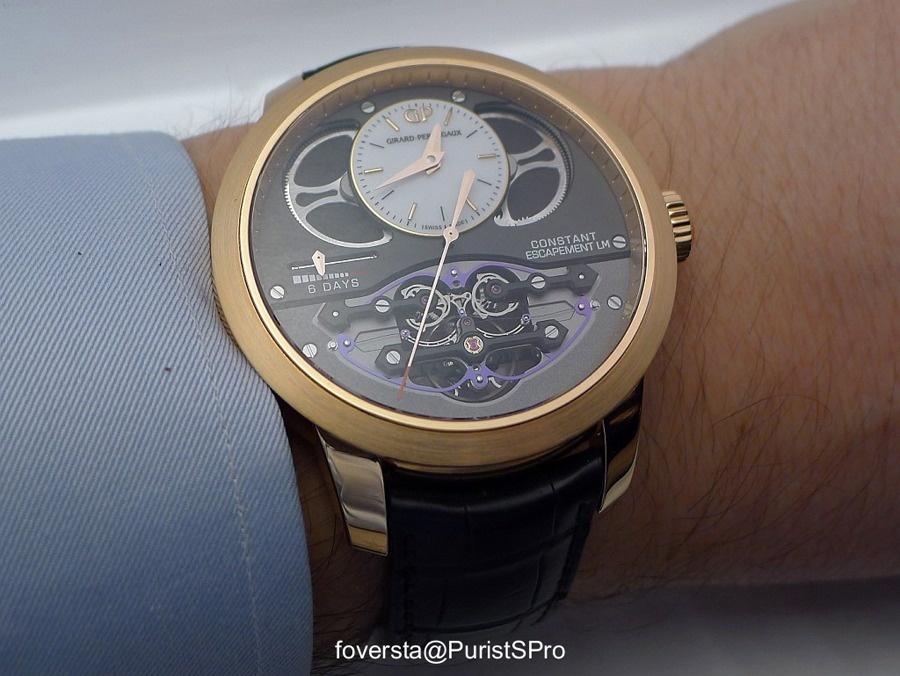
This is my first take on this fantastic
watch, when I have learned more and understand more I will surely return to the
Constant Escapement!
What also would be very interesting is to compare this watch to some of the other big brands solution to this – Holy Grail of watchmaking: the constant force.
Hope you enjoyed!
Best
Blomman
This message has been edited by blomman on 2014-05-19 11:04:02The Girard-Perregaux Constant Escapement, part of the Bridges collection, represents a significant horological advancement focused on achieving constant force delivery. This model integrates a revolutionary escapement system designed to ensure consistent energy transmission to the balance wheel, regardless of the mainspring's state of wind. It was developed over five years, culminating in its debut at Baselworld 2013.
The watch features a 48mm case, housing a movement that incorporates an ultra-thin silicon blade, measuring 14 micrometers in thickness. This blade acts as an intermediate energy storage device, flexing to an unstable state before delivering a precise, instantaneous micro-impulse to the balance. The escapement's symmetrical design prioritizes functional balance, utilizing modern materials and manufacturing techniques like deep reactive ion etching (DRIE).
For collectors, the Constant Escapement is notable for its genuine innovation in escapement architecture, a rare occurrence in watchmaking history. Its technical complexity and the use of advanced materials position it as a landmark piece demonstrating Girard-Perregaux's commitment to pushing mechanical boundaries.
First of all, I must repeat that I totally Under appreciated this Watch, when it came out, last year. I felt, on pictures, that it was bulky, way too big, and well, the a priori was quite negative. Then I saw it in th flesh, and the proportions worked for me. Ok, I would have preferred to see it 2 / 3 mm less big, but it works, on the wrist, and it works quite well! I appreciate its " intellectuality ", too. The way it deals with constant force in an original way, with the esacepement and the as
And I must confess that I have not been able to grasp all yet. The good thing is that now I have another reason to go back to the Manufacture...! ;) As I stated in the end of the review, this is my first take on this watch, I will definitely come back to this watch. Last year I was not that impressed after seeing the CE in pics, but once you see this one in the metal.... And start to understand the concept... You are in BIG trouble! :) Best Blomman
meets the eye at first glance! :) Best Blomman
Yes, the three bridges are very strong connected to the GP heritage! :) Best Blomman
This thread is active on the Girard Perregaux forum with 27 replies. Share your knowledge with fellow collectors.
Join the Discussion →