Collection
Dje's post offers a poignant reflection on the Girard-Perregaux 1966 Tribute to the Centenary Prize, a limited edition piece that holds deeper meaning following the passing of Dr. Macaluso. This article explores the watch's design, historical significance, and the community's appreciation for its classic elegance and chronometric heritage. Dje's personal connection to the timepiece provides a unique lens through which to appreciate its enduring appeal.


Six months ago
we discussed about the Girard-Perregaux annual calendar with equation of time ( gp.watchprosite.com
).
This watch is quite fascinating by its blend
of complications. It is also captivating by its simple and voluptuous beauty.
I've taken the opportunity to make
mine a simpler version of the 1966 range and fortunately I've been able
to put my hands on a special limited edition made two years ago to commemorate
the event that gave its name to the range.
I had planned to post this subject a few
days ago and share with you my pleasure of owning this special piece.
The death of Dr Macaluso this week has made
me slightly change my view on this piece. Not that I have a different opinion
about the qualities of the piece, but my eyes see it differently and wearing it
reminds me that a golden era has unfortunately passed and that the present is
now even more about writing the future. I wish to Dr Macaluso's sons, Stefano
and Massimo to be as successful and talentuous as their father, and even more
in the pursuit of Girard-Perregaux's development.
So
here is what I wrote in May to begin: "The 1966 range reminds us of the glorious chronometric past
of Girard-Perregaux.
I n 1966 Girard-Perregaux presented the first high frequency calibre beating at 36000 vph, fitted in the Gyromatic HF. This calibre created in-house by the Girard-Perregaux research and development team brought exceptional timing results and as a matter of consequence lead the State Council of the Canton to attribute to Girard-Perregaux the Centenary Prize of the Neuchatel Observatory. In fact the first production series Gyromatic HF watches sent to the chronometric competitions were confronted to specially prepared competitors.
In 1967 Girard-Perregaux received 662 certificates of chronometry from the Neuchatel observatory, i.e. 73% of those delivered in the classical wrist watch category.
The following years saw the Girard-Perregaux team develop their first quartz calibre and settle the 32 768 Hz frequency that is still used today. But that's another story….. "
So if the 1966
range is named after the Centenary Prize given to Girard-Perregaux, this
limited series of 250 pieces with blue dial and 250 pieces with a silver dial
is dedicated to the Prize itself.
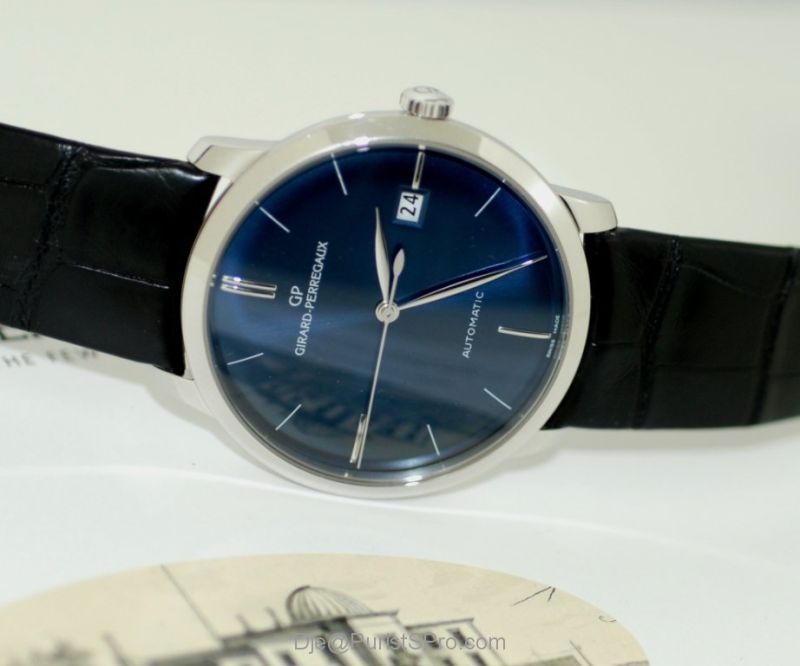
Girard-Perregaux 1966
The watch has
the standard "simple" 1966 model specifications, still with a
specific palladium case and a special blue dial that makes its main interest
IMO.
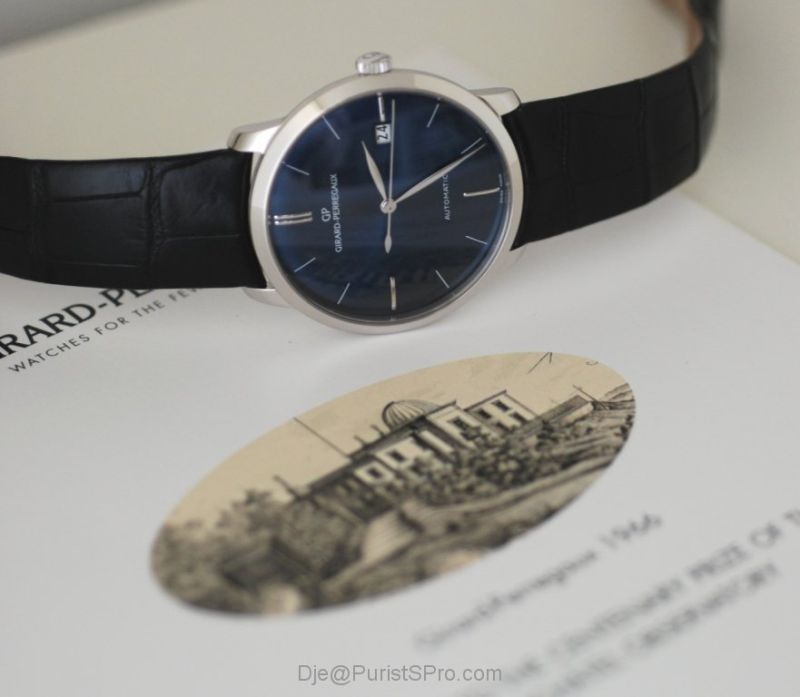
The Neuchatel Observatory
The 1966 range
was launched a few years ago already and that launch was particularly timely,
if not premonitory, to take the path of less extrovert watches. Seemingly the
great success encountered by the range (and by the comparable efforts of other
brands like Jaeger-LeCoultre or Vacheron Constantin with their simple, thin new
ranges) is a proof of the pertinence of the positioning and the high quality of
the products offered. If you doubt have a look by yourself.
In fact my
experience makes me think that simple watches need to be tried to be
appreciated, certainly more than the complicated burgers of the former years.
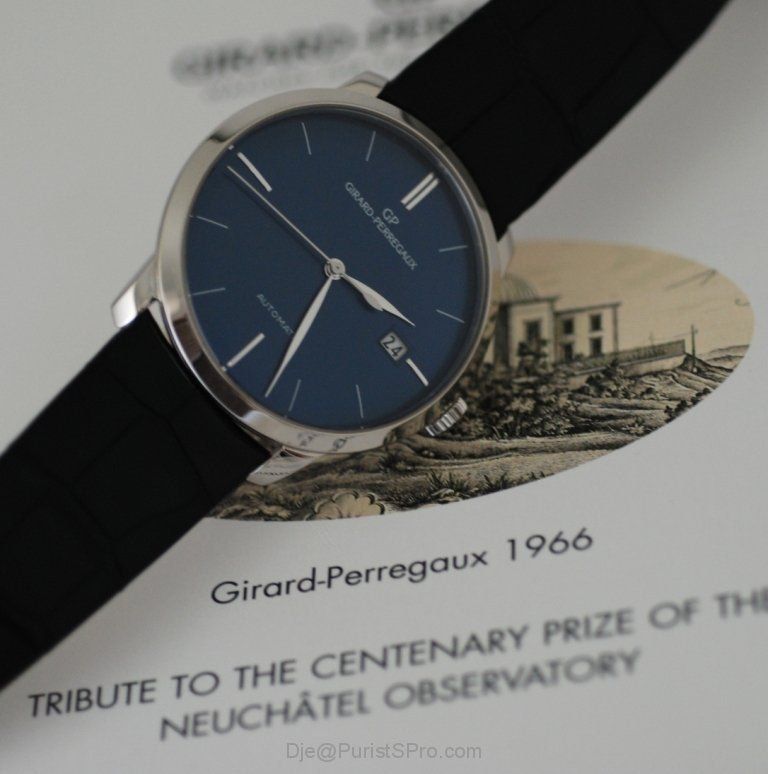
A commemorative edition
The talent of a
watch is before all to give the (exact as much as possible) time and then to
please the eyes. Well let's say that we are back to basics. The good news
is that such good simple taste is quite pleasing and refreshing. The fact and
consequence that it brings us more affordable watches is another quite positive
aspect.
The standard
white or pink gold models are indeed quite reasonably priced, of course
relatively to the unreachable dream watches we've so often seen.
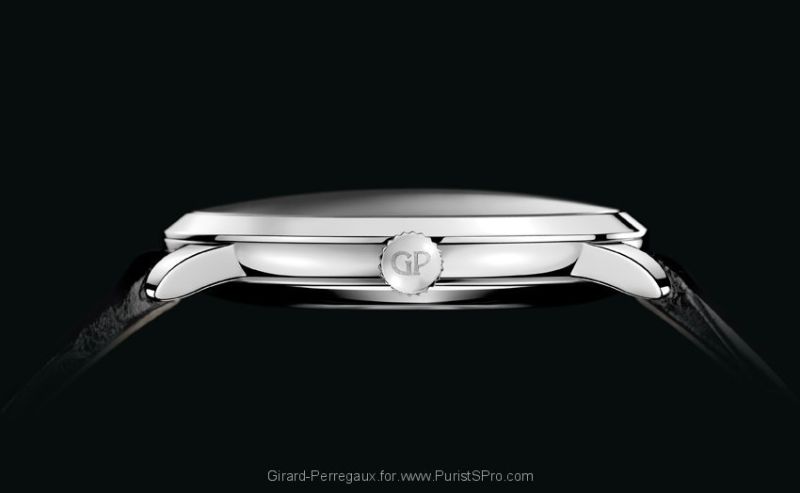
A voluptuous case
The watch is
generously sized at 38mm, and the thickness is limited. In fact I much prefer
for my moderate wrist this 38mm case to the 40mm one used for the complicated
models. A simple model in 40mm would be too much for me. I suspect it would be
too much for anybody in fact.
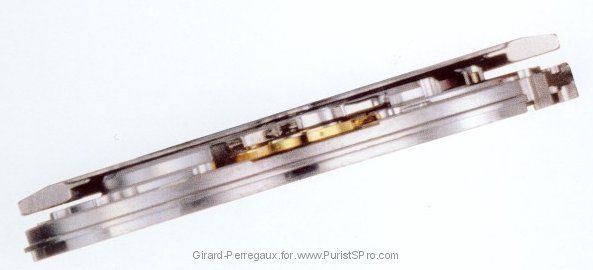
A thin automatic calibre
The
Girard-Perregaux manufactured automatic calibre is a well known and tested base
that is particularly pleasing to use as it is precise, efficient, and
harmoniously designed. The full gold rotor in pink gold adds a touch of warmth
to the piece, while remaining obviously discreet on the back.
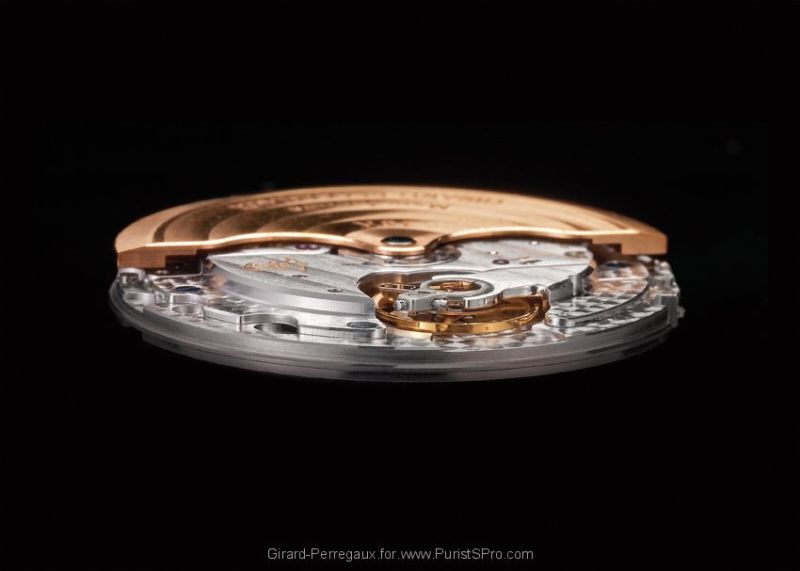
A manufacture engine
This calibre is
a thin base for many developments like chronographs, timezone watches,
complete, annual and perpetual calendars. It is also a prestigious choice for a
simple automatic watch.
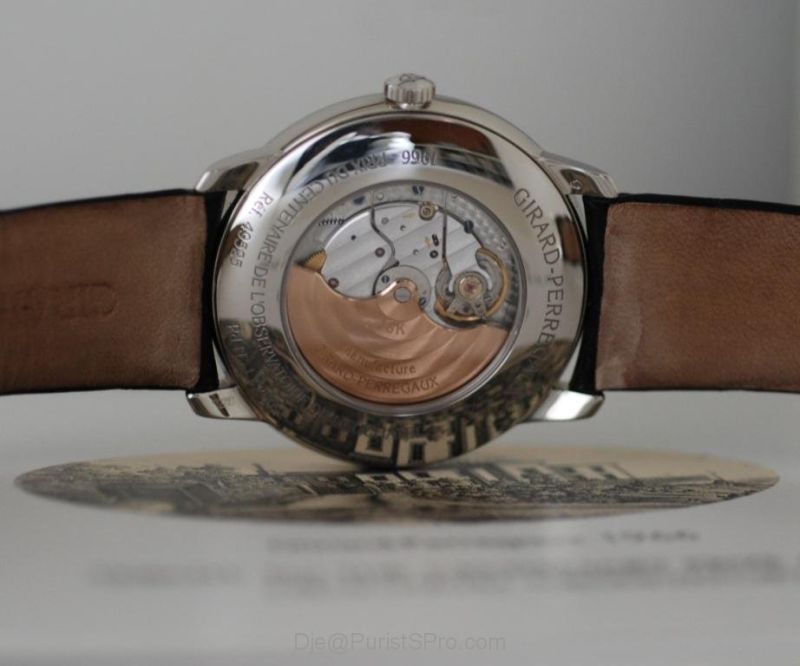
A gold rotor for a palladium case
At that time I
may remind that my 1966 has joined another Girard-Perregaux in my little
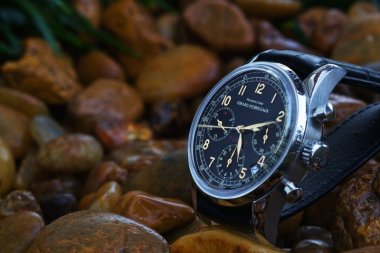
collection. You may already know my chronograph reference 4946.
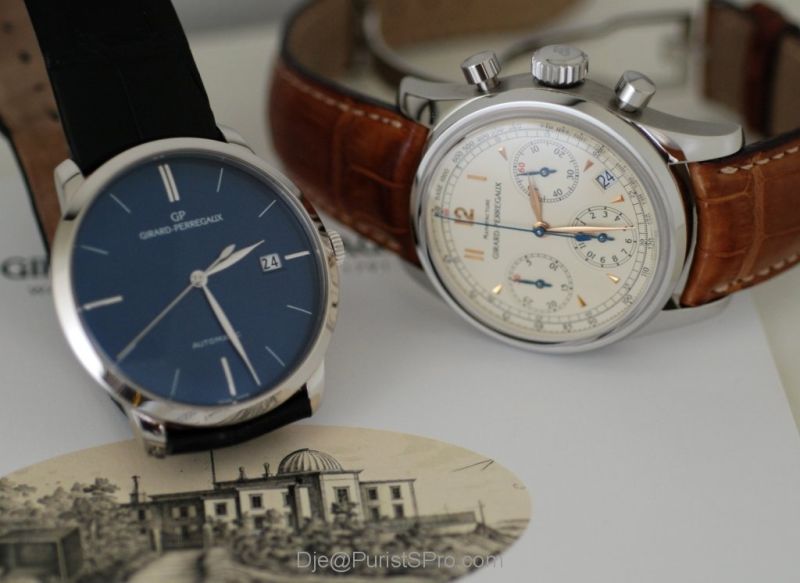
The 1966 and my 4946
Those watches
share the same base calibre under the same name. They also share one aspect
that I particularly appreciate as they have the same style of hands. Those
hands are offered on many Girard-Perregaux watches. Hands are essential as they
are in fact the most looked after of all parts in a watch. Beautiful hands on a
beautiful dial are a treat!
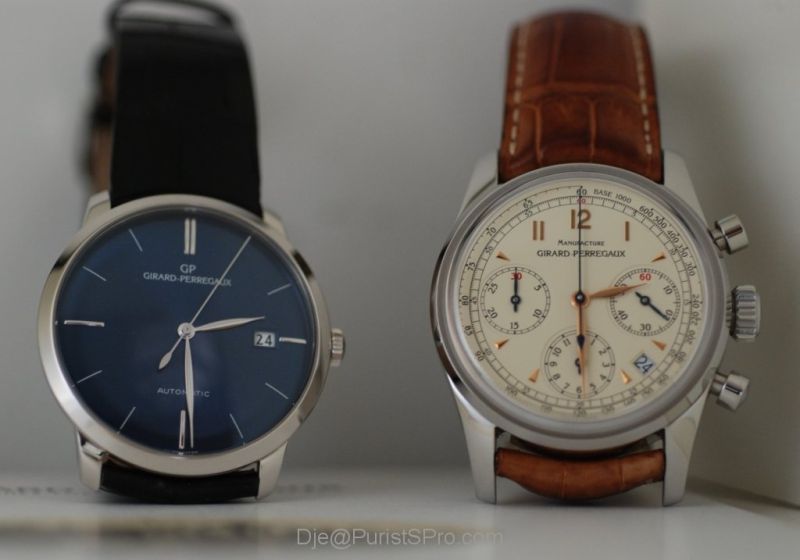
Typical Girard-Perregaux hands
Those two
watches also share the same case size of 38mm of diameter. I'm quite
happy to see a return of more moderately sized watches, and their success on
the market. The comparison between these two watches on the pictures IMO show
how the work on the case design is essential to give its character to the
piece. Size does not do it all! 
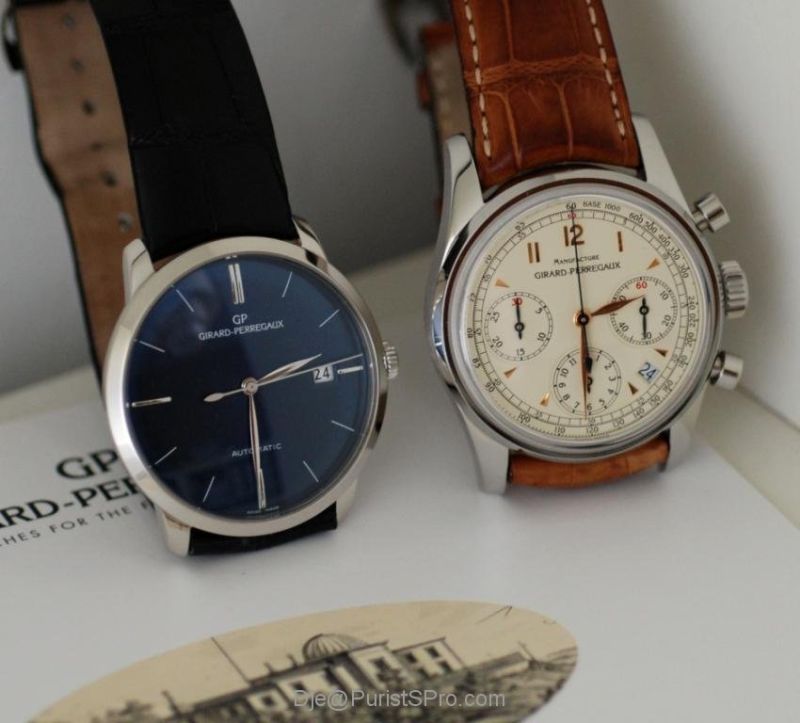
Two watches of same diametre
To end this
post I would like to emphasize my opinion that the Girard-Perregaux range
offers a wide variety of very tasty and different pieces that are
particularly well finished in conception and realization. Obviously this does
not allow a single model to embody in itself the richness of the company, and
consequently may refrain those who look for a watch that can personify a
company in itself, but is a promise of varied pleasures!
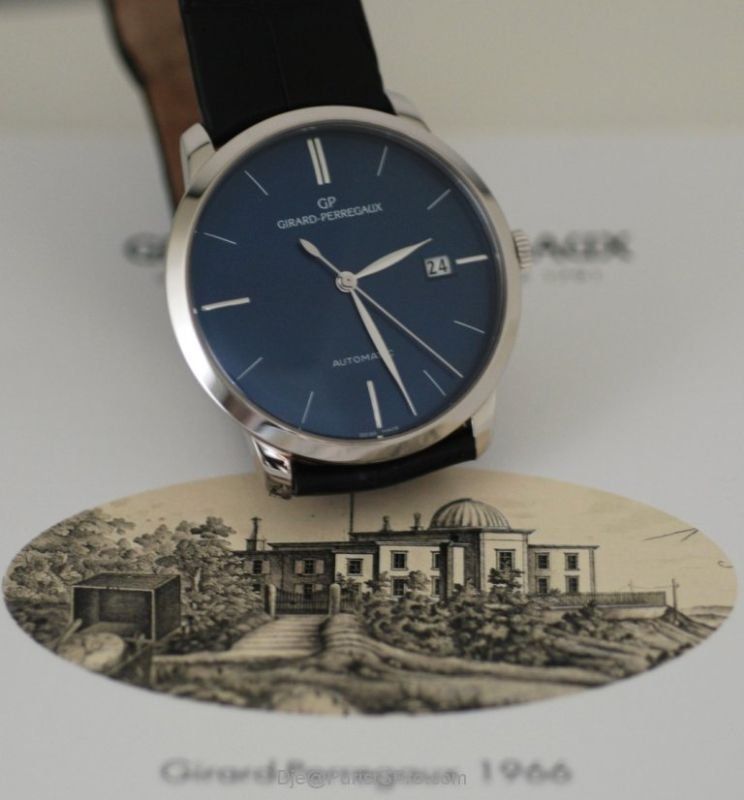
Chronometry is the essence of horology
I hope you
enjoyed the reading and have found interest in discovering even more!
Cheers
Dje
The Girard-Perregaux reference 4946 is a notable example from the brand's production during the 1960s, representing a period of design evolution for the manufacturer. This reference is characterized by its understated aesthetic, reflecting the prevailing design sensibilities of the era for dress watches. It offers a clear indication of Girard-Perregaux's approach to automatic timekeeping in a more compact form factor, distinguishing it from larger or more complicated offerings of the time.
The watch features a stainless steel case measuring 34mm in diameter, a size typical for men's watches of its decade. It is fitted with an acrylic crystal, common for watches of this period, providing durability and ease of maintenance. The timepiece is powered by the automatic GP Caliber 39, which provides a power reserve of approximately 40 hours. The dial is presented in a silver finish, complemented by a fixed bezel and a leather strap.
This reference appeals to collectors interested in vintage Girard-Perregaux pieces that embody the brand's mid-century design language and mechanical craftsmanship. Its straightforward date complication and classic proportions make it a versatile piece for those seeking a historically accurate representation of the brand's output. The 4946 offers a glimpse into the foundational elements that would influence later Girard-Perregaux designs.
I'm not used to see such blue dial with GP. A very fine watch and the 38mm is large enough due to the thin bezel and the date window position. Thanks a lot for the review. Fr.Xavier
Hi, In fact GP did also a few limited series with blue dial (but a different shade of blue) a few years ago, among those a very tempting Vintage 45 with large date and moon phases. As for the size, it is indeed the maximum for me for such a dressed and simple watch. Cheers Dje
provoking review of GP and two of my personal favorite watches. The 1966 is a great example of the creativity and technical prowess that GP has contributed to the art of watch making and the 4946 is a classic in the chronograph world. I do agree that the 38mm size in these two watches present the optimum diameter, wearing a little larger on the wrist with the open design of the 1966 and the crown and chrono pushers on the 4946 giving just the right balance. The trend back to the 38mm range is a
Palladium case, blue dial, nice proportions, great caliber, chronometric virtues... All is here, and the fact that it is a GP watch adds to the charm of this lovely time keeper. Smart, very smart choice. A watch for Connoisseur, for sure. Best, my friend. Nicolas
nt
First, it will be the opportunity to see you, then seeing a nice watch is always a pleasure! Best, my friend. Nicolas This message has been edited by amanico on 2010-11-11 22:23:44
This thread is active on the Girard Perregaux forum with 16 replies. Share your knowledge with fellow collectors.
Join the Discussion →