
Manufacture
CTCT celebrates Erwin Sattler's 50th anniversary by showcasing their monumental 8.80-meter precision pendulum clock, a testament to exceptional horological engineering. This article highlights the intricate design and construction of the world's largest precision pendulum clock, detailing its constant force, temperature, and air pressure compensation.


Big Time!
Erwin Sattler - 1958-2008
Extremely large pendulum clocks fitted to tall clock towers are a true rarity. But an 8.80 meter high precision pendulum clock with constant force, temperature- and airpressurecompensation and which only deviates from perfect timing by a few seconds a month is something unique and one that requires the application of construction techniques which are within the reach of only a handful of clockmakers.
But this was exactly the objective that manufacturer Erwin Sattler of Munich intended to obtain as a way of commemorating its 50 years of existence. Stephanie Sattler-Rick and Richard Müller took as their model for their precision clock the exceptional Clássica Secunda 1995 and augmented it to the previously unheard scale of 1 to 6.25. Moving to new premises meant that the site where this work of art would be installed could be conceived from scratch, specifically designed to house the clock. After all, this was going to be the largest precision pendulum clock in the world.
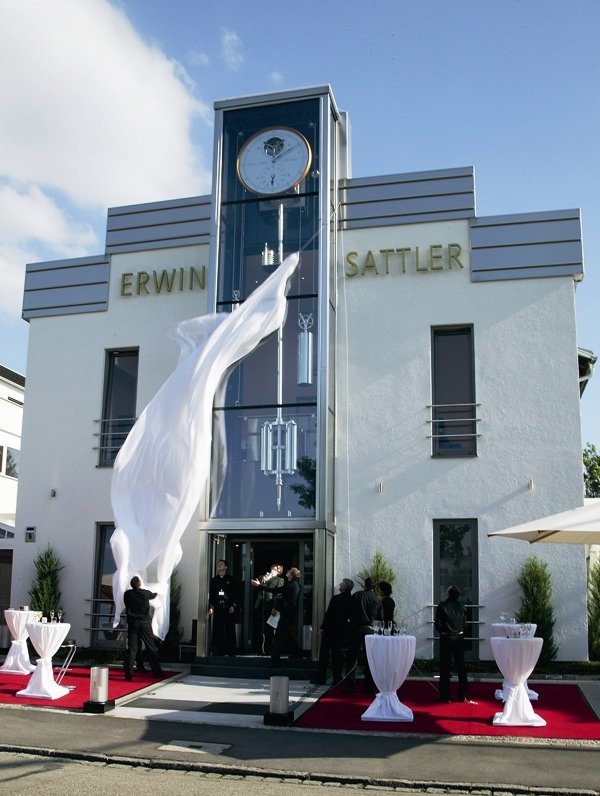
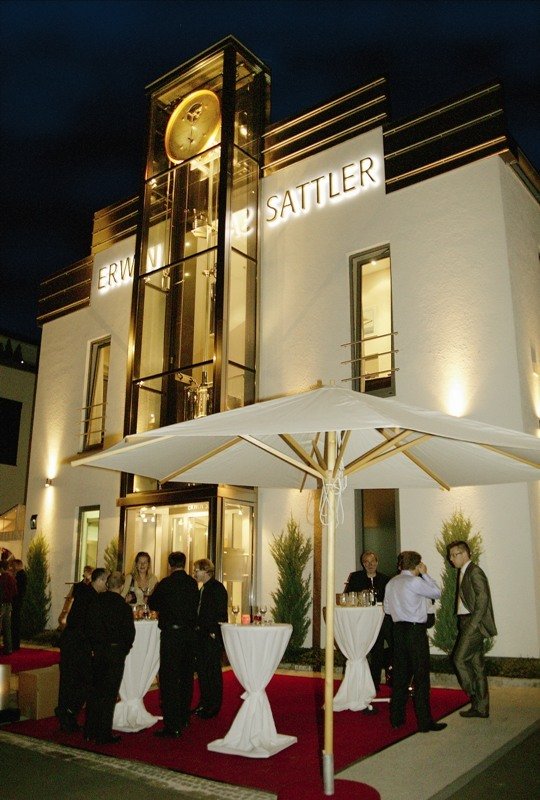
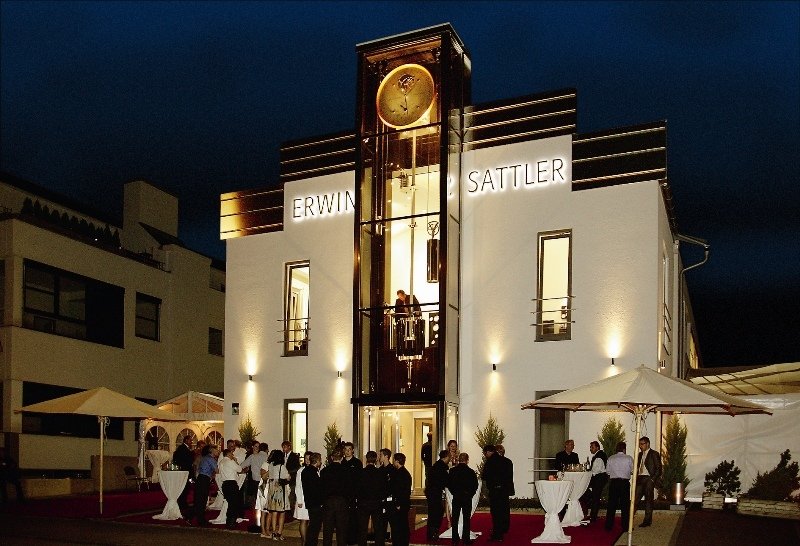
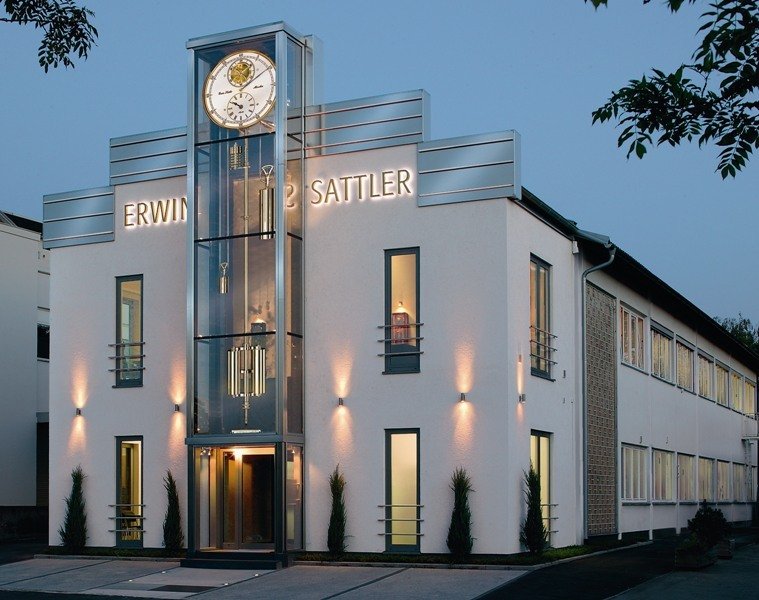
There then followed two long years of studies, research, manufacture and assembly. Over the main entrance of the company a 12-meter high and 2.4 meter wide steel structure was built specifically to house all the components of this impressive clock. Slowly the various parts were completed and assembled so that the Erwin Sattler 50th anniversary commemorations could begin. All through this process all difficulties which had arisen from this clock, considering its parts with their specific individual proportions and volume, were ironed out one by one.
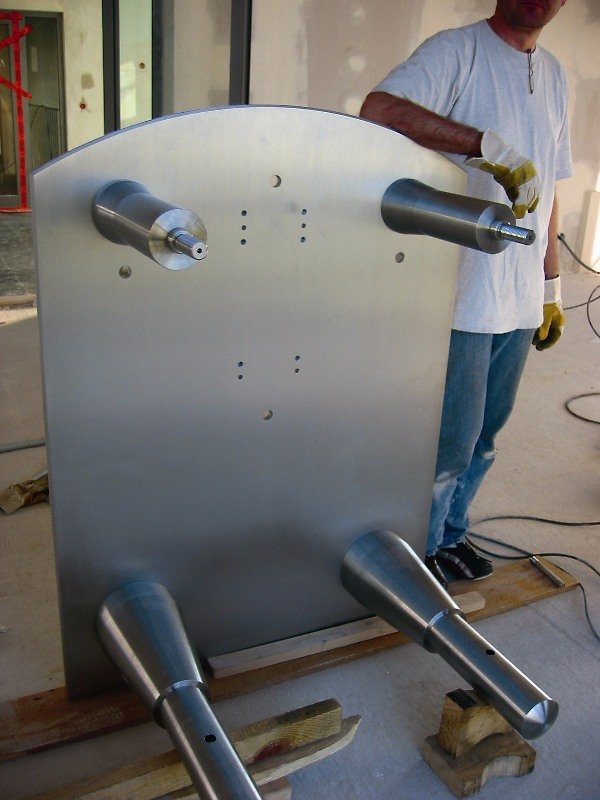
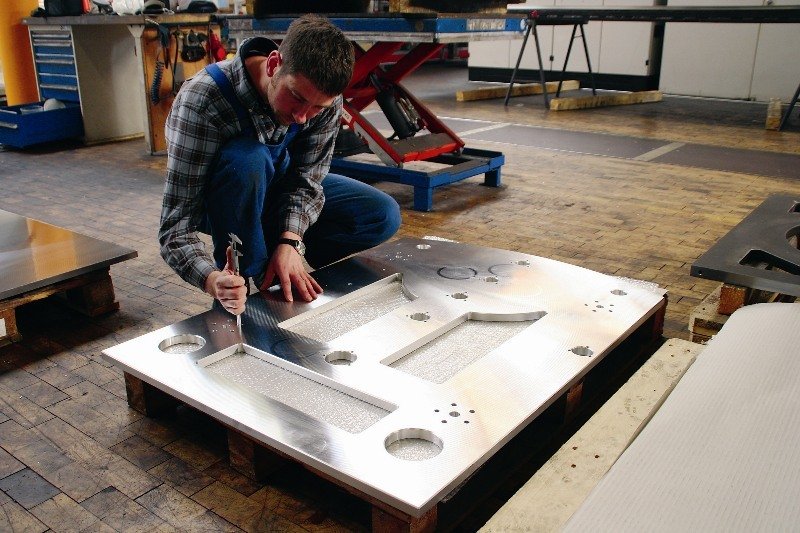
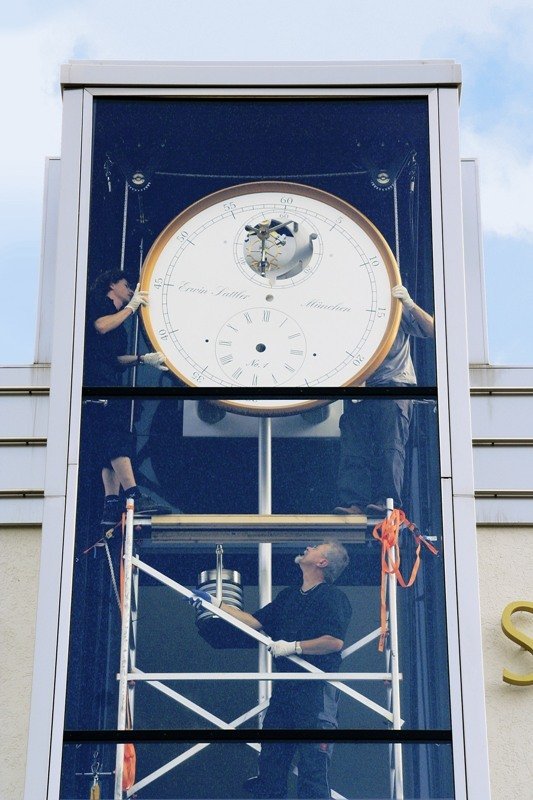
The dimensions of the composite parts are considerable indeed. The dial alone has a 160cm diameter, upon which three blue-coloured hands move in separate sub-dials in a style similar to the classic old observatory clocks known as astronomical regulators.
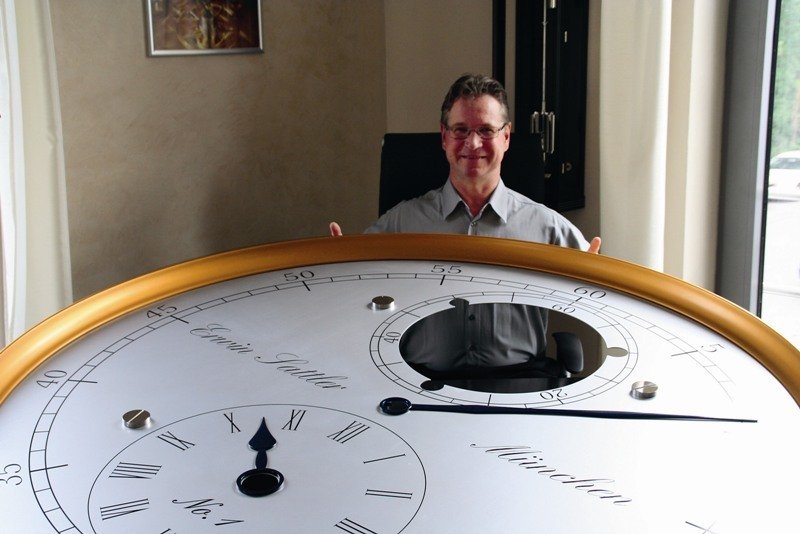
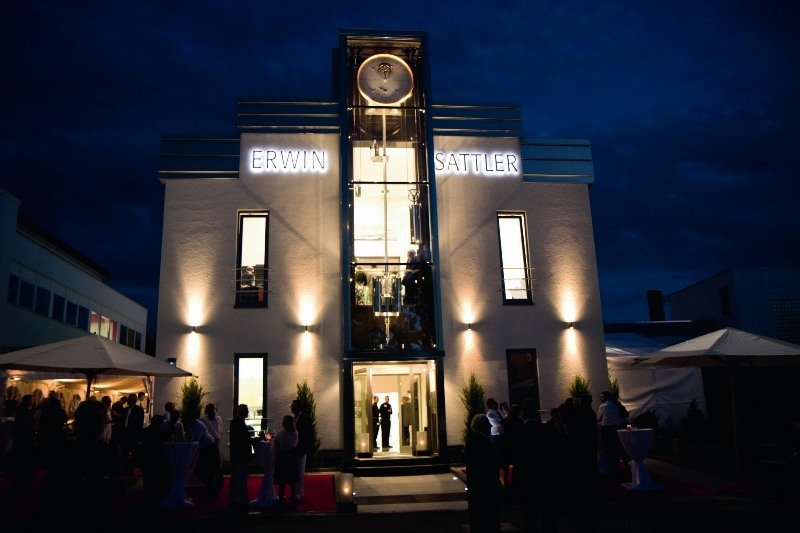
Seconds, minutes and hours have their own individual space. The tall steel case boasts unobstructed side-on views of the beauty of the movement thanks to the 13 huge glazed glass panes which with night-time illumination means that the complex inner workings - the brass milled cogs, milled teethed wheel centers and gold-plated gears complimented by no less than 36 steel ball bearings, as well as an enormous smooth ‘Graham’ escapement - are all visible through front openings cut into the dial, as well from the side glass panels.
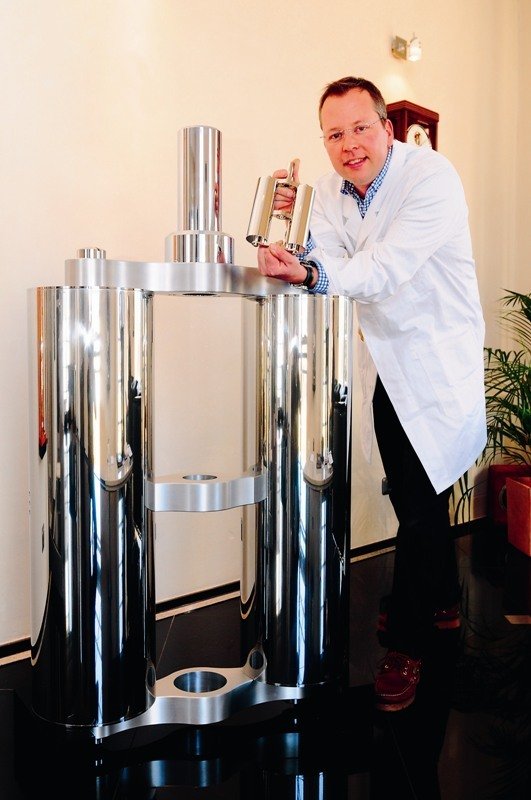
Since that a pendulum clock is only as faithfully accurate as its own pendulum, this component, so crucial for the clock’s isochronal movement, was given extra special attention.
Duly compensated to take into account the natural influences originating from temperature and air pressure variations, the pendulum was fashioned out of a mixture of various materials - carbon, brass, steel, and aluminum all in pre-determined proportions and dimensions, guaranteeing that the 7.80 meter long pendulum retains an unaltered frequency of 0.2 Hz, in other words 5 seconds for each oscillation, and is immune to any kind of atmospheric interference.
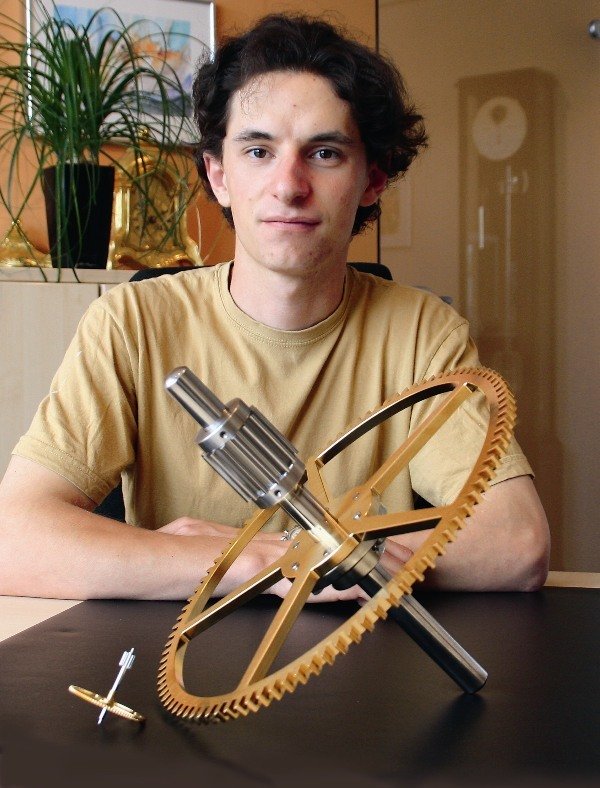
The original wheel and it´s big brother
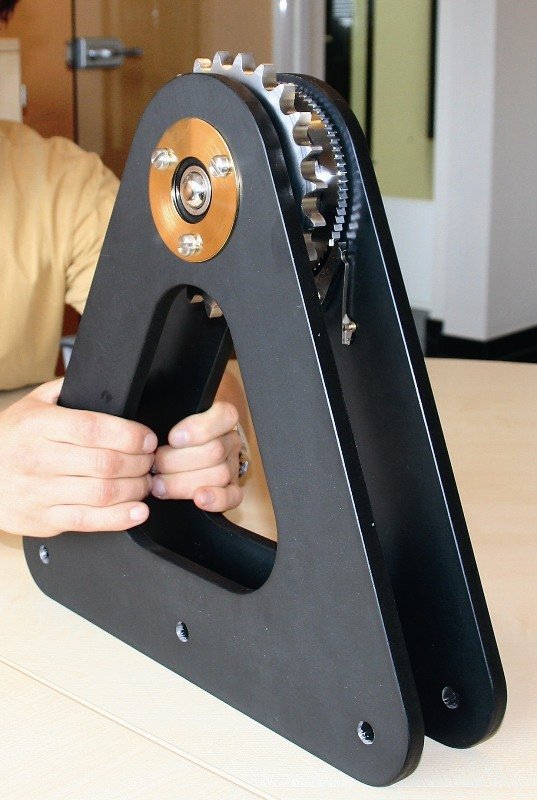
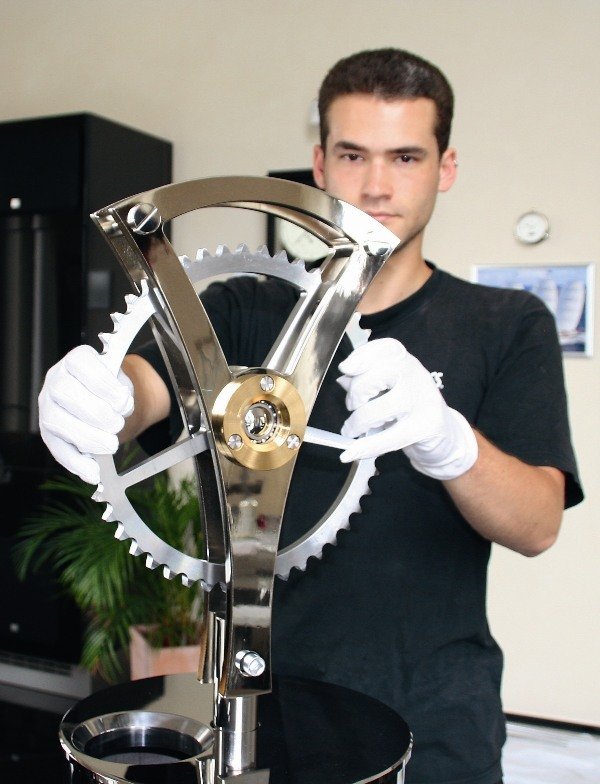
Faced with the components dimensions one could be given to thinking that some kind of auxiliary electrical system would be needed in order to power such a colossus. Even here the mechanical purity of this monumental clock remains untouched. The totally mechanical system even allows it, when it is being wound, to permanently maintain its movement, by having recourse to, once again, the creative genius of Christiaan Huygens (1629-1695), the inventor of the pendulum clock. It is basically a system of never ending pulleys - a rope-winding mechanism which only needs to be set in motion once a week - which are easily identified by the two distinct weights.
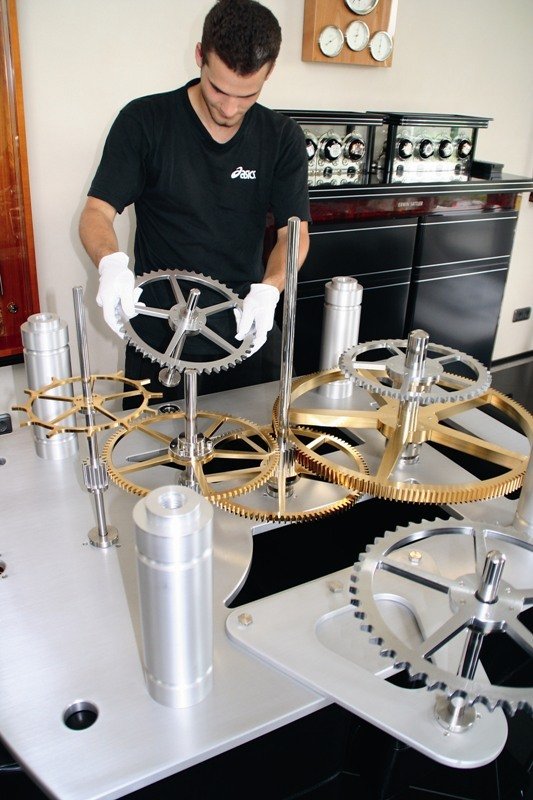
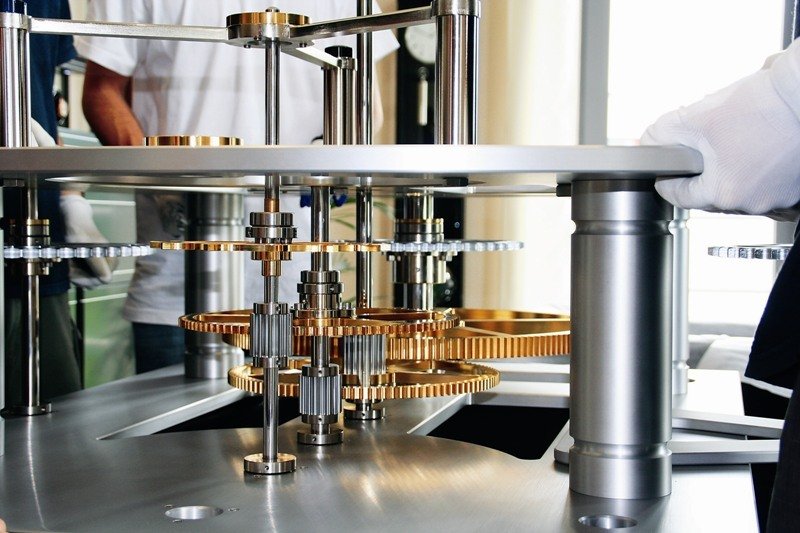
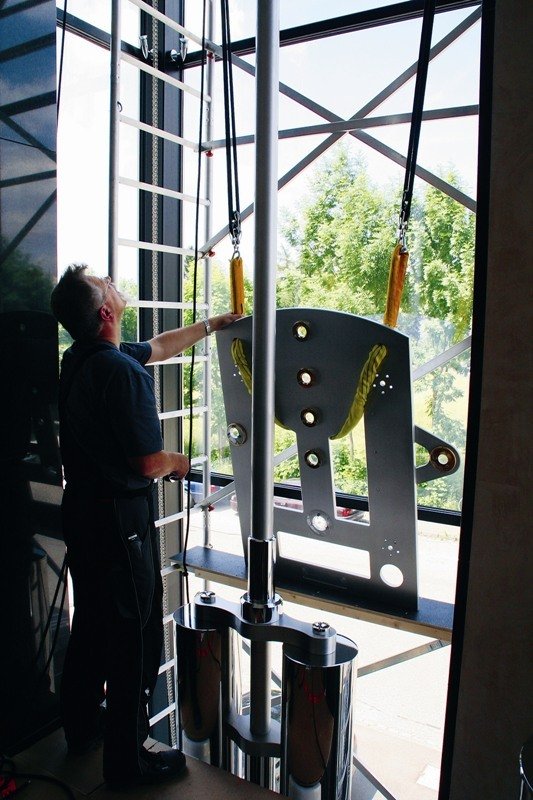
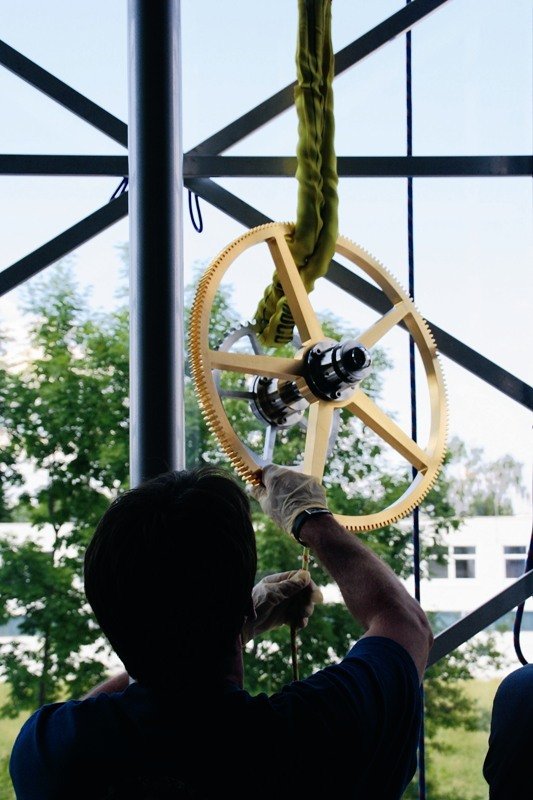
The big day finally arrived on July 26. Erwin Sattler was commemorating 50 years and the unveiling of the huge clock, by then christened the ‘Monumentum Temporis’ was the high point of the celebrations. Pulling away the cloth that covered the clock was done in the presence of the entire Sattler team and invited guests, among which were such illustrious names as Walter Lange (A. Lange & Sohne) and Kim Eva Wempe (Wempe).
The pendulum’s slow movement perfectly symbolized the passage of Erwin Sattler’s 50 years to date, even though its history actually begun a long time before.
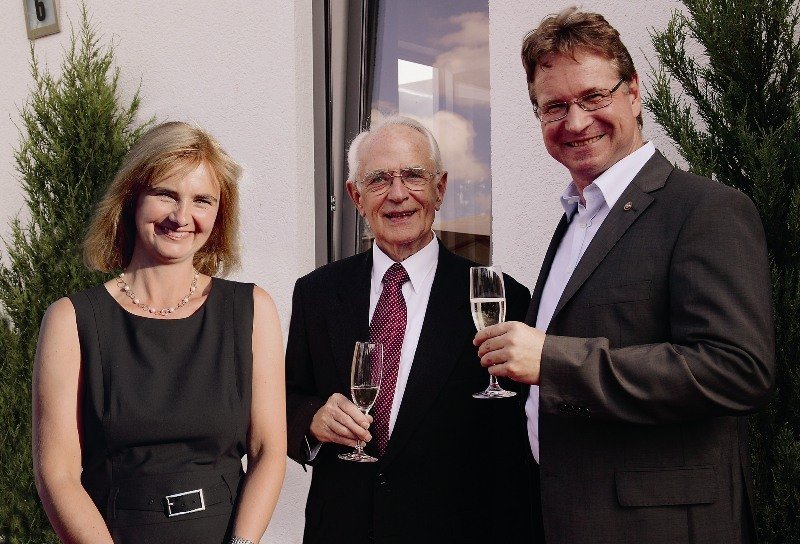
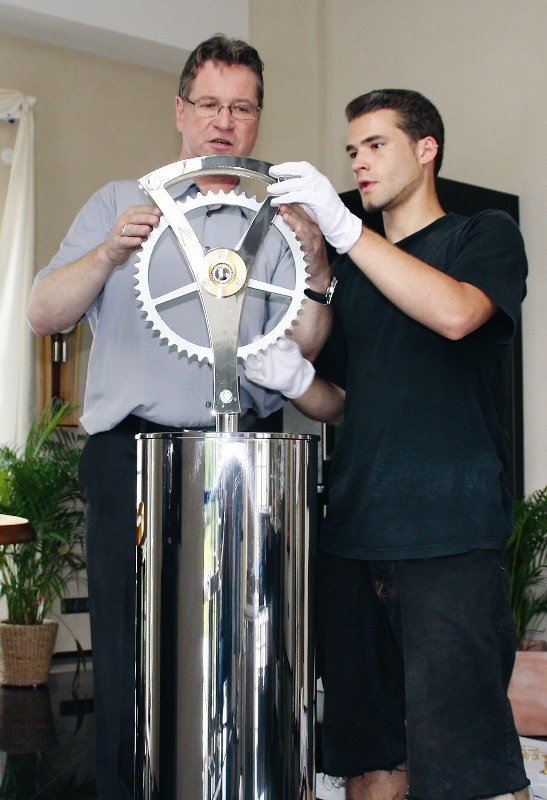
Stepahanie Sattler-Rick, Walter Lange and Richard Müller
The history of Erwin Sattler
In March 1903 Heinrich Sattler obtained the Patent Nº 163850 from the German Imperial government for his invention of a perpetual calendar system for table and wall clocks. The year 1958 marked the foundation by grandson Erwin Sattler of the company that would bear his own name. Together with his wife Viola, they produced over the next 25 years wall clocks with hand-made, artistically-decorated wooden cases. From 1979 the company went on to produce high-precision regulators that made the manufacturer internationally famous.
In 1984 the first precision pendulums with an Erwin Sattler movement appeared, conceived in collaboration with the clockmaker Robert Schleich. The models were characterized by a central ‘seconds’ movement, by the inclusion of rubies and adjusting pendulum. In that same year the clockmaker Richard Müller began the marketing and sales promotion for the company’s clock models destined for Germany and Austria.
Stephanie Sattler-Rick took over as Commercial Director, a title she still holds today. From 1990 Richard Müller became the Quality and Movement Development Director, ensuring a huge and remarkable leap of quality for Sattler. Under his leadership the first power lathes and numerically controlled milling tools are introduced. In 2002 the company became ‘Erwin Sattler OHG’, the property in equal parts of Stephanie Sattler Rick and Richard Müller. This proved an extremely productive period when the manufacturer produced more than 20 distinct mechanical movements of its own, in which more than 90 per cent of the components were produced by the company. In 2006 the manufactory produced its first system of watch winders, the year in which it was also decided to acquire new premises in the outskirts of Munich.
Finally we come to 2008, the year which commemorates the 50th anniversary of the founding of the “manufacture” by Erwin Sattler and the inauguration of the ‘Monumentum Temporis.’ Sattler is a unique manufactory in today’s clock and watch making industry in general, mainly concentrated on the production of wristwatches. Up until the present time there are only a handful of precision clock manufacturers with the prerequisite skills to make table, wall and grandfather clock movements. Meanwhile only Sattler has succeeded in striking that delicate balance between production, exclusivity and high quality. And if we consider yet that, unlike the vast majority of the remaining clock and watch industry, Erwin Sattler is genuinely and fundamentally concerned with the precision and isochronism of its movements.
In the best watchmaking tradition of the German 19th and 20th century precision clocks from Ludwig Strasser and Siegmund Reifler, where a clock achieved 0.015 seconds a day, Sattler keeps a very German spirit alive in making the best possible in the best way possible. Quality, precision, and exclusivity will increasingly be concepts intrinsically associated with Erwin Sattler.
Carlos Torres
This message has been edited by c.torres on 2008-09-11 07:13:51I love the way The Big Clock has become the indisputable focal point of the Erwin Sattler factory building. It would be great to arrive at work every day and see this symbol of corporate pride displayed so prominently above the entrance. Wonderful post, thank you. Cheers Tony P
I really thought it would be interesting for all the Purists comunity. Carlos Torres
The clock being the focal point of the building is so unique. Thank you for an excellent step by step write up of a historical occasion.The building is fabulous because of the clock! cheers fernando
Certainly quite different and I like it very much - thank you for the post! One question - curious what is being used for the various bearings in the clock? Cheers, Al
Many thanks for the report. Idle curiosity - what temperature range is it compensated for? I can image that if the "case" (building) itself isn't airconditioned you could get enormous temperature swings on a daily basis, and compensating for this is not easy. I can't imagine the entire pendulum is in invar or similar... nick
I imagine that the pendulm has such as high thermal inertia due to its size that it's more or less immune to rapid swings in temperatue, so perhaps it's not a problem. nick
This thread is active on the Horological Meandering forum with 30 replies. Share your knowledge with fellow collectors.
Join the Discussion →