Foversta's detailed review of the De Witt Twenty-Eight-8 Automatic in white gold with a blue dial offers a critical look at the brand's entry-level offering. This article delves into the watch's design evolution from the Academia case, its dial craftsmanship, and the controversial choice of movement, providing a comprehensive assessment for collectors.
The Twenty-Eight-8 Automatic is a very important watch for De Witt being its entry level. It was unveiled in 2010 and new versions were proposed in 2011, all in white or rose gold.
The elegance of the Twenty-8-Eight Automatic is based on its simplicity (no date, 3 hands with a central second hand) and the quality of finishings done on the dial and case. Among the various versions of the Twenty-Eight-8 Automatic, one particularly caught my attention: the white gold case and blue dial version.
It is without any doubt the most original of the line and the main color suits particularly well the style of finishings of the dial. The Twenty-Eight-8 case is a kind of softened evolution of the Academia case: the latter is characterized by very pronounced aesthetic features such as the design of the bezel inspired by a gear and pillars along the sides. The success of the designers was to keep this atmosphere despite the subtle evolution. The Twenty-Eight-8 case becomes more slender (its thickness is 10.3 mm while keeping a generous 43mm diameter), more refined than the Academia. The pillars are preserved but they are thinner and more numerous. The bezel is still inspired by a the gear but it doesn't have the volume feeling of the Academia even if some details in relief remain. The size of the lugs, very short, can contain the perceived size of the watch and allows even smaller wrists to be able to wear the watch.
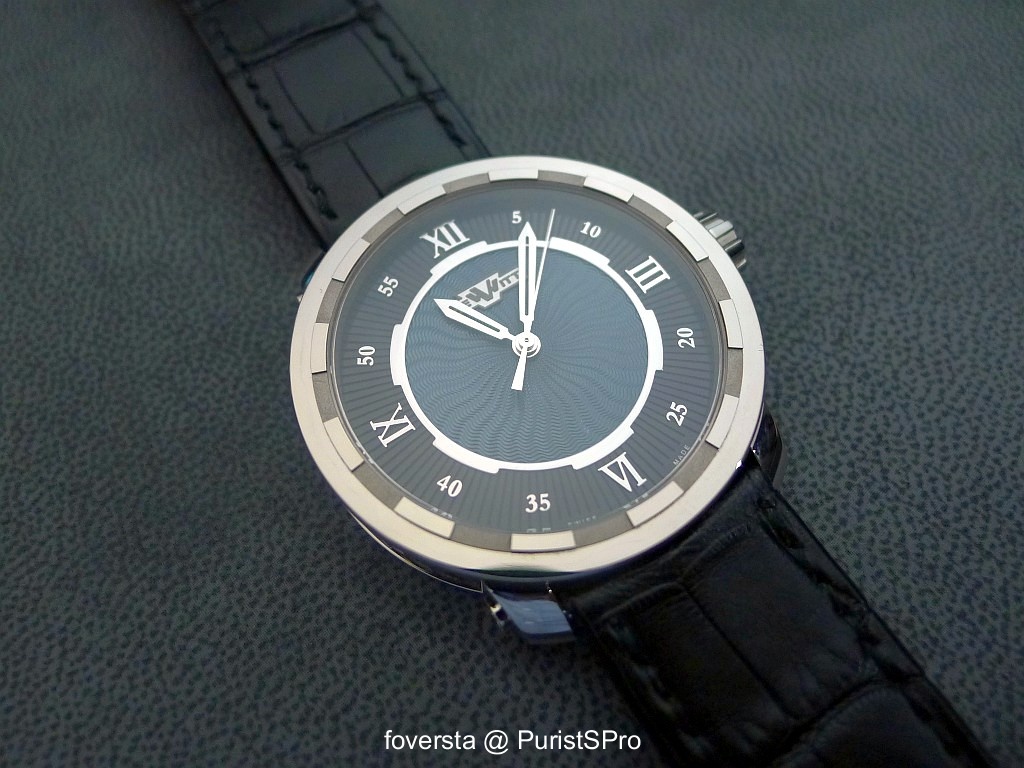
The dial is composed of several parts. The central part, in light blue, is decorated with a perfect small waves guillochage. The peripheral section is dark blue and has a fluted pattern. These two parts are bounded by a nice applied piece that takes up the bezel pattern. All is harmonious and coherent. The colors create beautiful lighting effects when they combine. The mixture light blue & dark blue leads to a sort of nice oceanic atmosphere.
To complete the design of the dial, rhodium-plated figures were applied in a somewhat surprising way. The four key figures are Roman, others are Arab. I usually do not like this type of mixture. But hopefully, on the Twenty-Eight-8 Automatic, it looks almost natural.
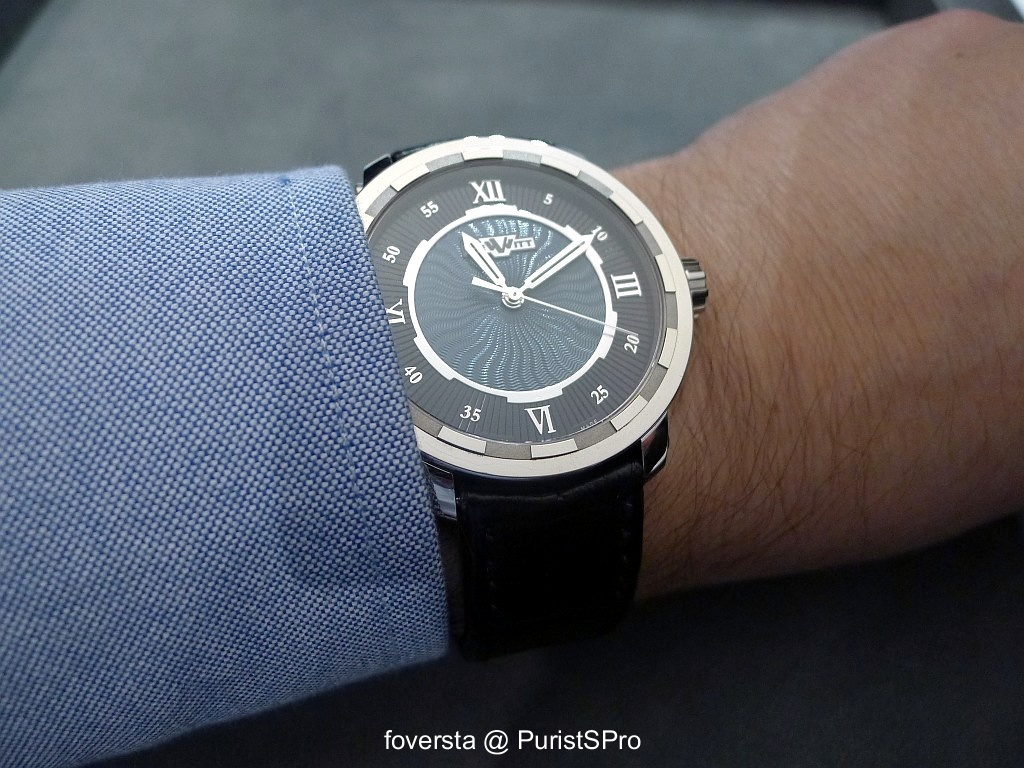
The main "sword" hands provide a very good contrast with the dial making the time legibility easy while matching well the numbers and the central applied piece. They were slightly hollowed out in order to reduce their visual weight.
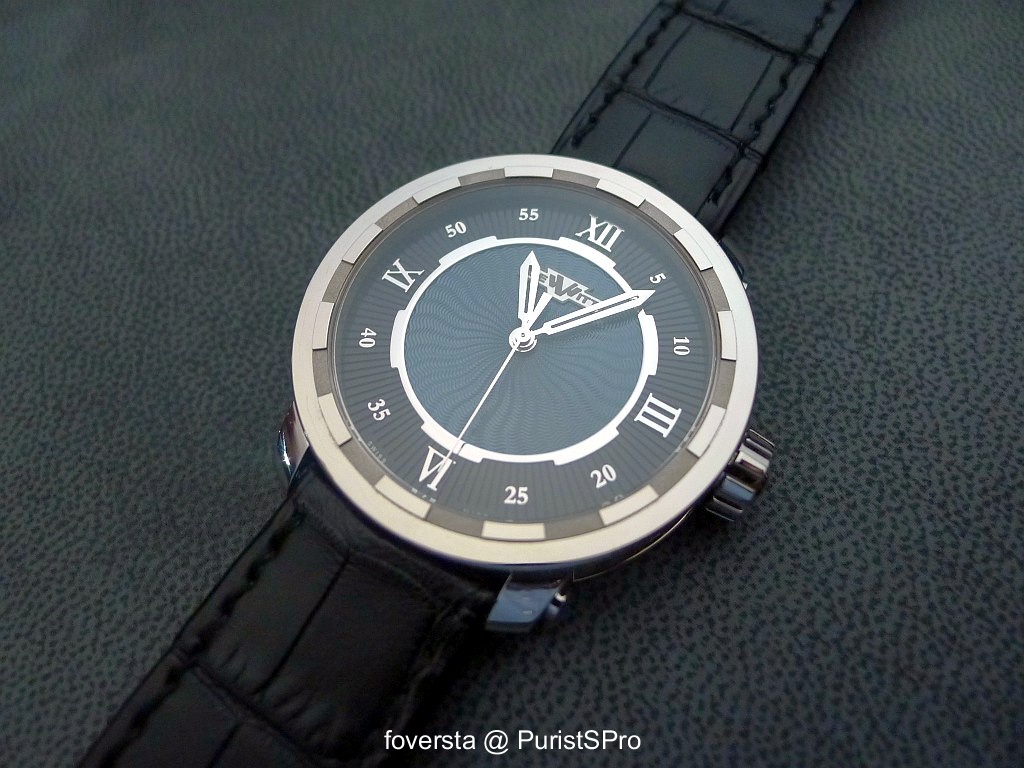
Like the case, dial gives a very favourable impression, at the same time sophisticated and simple with flawless finishes. Comfortable, very well finished and elegant, this Twenty-8-Eight Automatic has it all. All ... or rather almost everything. Because we must talk about the movement. It is not actually a big concern. But paradoxically, it is the problem. Under the terms DWT8AU the ETA 2892 is hidden. We have to thank De Witt, who, unlike many others, doesn't hide at any time the origin of its movement. And let's be honest, from the 2892 cohort of the market, it is one of the most difficult to recognize thanks to the design of the winding bridge getting a shape of propeller blades below the rotor which was developed in-house. When the rotor makes its revolution over this bridge, it creates a nice effect, like a kind of turbine in action. So it is not the performance of the movement which causes disappointment. The disappointment comes from the fact that there is a kind of mismatch between the high level of achievement of certain parts of the watch and the non-exclusive side of the movement.
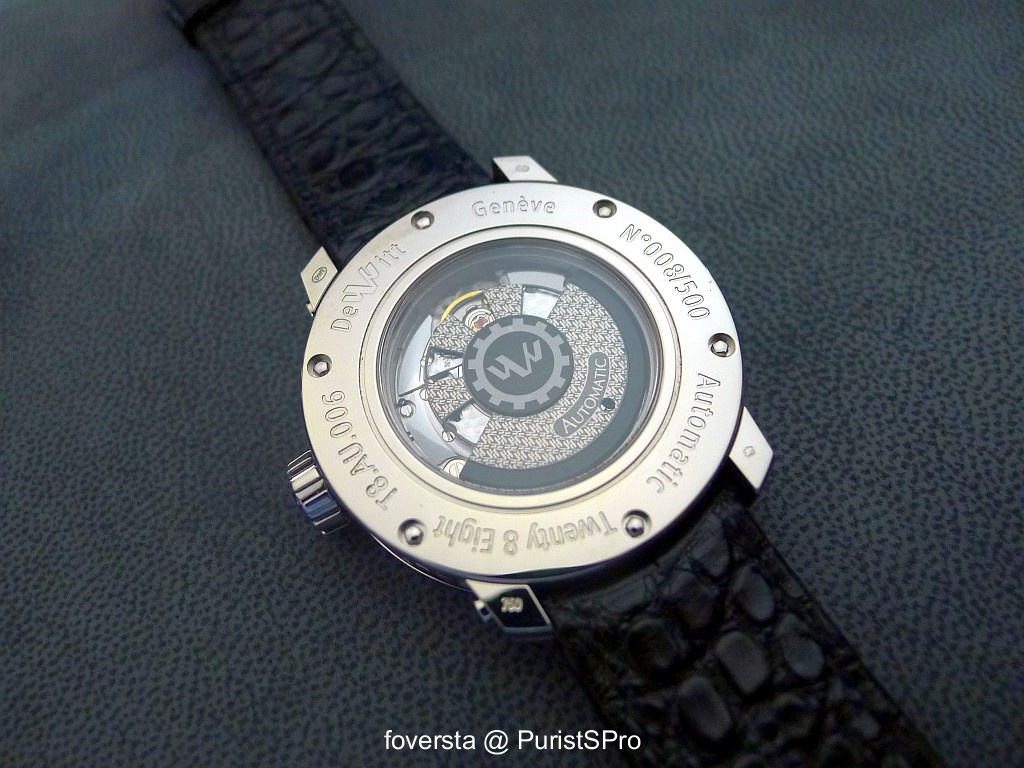
"He who can do more can do less" is surely one of the most false proverbs in watchmaking industry. De Witt gives here the proof in a certain way. Concentrated in the production of complicated movements such as the Tourbillon with peripheral oscillating rotor, De Witt finds itself in the position to use a well-known and spread movement for its simple watches. This is a bit a pity because if we look at this watch as a whole, we can consider it as a successful approach in the world of 3 hands timepieces. At the end of the day, the positive feeling remains: I was seduced by the presentation of the dial and the refinement of the case. I can imagine what would have been the result with a more exclusive movement.
I would like to thank the De Witt team for the warm welcome during the 2011 Salon Belles Montres in Paris.
Fr.Xavier


