Review
SJX's 'world's first review' of the Calibre de Cartier from SIHH 2010 offers an in-depth analysis of Cartier's bold new direction into the sporty men's watch segment. This comprehensive article, split into five parts, examines the design, movement, and market positioning of a watch that marked a significant departure from Cartier's traditional elegant aesthetics.


Launched at SIHH 2010, the Calibre de Cartier is a totally new design for Cartier and this is the world's first review of it. This in-depth review is split in five parts for easy reading.
Review of the Calibre de Cartier
By SJX
May 2010
The watch being reviewed is on loan from Cartier. It is one of the very first Calibre de Cartier watches made.
Launched at SIHH 2010, the Calibre de Cartier is a sharp departure from Cartier’s other lines. Conceived entirely as a sports, or at least sporty, men’s watch, the Calibre is aimed at a segment in which Cartier has yet to establish a significant presence.
Cartier has made sports watches thorough its storied past. The watch designed for the Pasha of Marrakesh to swim with was a notable early waterproof watch while the Santos was designed as an aviator’s watch. But because of their refined aesthetics neither of these watches or their descendants can truly be regarded as sports watch in the modern sense of the term.
More recently Cartier has presented watches like the Roadster and 21 Chronoscaph, as well as the Pasha Seatimer which features a rotating elapsed time bezel. Last year saw Cartier unveil one of its most aesthetically radical watches, the Santos 100 coated in black ADLC. All of these watches, however, are derivatives of existing designs.
In contrast, the Calibre de Cartier is a wholly new design, conceived for a particular segment. It is not a diver’s watch like the Rolex Sea-Dweller, nor a pilot’s watch like the IWC Mark XVI; instead it is the kind of watch that is entirely suitable for daily wear to the office and perhaps to the gym. It is, in short, a type of watch that caters to a very broad market.
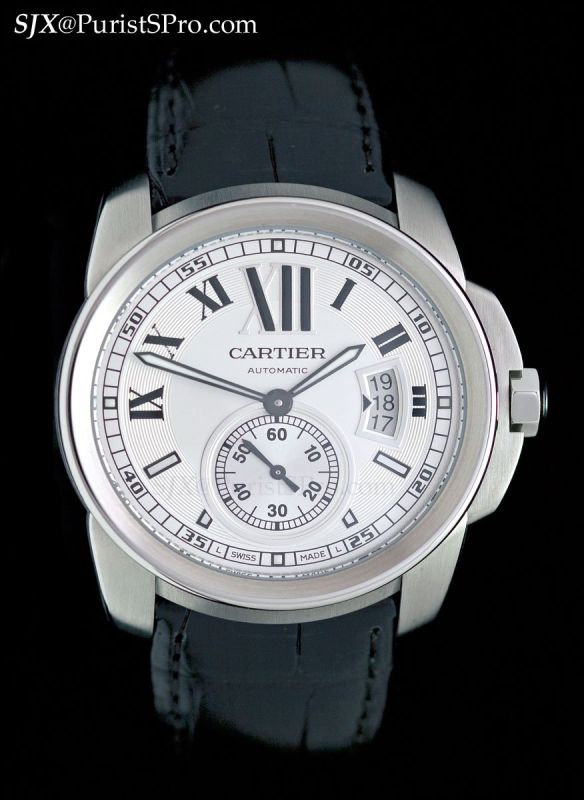
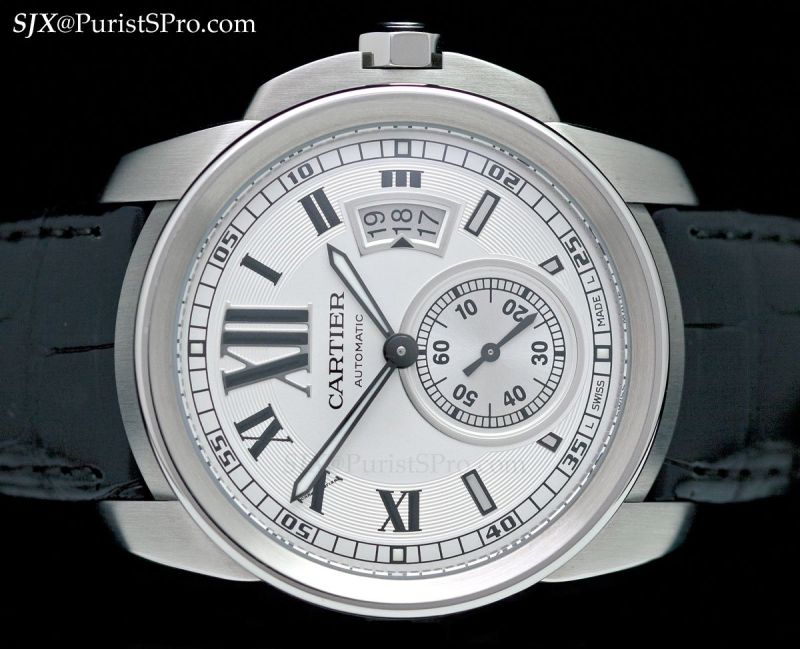
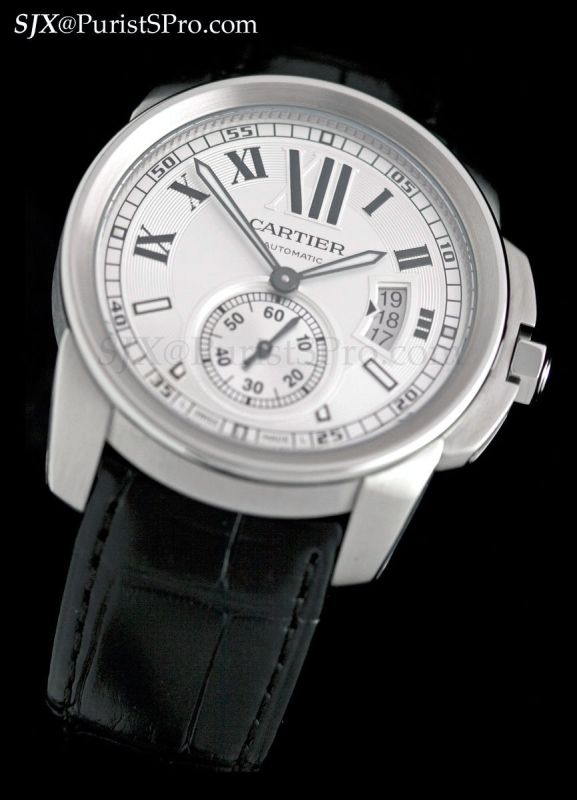
Yet this watch is hardly bland or generic. While the Calibre de Cartier retains design flourishes that are identified with Cartier, like the sword hands and sapphire in the crown, it looks and feels very different from any Cartier that has come before, primarily due to its large and sculpted case.
But what’s inside the new case is equally significant. The Calibre de Cartier uses a new in-house calibre, the 1904 MC, a simple and robust movement with evident potential for production on a large scale. Coupled with its US$6500 retail price, it puts the Calibre in a strong position relative to others in this price range.

This message has been edited by SJX on 2010-08-23 05:28:08
The Cartier Santos 100 was introduced in 2004 to commemorate the 100th anniversary of the original Santos-Dumont watch. It represents a contemporary interpretation of the historic pilot's watch, featuring a larger and more robust case design compared to its predecessors. This model positioned itself as a sportier, more modern offering within the Santos collection, appealing to collectors seeking a bolder presence on the wrist while retaining the iconic square aesthetic.
The Santos 100 typically features a stainless steel or precious metal case, often with a brushed finish and polished bezel screws. Case dimensions vary, but common sizes include a large model around 51mm x 41mm. It is powered by an automatic mechanical movement, often a modified ETA caliber, providing reliable timekeeping. The crystal is usually sapphire, and water resistance is generally rated for daily wear.
For collectors, the Santos 100 is notable for its blend of heritage design with modern proportions and construction. It marked a significant update to the Santos line, moving towards a more substantial and contemporary aesthetic. Its robust build and versatile design made it a popular choice, bridging the gap between Cartier's dressier offerings and more overtly sporty watches.
A whole new look I love the look and finish of the case. The design, especially the prominent lugs, is somewhat reminiscent of the Gerald Genta Gefica but more refined; more city than Safari. At 42 mm the watch is not enormous but possesses presence owing to the broad lugs and large crown guard. It can sometimes appear larger than 42 mm and the perception of size is enhanced by the narrow bezel and large dial. But it sits very well on the wrist thanks to the curve of the lugs. The width of the c
Fantastic photos as usual. Great Work Always a pleasure to read your articles! Thanks for this sharing. I am a bit suspricious for this Cartier. For me a Cartier is a watch like no other. A tank, a tortue and more recentyle a Ballon Bleu are unique watches, nothing can be compared. Their style is directly recognized as Cartier. Something really unique in the dress watches. The comparison is a bit dared but like Panerai in sport watches. I am not fond of Ballon Bleu but what a fantastic design. I
First, Cartier wanted a case that is totally different and distinctly masculine. They succeeded in that. Second, I agree that it does not look like a Cartier in terms of how the consumer sees Cartier today. But with time, and with line extensions to beef up the Calibre de Cartier range, it is very possible the Calibre de Cartier will become a watch that is a Cartier, more than it is a watch, just like the Tank and Santos. - SJX
As for me, I keep my point of view for the moment, I see a watch not a Cartier. The Santos 100 was a good example to succeed in doing a casual watch with keeping Cartier style. The mystery version is just amazing. So modern, so Cartier at the same time. Cheers Francois
The new look continued Of the entire watch, the dial design leaves me the most conflicted feelings. It is a strong and distinctive design that incorporates some stylistic elements that are conventionally associated with Cartier. Though overall design is handsome, some of the details are not to my taste. Like the case, the finish on the bezel is careful and well executed. It is concave with a brushed inner ring and a polished top and outer edge. While the visual effect of the concave bezel is ple
I was thinkiung more allong the lines of UTC, in fact it could have been. Parhaps with the sub secconds as date? But think a "pano date" display might have been intreguing to. Might hab\ve been to bold though ...
This thread is active on the Cartier forum with 50 replies. Share your knowledge with fellow collectors.
Join the Discussion →