
New Release
Pingtsai introduces the Limited Edition Bulgari Roma, a timepiece celebrating nearly four decades of innovation and timeless modernity. This article explores the watch's design philosophy, rooted in ancient Roman imperial coins and its evolution as a pioneering force in watchmaking since its 1975 debut.
Bvlgari Roma: A Contemporary Icon Carves Out an Imperial Path Through the Decades
A limited, numbered series expressing timeless modernity
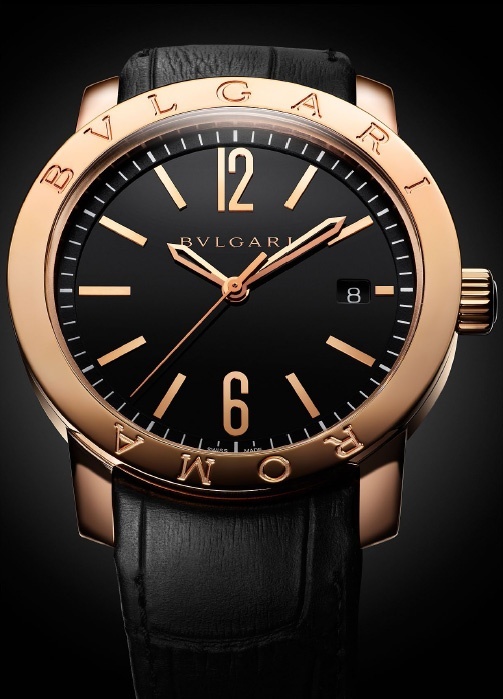
It has crossed several decades, survived society’s numerous upheavals and remained resolutely free of constantly changing trends. As imperial as ever, Bvlgari Roma is still as inherently up-to-date and contemporary as the day it was born. Its rebirth in 2012 celebrates almost four decades of innovation and modernity.
The emergence of Bvlgari Roma in 1975 signaled a complete break with the prevailing watchmaking conservatism, under the impetus of the Bulgari family that was keen to shatter standard conventions while boldly proclaiming its roots.
The new creation was inspired by ancient Rome, when emperors chose currency as a means of asserting their sovereignty. Struck with their profile and their reign name, coins symbolized authority, strength, power and character. Bvlgari Roma thus featured a bezel bearing the name of the House and proclaiming the origins of its roots in the Eternal City. These elements became an integral part of the overall design within a formal approach focused on the geometry of the cylinder. It highlighted a sense of purity, understatement and refinement, while evoking the architectural heritage of ancient Rome.
Bvlgari Roma proved a true watershed in the mid-1970s, playing a pioneering role in the watchmaking world; laying a new milestone in the history of watchmaking trends; as well as heralding a dynamic that would later be widely followed in vibrant testimony to this model’s iconic strength.
From that point onward, the Brand signature belonged firmly to Bulgari. The House set the finishing touch to its symbolic and stylistic use by introducing Bvlgari Bvlgari in 1977. In line with Bvlgari Roma, the double logo established itself as a style standard on a model that represented far more than just a watch, conveying a number of underlying values relating to architecture, social symbolism and aesthetics.
The line testifies to the eras it has swept through in its journey to the present day. Initially a symbol of creative boldness, the model subsequently embodied absolute luxury, before acquiring the rank of a subtly refined watch. Across the decades, the doubly engraved model has borne witness to a paradoxical power: the line has varied only slightly through almost imperceptible touches, thus remaining entirely loyal to its foundational design codes while nonetheless remaining undeniably modern. Watchmaking history offers very few comparable examples of models born in the 20th century and that remain as on-trend as ever.
The theme of the signature on the bezel paved a new path for horological creativity, convincingly demonstrating that pared-down simplicity may encompass an infinitely complex range of essential values discreetly expressed through design.
This creation embodies the stylistic vibrancy of the Rome-based House. 2013 brings a fresh tribute to a truly iconic line of which Bvlgari Roma is the emblematic historical representative.
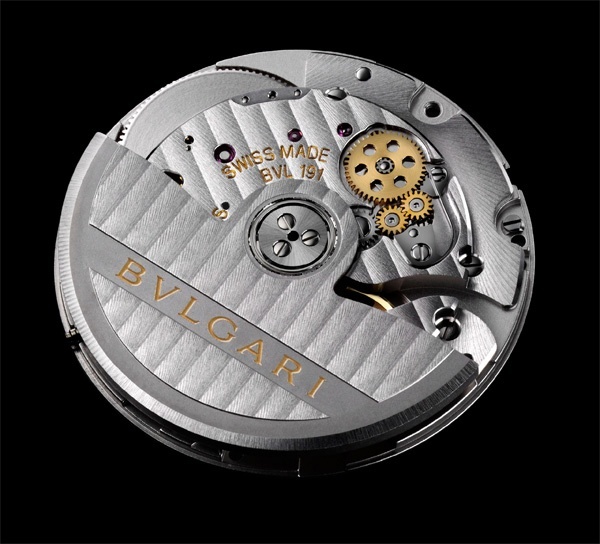
Its excellence is accentuated by a proprietary self-winding movement. Entirely in-house developed and produced, it is housed within an elegantly curved 18-carat pink gold case teamed with a black alligator leather strap, Bvlgari Roma will be issued in a strictly limited and numbered 250-piece edition.
Specifications
Movement - Calibre BVL 191 - Mechanical calibre with automatic winding via a ball bearing-mounted bidirectional oscillating weight; 11.5 lignes; 28,800vph (4 Hz); hours, minutes, seconds and instantaneous date; 42-hour power reserve.
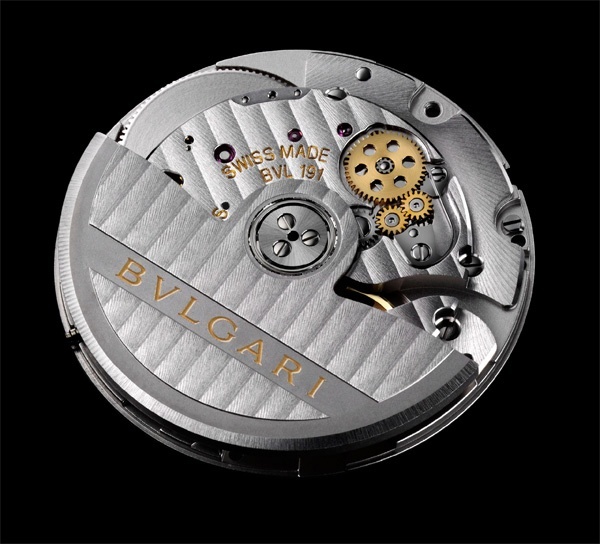
Dimensions & Jewelling - 26.20mm x 3.80mm; 26 jewels.
finishing Côtes de Genève, snailed and sandblasted decorations; bevelled and polished bridge rims, circular satin-brushed wheels, burnished pivots, chamfered sinks; domed and polished screw heads.
Power Reserve - BVL 191: 42 hours
Dial - black lacquered, facetted rhodium or 18k pink gold plated hour-markers
Case - finely crafted case in 18k pink gold, screw-locked crown and screw-down case-back
Strap – black alligator leather strap; gold pin buckle
The BVLGARI ROMA is immediately recognisable as Italian and there is a family resemblance of the dial to the BVLGARI OKTO introduced last year. It shares the same controversy about the small date window that is limited by the length of the baton markers. Even though the design may be timeless, eventually the passage of time will bring on presbyopia and the date will be illegible to mere mortals. I venture again that the best symmetry could be achieved with no date display. In our world of PDA an
...you had a whole explanation about the small date :)
My brain can rationalise the design process. My heart prefers the cleaner dial without date because I also believe that form should follow funtion. If you cannot read the date anyway, why bother putting a small display there? Regards, MTF
This thread is active on the Bulgari forum with 4 replies. Share your knowledge with fellow collectors.
Join the Discussion →