
Manufacture
Pingtsai delves into Bulgari's sophisticated Champlevé enamel technique, showcasing the intricate four-month process behind their exquisite Diagono dials. This post highlights Bulgari's evolution towards true manufacture status, blending impressive mechanics with stunning aesthetics through age-old European craftsmanship.
Champlevé, Bulgari-Style: A Four Month Process to Create An Exquisite Dial
Recent watch releases by Bulgari have displayed some of their best dial work to date with intricate hand engraving and miniature hand painting. The efforts have been more than impressive and have added more of a craftsman-like element of appeal to the dials of their watches, giving depth to its traditionally commercialistic approach.
The Serpenti and other tubagos bracelet watches require great skill to create and craft. However the manner in which they were marketed and matched with quartz movements reflected a more commercial approach. With the recently released Commedia Dell’Art and Il Giardino Tropicale watches, matching impressive mechanics with equally stunning aesthetics, Bulgari is finally embodying the meaning of being a true manufacture.
An Age-Old European Technique
Bulgari continues to expand upon its masterful dial creating skills with Champlevé enamel work, or inlaid enamel, present in the most recent Diagono Moonphase and Tourbillon dials. It is a technique that has been known since ancient times. Champlevé appeared in the West around the 11th century, and was practiced especially in Limoges and Cologne, which became the European centres of champlevé. Beginning in the 12th century and continuing through the rest of the Middle Ages, Limoges was the capital of champlevé enamel on copper, which became extremely popular. Orders poured in from all over Europe.
Champlevé always implies a close bonding between the metal and the coloring substance. The champlevé technique consists of carving cavities into the metal to form the desired aesthetic motif. The design is transferred with a hard lead pencil or dry point engraving tool. The idea is to place the coloring substance in the depressions created for this purpose, the size of which is on the order of a half-millimeter. These cavities are carved with extreme accuracy. Traditional champlevé seeks to achieve a perfectly smooth surface.
A Multi-Step Process for Diagono Dials
The Diagono dials made by Bulgari take four months of work, on average, from the beginning of the process through to the finished piece. After the metal plate is machined to create the cavities, the lacquering phase begins: but first, the colors have to be prepared in just the right mixtures to achieve the desired uniform shades.

Applying the Varnish
Once this step is complete the layers of varnish – about twenty in all – are applied by hand. As soon as each layer of varnish is applied, the piece is placed in the kiln or air-dried to set the lacquer. Though this step may seem simple, it is not. It involves a combination of subtle factors such as firing time, temperature changes, and air-drying time.
Hand Polishing
Then comes hand-polishing, which is very complicated in that it involves smoothing and polishing two very different substances: brass and lacquer. At this stage, the dial must be perfectly flat so as not to cause any dimples in the lacquer filling the cavities. After this long operation come electroplating and transferring, all dedicated to ensuring the perfect quality of this essential element that becomes the “face” of the watch.
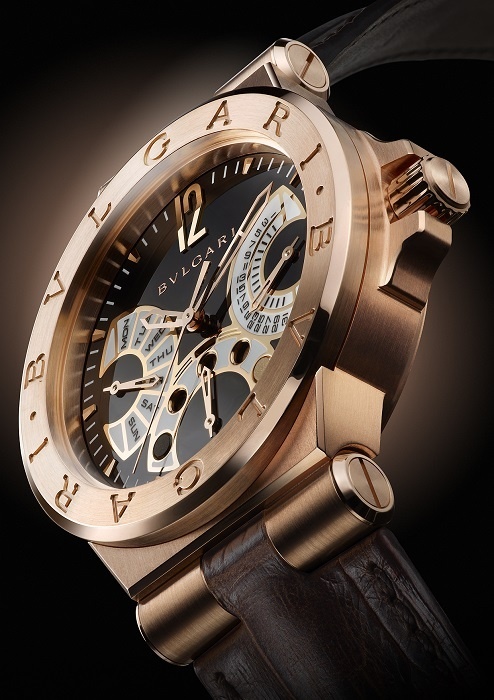
Champlevé resembles another way that Bulgari has looked to the past for techniques and inspiration and applied them in a modern way. They have certainly taken enamel dials to a whole new level with their Champlevé technique. One can only imagine what new developments are to be revealed next.
of this champlevé process during different steps. It would help give us a better visual understanding of this process. - AT
I will have to ask them
pingtsai, Please can you clarify something? As Piaget forum moderator, I am familiar with the various grande feu enamel techniques employed for Piaget dials; one of which, is Champlevé Enamel. You then described the 4 month process for BVLGARI Diagono dials with 20 coats of lacquer applied sequentially in the cut metal 'cells' and air dried. Whilst the filling of metal 'cells' with coloured varnish is similar to the champlevé enamel technique, can they still call it "champlevé" if it is not fire
This thread is active on the Bulgari forum with 3 replies. Share your knowledge with fellow collectors.
Join the Discussion →


